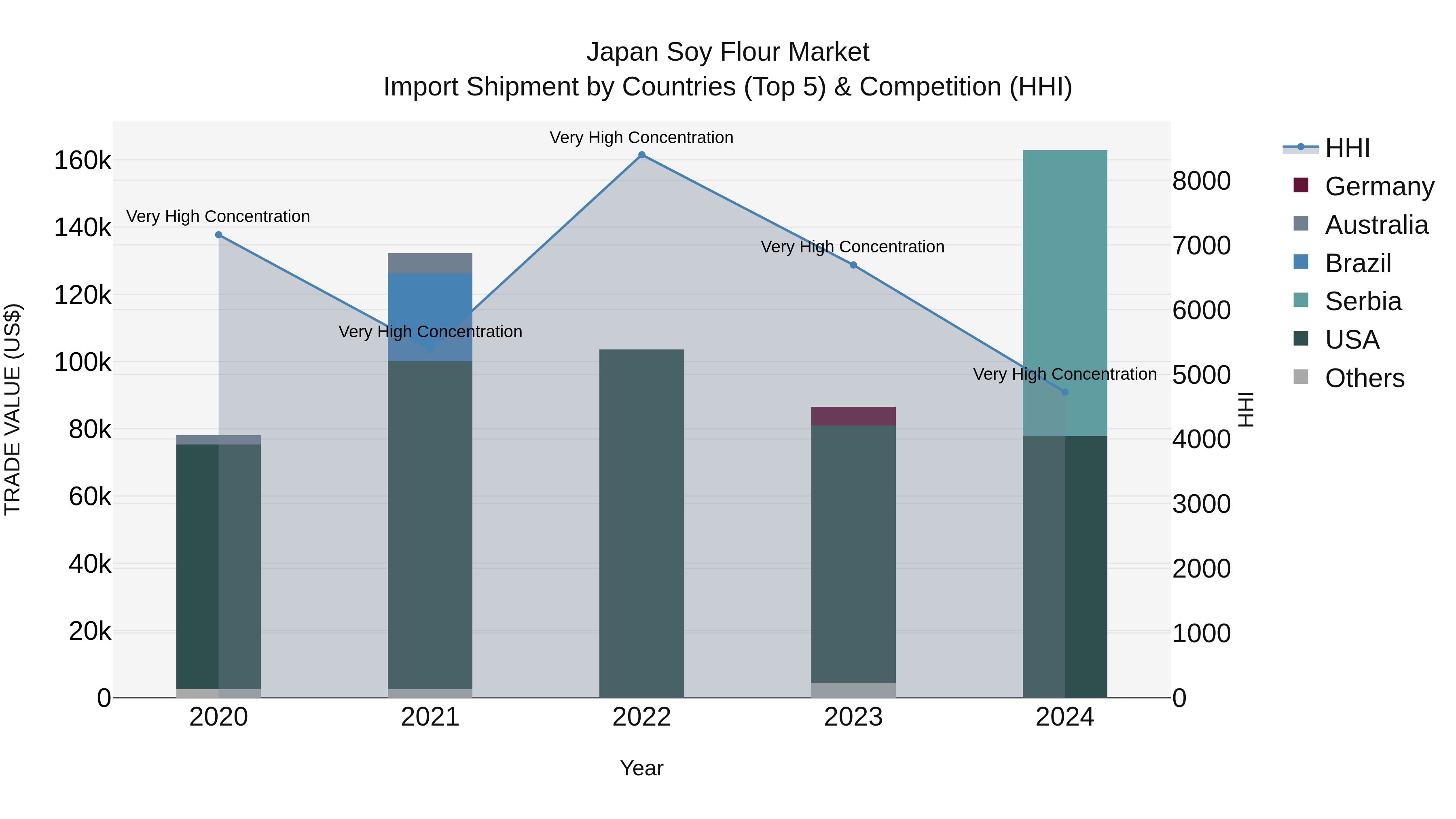
Japan Soy Flour Market Import Shipment by Countries (Top 5) & Competition (HHI)
Japan's soy flour import shipments in 2024 continued to showcase a high Herfindahl-Hirschman Index (HHI) concentration, with top exporting countries being Serbia, USA, Australia, Austria, and China. The compound annual growth rate (CAGR) from 2020 to 2024 stood impressively at 20.19%, reflecting a robust upward trend in import volumes. Furthermore, the growth rate from 2023 to 2024 surged to 88.28%, underscoring the accelerating pace of soy flour imports into Japan. This data indicates a strong demand for soy flour in the Japanese market and highlights the competitive landscape among exporting nations.
Japan Soy Flour Market Overview
The Japan Soy Flour Market is experiencing steady growth driven by increasing consumer awareness of the health benefits associated with soy consumption. Soy flour is gaining popularity as a versatile and nutritious ingredient in various food products such as baked goods, snacks, and meat alternatives. The market is also benefiting from the rising demand for plant-based protein sources among health-conscious consumers. Key players in the Japan Soy Flour Market include Fuji Oil Holdings Inc., Nisshin Oillio Group, and Archer Daniels Midland Company. The market is characterized by competitive pricing strategies, product innovation, and a focus on sustainable sourcing practices. As the trend towards plant-based diets continues to grow, the Japan Soy Flour Market is expected to expand further, offering opportunities for both domestic and international soy flour manufacturers.
Japan Soy Flour Market Trends
In Japan, the soy flour market is experiencing a growing trend towards plant-based and gluten-free products, driven by increasing consumer awareness of health and dietary concerns. Soy flour is gaining popularity as a versatile ingredient in various food applications, including baked goods, snacks, meat substitutes, and beverages due to its nutritional benefits and functional properties. The market is also witnessing a rise in demand for organic and non-GMO soy flour products, reflecting consumer preferences for clean label and sustainable choices. Manufacturers are focusing on product innovation and marketing strategies to cater to evolving consumer preferences, such as offering flavored or fortified soy flour products. Overall, the Japan soy flour market is poised for continued growth as health-conscious consumers seek out plant-based alternatives in their diets.
Japan Soy Flour Market Challenges
In the Japan Soy Flour Market, challenges are primarily related to consumer perceptions and preferences. Despite the numerous health benefits associated with soy flour, such as being a good source of protein and fiber, there is a prevailing preference for traditional wheat-based products in Japanese cuisine. Additionally, some consumers may be hesitant to try soy flour due to concerns about taste and texture differences compared to wheat flour. Furthermore, competition from other alternative flours, such as rice flour and corn flour, adds to the challenge of expanding the market share of soy flour in Japan. To overcome these challenges, companies operating in the Japan Soy Flour Market need to focus on educating consumers about the benefits of soy flour, developing innovative product offerings, and collaborating with food manufacturers to incorporate soy flour into popular food products.
Japan Soy Flour Market Investment Opportunities
Investment opportunities in the Japan Soy Flour Market include the growing demand for plant-based protein sources, especially among health-conscious consumers looking for alternatives to animal products. With an increasing focus on sustainability and environmental concerns, soy flour offers a versatile ingredient for various food products such as bakery items, snacks, and meat substitutes. Additionally, the rising trend of gluten-free and allergen-friendly products presents a significant market opportunity for soy flour as a suitable substitute in food manufacturing. Investors can capitalize on this trend by partnering with soy flour manufacturers, investing in research and development for innovative soy-based products, or exploring distribution channels to reach a wider consumer base in Japan`s evolving food industry. Overall, the Japan Soy Flour Market presents promising investment prospects driven by changing consumer preferences and industry trends.
Japan Soy Flour Market Government Policy
Government policies in Japan related to the soy flour market primarily focus on promoting the consumption of soy-based products for their health benefits and sustainability. The Japanese government has implemented measures to support the development and production of soy flour as a nutritious ingredient in various food products, including subsidies for soybean cultivation and processing facilities. Additionally, there are regulations in place to ensure the quality and safety of soy flour products, as well as labeling requirements to inform consumers about the nutritional content and origin of the soybeans used. The government also encourages research and innovation in the soy flour industry to enhance its competitiveness in the global market and contribute to the overall growth of the agriculture sector in Japan.
Japan Soy Flour Market Future Outlook
The Japan Soy Flour Market is poised for steady growth in the coming years due to the increasing consumer awareness regarding the health benefits of soy products. Soy flour is a rich source of plant-based protein and is widely used in various food products, including bakery goods, meat alternatives, and beverages. With the rising trend of plant-based diets and the growing demand for gluten-free and allergen-friendly products, the demand for soy flour is expected to continue to rise. Additionally, the government`s initiatives to promote the consumption of soy-based products as part of a healthy diet are likely to further drive market growth. Overall, the Japan Soy Flour Market is projected to witness sustained growth and innovation in product offerings to cater to the evolving consumer preferences.
Key Highlights of the Report:
- Japan Soy Flour Market Outlook
- Market Size of Japan Soy Flour Market, 2021
- Forecast of Japan Soy Flour Market, 2031
- Historical Data and Forecast of Japan Soy Flour Revenues & Volume for the Period 2018 - 2031
- Japan Soy Flour Market Trend Evolution
- Japan Soy Flour Market Drivers and Challenges
- Japan Soy Flour Price Trends
- Japan Soy Flour Porter's Five Forces
- Japan Soy Flour Industry Life Cycle
- Historical Data and Forecast of Japan Soy Flour Market Revenues & Volume By Type for the Period 2018 - 2031
- Historical Data and Forecast of Japan Soy Flour Market Revenues & Volume By Full-fat Soy Flour for the Period 2018 - 2031
- Historical Data and Forecast of Japan Soy Flour Market Revenues & Volume By Defatted Soy Flour for the Period 2018 - 2031
- Historical Data and Forecast of Japan Soy Flour Market Revenues & Volume By Application for the Period 2018 - 2031
- Historical Data and Forecast of Japan Soy Flour Market Revenues & Volume By Bakery & Confectionery for the Period 2018 - 2031
- Historical Data and Forecast of Japan Soy Flour Market Revenues & Volume By Meat Substitute for the Period 2018 - 2031
- Historical Data and Forecast of Japan Soy Flour Market Revenues & Volume By Soup & Sausages for the Period 2018 - 2031
- Historical Data and Forecast of Japan Soy Flour Market Revenues & Volume By Meat and Poultry for the Period 2018 - 2031
- Historical Data and Forecast of Japan Soy Flour Market Revenues & Volume By Others for the Period 2018 - 2031
- Historical Data and Forecast of Japan Soy Flour Market Revenues & Volume By Distribution Channel for the Period 2018 - 2031
- Historical Data and Forecast of Japan Soy Flour Market Revenues & Volume By Online Stores for the Period 2018 - 2031
- Historical Data and Forecast of Japan Soy Flour Market Revenues & Volume By Convenience Store for the Period 2018 - 2031
- Historical Data and Forecast of Japan Soy Flour Market Revenues & Volume By Departmental Store for the Period 2018 - 2031
- Historical Data and Forecast of Japan Soy Flour Market Revenues & Volume By Direct Sales for the Period 2018 - 2031
- Historical Data and Forecast of Japan Soy Flour Market Revenues & Volume By Others for the Period 2018 - 2031
- Japan Soy Flour Import Export Trade Statistics
- Market Opportunity Assessment By Type
- Market Opportunity Assessment By Application
- Market Opportunity Assessment By Distribution Channel
- Japan Soy Flour Top Companies Market Share
- Japan Soy Flour Competitive Benchmarking By Technical and Operational Parameters
- Japan Soy Flour Company Profiles
- Japan Soy Flour Key Strategic Recommendations






































