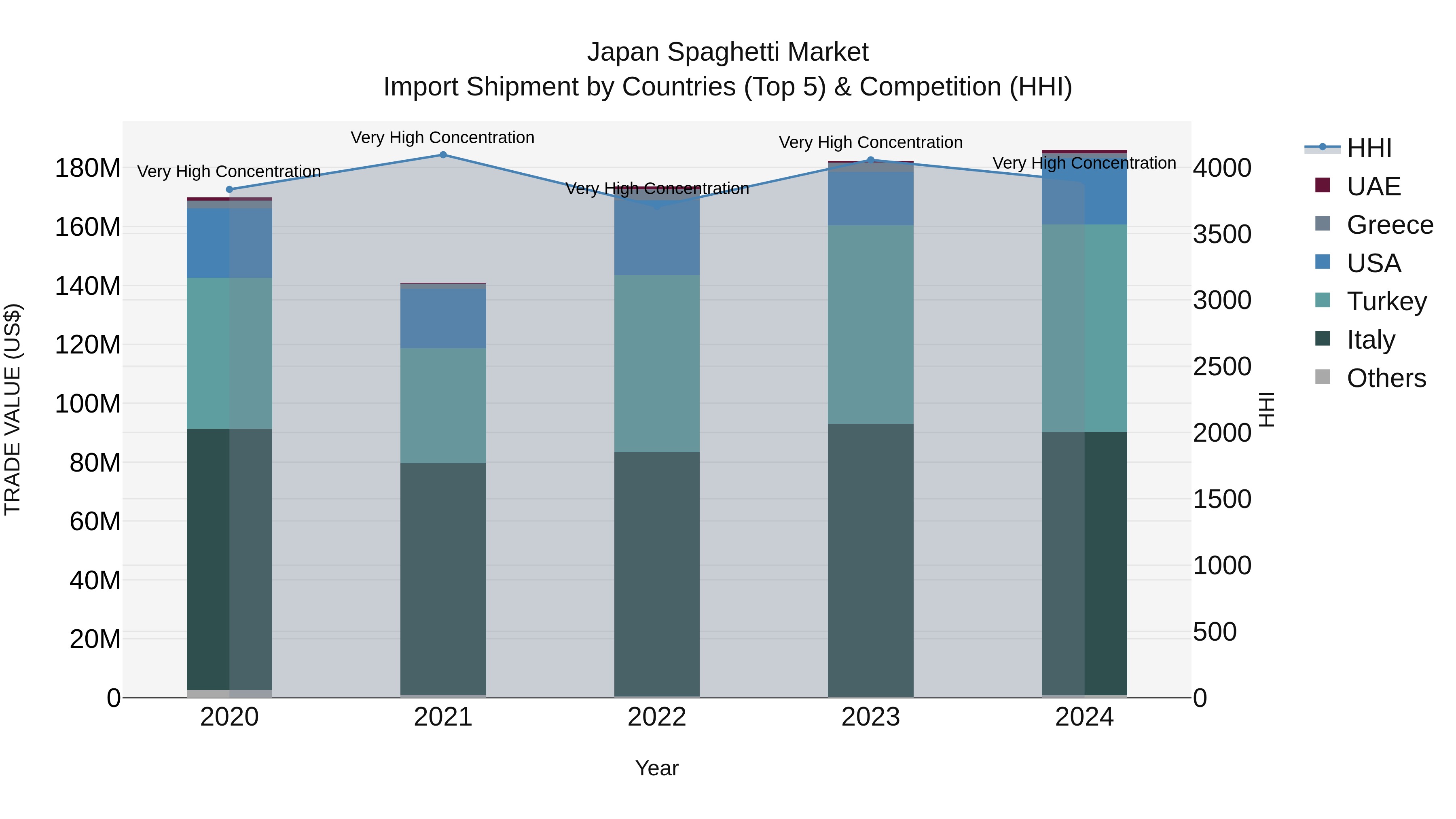
Japan Spaghetti Market Import Shipment by Countries (Top 5) & Competition (HHI)
The Japan spaghetti import market in 2024 continued to see a high concentration of shipments, with top exporting countries being Italy, Turkey, USA, Greece, and UAE. The market maintained a steady growth rate with a Compound Annual Growth Rate (CAGR) of 2.29% from 2020 to 2024. In 2024, the growth rate increased by 2.04% compared to the previous year, indicating a positive trend in the import of spaghetti to Japan. This data suggests a consistent demand for spaghetti from these key exporting countries, highlighting the popularity of this pasta dish in the Japanese market.
Japan Spaghetti Market Overview
The Japan spaghetti market is a growing sector within the country`s food industry, driven by a combination of factors including changing consumer preferences, increased exposure to Western cuisine, and a growing interest in convenience foods. Spaghetti, a popular Italian dish, has become a staple in many Japanese households due to its ease of preparation and versatility in terms of flavor combinations. The market offers a wide range of spaghetti products, including various pasta shapes, sauces, and ready-to-eat meal options. Key players in the market include both domestic and international brands, with a focus on product innovation and catering to evolving consumer tastes. As more Japanese consumers incorporate spaghetti into their regular meal rotation, the market is expected to continue its growth trajectory in the coming years.
Japan Spaghetti Market Trends
The Japan spaghetti market is experiencing a shift towards healthier and more diverse options, with a focus on whole grain and vegetable-based pastas. Consumers are increasingly seeking out gluten-free and organic pasta varieties, driven by growing health consciousness and dietary preferences. Convenience and ready-to-eat pasta products are also gaining popularity among busy urban consumers looking for quick meal solutions. Traditional Japanese flavors and ingredients are being incorporated into spaghetti dishes, catering to local tastes and preferences. Online sales and delivery services are on the rise, offering a convenient way for consumers to purchase a wide range of spaghetti products. Overall, the Japan spaghetti market is evolving to meet the changing demands of consumers seeking healthier, more convenient, and innovative pasta options.
Japan Spaghetti Market Challenges
In the Japan Spaghetti Market, some challenges are encountered due to cultural preferences and dietary habits. Japanese consumers traditionally have a preference for rice-based dishes over pasta, which can hinder the widespread adoption of spaghetti. Additionally, the perception of pasta as a foreign or Western food may pose a challenge in appealing to the local market. Furthermore, the presence of a variety of traditional Japanese noodle dishes, such as ramen and udon, creates strong competition for spaghetti in the Japanese food market. To succeed in this market, companies need to carefully navigate these cultural factors, understand consumer preferences, and potentially adapt their marketing strategies to promote spaghetti as a desirable and convenient meal option for Japanese consumers.
Japan Spaghetti Market Investment Opportunities
The Japan spaghetti market offers investment opportunities in several areas. One potential avenue is the growing demand for convenience and ready-to-eat pasta products, such as pre-packaged spaghetti meals or pasta sauces. Investing in innovative food technology to develop new, convenient spaghetti products could be lucrative. Another opportunity lies in catering to the increasing health-conscious consumer base by offering whole wheat or gluten-free spaghetti options. Additionally, there is a trend towards premium and gourmet pasta products in Japan, presenting opportunities for investment in high-quality, artisanal spaghetti brands. Furthermore, leveraging e-commerce platforms and online marketing strategies to reach a wider customer base could also be a profitable investment in the dynamic Japan spaghetti market.
Japan Spaghetti Market Government Policy
The government policies related to the Japan Spaghetti Market primarily focus on food safety regulations, import tariffs, and support for domestic producers. The Ministry of Agriculture, Forestry and Fisheries (MAFF) oversees the regulations to ensure the quality and safety of imported and domestically produced spaghetti. Import tariffs are imposed on foreign spaghetti products to protect domestic producers and promote self-sufficiency in the agricultural sector. Additionally, the government provides subsidies and support programs to local farmers and producers to enhance competitiveness and promote the consumption of domestically produced spaghetti. Overall, the government policies aim to strike a balance between protecting domestic producers and ensuring food safety while also promoting innovation and sustainability in the Japan Spaghetti Market.
Japan Spaghetti Market Future Outlook
The future outlook for the Japan Spaghetti Market appears promising, with a steady growth trajectory expected in the coming years. Factors such as the increasing popularity of Italian cuisine, a growing trend towards convenience foods, and a rising demand for diverse and international food options among Japanese consumers are anticipated to drive market expansion. Additionally, the influence of globalization and the availability of a wide range of pasta varieties in the market are likely to further propel the growth of the spaghetti market in Japan. Market players may benefit from emphasizing product innovations, catering to evolving consumer preferences, and leveraging marketing strategies to capitalize on the growing demand for spaghetti products in the country.
Key Highlights of the Report:
- Japan Spaghetti Market Outlook
- Market Size of Japan Spaghetti Market, 2021
- Forecast of Japan Spaghetti Market, 2031
- Historical Data and Forecast of Japan Spaghetti Revenues & Volume for the Period 2018 - 2031
- Japan Spaghetti Market Trend Evolution
- Japan Spaghetti Market Drivers and Challenges
- Japan Spaghetti Price Trends
- Japan Spaghetti Porter's Five Forces
- Japan Spaghetti Industry Life Cycle
- Historical Data and Forecast of Japan Spaghetti Market Revenues & Volume By Product for the Period 2018 - 2031
- Historical Data and Forecast of Japan Spaghetti Market Revenues & Volume By Fresh for the Period 2018 - 2031
- Historical Data and Forecast of Japan Spaghetti Market Revenues & Volume By Dried for the Period 2018 - 2031
- Historical Data and Forecast of Japan Spaghetti Market Revenues & Volume By End Use for the Period 2018 - 2031
- Historical Data and Forecast of Japan Spaghetti Market Revenues & Volume By Mass Market Retail for the Period 2018 - 2031
- Historical Data and Forecast of Japan Spaghetti Market Revenues & Volume By Horeca for the Period 2018 - 2031
- Historical Data and Forecast of Japan Spaghetti Market Revenues & Volume By Distribution Channel for the Period 2018 - 2031
- Historical Data and Forecast of Japan Spaghetti Market Revenues & Volume By Supermarket and Hypermarket for the Period 2018 - 2031
- Historical Data and Forecast of Japan Spaghetti Market Revenues & Volume By Convenience Store for the Period 2018 - 2031
- Historical Data and Forecast of Japan Spaghetti Market Revenues & Volume By Online for the Period 2018 - 2031
- Historical Data and Forecast of Japan Spaghetti Market Revenues & Volume By Others for the Period 2018 - 2031
- Japan Spaghetti Import Export Trade Statistics
- Market Opportunity Assessment By Product
- Market Opportunity Assessment By End Use
- Market Opportunity Assessment By Distribution Channel
- Japan Spaghetti Top Companies Market Share
- Japan Spaghetti Competitive Benchmarking By Technical and Operational Parameters
- Japan Spaghetti Company Profiles
- Japan Spaghetti Key Strategic Recommendations






































