Japan Squash Market Size & Growth Rate
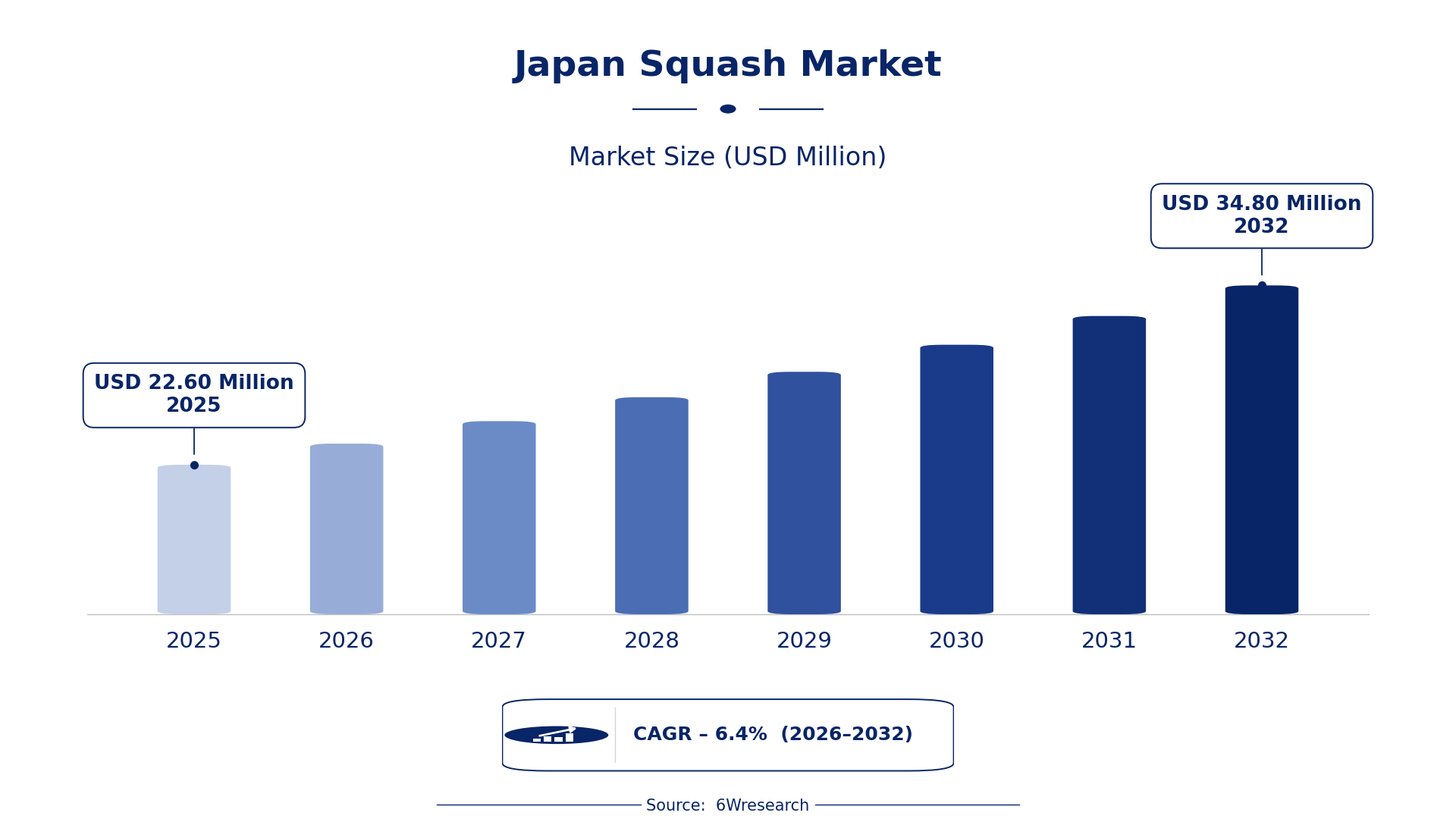
According to 6Wresearch internal database and industry insights, the Japan Squash Market was valued at USD 22.60 Million in 2025 and is projected to reach USD 34.80 Million by 2032, growing at a CAGR of approximately 6.4% during 2026–2032.
Japan Squash Market Highlights
| Report Metric | Details |
| Report Name | Japan Squash Market (2026-2032) |
| Market Size 2025 | USD 22.60 Million |
| Market Size 2032 | USD 34.80 Million |
| Absolute Growth 2025–2032 | USD 12.20 Million |
| CAGR 2026–2032 | 6.4% |
| Peak Annual Growth | 7.4% in 2026 |
| Forecast Period | 2026–2032 |
| Historical Data | 2022–2025 |
| Base Year | 2025 |
| Leading Type, 2025 | No Added Sugar (58% share) |
| Leading Nature, 2025 | Regular (63% share) |
| Leading Flavors, 2025 | Citrus Fruit (44% share) |
| Leading Distribution Channel, 2025 | Offline Channels (57% share) |
| Fastest-Growing Type | Added Sugar (8.5% CAGR) |
| Fastest-Growing Nature | Blended (7.9% CAGR) |
| Fastest-Growing Flavors | Berry (8.4% CAGR) |
| Fastest-Growing Distribution Channel | Online Channels (8.1% CAGR) |
| Growing Sector | Online Channels |
| Key End Users | Offline Channels, Online Channels |
Japan Squash Market Year-wise Growth Rate and Key Drivers (2022–2032)
This graph illustrates the annual growth rates of the market from 2022 to 2032, highlighting a steady upward trajectory and projected market expansion over the forecast period.
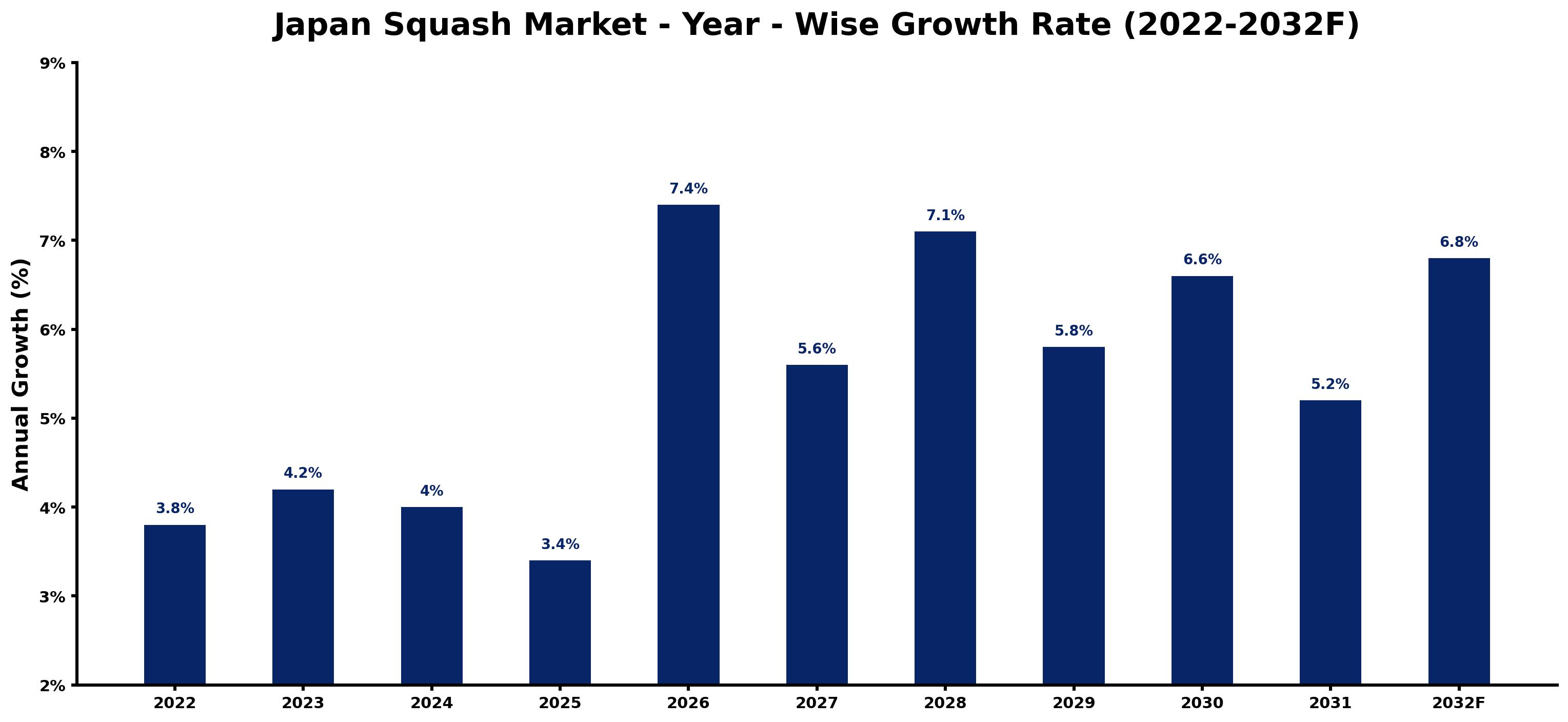
Each row of the following table gives one year's estimated growth and the event or demand shift that explains it.
| Year | Estimated Annual Growth (%) | Market Rationale |
| 2022 | 3.8 | The market experienced steady demand as consumers sought refreshing beverages. |
| 2023 | 4.2 | Growth accelerated due to increased health awareness among consumers. |
| 2024 | 4.0 | Demand growth slowed as market saturation began to take effect. |
| 2025 | 3.4 | The market continued to grow, but at a reduced pace due to competition. |
| 2026 | 7.4 | A surge in health-focused products is expected to drive growth in demand. |
| 2027 | 5.6 | Growth will moderate as consumer preferences stabilise and competition intensifies. |
| 2028 | 7.1 | Demand is projected to increase again with new product launches and marketing efforts. |
| 2029 | 5.8 | Growth will slow as market dynamics shift towards established brands. |
| 2030 | 6.6 | A renewed focus on health and wellness will drive demand higher once more. |
| 2031 | 5.2 | Growth is expected to decelerate as market maturity sets in, stabilising consumer choices. |
| 2032 | 6.8 | A rise in health-conscious consumers is projected to boost demand further. |
Note: Market size estimations and growth projections presented in this report are based on 6Wresearch's proprietary forecasting methodology, utilizing the latest available industry data, government publications, and primary research inputs.
Japan Squash Market Synopsis
Squash is a beverage made from concentrated fruit juices, water, and sweeteners, primarily consumed as a refreshing drink or mixer in cocktails. The Japan Squash Market is valued at approximately USD 22.60 million in 2025, driven by health consciousness and preferences for low-sugar beverages. The Tokyo Metropolitan Government's health initiative in 2023 and the popularity of citrus fruit flavours, accounting for 40% of the market, further fuel demand.
Market Dynamics Impact Analysis (2026–2032)
| Factor | Type | Impact | Primary Segment Affected |
| Growing health awareness among consumers | Driver | High | No Added Sugar |
| Increase in online sales channels | Driver | Medium | Added Sugar |
| High demand for low-sugar products | Opportunity | High | No Added Sugar |
| Rising interest in unique flavor profiles | Opportunity | Medium | Berry |
| Market saturation in traditional flavors | Restraint | High | Regular |
| Competition from alternative beverages | Restraint | Medium | Blended |
| Changing consumer preferences towards healthier options | Challenge | High | Regular |
| Rising production costs impacting pricing | Challenge | Medium | Added Sugar |
Evaluation of Drivers in Japan Squash Market (2026–2032)
Demand rests on the following drivers, each shown with the segment it touches most.
| Drivers | Primary Segment Affected | Why It Matters (Evidence) |
| Increased consumer focus on health and wellness | No Added Sugar | The average Japanese consumes about 30 liters of squash annually, driving demand for healthier options. |
| Growth of e-commerce platforms for beverage sales | Added Sugar | Online sales of beverages increased by 20% in 2023, encouraging purchases through digital channels. |
| Health initiatives promoting low-sugar beverages | No Added Sugar | The Tokyo Metropolitan Government launched a health initiative in 2023 to promote low-sugar beverages. |
| Popularity of citrus fruit flavors among consumers | Citrus Fruit | Citrus flavors account for 40% of the market, appealing to a broad consumer base. |
| Consumer interest in unique flavor combinations | Berry | Berry flavors are appealing to younger consumers, driving demand for new product launches. |
Spending rises because investment in health-focused products is increasing, with the average Japanese consuming about 30 liters of squash annually. The rise of online shopping has transformed beverage purchasing habits, with online sales increasing by 20% in 2023. Citrus fruit flavors dominate the market, appealing to various demographics, while berry flavors attract younger consumers, stimulating demand in the squash market.
Evaluation of Restraints in Japan Squash Market
The following restraints limit how fast demand can grow.
| Market Restraint | Primary Segment Affected | Why It Matters (Evidence) |
| Market saturation in traditional flavor segments | Regular | Traditional flavors face limited growth opportunities due to high market penetration. |
| Competition from alternative beverage options | Blended | As consumers explore various beverage choices, blended squash products struggle to gain market share. |
| Rising production costs affecting pricing strategies | Added Sugar | Increased costs for raw materials lead to higher prices, deterring price-sensitive consumers. |
| Limited consumer interest in niche flavors | Others | Niche flavors struggle to gain traction, resulting in lower sales volumes compared to mainstream options. |
| Health trends shifting towards zero-calorie drinks | No Added Sugar | As health trends evolve, consumers may prefer zero-calorie options over traditional squash. |
Japan Squash Market Challenges
High competition from both domestic and international brands pressures producers to reduce prices, leading to lower profit margins. This fierce rivalry exists because Japan's beverage market is valued at approximately 3 trillion JPY, forcing producers to allocate more resources to marketing. Limited expertise in beverage formulation hampers producers' ability to innovate, risking a potential 15% loss in market share due to unappealing products. Supply chain disruptions can delay raw material deliveries by up to two weeks for distributors, impacting product availability. Slow technology adoption raises operational costs, complicating producers' efforts to meet consumer demands.
Trends in the Japan Squash Market
Four trends stand out in the Japan Squash Market.
- Shift towards Healthier Beverage Choices: In 2023, a health initiative promoting low-sugar beverages was launched, reflecting a growing consumer preference for healthier options. This trend is expected to influence product development and marketing strategies across the squash market.
- Emergence of E-commerce in Beverage Sales: The rise of online shopping has transformed beverage purchasing habits, with online sales increasing by 20% in 2023. This shift allows consumers to explore a wider variety of squash products conveniently.
- Growing Popularity of Unique Flavours: Berry flavours are emerging as a popular choice among younger consumers, with an expected CAGR of 8.4% from 2026 to 2032. This trend encourages producers to innovate and diversify their flavour offerings.
- Increase in Health-Conscious Consumer Base: The average household in Japan spends about 5,000 JPY monthly on beverages, indicating a strong market for health-oriented products. This spending trend supports the growth of low-sugar and no-added-sugar squash options.
Investment Opportunities in the Japan Squash Market
The following opportunities in the Japan Squash Market pair current demand with a clear way in.
- Collaborate with Local Producers: Now is an ideal time to invest in no-added-sugar squash products, as health trends rise. Partnering with local beverage manufacturers in Tokyo can facilitate market entry.
- Capitalize on E-commerce Growth: With online beverage sales increasing by 20% in 2023, investing in e-commerce platforms for squash products is timely. Targeting health-conscious consumers through digital channels can expand market reach.
- Prioritise Flavour Innovation: The growing popularity of berry flavours presents an opportunity to develop new products. Suppliers can target younger consumers in urban areas, responding to their demand for unique flavours.
- Enter Health-Conscious Segments: As health trends evolve, there is a demand for low-sugar options. Suppliers can enter this segment by obtaining certifications that appeal to health-focused buyer groups.
Government Initiatives in the Japan Squash Market
The Act against Unjustifiable Premiums and Misleading Representations prohibits misleading labelling and advertising of goods, ensuring consumers receive accurate information about squash products. Compliance with this law is crucial for producers to maintain consumer trust and market integrity.
The Japan Soft Drink Association oversees industry regulations, providing guidelines for quality and safety standards. This agency plays a key role in ensuring that beverage manufacturers adhere to JIS standards, benefiting consumers through improved product consistency.
Future Insight of the Japan Squash Market
The launch of advanced online sales platforms will transform the purchasing landscape by 2032, allowing buyers to access a wider variety of squash products. A focus on health-oriented beverages will drive suppliers to develop low-sugar options, aligning with changing consumer preferences. Stricter JIS standards will enhance product quality, ensuring buyers receive safer and more consistent beverages. As the average Japanese consumes about 30 litres of squash annually, suppliers will need to adapt their offerings to cater to this sustained demand.
Market Segmentation Analysis
Japan Squash Market report covers a detailed analysis of the following market segments:
By Type – No Added Sugar Leads, Added Sugar Expected to Grow Fastest
According to Bhawna Singh, Assistant Manager at 6Wresearch, the largest type category in 2025 was No Added Sugar, at 58% of revenue. The No Added Sugar segment captures the largest share as health-conscious consumers increasingly prefer beverages with reduced sugar content. This shift is highlighted by initiatives from the Ministry of Health, Labour and Welfare that promote healthier beverage choices. Added Sugar is set to record the highest CAGR in this split, 8.5% over 2026–2032. The Added Sugar segment is rapidly expanding as it remains a staple in mainstream products, appealing to a wide audience. The ongoing demand for familiar flavours and traditional options is propelling this segment's growth. Suppliers should balance their offerings to cater to both health trends and traditional preferences.
By Nature – Regular Leads, Blended Expected to Grow Fastest
Regular took 63% of nature revenue in 2025, more than any other category. Regular squash holds the largest share as it is widely consumed across various demographics in Japan, appealing to a broad audience. Its established presence in households, with the average Japanese consuming about 30 litres annually, ensures consistent demand. Blended is projected to grow fastest, at a CAGR of 7.9% during 2026–2032. Blended squash is witnessing rapid growth as consumers increasingly seek unique flavour combinations, particularly those looking for variety in their beverage choices. This trend is supported by the popularity of citrus fruit flavours, which make up 40% of the market. Suppliers should consider expanding their product offerings to include blended squash to meet changing consumer preferences.
By Flavors – Citrus Fruit Leads, Berry Expected to Grow Fastest
Citrus Fruit accounted for 44% of the market by flavors in 2025. Citrus Fruit flavours dominate the market as they are a popular choice among consumers, accounting for a substantial portion of squash sales. This preference is driven by the refreshing taste and familiarity of citrus-based beverages. The quickest growth will come from Berry, forecast to expand at a CAGR of 8.4% between 2026 and 2032. Berry flavours are gaining traction, especially among younger consumers who are increasingly drawn to fruity and vibrant tastes. This demographic shift indicates a potential for growth in this flavour segment. Suppliers should explore expanding their flavour offerings to include more berry-based options to attract younger audiences.
By Distribution Channel – Offline Channels Lead, Online Channels Expected to Grow Fastest
With 57% of distribution channel revenue in 2025, Offline Channels was the largest category. Offline Channels dominate the market as the primary sales avenue, with consumers traditionally purchasing beverages from physical retail locations. This method remains trusted, particularly in urban areas like Tokyo, where beverage consumption is highest. Over 2026–2032, Online Channels are expected to post the fastest growth, at a CAGR of 8.1%. Online Channels are experiencing rapid growth, with a 20% increase in sales in 2023, indicating a shift towards convenience in purchasing habits. This trend highlights the increasing importance of digital platforms in the beverage market. Suppliers need to strengthen their online strategies to capitalise on the growing trend of e-commerce in beverage sales.
Key Attractiveness of the Report
- 10 Years of Market Numbers
- Historical Data Starting from 2022 to 2025
- Base Year 2025
- Forecast Data until 2032
- Key Performance Indicators Impacting the Market
- Major Upcoming Developments and Projects
Key Highlights of the Report:
- Japan Squash Market Outlook
- Market Size of Japan Squash Market, 2025
- Forecast of Japan Squash Market, 2032
- Historical Data and Forecast of Japan Squash Revenues & Volume for the Period 2022-2032
- Japan Squash Market Trend Evolution
- Japan Squash Market Drivers and Challenges
- Japan Squash Price Trends
- Japan Squash Porter's Five Forces
- Japan Squash Industry Life Cycle
- Historical Data and Forecast of Japan Squash Market Revenues & Volume By Type for the Period 2022-2032
- Historical Data and Forecast of Japan Squash Market Revenues & Volume By No Added Sugar for the Period 2022-2032
- Historical Data and Forecast of Japan Squash Market Revenues & Volume By Added Sugar for the Period 2022-2032
- Historical Data and Forecast of Japan Squash Market Revenues & Volume By Nature for the Period 2022-2032
- Historical Data and Forecast of Japan Squash Market Revenues & Volume By Regular for the Period 2022-2032
- Historical Data and Forecast of Japan Squash Market Revenues & Volume By Blended for the Period 2022-2032
- Historical Data and Forecast of Japan Squash Market Revenues & Volume By Flavors for the Period 2022-2032
- Historical Data and Forecast of Japan Squash Market Revenues & Volume By Citrus Fruit, for the Period 2022-2032
- Historical Data and Forecast of Japan Squash Market Revenues & Volume By Berry, for the Period 2022-2032
- Historical Data and Forecast of Japan Squash Market Revenues & Volume By Tropical & Exotic Fruit for the Period 2022-2032
- Historical Data and Forecast of Japan Squash Market Revenues & Volume By Mixed Fruit for the Period 2022-2032
- Historical Data and Forecast of Japan Squash Market Revenues & Volume By Others for the Period 2022-2032
- Historical Data and Forecast of Japan Squash Market Revenues & Volume By Distribution Channel for the Period 2022-2032
- Historical Data and Forecast of Japan Squash Market Revenues & Volume By Offline Channels for the Period 2022-2032
- Historical Data and Forecast of Japan Squash Market Revenues & Volume By Online Channels for the Period 2022-2032
- Japan Squash Import Export Trade Statistics
- Market Opportunity Assessment By Type
- Market Opportunity Assessment By Nature
- Market Opportunity Assessment By Flavors
- Market Opportunity Assessment By Distribution Channel
- Japan Squash Top Companies Market Share
- Japan Squash Competitive Benchmarking By Technical and Operational Parameters
- Japan Squash Company Profiles
- Japan Squash Key Strategic Recommendations
Market Covered
The following segment groups are covered in the report.
By Type
- No Added Sugar
- Added Sugar
By Nature
- Regular
- Blended
By Flavors
- Citrus Fruit
- Berry
- Tropical & Exotic Fruit
- Mixed Fruit
- Others
By Distribution Channel
- Offline Channels
- Online Channels































