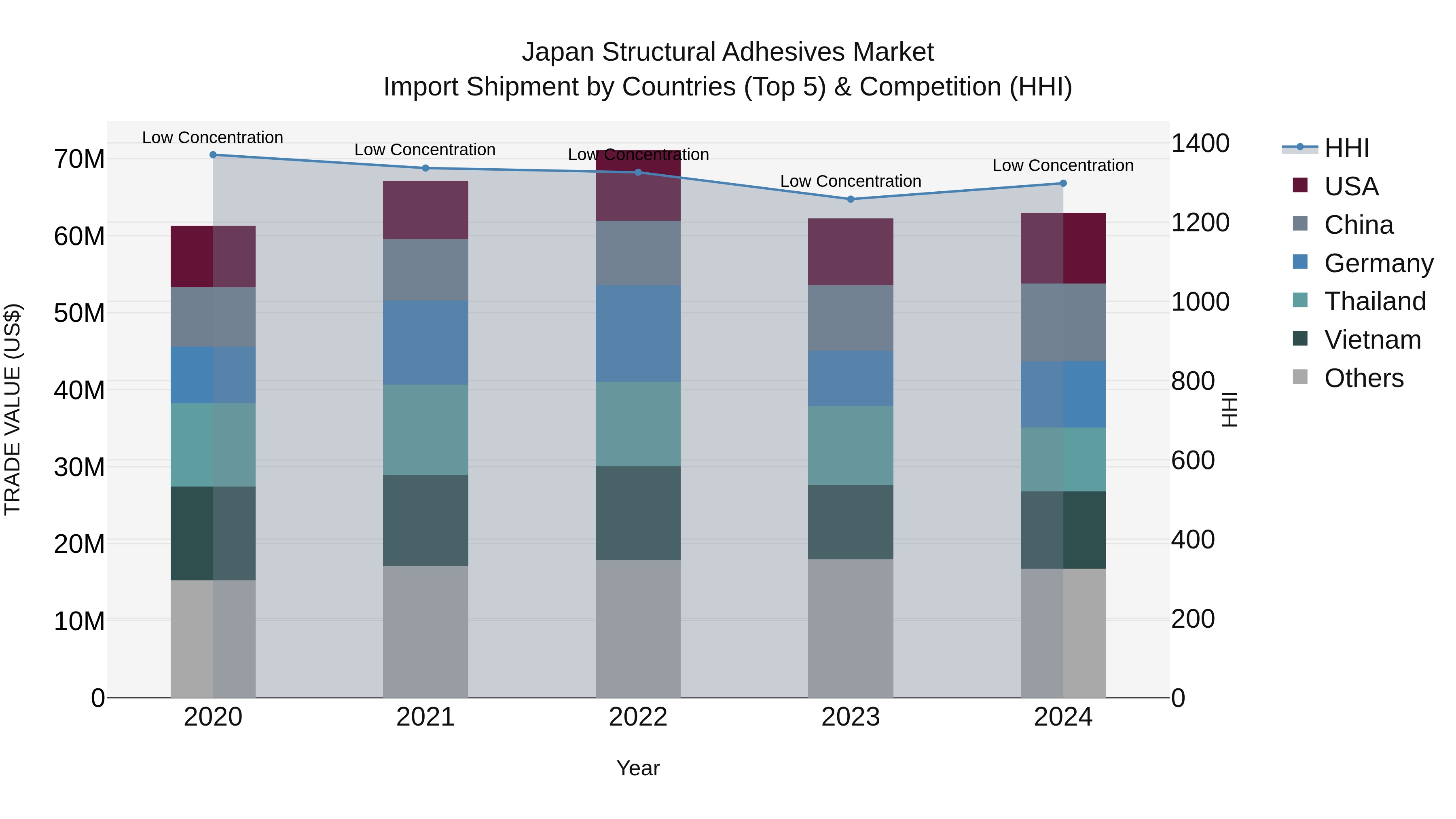
Japan Structural Adhesives Market Import Shipment by Countries (Top 5) & Competition (HHI)
Japan continues to see a steady increase in structural adhesives import shipments, with top exporters including China, Vietnam, USA, Germany, and Thailand. Despite the influx of imports, the market remains fragmented with low concentration indicated by the Herfindahl-Hirschman Index (HHI) in 2024. The compound annual growth rate (CAGR) from 2020 to 2024 stands at 0.68%, showcasing a stable trajectory. Moreover, the growth rate from 2023 to 2024 is a promising 1.17%, indicating a potential uptick in demand for structural adhesives in the Japanese market.
Japan Structural Adhesives Market Growth Rate
According to 6Wresearch internal database and industry insights, the Japan Structural Adhesives Market is growing at a compound annual growth rate (CAGR) of 6.2% during the forecast period (2026-2032).
Topics Covered in the Japan Structural Adhesives Market Report
The Japan Structural Adhesives Market report thoroughly covers the market by product types and end-users. The report provides an unbiased and detailed analysis of ongoing market trends, opportunities/high growth areas, and market drivers, helping stakeholders devise and align their market strategies according to the current and future market dynamics.
Japan Structural Adhesives Market Highlights
| Report Name | Japan Structural Adhesives Market |
| Forecast period | 2026-2032 |
| CAGR | 6.2% |
| Growing Sector | Automotive |
Japan Structural Adhesives Market Synopsis
The Japan Structural Adhesives Market is expected to grow significantly as of increasing demand for lightweight materials and high-performance materials used in the automotive and aerospace and construction sectors. The market expansion is supported by technological progress in adhesive formulations and the development of electric vehicle and wind energy industries. The market trends are being shaped by the growing demand for sustainable eco-friendly adhesives as both consumers and manufacturers want to decrease their environmental impact.
Evaluation of Growth Drivers in the Japan Structural Adhesives Market
Below mentioned are some growth drivers and their impact on market dynamics:
| Drivers | Primary Segments Affected | Why It Matters |
| Growth in Electric Vehicles | End-user (Automotive, Aerospace) | Increased demand for high-performance, lightweight adhesives in vehicle production. |
| Technological Advancements | Product Types (Epoxy, Acrylic, Others) | New advancements in adhesive technology makes more durable bonds and makes performance better. |
| Growing Renewable Energy Adoption | End-user (Wind Energy) | Increasing demand for structural adhesives in wind turbine manufacturing to increase durability and efficiency. |
| Expansion of Building & Construction | End-user (Building & Construction) | Increasing construction activities and demand for durable adhesives for structural bonding. |
| Sustainability Focus | Product Types (Epoxy, Urethanes) | Growing focus on eco-friendly and low-emission adhesives aligns with global sustainability goals. |
The Japan Structural Adhesives Market is projected to grow at a CAGR of 6.2% during the forecast period of 2026-2032. The primary factors that drive the Japan Structural Adhesives Market forward include two main trends which see both the automotive and aerospace industries demanding lightweight materials while adhesive technologies continue to develop new adhesive solutions. The market expansion appears to be fueled by the increasing adoption of structural adhesives within renewable energy applications which include wind energy systems. The market expansion across different sectors results from three main factors which include rising demand for high-performance adhesives, shift toward eco-friendly products and government support for sustainable practices.
Evaluation of Restraints in the Japan Structural Adhesives Market
Below mentioned are some major restraints and their influence on market dynamics:
| Restraints | Primary Segments Affected | What This Means |
| High Cost of Raw Materials | Product Types (All Types) | Increases production costs, limiting market accessibility for price-sensitive sectors. |
| Stringent Environmental Regulations | Product Types (All Types) | It basically makes manufacturers to comply with strict emission and increasing costs. |
| Limited Availability of Skilled Labor | End-user (Automotive, Aerospace) | Less availability of skilled labours impacts the market growth and effects production rates. |
| Competition from Alternative Materials | End-user (Building & Construction) | Competitors from other bonding technologies (e.g., welding) may reduce adhesive demand. |
| Technological Barriers | Product Types (Epoxy, Urethanes) | Technological complexities in developing advanced adhesives could slow down market adoption |
Japan Structural Adhesives Market Challenges
The Japan Structural Adhesives Market faces two main difficulties as high raw material costs create challenges for product pricing which decreases market competitiveness. The production process becomes more difficult and expensive as of strict environmental regulations which control the chemical makeup and emission levels of adhesives. The lack of skilled workers who can handle advanced adhesive applications together with technological obstacles which prevent the development of better adhesive materials create difficulties for manufacturers. The adhesive market experiences growth limitations as of competition from various bonding technologies including welding.
Japan Structural Adhesives Market Trends
Some major trends contributing to the development of the Japan Structural Adhesives Market Growth are:
- Sustainability in Adhesive Products: There is a growing demand among companies for eco-friendly, low-emission, and recyclable adhesives due to stricter government regulations.
- Growth of Electric Vehicle Market: There is a changing shift toward advanced adhesives for bonding lightweight materials and ensuring long-lasting performance.
- Rise in DIY and Consumer Adhesive Products: There is a growing consumers preference for DIY adhesives for various applications, including home improvement and repairs.
Investment Opportunities in the Japan Structural Adhesives Market
Here are some investment opportunities in the Japan Structural Adhesives Industry:
- R&D in Advanced Adhesive Technologies: Putting more funds in research to develop high-performance adhesives for use in the automotive, aerospace, and wind energy industries.
- Electric Vehicle Adhesives: The investors are increasingly investing more in the development of adhesives specifically designed for lightweight automotive and electric vehicle applications.
- Wind Energy Adhesives: Investing in adhesive formulations that meet the performance requirements for wind turbine manufacturing, offering improved durability and strength.
Top 5 Leading Players in the Japan Structural Adhesives Market
Here are some top companies contributing to the Japan Structural Adhesives Market Share:
1. Henkel AG & Co. KGaA
| Company Name | Henkel AG & Co. KGaA |
|---|---|
| Established Year | 1876 |
| Headquarters | Düsseldorf, Germany |
| Official Website | Click Here |
Henkel is a leading player in the Japan structural adhesives market, providing innovative solutions for automotive, aerospace, and industrial applications. Their range of adhesives offers high strength, durability, and environmental compliance.
2. 3M Japan Ltd.
| Company Name | 3M Japan Ltd. |
|---|---|
| Established Year | 1949 |
| Headquarters | Tokyo, Japan |
| Official Website | Click Here |
3M is a global leader in adhesive technologies, offering advanced structural adhesives for automotive, aerospace, and construction applications. The company focuses on high-performance adhesives that meet the needs of the Japanese market.
3. Sika AG
| Company Name | Sika AG |
|---|---|
| Established Year | 1910 |
| Headquarters | Baar, Switzerland |
| Official Website | Click Here |
Sika provides a range of structural adhesives, focusing on high-strength bonding solutions for construction, automotive, and industrial sectors. Their adhesives are recognized for superior bonding strength and durability in Japan.
4. H.B. Fuller
| Company Name | H.B. Fuller |
|---|---|
| Established Year | 1887 |
| Headquarters | St. Paul, USA |
| Official Website | Click Here |
H.B. Fuller offers a broad portfolio of structural adhesives for various industries in Japan, including automotive, wind energy, and building materials. Their adhesives are known for their excellent bonding properties and reliability.
5. BASF SE
| Company Name | BASF SE |
|---|---|
| Established Year | 1865 |
| Headquarters | Ludwigshafen, Germany |
| Official Website | Click Here |
BASF provides structural adhesives solutions that cater to multiple industries in Japan, focusing on sustainable and high-performance adhesives for automotive, aerospace, and construction.
Government Initiatives in the Japan Structural Adhesives Market
According to the Japanese government data, the organization has supported the creation of modern adhesive technologies through its programs dedicated to sustainable development and energy efficient solutions and environmentally friendly methods. The Japan Adhesives Industry Association (JAIA) promotes high-performance adhesive solutions for use in the automotive construction and wind energy industries. The government provides research and development incentives for sustainable material innovations which support adhesive innovation and help structural adhesives gain traction in Japan's expanding industrial market.
Future Insights of the Japan Structural Adhesives Market
The Japan Structural Adhesives Market will experience growth as new adhesive technologies have developed for use in electric vehicle and renewable energy applications. The market will expand as automotive and aerospace and construction industries are increasing their demand for products. The market will develop through three main factors which include sustainable adhesive solutions, better manufacturing processes and government backing for industrial growth. The development of advanced adhesive formulations will create new business opportunities which will focus on producing high-performance and environmentally friendly products.
Market Segmentation Analysis
The report offers a comprehensive study of the subsequent market segments and their leading categories.
Epoxy to Dominate the Market – By Product Type
According to Guneet Kaur, Senior Research Analyst, 6Wresearch, the Epoxy-based structural adhesives is leading the market. Mainly due to their high bonding strength and durability in harsh conditions. They are widely used in the automotive, aerospace, and construction industries for bonding metal, plastic, and composite materials.
Automotive to Dominate the Market – By End-use
The automotive industry dominates the market because vehicle manufacturing requires both lightweight materials and strong bonding technologies. Automotive manufacturers now prefer epoxy and polyurethane adhesives to bond components which include windshields and doors and panels.
Key Attractiveness of the Report
- 10 Years Market Numbers
- Historical Data Starting from 2022 to 2025
- Base Year: 2025
- Forecast Data until 2032
- Key Performance Indicators Impacting the Market
- Major Upcoming Developments and Projects
Key Highlights of the Report:
- Japan Structural Adhesives Market Outlook
- Market Size of Japan Structural Adhesives Market, 2025
- Forecast of Japan Structural Adhesives Market, 2032
- Historical Data and Forecast of Japan Structural Adhesives Revenues & Volume for the Period 2022- 2032
- Japan Structural Adhesives Market Trend Evolution
- Japan Structural Adhesives Market Drivers and Challenges
- Japan Structural Adhesives Price Trends
- Japan Structural Adhesives Porter's Five Forces
- Japan Structural Adhesives Industry Life Cycle
- Historical Data and Forecast of Japan Structural Adhesives Market Revenues & Volume By Product Type for the Period 2022- 2032
- Historical Data and Forecast of Japan Structural Adhesives Market Revenues & Volume By Epoxy for the Period 2022- 2032
- Historical Data and Forecast of Japan Structural Adhesives Market Revenues & Volume By Acrylic for the Period 2022- 2032
- Historical Data and Forecast of Japan Structural Adhesives Market Revenues & Volume By Urethanes for the Period 2022- 2032
- Historical Data and Forecast of Japan Structural Adhesives Market Revenues & Volume By Cyanoacrylate for the Period 2022- 2032
- Historical Data and Forecast of Japan Structural Adhesives Market Revenues & Volume By Others for the Period 2022- 2032
- Historical Data and Forecast of Japan Structural Adhesives Market Revenues & Volume By End- use for the Period 2022- 2032
- Historical Data and Forecast of Japan Structural Adhesives Market Revenues & Volume By Automotive for the Period 2022- 2032
- Historical Data and Forecast of Japan Structural Adhesives Market Revenues & Volume By Aerospace for the Period 2022- 2032
- Historical Data and Forecast of Japan Structural Adhesives Market Revenues & Volume By Marine for the Period 2022- 2032
- Historical Data and Forecast of Japan Structural Adhesives Market Revenues & Volume By Building & Construction for the Period 2022- 2032
- Historical Data and Forecast of Japan Structural Adhesives Market Revenues & Volume By Wind Energy for the Period 2022- 2032
- Historical Data and Forecast of Japan Structural Adhesives Market Revenues & Volume By Others for the Period 2022- 2032
- Japan Structural Adhesives Import Export Trade Statistics
- Market Opportunity Assessment By Product Type
- Market Opportunity Assessment By End- use
- Japan Structural Adhesives Top Companies Market Share
- Japan Structural Adhesives Competitive Benchmarking By Technical and Operational Parameters
- Japan Structural Adhesives Company Profiles
- Japan Structural Adhesives Key Strategic Recommendations
Market Covered
The report subsequently covers the market by following segments and subsegments.
By Product Type
- Epoxy
- Acrylic
- Urethanes
- Cyanoacrylate
- Others
By End-use
- Automotive
- Aerospace
- Marine
- Building & Construction
- Wind Energy
- Others






































