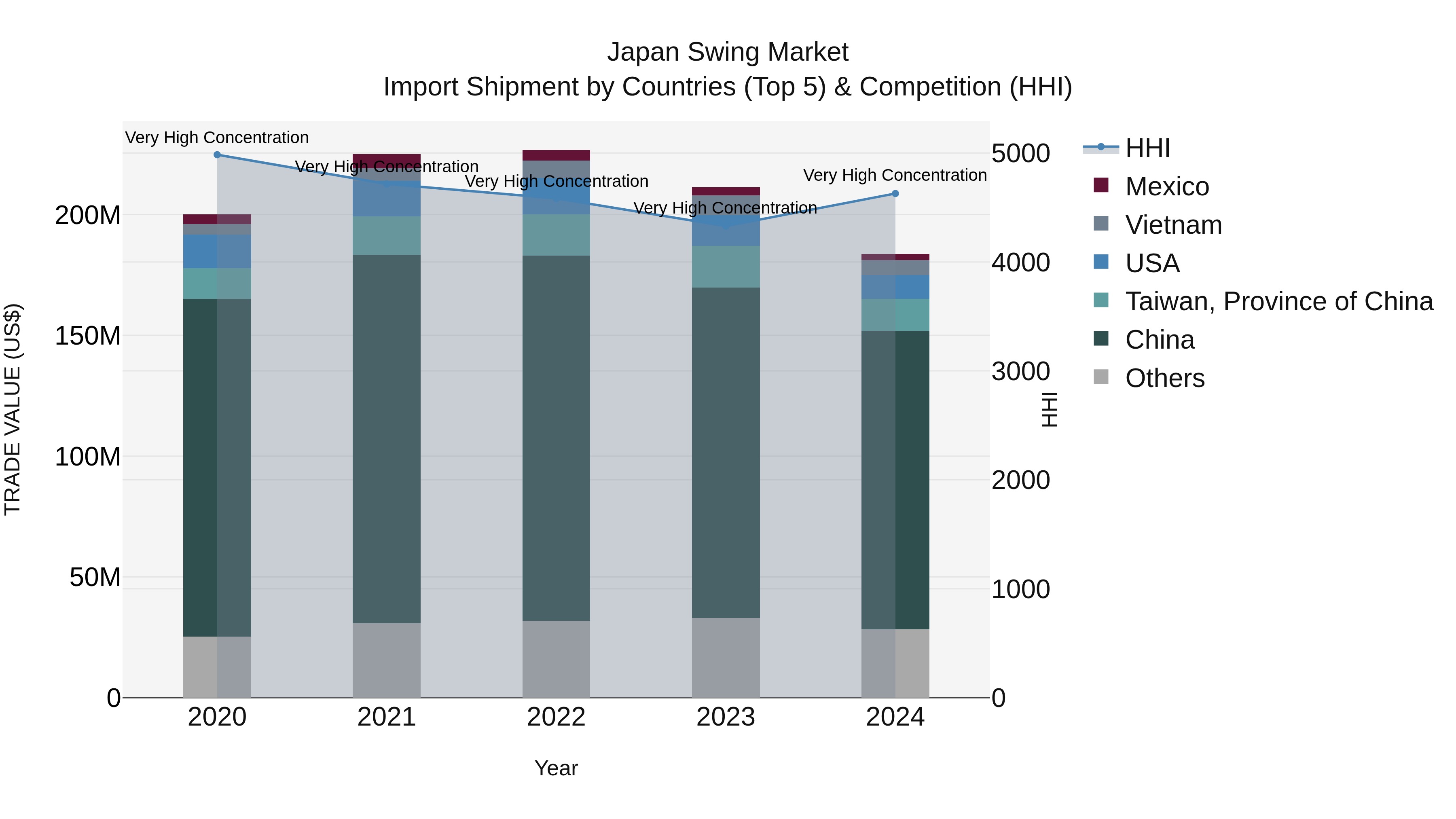
Japan Swing Market Import Shipment by Countries (Top 5) & Competition (HHI)
Despite the high concentration of import shipments in Japan for swing products, the market experienced a decline with a CAGR of -2.1% from 2020 to 2024. In 2024, the top exporting countries to Japan for swing products were China, Taiwan, USA, Vietnam, and Indonesia. The growth rate from 2023 to 2024 saw a significant decrease of -13.04%, indicating potential challenges in the market. Monitoring these trends and understanding the dynamics of these key exporting countries will be crucial for stakeholders in the swing import industry in Japan.
Japan Swing Market Overview
The Japan Swing Market refers to a niche segment within the broader financial market where traders engage in short- to medium-term trading strategies to capitalize on price swings in various financial instruments such as stocks, forex, and commodities. Swing traders typically hold positions for a few days to a few weeks, aiming to profit from both upward and downward price movements by analyzing technical indicators, chart patterns, and market trends. In Japan, the Swing Market has gained popularity among retail and institutional investors looking to generate consistent returns while minimizing exposure to long-term market fluctuations. With a focus on timing entry and exit points strategically, participants in the Japan Swing Market closely monitor market volatility and use risk management techniques to optimize their trading performance in this dynamic and fast-paced trading environment.
Japan Swing Market Trends
The Japan Swing Market is currently experiencing a rise in popularity among younger generations as a form of social activity and exercise. More people are turning to swing dancing as a way to connect with others and stay active, leading to an increase in swing dance events and classes across the country. In addition, there is a growing interest in vintage fashion and music associated with swing culture, contributing to the overall appeal of the trend. With its fun and energetic nature, swing dancing is becoming a popular choice for social gatherings and a way to unwind from the stresses of daily life. This trend is expected to continue growing as more people discover the joy and community spirit that comes with participating in the Japan Swing Market.
Japan Swing Market Challenges
In the Japan Swing Market, some challenges include the prevalence of traditional values and conservative consumer behavior, which can make it difficult for new and innovative products to gain acceptance. Additionally, the market is highly competitive with strong domestic players and high entry barriers for foreign companies. Cultural differences and language barriers can also pose challenges for foreign companies looking to enter the market. Moreover, the aging population in Japan presents a challenge as consumer preferences and spending habits shift towards more practical and cost-effective options. Adapting marketing strategies to resonate with the unique preferences and sensibilities of Japanese consumers while navigating complex regulations and distribution channels are key challenges faced by companies operating in the Japan Swing Market.
Japan Swing Market Investment Opportunities
The Japan Swing Market offers various investment opportunities for those looking to capitalize on short to medium-term price fluctuations in stocks. Swing trading involves buying and selling stocks over a span of days or weeks to take advantage of market momentum. Investors can focus on sectors showing growth potential or individual stocks exhibiting strong technical indicators for swing trading strategies. Additionally, the Japan Swing Market provides opportunities for trading exchange-traded funds (ETFs) and futures contracts linked to Japanese stock indices. By closely monitoring market trends, utilizing technical analysis tools, and having a disciplined approach to risk management, investors can potentially profit from the price movements in the Japan Swing Market.
Japan Swing Market Government Policy
Government policies in Japan related to the Swing Market focus on promoting renewable energy sources, including wind and solar power, to reduce carbon emissions and combat climate change. The government offers subsidies and incentives to encourage the adoption of clean energy technologies, which has led to the growth of the swing market in the country. Japan`s energy policy also emphasizes energy efficiency and conservation measures to reduce reliance on fossil fuels and increase energy security. Additionally, the government has set targets for increasing the share of renewable energy in the country`s energy mix, driving investment and innovation in the swing market. Overall, Japan`s policy framework supports the development of sustainable energy solutions, positioning the swing market for further expansion and advancement in the coming years.
Japan Swing Market Future Outlook
The future outlook for the Japan Swing Market appears to be promising, with steady growth expected in the coming years. Factors such as increasing urbanization, rising disposable incomes, and a growing interest in health and wellness activities are driving the demand for swing products in Japan. Additionally, the trend towards outdoor recreation and leisure activities among all age groups is likely to further boost the market. Manufacturers are anticipated to focus on product innovation, incorporating advanced technology and sustainable materials to cater to the evolving preferences of consumers. Overall, the Japan Swing Market is poised for expansion, presenting opportunities for market players to capitalize on the growing consumer interest in recreational and leisure products.
Key Highlights of the Report:
- Japan Swing Market Outlook
- Market Size of Japan Swing Market, 2024
- Forecast of Japan Swing Market, 2031
- Historical Data and Forecast of Japan Swing Revenues & Volume for the Period 2021 - 2031
- Japan Swing Market Trend Evolution
- Japan Swing Market Drivers and Challenges
- Japan Swing Price Trends
- Japan Swing Porter's Five Forces
- Japan Swing Industry Life Cycle
- Historical Data and Forecast of Japan Swing Market Revenues & Volume By Product Type for the Period 2021 - 2031
- Historical Data and Forecast of Japan Swing Market Revenues & Volume By Full-sized swing for the Period 2021 - 2031
- Historical Data and Forecast of Japan Swing Market Revenues & Volume By Portable Swing for the Period 2021 - 2031
- Historical Data and Forecast of Japan Swing Market Revenues & Volume By Application for the Period 2021 - 2031
- Historical Data and Forecast of Japan Swing Market Revenues & Volume By Household for the Period 2021 - 2031
- Historical Data and Forecast of Japan Swing Market Revenues & Volume By Nursery for the Period 2021 - 2031
- Historical Data and Forecast of Japan Swing Market Revenues & Volume By Hospital for the Period 2021 - 2031
- Historical Data and Forecast of Japan Swing Market Revenues & Volume By Garden for the Period 2021 - 2031
- Historical Data and Forecast of Japan Swing Market Revenues & Volume By Distribution Channel for the Period 2021 - 2031
- Historical Data and Forecast of Japan Swing Market Revenues & Volume By Modern Trade for the Period 2021 - 2031
- Historical Data and Forecast of Japan Swing Market Revenues & Volume By Departmental Stores for the Period 2021 - 2031
- Historical Data and Forecast of Japan Swing Market Revenues & Volume By Specialty Stores for the Period 2021 - 2031
- Historical Data and Forecast of Japan Swing Market Revenues & Volume By Online Stores for the Period 2021 - 2031
- Historical Data and Forecast of Japan Swing Market Revenues & Volume By Others for the Period 2021 - 2031
- Japan Swing Import Export Trade Statistics
- Market Opportunity Assessment By Product Type
- Market Opportunity Assessment By Application
- Market Opportunity Assessment By Distribution Channel
- Japan Swing Top Companies Market Share
- Japan Swing Competitive Benchmarking By Technical and Operational Parameters
- Japan Swing Company Profiles
- Japan Swing Key Strategic Recommendations






































