Japan Telecom Cloud Billing Market Size & Growth Rate (2026-2032)
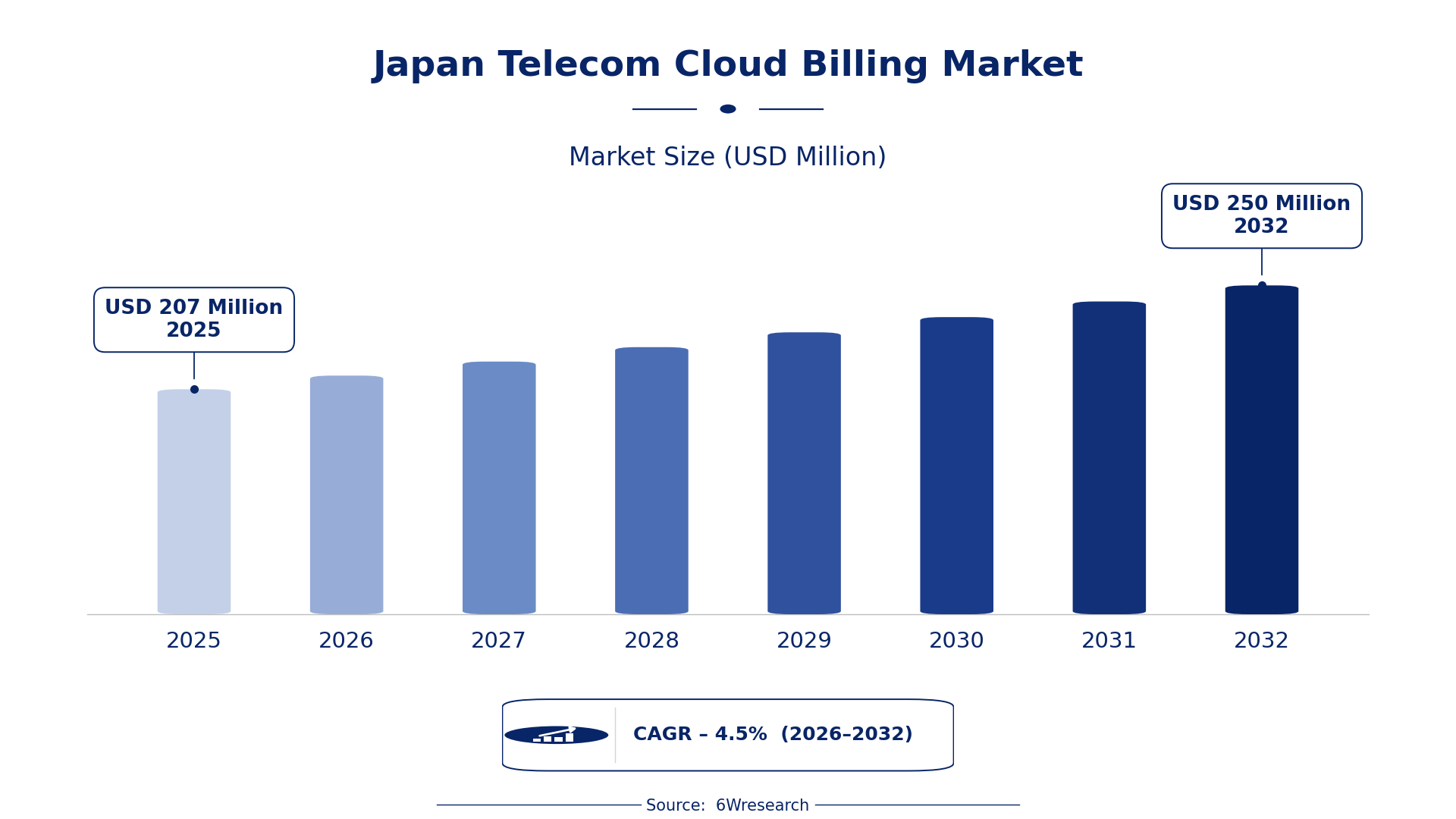
The Japan Telecom Cloud Billing Market was estimated at USD 207 Million in 2025 and is projected to reach USD 250 Million by 2032, growing at a CAGR of 4.5% from 2026 to 2032.
Japan Telecom Cloud Billing Market Synopsis
The Japan Telecom Cloud Billing Market has recently gained traction, largely driven by the telecom sector’s relentless push towards digital transformation. As service providers grapple with the complexities of modern billing demands, the need for cloud-based solutions is becoming increasingly evident.
Looking ahead, the momentum is set to continue as telecom operators increasingly prioritize real-time analytics and flexible billing solutions. With subscription-based models gaining popularity, companies are exploring innovative cloud billing platforms to enhance efficiency and customer satisfaction.
Japan Telecom Cloud Billing Market Year-wise Growth Rate and Key Drivers
This graph illustrates the annual growth rates of the Japan Telecom Cloud Billing Market from 2021 to 2032, highlighting a steady upward trajectory and projected expansion over the forecast period.
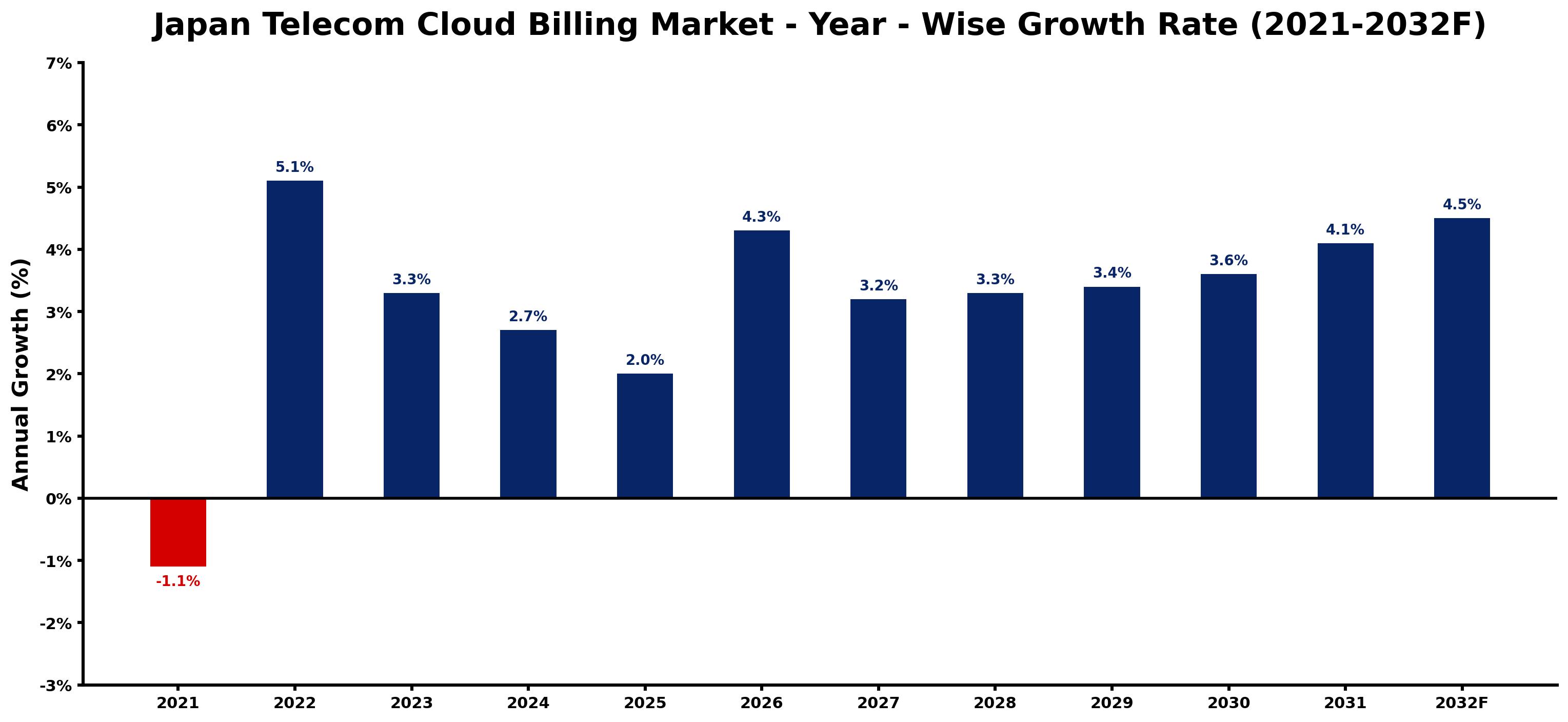
The table below presents the year‑wise growth rates along with the key drivers influencing the market
| Year | Growth Rate | Major Drivers |
| 2021 | -1.1% | Nippon Telegraph and Telephone limits cloud revenue growth. |
| 2022 | 5.1% | Increased 5G deployment enhancing cloud service billing requirements. |
| 2023 | 3.3% | Telecom companies adopting AI for improved billing accuracy. |
| 2024 | 2.7% | Rising smartphone penetration driving cloud billing solutions growth. |
| 2025 | 2.0% | Local startups innovating in telecom billing software solutions. |
| 2026 | 4.3% | Regulatory support for digital payment options boosting adoption. |
| 2027 | 3.2% | Partnerships between telecoms and tech firms enhancing offerings. |
| 2028 | 3.3% | Growing e-commerce model necessitating advanced billing systems. |
| 2029 | 3.4% | Consumer preference shift towards digitized billing services. |
| 2030 | 3.6% | Increased demand for bundled telecom and cloud services. |
| 2031 | 4.1% | Regulatory incentives for cloud technology investments in telecom. |
| 2032 | 4.5% | Strong demand for real-time billing solutions from users. |
Note: Market size estimations and growth projections presented in this report are based on 6Wresearch's proprietary forecasting methodology, utilizing the latest available industry data, government publications, and primary research inputs.
Japan Telecom Cloud Billing Market Key Takeaways
Below are some of the specific key takeaways from the market, including:
- Increasing demand for real-time billing and advanced analytics is driving cloud billing adoption among telecom companies.
- The market is shifting towards subscription-based billing models, catering to the need for flexible pricing and personalized services.
- Telecom operators are investing in automation tools to enhance billing accuracy and operational efficiency.
- Data privacy compliance is becoming a focal point, pushing companies to adopt secure billing solutions.
- The competition is intensifying, with numerous players aiming to differentiate through innovative service offerings.
Evaluation of Restraints in Japan Telecom Cloud Billing Market
A significant restraint in the Japan Telecom Cloud Billing Market is the complex regulatory framework surrounding data security. Telecom providers must navigate strict data protection regulations, which necessitate substantial investments in compliance and technology. Additionally, the high level of competition is forcing companies to continuously innovate and differentiate their offerings to avoid pricing pressures, complicating their operational strategies.
Japan Telecom Cloud Billing Market Trends
Several trends are shaping the Japan Telecom Cloud Billing Market today. Notably, there is a noticeable shift toward subscription-based billing, as telecom companies strive to meet consumer demand for flexible pricing. The integration of advanced billing analytics is also gaining traction, enabling service providers to enhance accuracy and operational efficiency.
Another critical trend is the growing emphasis on data privacy compliance. This is compelling telecom operators to invest in secure billing solutions to safeguard customer information. The increasing adoption of cloud platforms supports scalability and agility in billing operations, reflecting a broader trend towards customer-centric billing practices.
Japan Telecom Cloud Billing Market Opportunities
As telecom operators increasingly adopt cloud-based solutions, the market presents numerous investment opportunities. The rising demand for advanced billing systems that can efficiently manage complex subscription models is paving the way for innovative cloud billing platforms. Companies focusing on features such as usage-based billing, automated invoicing, and comprehensive analytics are particularly well-positioned for growth. Collaborations with telecom operators to develop tailored solutions could also yield lucrative returns.
Government Initiatives in the Japan Telecom Cloud Billing Market
Government initiatives play a crucial role in shaping the Japan Telecom Cloud Billing Market by creating a supportive environment for technological adoption. Regulatory reforms aim to promote innovation in billing systems, making it easier for telecom companies to transition to cloud solutions. This focus on digital transformation has led to financial incentives for businesses investing in cloud technologies.
- A regulatory framework was introduced in 2025 mandating transparency in billing practices to enhance consumer trust.
- A national digital infrastructure upgrade programme is currently underway to improve access to advanced cloud billing solutions across the country.
- Recently completed initiatives have included financial incentives for telecom operators to encourage the adoption of secure cloud billing technologies.
- Plans for a public-private partnership expected to boost cloud services in the telecom sector are scheduled for 2028.
- Ongoing efforts to streamline data privacy regulations are aimed at supporting compliance in billing systems.
Future Insights of the Japan Telecom Cloud Billing Market
Looking towards 2026-2032, the Japan Telecom Cloud Billing Market is likely to experience significant growth as telecom companies increasingly prioritize cloud solutions. The ongoing shift towards subscription-based services and the demand for flexible billing options are set to drive the market. Advancements in technology will facilitate more streamlined billing processes, enhancing revenue management for service providers. In this competitive environment, innovation will be crucial for sustained success.
Japan Telecom Cloud Billing Market Latest Developments
Recent industry activity in the Japan Telecom Cloud Billing Market has been marked by advancements in technology and strategic partnerships. Companies are focusing on enhancing their service offerings through innovative cloud solutions, positioning themselves to meet the evolving needs of telecom operators.
- A major technology vendor launched a new cloud billing platform in early 2025, aimed at simplifying billing processes for telecom operators.
- In mid-2025, a leading regional operator began implementing advanced analytics tools to improve billing accuracy and customer insights.
- An initiative started in late 2025 to integrate real-time billing capabilities into existing systems is currently underway.
- Plans for a significant rollout of usage-based billing options across various telecom services are expected to begin in Q2 2026.
- A partnership between two technology firms focused on developing automated invoicing solutions is set to take shape later in 2025.
Japan Telecom Cloud Billing Market - Key Attractiveness of the Report
- 10 Years of Market Numbers
- Historical Data Starting from 2022 to 2025
- Base Year: 2025
- Forecast Data until 2032
- Key Performance Indicators Impacting the Market
- Major Upcoming Developments and Projects
Key Highlights of the Report:
- Japan Telecom Cloud Billing Market Outlook
- Market Size of Japan Telecom Cloud Billing Market, 2025
- Forecast of Japan Telecom Cloud Billing Market, 2032
- Historical Data and Forecast of Japan Telecom Cloud Billing Revenues & Volume for the Period 2022-2032F
- Japan Telecom Cloud Billing Market Trend Evolution
- Japan Telecom Cloud Billing Market Drivers and Challenges
- Japan Telecom Cloud Billing Price Trends
- Japan Telecom Cloud Billing Porter's Five Forces
- Japan Telecom Cloud Billing Industry Life Cycle
- Historical Data and Forecast of Japan Telecom Cloud Billing Market Revenues & Volume By Type of Billing for the Period 2022-2032F
- Historical Data and Forecast of Japan Telecom Cloud Billing Market Revenues & Volume By Convergent for the Period 2022-2032F
- Historical Data and Forecast of Japan Telecom Cloud Billing Market Revenues & Volume By Prepaid for the Period 2022-2032F
- Historical Data and Forecast of Japan Telecom Cloud Billing Market Revenues & Volume By Postpaid for the Period 2022-2032F
- Historical Data and Forecast of Japan Telecom Cloud Billing Market Revenues & Volume By Interconnect for the Period 2022-2032F
- Historical Data and Forecast of Japan Telecom Cloud Billing Market Revenues & Volume By Roaming for the Period 2022-2032F
- Historical Data and Forecast of Japan Telecom Cloud Billing Market Revenues & Volume By Others (Direct to Consumer (D2C) and Metered) for the Period 2022-2032F
- Historical Data and Forecast of Japan Telecom Cloud Billing Market Revenues & Volume By Cloud Platform for the Period 2022-2032F
- Historical Data and Forecast of Japan Telecom Cloud Billing Market Revenues & Volume By SaaS for the Period 2022-2032F
- Historical Data and Forecast of Japan Telecom Cloud Billing Market Revenues & Volume By Others (IaaS and PaaS) for the Period 2022-2032F
- Historical Data and Forecast of Japan Telecom Cloud Billing Market Revenues & Volume By End User for the Period 2022-2032F
- Historical Data and Forecast of Japan Telecom Cloud Billing Market Revenues & Volume By Individuals for the Period 2022-2032F
- Historical Data and Forecast of Japan Telecom Cloud Billing Market Revenues & Volume By Enterprises for the Period 2022-2032F
- Historical Data and Forecast of Japan Telecom Cloud Billing Market Revenues & Volume By Application for the Period 2022-2032F
- Historical Data and Forecast of Japan Telecom Cloud Billing Market Revenues & Volume By Revenue Management for the Period 2022-2032F
- Historical Data and Forecast of Japan Telecom Cloud Billing Market Revenues & Volume By Account Management for the Period 2022-2032F
- Historical Data and Forecast of Japan Telecom Cloud Billing Market Revenues & Volume By Customer Management for the Period 2022-2032F
- Historical Data and Forecast of Japan Telecom Cloud Billing Market Revenues & Volume By Rate of Charging Mode for the Period 2022-2032F
- Historical Data and Forecast of Japan Telecom Cloud Billing Market Revenues & Volume By Subscription-Based for the Period 2022-2032F
- Historical Data and Forecast of Japan Telecom Cloud Billing Market Revenues & Volume By Usage-Based for the Period 2022-2032F
- Historical Data and Forecast of Japan Telecom Cloud Billing Market Revenues & Volume By Service for the Period 2022-2032F
- Historical Data and Forecast of Japan Telecom Cloud Billing Market Revenues & Volume By Professional for the Period 2022-2032F
- Historical Data and Forecast of Japan Telecom Cloud Billing Market Revenues & Volume By Managed for the Period 2022-2032F
- Japan Telecom Cloud Billing Import Export Trade Statistics
- Market Opportunity Assessment By Type of Billing
- Market Opportunity Assessment By Cloud Platform
- Market Opportunity Assessment By End User
- Market Opportunity Assessment By Application
- Market Opportunity Assessment By Rate of Charging Mode
- Market Opportunity Assessment By Service
- Japan Telecom Cloud Billing Top Companies Market Share
- Japan Telecom Cloud Billing Competitive Benchmarking By Technical and Operational Parameters
- Japan Telecom Cloud Billing Company Profiles
- Japan Telecom Cloud Billing Key Strategic Recommendations






































