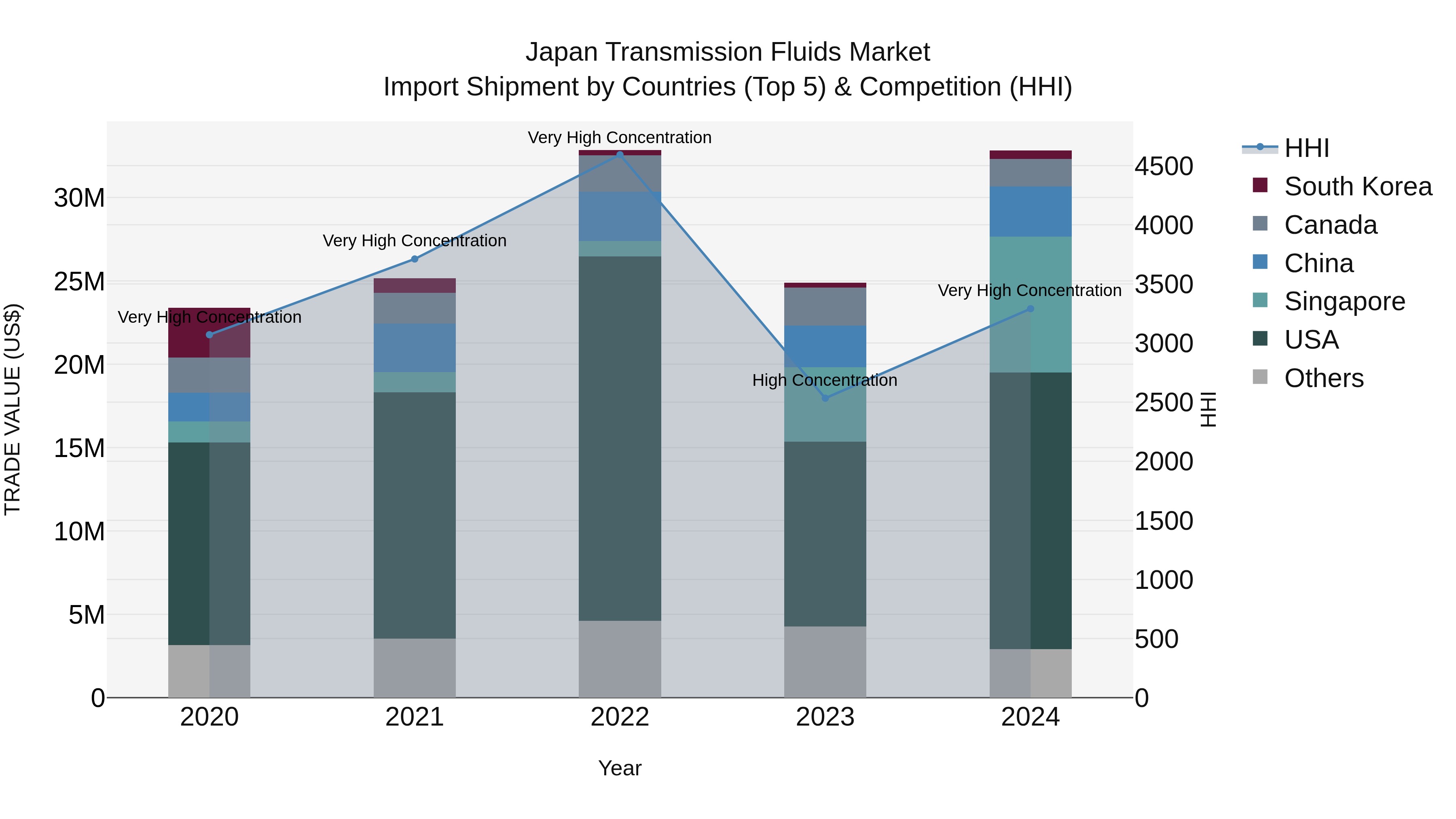
Japan Transmission Fluids Market Import Shipment by Countries (Top 5) & Competition (HHI)
In 2024, Japan saw a significant increase in transmission fluids import shipments, with top exporting countries being the USA, Singapore, China, Canada, and Thailand. The market exhibited very high concentration levels, indicating a competitive landscape dominated by a few key players. The Compound Annual Growth Rate (CAGR) from 2020 to 2024 was robust at 8.85%, with a notable growth rate of 31.9% from 2023 to 2024. This data suggests a thriving market for transmission fluids in Japan, driven by strong demand and strategic partnerships with key exporting nations.
Japan Transmission Fluids Market Overview
The Japan Transmission Fluids Market is witnessing steady growth, driven by factors such as the expanding automotive industry, technological advancements in transmission systems, and increasing demand for fuel-efficient vehicles. The market is characterized by the presence of key players like Idemitsu Kosan Co., Ltd., Nippon Oil Corporation, and Exxon Mobil Corporation offering a wide range of transmission fluids catering to various vehicle types. Additionally, the growing trend towards automatic transmissions in vehicles is boosting the demand for high-quality transmission fluids with improved performance characteristics. The market is also influenced by stringent regulations promoting the use of eco-friendly fluids, leading to the development of bio-based transmission fluids. Overall, the Japan Transmission Fluids Market is poised for further growth, driven by innovation, sustainability, and evolving automotive technologies.
Japan Transmission Fluids Market Trends and Opportunities
The Japan Transmission Fluids Market is experiencing a shift towards environmentally friendly and high-performance products due to increasing awareness about sustainability and technological advancements. There is a growing demand for synthetic transmission fluids that offer better fuel efficiency and longer transmission life. Additionally, the market is witnessing opportunities in the development of transmission fluids tailored for electric vehicles to meet the specific requirements of their transmission systems. Key players in the market are focusing on product innovations and strategic partnerships to gain a competitive edge. Overall, the Japan Transmission Fluids Market is poised for growth driven by the increasing need for efficient and durable transmission fluids in both traditional and electric vehicles.
Japan Transmission Fluids Market Challenges
In the Japan Transmission Fluids Market, some key challenges include increasing environmental regulations requiring the development of more eco-friendly transmission fluids, intense competition from both domestic and international manufacturers, and the need for continuous innovation to meet evolving automotive technologies. Additionally, fluctuations in raw material prices and the impact of global events on supply chains can also pose challenges for companies operating in this market. Adapting to changing consumer preferences, such as a shift towards electric vehicles that may not require traditional transmission fluids, is another significant challenge that companies in the Japan Transmission Fluids Market need to address to remain competitive in the long term.
Japan Transmission Fluids Market Drivers
The Japan Transmission Fluids Market is primarily driven by the increasing demand for automatic transmission vehicles, which require regular maintenance of transmission fluids for optimal performance. Additionally, the growing automotive industry in Japan, coupled with rising disposable income levels, is fueling the demand for high-quality transmission fluids. The focus on fuel efficiency and the need for advanced transmission technologies are also contributing factors driving market growth. Moreover, the increasing awareness among consumers regarding the importance of proper maintenance to prolong the lifespan of vehicles is boosting the demand for transmission fluids in Japan. Innovations in transmission fluid formulations, such as synthetic and semi-synthetic products, are further propelling market expansion by offering improved performance and durability to vehicles.
Japan Transmission Fluids Market Government Policy
In Japan, government policies related to the transmission fluids market primarily focus on environmental sustainability and safety regulations. The Japanese government has implemented strict guidelines to ensure that transmission fluids meet specific quality standards to reduce harmful emissions and minimize environmental impact. Additionally, there are regulations in place to promote the use of eco-friendly transmission fluids, encouraging manufacturers to develop products that are biodegradable and less harmful to the environment. The government also emphasizes the importance of consumer safety by setting standards for labeling and packaging of transmission fluids to ensure clear information for users. Overall, the government policies in Japan aim to promote a sustainable and safe transmission fluids market that aligns with environmental protection and consumer well-being.
Japan Transmission Fluids Market Future Outlook
The Japan Transmission Fluids Market is expected to witness steady growth in the coming years due to factors such as the increasing demand for automatic transmission vehicles and the growing awareness about the importance of maintaining proper transmission systems. The market is likely to be driven by technological advancements leading to the development of high-performance transmission fluids that offer better protection and efficiency. Additionally, the expanding automotive industry in Japan and the shift towards electric vehicles are anticipated to further boost the demand for transmission fluids. However, challenges such as stringent environmental regulations and the increasing trend towards electric vehicles may pose some limitations to market growth. Overall, the Japan Transmission Fluids Market is forecasted to show positive growth potential in the foreseeable future.
Key Highlights of the Report:
- Japan Transmission Fluids Market Outlook
- Market Size of Japan Transmission Fluids Market, 2024
- Forecast of Japan Transmission Fluids Market, 2031
- Historical Data and Forecast of Japan Transmission Fluids Revenues & Volume for the Period 2021-2031
- Japan Transmission Fluids Market Trend Evolution
- Japan Transmission Fluids Market Drivers and Challenges
- Japan Transmission Fluids Price Trends
- Japan Transmission Fluids Porter's Five Forces
- Japan Transmission Fluids Industry Life Cycle
- Historical Data and Forecast of Japan Transmission Fluids Market Revenues & Volume By Type for the Period 2021-2031
- Historical Data and Forecast of Japan Transmission Fluids Market Revenues & Volume By Automatic Transmission Fluid/ATF for the Period 2021-2031
- Historical Data and Forecast of Japan Transmission Fluids Market Revenues & Volume By Manual Transmission Fluid/MTF for the Period 2021-2031
- Historical Data and Forecast of Japan Transmission Fluids Market Revenues & Volume By CVT for the Period 2021-2031
- Historical Data and Forecast of Japan Transmission Fluids Market Revenues & Volume By DCT for the Period 2021-2031
- Historical Data and Forecast of Japan Transmission Fluids Market Revenues & Volume By Base Oil for the Period 2021-2031
- Historical Data and Forecast of Japan Transmission Fluids Market Revenues & Volume By Mineral for the Period 2021-2031
- Historical Data and Forecast of Japan Transmission Fluids Market Revenues & Volume By Synthetic for the Period 2021-2031
- Historical Data and Forecast of Japan Transmission Fluids Market Revenues & Volume By Semi-Synthetic for the Period 2021-2031
- Historical Data and Forecast of Japan Transmission Fluids Market Revenues & Volume By End Use Industry for the Period 2021-2031
- Historical Data and Forecast of Japan Transmission Fluids Market Revenues & Volume By Automotive for the Period 2021-2031
- Historical Data and Forecast of Japan Transmission Fluids Market Revenues & Volume By Off-Road Vehicle for the Period 2021-2031
- Japan Transmission Fluids Import Export Trade Statistics
- Market Opportunity Assessment By Type
- Market Opportunity Assessment By Base Oil
- Market Opportunity Assessment By End Use Industry
- Japan Transmission Fluids Top Companies Market Share
- Japan Transmission Fluids Competitive Benchmarking By Technical and Operational Parameters
- Japan Transmission Fluids Company Profiles
- Japan Transmission Fluids Key Strategic Recommendations






































