Japan Unified Network Management Market Size & Growth Rate (2026-2032)
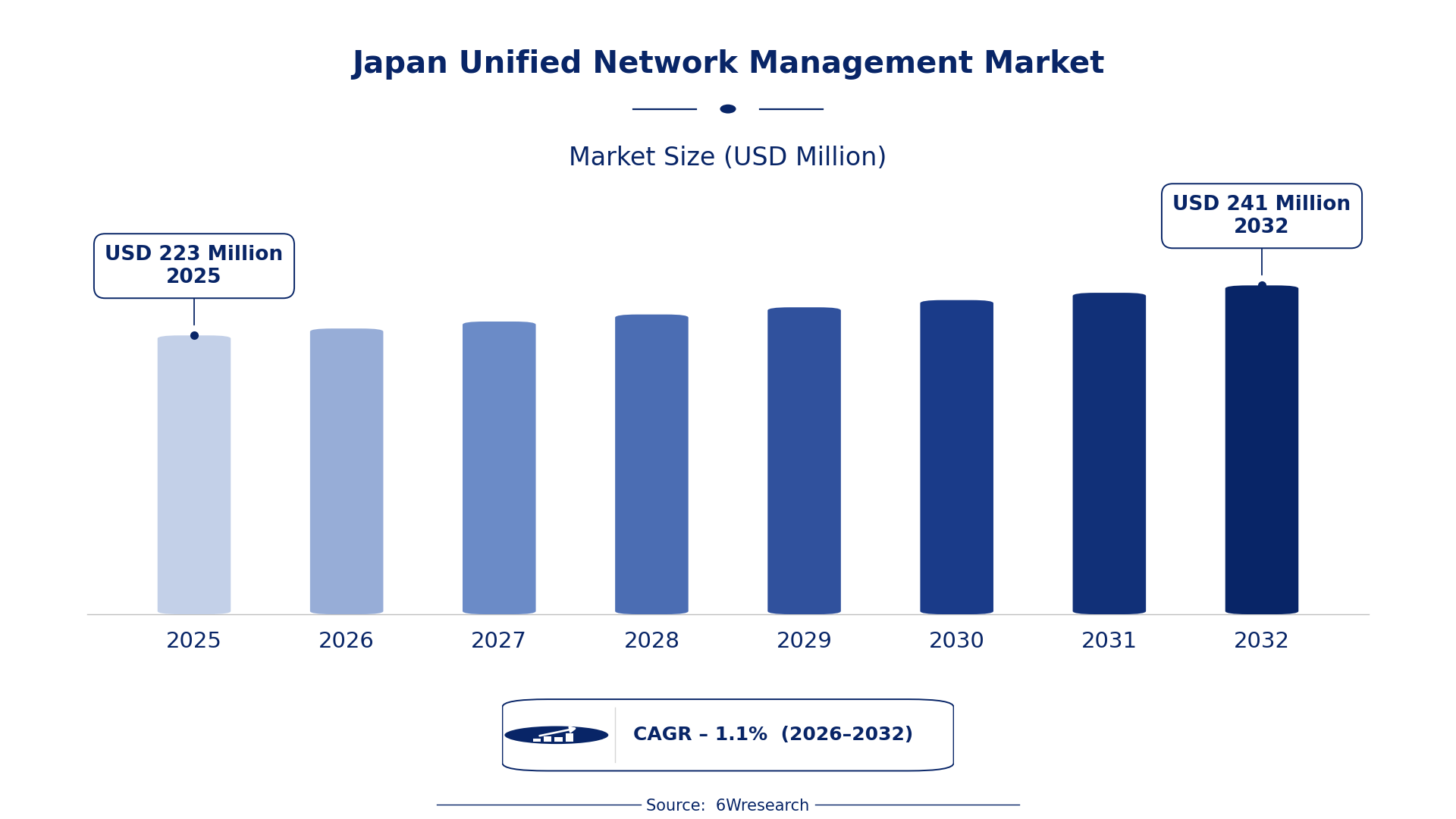
The Japan Unified Network Management Market was estimated at USD 223 Million in 2025 and is projected to reach USD 241 Million by 2032, growing at a CAGR of 1.1% from 2026 to 2032.
Japan Unified Network Management Market Synopsis
The Japan Unified Network Management Market is witnessing a surge fueled by the increasing reliance on advanced networking technologies. Organizations across various sectors are actively seeking integrated solutions that streamline the management of their network infrastructures. The need for enhanced operational efficiency and reduced downtime is propelling demand for unified platforms that offer centralized visibility and control.
With the rise of cloud computing and the Internet of Things (IoT), the complexity of network management is intensifying. Businesses are not just looking for monitoring tools; they require comprehensive systems that can handle configuration, troubleshooting, and analytics. As these trends continue to evolve, the market shows strong potential for sustained growth in the coming years.
Japan Unified Network Management Market Year-wise Growth Rate and Key Drivers
This graph illustrates the annual growth rates of the Japan Unified Network Management Market from 2021 to 2032, highlighting a steady upward trajectory and projected expansion over the forecast period.
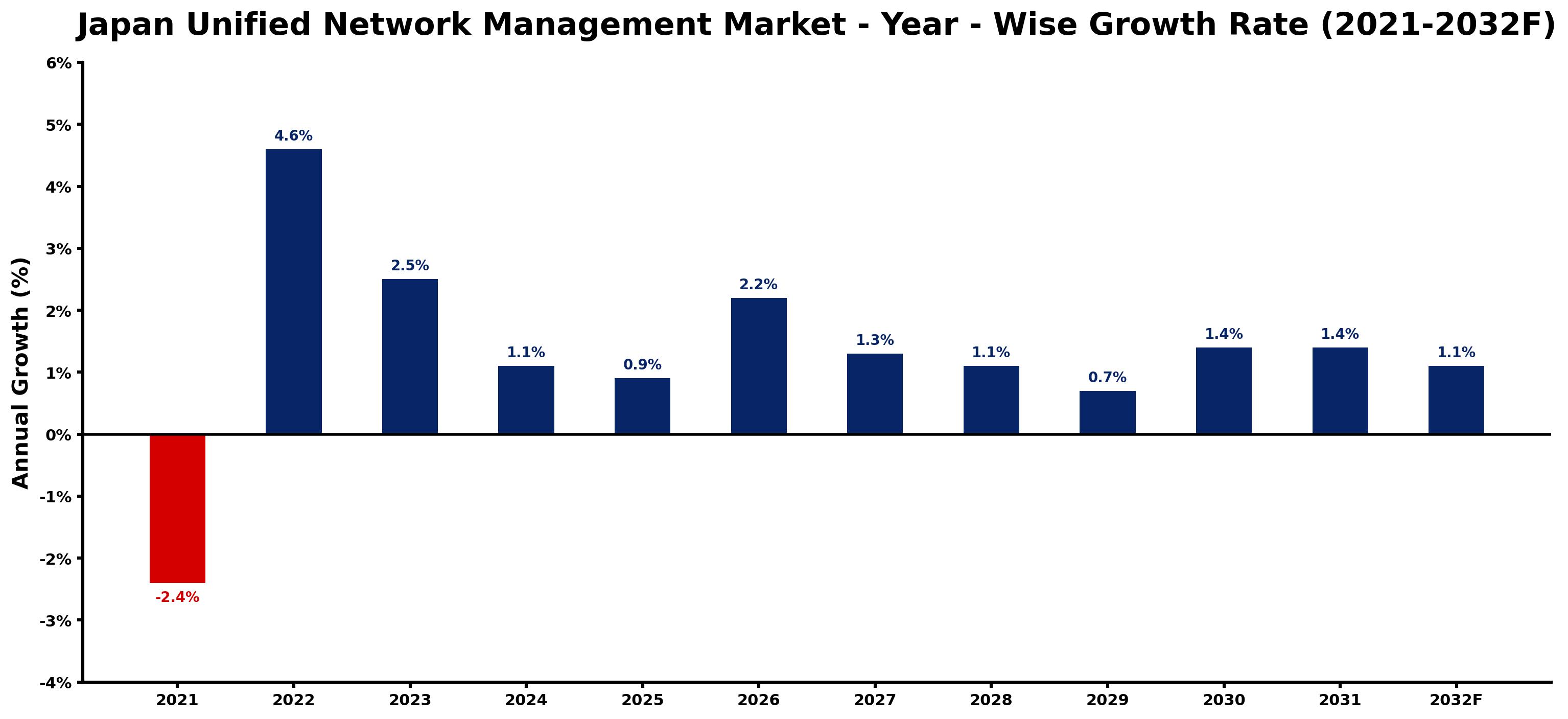
The table below presents the year‑wise growth rates along with the key drivers influencing the market
| Year | Growth Rate | Major Drivers |
| 2021 | -2.4% | Nippon Telegraph and Telephone's network expansion delays. |
| 2022 | 4.6% | Increased cybersecurity regulations from the Ministry of Internal Affairs. |
| 2023 | 2.5% | Growing emphasis on 5G technology deployment across urban areas. |
| 2024 | 1.1% | Rise in remote work initiatives enhancing network performance requirements. |
| 2025 | 0.9% | Government funding for digital transformation in local businesses. |
| 2026 | 2.2% | Increased enterprise cloud adoption boosting unified management demand. |
| 2027 | 1.3% | Enhanced telecommunication infrastructure supporting better network visibility. |
| 2028 | 1.1% | Japanese firms prioritizing operational efficiency through network integration. |
| 2029 | 0.7% | Focus on disaster recovery solutions driving network management investments. |
| 2030 | 1.4% | AI development partnerships fostering innovation in network technologies. |
| 2031 | 1.4% | Rising concerns over data privacy spurring regulatory compliance needs. |
| 2032 | 1.1% | Growing need for hybrid cloud environments in Japanese corporations. |
Note: Market size estimations and growth projections presented in this report are based on 6Wresearch's proprietary forecasting methodology, utilizing the latest available industry data, government publications, and primary research inputs.
Japan Unified Network Management Market Key Takeaways
Below are some of the specific key takeaways from the market, including:
- The market is increasingly influenced by the adoption of cloud services and IoT devices.
- Demand for integrated platforms is rising to manage diverse network infrastructures efficiently.
- AI and machine learning are becoming essential for enhancing network performance and security.
- Scalability and flexibility are critical as organizations adapt to changing business needs.
- Investment opportunities are emerging in companies offering comprehensive network management solutions.
Evaluation of Restraints in Japan Unified Network Management Market
The Japan Unified Network Management Market faces notable restraints primarily stemming from the complexity of managing diverse technologies. Companies often grapple with the integration of legacy systems, cloud services, and newer technologies, which can lead to inefficiencies and increased operational costs. The rapid pace of technological advancement further complicates the ability to keep up with industry standards and customer expectations. Organizations must focus on creating solutions that not only address current complexities but also anticipate future challenges in network management.
Japan Unified Network Management Market Trends
Several key trends are shaping the Japan Unified Network Management Market. A primary trend is the increasing demand for integrated management platforms that can offer centralized control over heterogeneous network environments. Additionally, the incorporation of AI and machine learning technologies is helping businesses enhance their network capabilities, allowing for predictive maintenance and improved security measures. on top of that, as organizations prioritize scalability, solutions that can easily adapt to evolving business demands are becoming indispensable.
Japan Unified Network Management Market Opportunities
Investment opportunities within the Japan Unified Network Management Market are becoming increasingly attractive. Companies are urged to develop comprehensive solutions that encompass monitoring, configuration, and performance optimization. The ongoing digital transformation across various sectors creates a fertile ground for growth. In particular, solutions that leverage innovative technologies like AI for network management can set investors apart in a market that values efficiency and reliability.
Government Initiatives in the Japan Unified Network Management Market
Government policies are playing a significant role in shaping the Japan Unified Network Management Market. The Japanese government is actively promoting the development of the telecommunications sector through various initiatives aimed at enhancing network infrastructure. With a focus on innovation and expansion, these policies are essential for supporting the growing demand for advanced communication technologies.
- A recently completed initiative focused on promoting the enhancement of network infrastructure for IoT, aimed at fostering innovation in telecommunications.
- Currently ongoing is the "5th Generation Mobile Communications Promotion Plan," which seeks to bolster 5G network capabilities across the nation.
- A planned public-private partnership is expected to expand telecom infrastructure access by 2028, addressing the increasing demand for robust network solutions.
- The Telecommunications Business Act is currently governing the operational standards for network services, ensuring fair competition.
Future Insights of the Japan Unified Network Management Market
Looking ahead to 2026-2032, the Japan Unified Network Management Market is set to grow as organizations increasingly recognize the importance of effective network management. With digital transformation initiatives on the rise, demand for comprehensive solutions that provide centralized control is expected to escalate. Factors such as cloud service adoption, the proliferation of IoT devices, and a heightened focus on security measures will drive market expansion. Companies prioritizing innovation and automation will likely secure a competitive advantage in this dynamic environment.
Japan Unified Network Management Market Latest Developments
Recent industry activity in the Japan Unified Network Management Market has been marked by significant advancements and strategic initiatives. Organizations are actively investing in technology to keep pace with the growing complexity of network environments. As digital transformation accelerates, companies are rolling out solutions that promise enhanced efficiency and security.
- A major technology vendor launched an integrated network management platform in early 2025, offering centralized visibility and control over diverse infrastructures.
- An ongoing initiative to upgrade network monitoring systems has been underway since mid-2025, aiming to improve operational efficiency across sectors.
- Upcoming in Q3 2026 is a rollout of an AI-driven analytics tool designed to enhance predictive maintenance capabilities.
- A regional operator is currently partnering with cloud service providers to expand its service offerings by late 2025.
Japan Unified Network Management Market - Key Attractiveness of the Report
- 10 Years of Market Numbers
- Historical Data Starting from 2022 to 2025
- Base Year: 2025
- Forecast Data until 2032
- Key Performance Indicators Impacting the Market
- Major Upcoming Developments and Projects
Key Highlights of the Report:
- Japan Unified Network Management Market Outlook
- Market Size of Japan Unified Network Management Market, 2025
- Forecast of Japan Unified Network Management Market, 2032
- Historical Data and Forecast of Japan Unified Network Management Revenues & Volume for the Period 2022-2032F
- Japan Unified Network Management Market Trend Evolution
- Japan Unified Network Management Market Drivers and Challenges
- Japan Unified Network Management Price Trends
- Japan Unified Network Management Porter's Five Forces
- Japan Unified Network Management Industry Life Cycle
- Historical Data and Forecast of Japan Unified Network Management Market Revenues & Volume By Networking Type for the Period 2022-2032F
- Historical Data and Forecast of Japan Unified Network Management Market Revenues & Volume By Wireline Network Management for the Period 2022-2032F
- Historical Data and Forecast of Japan Unified Network Management Market Revenues & Volume By Wireless Network Management for the Period 2022-2032F
- Historical Data and Forecast of Japan Unified Network Management Market Revenues & Volume By Solution for the Period 2022-2032F
- Historical Data and Forecast of Japan Unified Network Management Market Revenues & Volume By Network Traffic Management for the Period 2022-2032F
- Historical Data and Forecast of Japan Unified Network Management Market Revenues & Volume By Network Monitoring Management for the Period 2022-2032F
- Historical Data and Forecast of Japan Unified Network Management Market Revenues & Volume By Network Security Management for the Period 2022-2032F
- Historical Data and Forecast of Japan Unified Network Management Market Revenues & Volume By Network Application Management for the Period 2022-2032F
- Historical Data and Forecast of Japan Unified Network Management Market Revenues & Volume By Configuration and Server Management for the Period 2022-2032F
- Historical Data and Forecast of Japan Unified Network Management Market Revenues & Volume By Others (IP Address Management and Network Device Management) for the Period 2022-2032F
- Historical Data and Forecast of Japan Unified Network Management Market Revenues & Volume By Service for the Period 2022-2032F
- Historical Data and Forecast of Japan Unified Network Management Market Revenues & Volume By Training and Support for the Period 2022-2032F
- Historical Data and Forecast of Japan Unified Network Management Market Revenues & Volume By Consulting for the Period 2022-2032F
- Historical Data and Forecast of Japan Unified Network Management Market Revenues & Volume By Managed and Integration service for the Period 2022-2032F
- Historical Data and Forecast of Japan Unified Network Management Market Revenues & Volume By Deployment Type for the Period 2022-2032F
- Historical Data and Forecast of Japan Unified Network Management Market Revenues & Volume By On-Cloud for the Period 2022-2032F
- Historical Data and Forecast of Japan Unified Network Management Market Revenues & Volume By On-Premises for the Period 2022-2032F
- Historical Data and Forecast of Japan Unified Network Management Market Revenues & Volume By User Type for the Period 2022-2032F
- Historical Data and Forecast of Japan Unified Network Management Market Revenues & Volume By Large Enterprises for the Period 2022-2032F
- Historical Data and Forecast of Japan Unified Network Management Market Revenues & Volume By Small and Medium Enterprises for the Period 2022-2032F
- Historical Data and Forecast of Japan Unified Network Management Market Revenues & Volume By Industry Vertical for the Period 2022-2032F
- Historical Data and Forecast of Japan Unified Network Management Market Revenues & Volume By BFSI for the Period 2022-2032F
- Historical Data and Forecast of Japan Unified Network Management Market Revenues & Volume By High-Tech and Telecom for the Period 2022-2032F
- Historical Data and Forecast of Japan Unified Network Management Market Revenues & Volume By Retail and Consumer Goods for the Period 2022-2032F
- Historical Data and Forecast of Japan Unified Network Management Market Revenues & Volume By Travel and Hospitality for the Period 2022-2032F
- Historical Data and Forecast of Japan Unified Network Management Market Revenues & Volume By Government for the Period 2022-2032F
- Historical Data and Forecast of Japan Unified Network Management Market Revenues & Volume By Media and Entertainment for the Period 2022-2032F
- Historical Data and Forecast of Japan Unified Network Management Market Revenues & Volume By Healthcare for the Period 2022-2032F
- Historical Data and Forecast of Japan Unified Network Management Market Revenues & Volume By Education for the Period 2022-2032F
- Japan Unified Network Management Import Export Trade Statistics
- Market Opportunity Assessment By Networking Type
- Market Opportunity Assessment By Solution
- Market Opportunity Assessment By Service
- Market Opportunity Assessment By Deployment Type
- Market Opportunity Assessment By User Type
- Market Opportunity Assessment By Industry Vertical
- Japan Unified Network Management Top Companies Market Share
- Japan Unified Network Management Competitive Benchmarking By Technical and Operational Parameters
- Japan Unified Network Management Company Profiles
- Japan Unified Network Management Key Strategic Recommendations






































