Japan Vending machines Market Summary
The japan vending machines market was estimated at USD 209 Million in 2025 and is projected to reach USD 225 Million by 2032, growing at a CAGR of 2.1% from 2026 to 2032.
Japan Vending machines Market Year-wise Growth Rate and Key Drivers
This graph highlights how the Japan Vending machines Market has steadily grown over the past five years, supported by major growth factors.
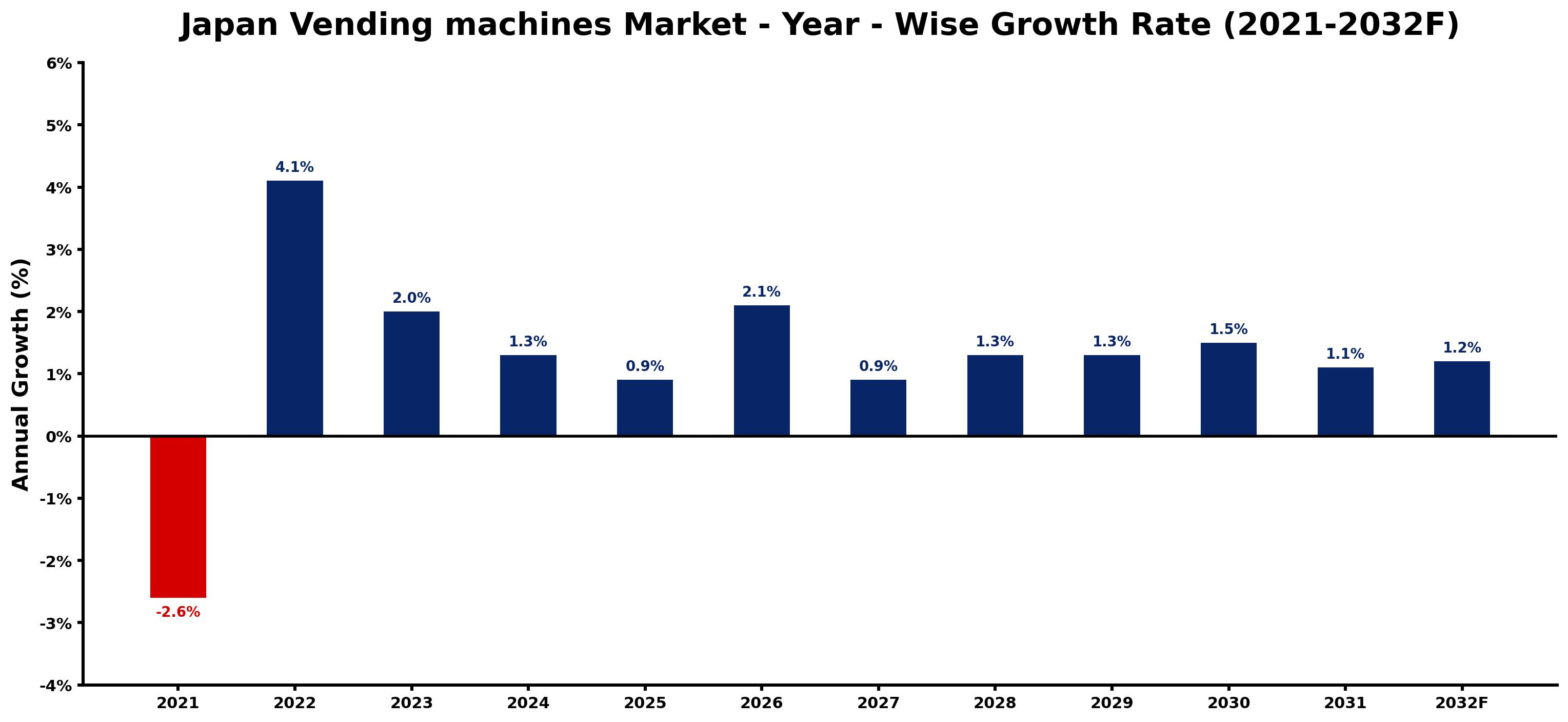
The table below presents the year wise growth rates along with the key drivers influencing the market
| Year | Growth Rate | Major Drivers |
| 2021 | -2.6% | Pandemicrelated closures diminished foot traffic in hightraffic locations, severely impacting vending machine sales. |
| 2022 | 4.1% | Innovative vending machine designs incorporated healthier snack options, attracting health-conscious consumers. |
| 2023 | 2.0% | Technological integration facilitated cashless payments, enhancing user experience and operational efficiency. |
| 2024 | 1.3% | Urbanization trends in Japan increased foot traffic, creating opportunities for strategically placed machines. |
| 2025 | 0.9% | Sustainability awareness encouraged businesses to incorporate eco-friendly vending machines into their operations. |
| 2026 | 2.1% | Localized product offerings catered to regional tastes, boosting sales in diverse markets across Japan. |
| 2027 | 0.9% | Partnerships with local brands expanded product selections, appealing to niche customer segments effectively. |
| 2028 | 1.3% | Advancements in AI and IoT technologies improved inventory management and customer engagement capabilities. |
| 2029 | 1.3% | Growing tourism led to increased demand for vending machines in high-traffic tourist areas. |
| 2030 | 1.5% | Shift towards remote work increased demand for convenient grab-and-go food options at workplaces. |
| 2031 | 1.1% | Health crises continued to shape consumer purchasing behaviors, favoring automated purchasing solutions. |
| 2032 | 1.2% | Emerging trends in smart cities integrated vending machines into urban infrastructure, enhancing accessibility. |
Note - Market size estimations and growth projections presented in this report are based on 6Wresearch's advanced forecasting approach, validated with industry datasets as of June 2026.
Japan Vending machines Market Synopsis
The Japan Vending machines Market is projected to reach 2.1% and witness significant growth during the forecast period (2026-2032). This market represents a highly sophisticated and innovative sector that caters to a broad spectrum of consumer demands, well beyond traditional beverages and snacks. The country boasts the highest density of vending machines globally, with over 5 million units strategically placed across urban and rural landscapes.
Japan Vending machines Market Growth Drivers
Several key drivers are propelling the Japan vending machines market towards sustained growth. One of the foremost factors is the ingrained culture of convenience within Japanese society, which consistently demands accessible solutions for everyday needs. Additionally, the increasing adoption of cashless payment technologies is enhancing consumer experiences, making transactions more efficient and secure.
- The convenience factor is further amplified by the wide range of products available through these machines, which include everything from hot meals to electronics, thereby catering to diverse consumer preferences.
- Technological advancements, including touchless interfaces, are transforming the way consumers interact with vending machines, making them more user-friendly and appealing to a wider audience.
- The emphasis on automation in daily life encourages continuous growth, as vending machines become integral to urban settings and workplaces.
- Furthermore, as health consciousness rises, vending machine operators are beginning to integrate healthier food options into their offerings, accommodating a shift in consumer preferences towards nutritious choices.
- Lastly, the push for sustainable practices and environmentally friendly products is influencing market dynamics as operators innovate to align with consumer values and regulatory standards.
Japan Vending machines Market Trends and Opportunities
Emerging trends in the Japan vending machines market reflect a pivot towards modern convenience and technological integration. The growing preference for cashless transactions has driven vending operators to equip machines with advanced payment systems, including mobile wallets and contactless card readers. This trend is critical in enhancing customer convenience and satisfaction.
- The demand for healthier product options is on the rise, with consumers increasingly seeking fresh salads, organic snacks, and low-sugar beverages, creating opportunities for vending machine operators to expand their offerings.
- Smart vending machines that utilize Internet of Things (IoT) technology are gaining popularity, offering real-time inventory tracking and automated restocking, which significantly improves operational efficiency.
- Personalization of marketing strategies through vending machines is also emerging as a valuable trend, providing operators with insights into consumer behavior to tailor offerings accordingly.
- Regionally, urban centers are witnessing a saturation of vending machines, pushing operators to explore untapped markets and rural areas, thus creating new opportunities for growth.
- As sustainability becomes increasingly important, the implementation of eco-friendly vending machines that source sustainable and recyclable materials is becoming a key trend for attracting environmentally conscious consumers.
Japan Vending machines Market Challenges and Restraints
Despite its robust growth trajectory, the Japan vending machines market faces several challenges that could hinder progress. Urban saturation poses a significant obstacle, as densely populated areas offer limited space for new installations, intensifying competition among existing operators.
- In addition, an aging population means that operators must innovate to cater to the evolving needs and preferences of older consumers, who may require different product types and user interfaces.
- Market players are also contending with rising maintenance costs alongside the need for efficient inventory management, which can impact profitability.
- The rapid technological advancements required to remain competitive necessitate ongoing investment, creating potential financial burdens for smaller operators.
- Furthermore, the shift towards cashless payments, while beneficial, requires significant updates to existing machines, presenting a challenge for operators needing to balance modernization with cost-effectiveness.
- Finally, meeting consumer demand for healthy and diverse products necessitates constant innovation, which can be resource-intensive and may not yield immediate returns.
Japan Vending machines Market Investment Opportunities
The Japan vending machines market presents compelling investment opportunities driven by consumer demand for convenience and technology adoption. The extensive variety of products available through vending machines offers multiple revenue avenues while penetrating high-traffic locations, such as train stations and shopping centers.
- Investors can benefit from the steady income potential offered by strategically placed vending machines, particularly in areas with high foot traffic.
- The growing trend towards smart vending machines equipped with advanced technology provides opportunities for partnerships and innovation in delivery and customer interaction.
- Additionally, the move towards healthier product offerings can open up new market segments, attracting health-conscious consumers and increasing overall sales.
- Sustainability-focused businesses stand to gain from the increasing consumer preference for eco-friendly products, providing another avenue for investment.
- Ultimately, as the Japanese vending machines market continues to innovate and evolve, investors have the opportunity to establish themselves in a thriving sector poised for future growth.
Japan Vending machines Market Government Investment and Initiatives
Government policies play a critical role in shaping the Japan vending machines market through regulations, incentives, and public initiatives. The Vending Machine Business Act mandates adherence to licensing and compliance with health and safety standards, ensuring that operators maintain high-quality service and product offerings.
- Additionally, the Act on Promotion of Recycling of Small Waste Electrical and Electronic Equipment encourages the recycling of vending machines, aligning with sustainability goals.
- Through initiatives such as the Cool Japan Strategy, the government supports technological advancements in vending machine innovation, promoting growth and competitiveness in the sector.
- Public spending on smart infrastructure also benefits the vending machines market, as improvements to urban environments enhance the visibility and accessibility of vending machines.
- Furthermore, the government's focus on integrating new technologies within vending solutions fosters an environment ripe for investment and innovation.
- Overall, governmental frameworks are designed to ensure the responsible operation of vending machines while advancing environmental and technological initiatives within the industry.
Japan Vending machines Market Latest Developments (May 2025 - June 2026)
Recent industry developments in the Japan vending machines market have underscored a growing emphasis on technological integration and sustainability. Initiatives aimed at enhancing customer engagement through personalized marketing strategies have gained traction, along with the ongoing rollout of smart vending machines that utilize IoT technology for better inventory management.
- The expansion of cashless payment systems has also continued, with a wide adoption of mobile payment apps and contactless card readers at vending locations across Japan.
- Vending operators are increasingly introducing healthier and locally sourced food options, responding to consumer demand for nutrition-conscious products.
- Moreover, sustainability initiatives have accelerated, with a growing number of eco-friendly vending machines being deployed, focusing on reducing waste and using recyclable materials.
- Public-private partnerships have also emerged, aimed at exploring technological innovations that further integrate vending machines into urban infrastructure.
- Overall, these developments reflect a dynamic shift within the Japan vending machines market as it adapts to modern consumer preferences and embraces technological advancements.
Japan Vending machines Market - Key Attractiveness of the Report
- 10 Years of Market Numbers
- Historical Data Starting from 2022 to 2025
- Base Year: 2025
- Forecast Data until 2032
- Key Performance Indicators Impacting the Market
- Major Upcoming Developments and Projects
Key Highlights of the Report:
- Japan Vending machines Market Outlook
- Market Size of Japan Vending machines Market, 2025
- Forecast of Japan Vending machines Market, 2032
- Historical Data and Forecast of Japan Vending machines Revenues & Volume for the Period 2022-2032F
- Japan Vending machines Market Trend Evolution
- Japan Vending machines Market Drivers and Challenges
- Japan Vending machines Price Trends
- Japan Vending machines Porter's Five Forces
- Japan Vending machines Industry Life Cycle
- Historical Data and Forecast of Japan Vending machines Market Revenues & Volume By Applications for the Period 2022-2032F
- Historical Data and Forecast of Japan Vending machines Market Revenues & Volume By Commercial Places for the Period 2022-2032F
- Historical Data and Forecast of Japan Vending machines Market Revenues & Volume By Offices for the Period 2022-2032F
- Historical Data and Forecast of Japan Vending machines Market Revenues & Volume By Public Places for the Period 2022-2032F
- Historical Data and Forecast of Japan Vending machines Market Revenues & Volume By Others for the Period 2022-2032F
- Historical Data and Forecast of Japan Vending machines Market Revenues & Volume By Payment Mode for the Period 2022-2032F
- Historical Data and Forecast of Japan Vending machines Market Revenues & Volume By Cash for the Period 2022-2032F
- Historical Data and Forecast of Japan Vending machines Market Revenues & Volume By Cashless for the Period 2022-2032F
- Japan Vending machines Import Export Trade Statistics
- Market Opportunity Assessment By Applications
- Market Opportunity Assessment By Payment Mode
- Japan Vending machines Top Companies Market Share
- Japan Vending machines Competitive Benchmarking By Technical and Operational Parameters
- Japan Vending machines Company Profiles
- Japan Vending machines Key Strategic Recommendations






































