Japan Virtual Production Market Size & Growth Rate
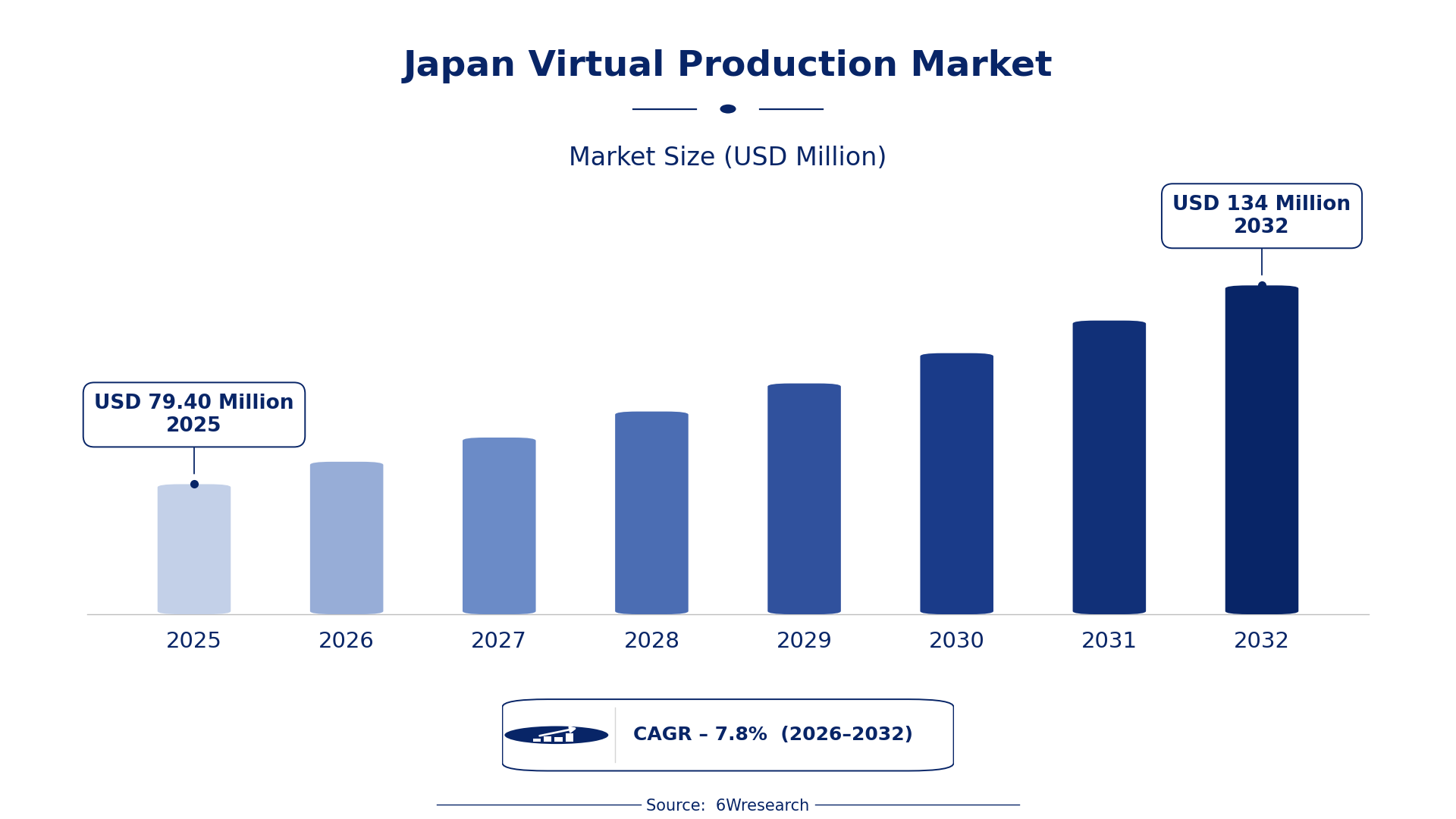
According to 6Wresearch internal database and industry insights, the Japan Virtual Production Market was valued at USD 79.40 Million in 2025 and is projected to reach USD 134 Million by 2032, growing at a CAGR of approximately 7.8% during 2026–2032.
Japan Virtual Production Market Highlights
| Report Metric | Details |
| Report Name | Japan Virtual Production Market (2026-2032) |
| Market Size 2025 | USD 79.40 Million |
| Market Size 2032 | USD 134 Million |
| Absolute Growth 2025–2032 | USD 54.60 Million |
| CAGR 2026–2032 | 7.8% |
| Peak Annual Growth | 10.7% in 2032 |
| Forecast Period | 2026–2032 |
| Historical Data | 2022–2025 |
| Base Year | 2025 |
| Leading Offering, 2025 | Software (48% share) |
| Leading Type, 2025 | Production (48% share) |
| Leading End User, 2025 | Movies (45% share) |
| Fastest-Growing Type | Pre-Production (10.8% CAGR) |
| Fastest-Growing End User | Television Series (10.7% CAGR) |
| Growing Sector | Television Series |
| Key End Users | Film studios, television networks, advertising agencies |
Japan Virtual Production Market Year-wise Growth Rate and Key Drivers (2022–2032)
This graph illustrates the annual growth rates of the market from 2022 to 2032, highlighting a steady upward trajectory and projected market expansion over the forecast period.
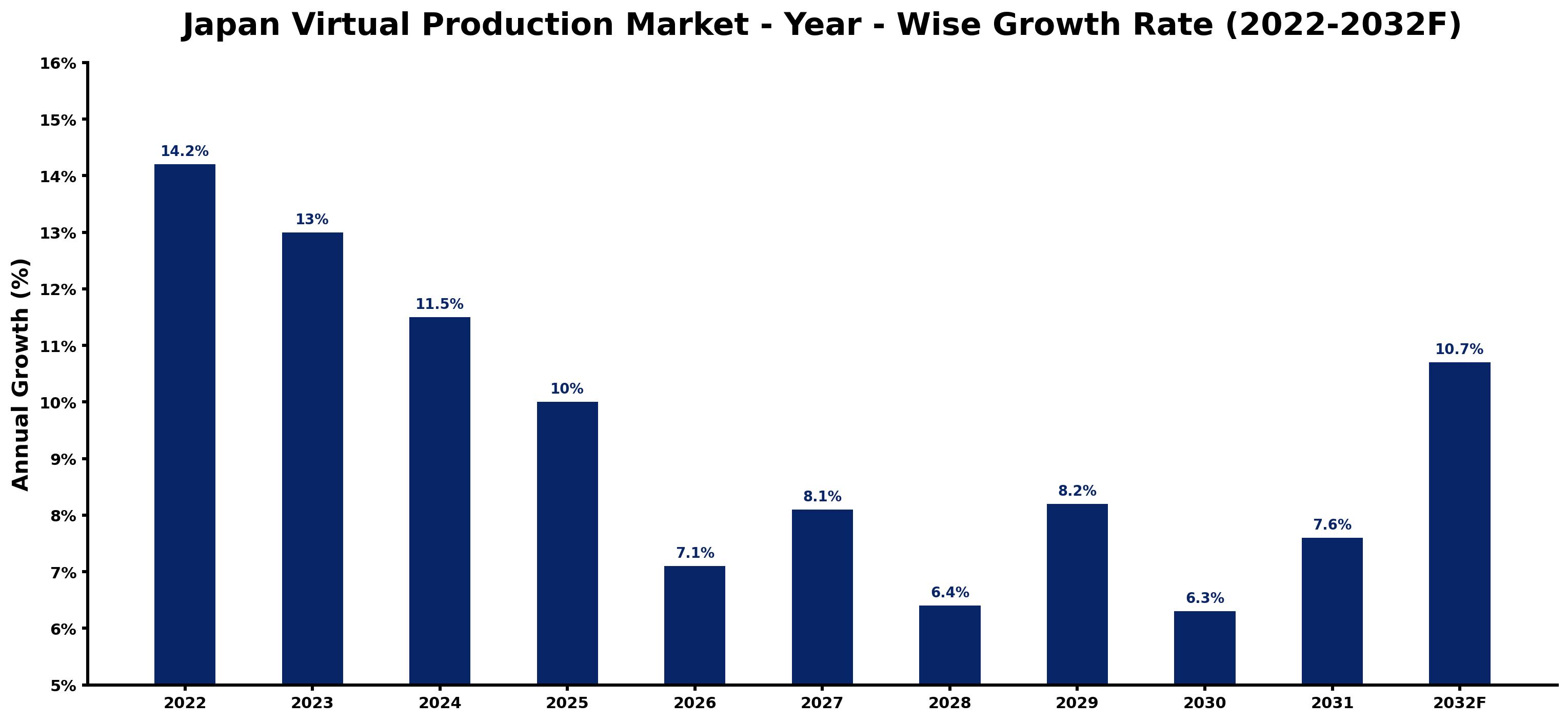
Below, each year's estimated growth is shown next to the factor that most influenced it.
| Year | Estimated Annual Growth (%) | Market Rationale |
| 2022 | 14.2 | The market experienced strong demand from local studios and film production activities. |
| 2023 | 13.0 | Growth slowed as the market adjusted to increased competition and rising production costs. |
| 2024 | 11.5 | The market continued to grow, driven by advancements in technology and enhanced production capabilities. |
| 2025 | 10.0 | Demand remained steady, supported by ongoing investments in virtual production facilities. |
| 2026 | 7.1 | Growth is expected to slow as the market matures and competition intensifies among service providers. |
| 2027 | 8.1 | Demand is projected to increase as new projects emerge, utilising advanced virtual production techniques. |
| 2028 | 6.4 | The market will see a slight slowdown as established players focus on improving operational efficiency. |
| 2029 | 8.2 | Growth is expected to accelerate due to rising interest in virtual production for television series. |
| 2030 | 6.3 | The market will experience a slowdown as projects face budget constraints and planning delays. |
| 2031 | 7.6 | Demand is projected to pick up as new technologies improve production capabilities and efficiency. |
| 2032 | 10.7 | Growth is expected to surge with increased adoption of virtual production across various media sectors. |
Note: Market size estimations and growth projections presented in this report are based on 6Wresearch's proprietary forecasting methodology, utilizing the latest available industry data, government publications, and primary research inputs.
Japan Virtual Production Market Synopsis
Virtual production integrates live-action footage with virtual environments in real-time, using advanced technologies like LED walls and game engines. This technique transforms storytelling in films, television, and advertisements. The Japan Virtual Production Market is growing due to increasing investments from local studios, a dynamic film industry producing over 400 feature films in 2023, and the establishment of the Japan Virtual Production Association to set industry standards. The average budget for virtual production projects is around ¥100 million, reflecting the financial commitment from buyers and the expanding market potential.
Market Dynamics Impact Analysis (2026–2032)
| Factor | Type | Impact | Primary Segment Affected |
| Rising investments in technology and infrastructure | Driver | High | Production |
| Growing audience demand for high-quality content | Driver | High | Television Series |
| Expansion of virtual production studios in Tokyo | Opportunity | High | Services |
| Increased integration of virtual production in educational programs | Opportunity | Medium | Hardware |
| High costs associated with advanced technology adoption | Restraint | High | Software |
| Limited availability of skilled professionals in the industry | Restraint | Medium | Services |
| Budget constraints impacting project feasibility | Challenge | High | Production |
| Compliance with industry standards and regulations | Challenge | Medium | Software |
Evaluation of Drivers in Japan Virtual Production Market (2026–2032)
Key forces behind demand, with the segment each one moves most, are listed below.
| Drivers | Primary Segment Affected | Why It Matters (Evidence) |
| Increasing production of feature films | Production | In 2023, over 400 feature films were produced, driving demand for advanced techniques in filmmaking. |
| Technological advancements in virtual production | Services | The integration of LED walls and game engines improves overall quality, leading to higher project budgets. |
| Growing audience for television content | Television Series | The Japanese television market had an audience of 50 million viewers in 2022, increasing demand for high-quality series. |
| Support from industry associations | Hardware | The Japan Virtual Production Association promotes standards, encouraging investment in virtual production technologies. |
| Rising interest in advertising techniques | Commercial Advertisement | Brands are utilising virtual production to create engaging ads, increasing project budgets significantly. |
Orders keep climbing as the Japanese film industry produced over 400 feature films in 2023, driving demand for advanced techniques in filmmaking. The average budget for a virtual production project is around ¥100 million, prompting studios to invest in cutting-edge technologies. With the Japanese television market boasting an audience of 50 million viewers in 2022, there is a growing need for high-quality content. The establishment of the Japan Virtual Production Association in 2022 has further encouraged investment in industry standards, increasing production capabilities. The integration of LED walls and game engines improves overall quality, attracting more projects.
Evaluation of Restraints in Japan Virtual Production Market
The following restraints limit how fast demand can grow.
| Market Restraint | Primary Segment Affected | Why It Matters (Evidence) |
| High costs associated with advanced technology adoption | Software | The average budget for virtual production projects is around ¥100 million, limiting smaller studios' participation. |
| Limited availability of skilled professionals in the industry | Services | The demand for expertise in virtual production exceeds the current supply, affecting project timelines. |
| Budget constraints impacting project feasibility | Production | Rising production costs lead to project cancellations or delays, affecting overall market growth. |
| Compliance with industry standards and regulations | Software | Adhering to standards like ISO 27001 requires additional investments, straining budgets for smaller studios. |
| Competition from traditional production methods | Television Series | Established practices may deter studios from adopting virtual production, slowing market penetration. |
Japan Virtual Production Market Challenges
Virtual production projects in Japan can cost around ¥100 million, straining budgets for local studios aiming to innovate. Competition among over 50 studios in Tokyo intensifies, leading to price wars that erode profit margins for producers. Supply chain disruptions in sourcing advanced LED technology can delay project timelines, impacting schedules for filmmakers. Technology adoption is slow, as educational programs integrating virtual environments are still developing, creating skill gaps that hinder efficient project execution for buyers and producers alike.
Trends in the Japan Virtual Production Market
The following changes are redrawing the Japan Virtual Production Market.
- Shift from Traditional to Virtual Production: Since 2022, the Japanese film industry has increasingly embraced virtual production techniques, improving storytelling capabilities. This shift is illustrated as Tokyo leads with over 50 virtual production studios, highlighting a growing trend in the sector.
- Emergence of Educational Programs in Virtual Production: In 2023, virtual production technology began to integrate into educational programs at Japanese universities, creating a new generation of skilled professionals. This initiative aims to address the skills gap in the industry, supporting future growth.
- Increased Focus on Data Security Standards: With the introduction of ISO 27001, studios are prioritising data security in virtual production. This standard, relevant since 2022, ensures that studios protect sensitive information, building trust among clients and partners.
- Growing Demand for High-Quality Television Series: In 2023, the Japanese television market saw a notable rise in demand for high-quality series, with an audience of 50 million viewers. This trend encourages studios to invest in virtual production to meet viewer expectations.
Investment Opportunities in the Japan Virtual Production Market
Where to invest in the Japan Virtual Production Market: the main openings are set out below.
- Gap in Skilled Professionals: With a projected shortage of skilled professionals, there is an opportunity to invest in training programs. Educational institutions in Tokyo can partner with studios to develop tailored courses, addressing the skills gap.
- Investment in Virtual Production Equipment: The rising demand for high-quality content presents an opportunity to supply advanced virtual production equipment. Studios in Tokyo are seeking partnerships to improve their capabilities, creating a market for suppliers.
- Expansion of Virtual Production Studios: The average budget for virtual production projects is around ¥100 million, indicating a need for more studios. Investing in new facilities in Tokyo can help meet the growing demand for virtual production.
- Development of Virtual Production Services: As the market grows, there is an opportunity to provide specialised services in virtual production. Collaborating with local studios in Tokyo can facilitate entry into this expanding market.
Government Initiatives in the Japan Virtual Production Market
The AI Promotion Act, established in 2025, adds a national framework for AI research and development, updating the existing Industrial Standardization Act. This law ensures that virtual production technologies meet industry standards and promotes innovation in the sector.
The Digital Agency supports digital content creation through the AI Promotion Act, which has an annual budget of ¥5 billion. This funding aids local studios in adopting virtual production technologies, ensuring they remain competitive in the market.
Future Insight of the Japan Virtual Production Market
Local studios will increasingly adopt virtual production techniques by 2032, driven by advancements in LED wall technology and real-time rendering. The Ministry of Economy, Trade and Industry's support program will allocate ¥5 billion annually to strengthen the digital content sector. Educational institutions will enhance curricula to prepare students for careers in this field, ensuring a skilled workforce. As industry standards evolve, the Japan Virtual Production Association will promote best practices, creating opportunities for both buyers and suppliers.
Market Segmentation Analysis
Japan Virtual Production Market report covers a detailed analysis of the following market segments:
By Offering – Software Leads and Records the Fastest Growth
According to Vasudha, AM at 6Wresearch, Software held 48% of the Japan Virtual Production Market by offering in 2025. Software leads the market as it is essential for real-time rendering and the integration of visual effects, which are critical for successful virtual production. The presence of over 50 virtual production studios in Japan indicates a strong demand for sophisticated software solutions. The same category is also set to grow fastest, at a CAGR of 9.0% during 2026–2032. The software segment is set for rapid growth due to the increasing need for advanced real-time rendering capabilities, particularly with the rise of cutting-edge technologies in projects. The establishment of the Japan Virtual Production Association in 2022 underscores the industry's commitment to enhancing software solutions. Suppliers should focus on developing advanced software features to meet the rising demands of virtual production studios.
By Type – Production Leads, Pre-Production Expected to Grow Fastest
Production accounted for 48% of the market by type in 2025. Production is the leading phase as it is where virtual production techniques are primarily implemented, directly influencing the final output of films and series. This phase is crucial for filmmakers aiming to effectively utilise virtual environments in their storytelling. The quickest growth will come from Pre-Production, forecast to expand at a CAGR of 10.8% between 2026 and 2032. Pre-production is experiencing the fastest growth as filmmakers increasingly acknowledge the value of planning and designing scenes with virtual production techniques. This trend is evident as more studios adopt these methods to optimise their creative processes. Suppliers should consider providing tailored solutions for pre-production to capitalise on its growing significance in the virtual production workflow.
By End User – Movies Lead, Television Series Expected to Grow Fastest
Movies took 45% of end user revenue in 2025, more than any other category. Movies dominate the market as they extensively utilise virtual production to enhance storytelling and visual appeal, reflecting the robust Japanese film industry. With over 400 feature films produced in 2023, the demand for advanced filmmaking techniques remains high. Over 2026–2032, Television Series are expected to post the fastest growth, at a CAGR of 10.7%. Television series are rapidly adopting virtual production due to the increasing demand for high-quality content among viewers. This trend is reinforced by the substantial audience of 50 million in the Japanese television market in 2022. Suppliers must adapt their offerings to support the growing adoption of virtual production in television series, ensuring they meet the needs of content creators.
Key Attractiveness of the Report
- 10 Years of Market Numbers
- Historical Data Starting from 2022 to 2025
- Base Year 2025
- Forecast Data until 2032
- Key Performance Indicators Impacting the Market
- Major Upcoming Developments and Projects
Key Highlights of the Report:
- Japan Virtual Production Market Outlook
- Market Size of Japan Virtual Production Market, 2025
- Forecast of Japan Virtual Production Market, 2032
- Historical Data and Forecast of Japan Virtual Production Revenues & Volume for the Period 2022-2032
- Japan Virtual Production Market Trend Evolution
- Japan Virtual Production Market Drivers and Challenges
- Japan Virtual Production Price Trends
- Japan Virtual Production Porter's Five Forces
- Japan Virtual Production Industry Life Cycle
- Historical Data and Forecast of Japan Virtual Production Market Revenues & Volume By Offering for the Period 2022-2032
- Historical Data and Forecast of Japan Virtual Production Market Revenues & Volume By Hardware for the Period 2022-2032
- Historical Data and Forecast of Japan Virtual Production Market Revenues & Volume By Software for the Period 2022-2032
- Historical Data and Forecast of Japan Virtual Production Market Revenues & Volume By Services for the Period 2022-2032
- Historical Data and Forecast of Japan Virtual Production Market Revenues & Volume By Type for the Period 2022-2032
- Historical Data and Forecast of Japan Virtual Production Market Revenues & Volume By Pre-Production for the Period 2022-2032
- Historical Data and Forecast of Japan Virtual Production Market Revenues & Volume By Production for the Period 2022-2032
- Historical Data and Forecast of Japan Virtual Production Market Revenues & Volume By Post-Production for the Period 2022-2032
- Historical Data and Forecast of Japan Virtual Production Market Revenues & Volume By End User for the Period 2022-2032
- Historical Data and Forecast of Japan Virtual Production Market Revenues & Volume By Movies for the Period 2022-2032
- Historical Data and Forecast of Japan Virtual Production Market Revenues & Volume By Television Series for the Period 2022-2032
- Historical Data and Forecast of Japan Virtual Production Market Revenues & Volume By Commercial Advertisement for the Period 2022-2032
- Historical Data and Forecast of Japan Virtual Production Market Revenues & Volume By Online Videos for the Period 2022-2032
- Japan Virtual Production Import Export Trade Statistics
- Market Opportunity Assessment By Offering
- Market Opportunity Assessment By Type
- Market Opportunity Assessment By End User
- Japan Virtual Production Top Companies Market Share
- Japan Virtual Production Competitive Benchmarking By Technical and Operational Parameters
- Japan Virtual Production Company Profiles
- Japan Virtual Production Key Strategic Recommendations
Market Covered
Coverage by segment is as follows.
By Offering
- Hardware
- Software
- Services
By Type
- Pre-Production
- Production
- Post-Production
By End User
- Movies
- Television Series
- Commercial Advertisement
- Online Videos































