Jordan Ascorbic Acid Market Size, Share & Growth Rate
The Jordan Ascorbic Acid Market was estimated at USD 225 Million in 2025 and is projected to reach USD 300 Million by 2032, growing at a CAGR of 4.2% from 2026 to 2032. This growth trajectory is primarily fueled by rising health consciousness among consumers, who increasingly recognize the importance of Vitamin C in maintaining immune health and preventing chronic diseases. The expanding applications of ascorbic acid in food and beverage sectors, as well as in cosmetics, are further propelling market dynamics.
Jordan Ascorbic Acid Market Year-wise Growth Rate and Key Drivers
This graph highlights how the Jordan Ascorbic Acid Market has steadily grown over the years, supported by major growth factors.
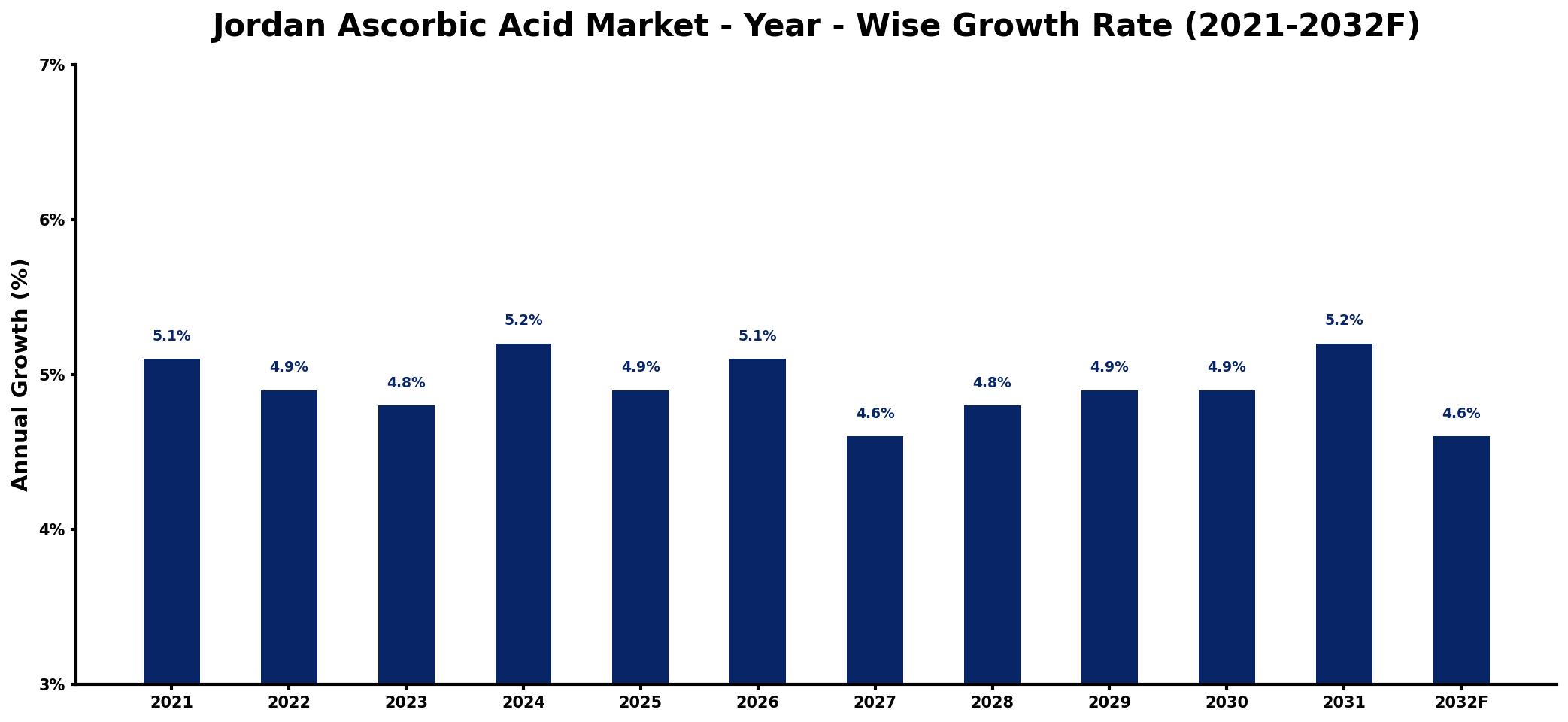
The table below presents the year‑wise growth rates along with the key drivers influencing the market
| Year | Growth Rate | Major Drivers |
| 2021 | 5.1% | Rising health awareness among consumers |
| 2022 | 4.9% | Increased demand for dietary supplements |
| 2023 | 4.8% | Growth in functional food market |
| 2024 | 5.2% | Expansion of pharmaceutical applications |
| 2025 | 4.9% | Surge in cosmetic industry usage |
| 2026 | 5.1% | Investments in food preservation technologies |
| 2027 | 4.6% | Shift towards natural ingredients preference |
| 2028 | 4.8% | Emerging markets adopting wellness trends |
| 2029 | 4.9% | rising export shipment volumes |
| 2030 | 4.9% | Rising popularity of preventive healthcare |
| 2031 | 5.2% | Increased research in nutritional benefits |
| 2032 | 4.6% | enhanced product quality standards |
Note: Market size estimations and growth projections presented in this report are based on 6Wresearch's proprietary forecasting methodology, utilizing the latest available industry data, government publications, and primary research inputs.
Jordan Ascorbic Acid Market Synopsis
In recent years, the Jordan Ascorbic Acid market has seen an uptick driven by heightened consumer awareness regarding health benefits. As consumers prioritize wellness, the demand for Vitamin C-rich products continues to surge. Looking ahead, this momentum is expected to amplify, particularly as the market evolves to incorporate innovative ascorbic acid formulations across diverse applications.
Despite the current growth, the market faces several headwinds such as regulatory challenges and fluctuating raw material costs. However, the increasing investment in R&D for ascorbic acid applications and the rising trend towards natural and organic products are positioning the market for sustained expansion. Overall, the Jordan Ascorbic Acid market appears ready to embrace opportunities for innovation and growth.
Jordan Ascorbic Acid Market Key Takeaways
- The market is driven by increasing health consciousness and demand for Vitamin C products.
- Innovations in product formulations are emerging as a key focus for market players.
- Natural and organic sources of ascorbic acid are gaining popularity among consumers.
- Regulatory frameworks are evolving, impacting product development and market entry strategies.
- Strategic collaborations are becoming essential for capturing market share in this fragmented landscape.
Evaluation of Restraints in Jordan Ascorbic Acid Market
The Jordan Ascorbic Acid market grapples with several constraints that could impede its growth potential. Fluctuating raw material prices can create uncertainty for manufacturers, affecting pricing strategies and profitability. Additionally, the stringent regulations enforced by authorities to ensure product safety and efficacy pose challenges for compliance, particularly for smaller players. The market is also characterized by intense competition, which can lead to price wars and increased pressure on margins. To navigate these hurdles, companies must prioritize quality control and strategic positioning to maintain their competitive edge.
Jordan Ascorbic Acid Market Trends
A notable trend in the Jordan Ascorbic Acid market is the growing consumer preference for products that deliver wellness benefits beyond basic nutrition. Increasingly, individuals are opting for supplements and food products fortified with ascorbic acid, looking for immune support and antioxidant properties. Additionally, the beauty and skincare industries are witnessing a rise in ascorbic acid incorporation due to its noted anti-aging and skin-brightening effects. This shift towards multifunctional products is reshaping how manufacturers approach product development and marketing strategies.
Jordan Ascorbic Acid Market Opportunities
Investment opportunities in the Jordan Ascorbic Acid market are ripe, particularly given the burgeoning demand for dietary supplements and fortified food products. As health-focused lifestyles become more prevalent, businesses have the chance to innovate and create diverse offerings that cater to this demographic. Additionally, collaboration with local distributors can facilitate market entry and product distribution, enhancing visibility. Furthermore, there is potential for exporting high-quality ascorbic acid products to meet demand in neighboring markets.
Government Initiatives in the Jordan Ascorbic Acid Market
The Jordanian government is actively supporting the growth of the ascorbic acid market through various initiatives aimed at promoting local production and innovation. Regulatory frameworks established by the Jordan Food and Drug Administration (JFDA) ensure quality control and product safety, thereby fostering consumer confidence. Additionally, subsidies and grants for research and development are encouraging manufacturers to innovate, while export promotion programs help local businesses reach international markets. These initiatives collectively create an environment conducive to market growth and sustainability.
Future Insights of the Jordan Ascorbic Acid Market
Looking towards the future, the Jordan Ascorbic Acid market is anticipated to continue its growth trajectory as awareness of Vitamin C benefits further permeates consumer consciousness. With increasing disposable incomes and shifting lifestyle habits, more individuals will likely invest in health-promoting products. Moreover, advancements in technology and product formulations will enable manufacturers to create more effective and appealing offerings, thereby expanding market reach. The future appears bright for the Jordan Ascorbic Acid market, as evolving consumer preferences fuel demand across various sectors.
Jordan Ascorbic Acid Market Latest Developments (2025 - 2026)
Recent developments in the Jordan Ascorbic Acid market highlight a focus on innovation and sustainability. Companies are increasingly investing in research to develop natural and organic ascorbic acid sources, aligning with growing consumer preferences for clean-label products. Additionally, market participants are exploring collaborations with health and wellness influencers to enhance product visibility and consumer engagement. Overall, the emphasis is on adapting to evolving market dynamics to meet the health-focused demands of consumers.
Jordan Ascorbic Acid Market - Key Attractiveness of the Report
- 10 Years of Market Numbers
- Historical Data Starting from 2022 to 2025
- Base Year: 2025
- Forecast Data until 2032
- Key Performance Indicators Impacting the Market
- Major Upcoming Developments and Projects
Key Highlights of the Report:
- Jordan Ascorbic Acid Market Outlook
- Market Size of Jordan Ascorbic Acid Market, 2025
- Forecast of Jordan Ascorbic Acid Market, 2032
- Historical Data and Forecast of Jordan Ascorbic Acid Revenues & Volume for the Period 2022-2032F
- Jordan Ascorbic Acid Market Trend Evolution
- Jordan Ascorbic Acid Market Drivers and Challenges
- Jordan Ascorbic Acid Price Trends
- Jordan Ascorbic Acid Porter's Five Forces
- Jordan Ascorbic Acid Industry Life Cycle
- Historical Data and Forecast of Jordan Ascorbic Acid Market Revenues & Volume By Grade for the Period 2022-2032F
- Historical Data and Forecast of Jordan Ascorbic Acid Market Revenues & Volume By Food & Pharmaceutical for the Period 2022-2032F
- Historical Data and Forecast of Jordan Ascorbic Acid Market Revenues & Volume By Industrial for the Period 2022-2032F
- Historical Data and Forecast of Jordan Ascorbic Acid Market Revenues & Volume By Application for the Period 2022-2032F
- Historical Data and Forecast of Jordan Ascorbic Acid Market Revenues & Volume By Food & Beverages for the Period 2022-2032F
- Historical Data and Forecast of Jordan Ascorbic Acid Market Revenues & Volume By Pharmaceutical for the Period 2022-2032F
- Historical Data and Forecast of Jordan Ascorbic Acid Market Revenues & Volume By Cosmetics for the Period 2022-2032F
- Historical Data and Forecast of Jordan Ascorbic Acid Market Revenues & Volume By Chemicals for the Period 2022-2032F
- Historical Data and Forecast of Jordan Ascorbic Acid Market Revenues & Volume By Agriculture for the Period 2022-2032F
- Historical Data and Forecast of Jordan Ascorbic Acid Market Revenues & Volume By Others for the Period 2022-2032F
- Jordan Ascorbic Acid Import Export Trade Statistics
- Market Opportunity Assessment By Grade
- Market Opportunity Assessment By Application
- Jordan Ascorbic Acid Top Companies Market Share
- Jordan Ascorbic Acid Competitive Benchmarking By Technical and Operational Parameters
- Jordan Ascorbic Acid Company Profiles
- Jordan Ascorbic Acid Key Strategic Recommendations






































