Jordan Cyber Security Market Size, Share & Growth Rate
The Jordan Cyber Security Market was estimated at USD 426 Million in 2025 and is projected to reach USD 593 Million by 2032, growing at a CAGR of 4.8% from 2026 to 2032. This growth trajectory is primarily driven by the rapid digital transformation occurring within Jordan, as businesses increasingly migrate to online platforms. Alongside this transition, the alarming rise in cyber threats, including sophisticated malware and phishing attacks, is compelling organizations to invest heavily in robust cybersecurity measures.
Jordan Cyber Security Market Year-wise Growth Rate and Key Drivers
This graph highlights how the Jordan Cyber Security Market has steadily grown over the years, supported by major growth factors.
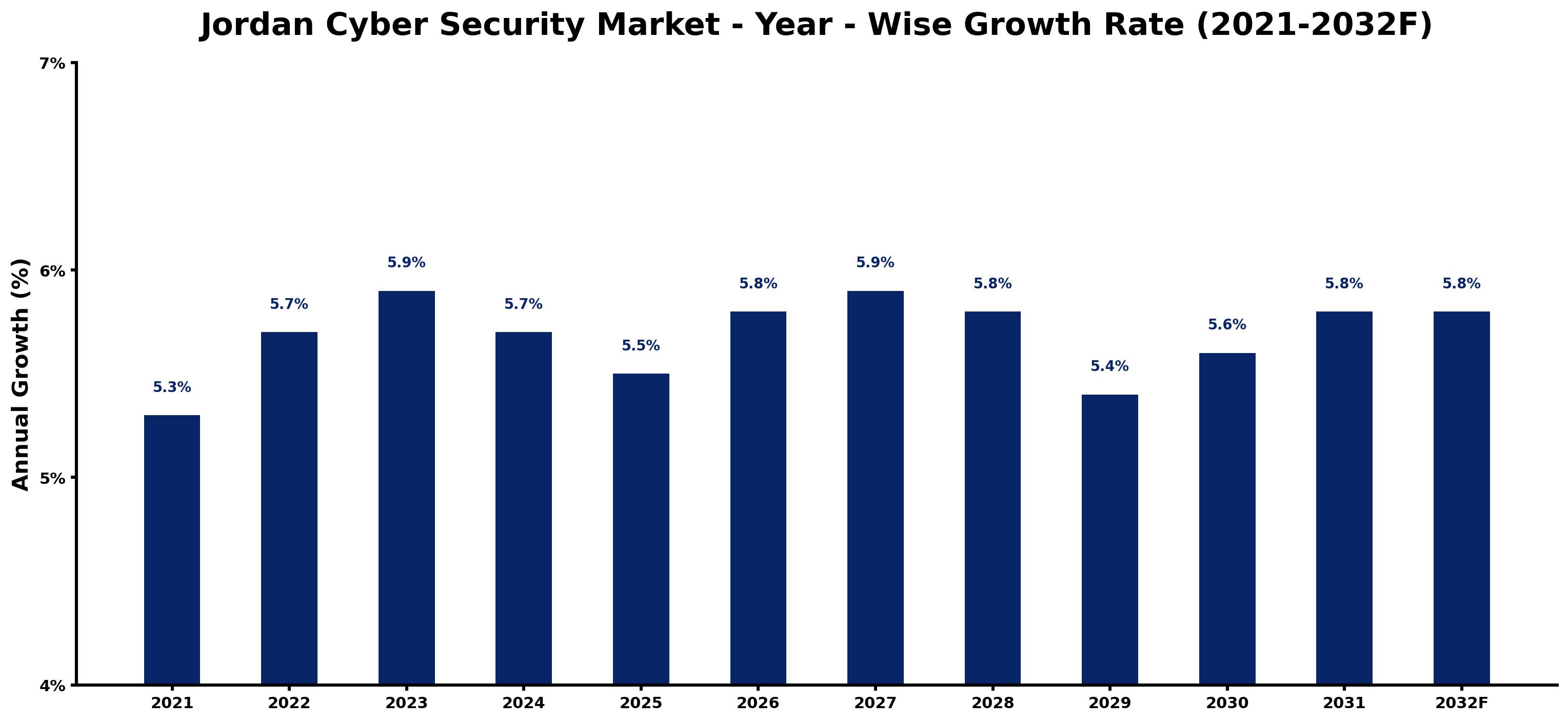
The table below presents the year‑wise growth rates along with the key drivers influencing the market
| Year | Growth Rate | Major Drivers |
| 2021 | 5.3% | Increasing industrial infrastructure investments |
| 2022 | 5.7% | Rapid growth in telecom and data center sectors |
| 2023 | 5.9% | Growing renewable energy integration projects |
| 2024 | 5.7% | Government infrastructure modernization initiatives |
| 2025 | 5.5% | Rapid growth in telecom and data center sectors |
| 2026 | 5.8% | Increasing adoption of advanced technologies |
| 2027 | 5.9% | Increasing industrial automation investments |
| 2028 | 5.8% | Increasing industrial automation investments |
| 2029 | 5.4% | Growing urbanization and commercial development |
| 2030 | 5.6% | Expansion of manufacturing activities |
| 2031 | 5.8% | Government infrastructure modernization initiatives |
| 2032 | 5.8% | Government infrastructure modernization initiatives |
Note - Market size estimations and growth projections presented in this report are based on 6Wresearch’s advanced forecasting approach, validated with industry datasets as of June 2026.
Jordan Cyber Security Market Synopsis
The Jordan Cyber Security Market is poised for substantial expansion as local enterprises prioritize the safeguarding of their digital assets. The increasing reliance on digital channels for business operations has created a pressing need for effective cybersecurity solutions that can protect sensitive data against evolving threats.
Recent developments underscore the urgency of cybersecurity in Jordan. Companies across various sectors are experiencing heightened risks, leading to a surge in the adoption of advanced security technologies aimed at thwarting cyberattacks. This trend reflects an overarching recognition of cybersecurity as a critical component of business strategy.
Jordan Cyber Security Market Key Takeaways
- Digital transformation is catalyzing investment in cybersecurity across Jordanian businesses.
- The market is responding to an uptick in cyber threats, prompting heightened demand for security solutions.
- Artificial intelligence is increasingly integrated into cybersecurity measures, enhancing threat detection and response capabilities.
- The Jordanian government is taking initiatives to bolster cybersecurity frameworks, promoting industry-wide standards.
- Continued internet penetration is driving the need for comprehensive cybersecurity strategies across various sectors.
Evaluation of Restraints in Jordan Cyber Security Market
Despite the promising growth outlook, several factors could restrain the Jordan Cyber Security Market. A significant barrier is the limited awareness and understanding of cybersecurity solutions among some local businesses. Many smaller enterprises may still view cybersecurity as an optional expense rather than a critical investment. Additionally, budget constraints and a shortage of skilled cybersecurity professionals can impede the implementation of robust security measures, ultimately limiting the overall effectiveness of existing solutions.
Jordan Cyber Security Market Trends
Key trends are shaping the landscape of the Jordan Cyber Security Market. The integration of artificial intelligence into cybersecurity solutions is at the forefront, facilitating proactive threat detection and automated responses. Furthermore, as businesses embrace cloud computing, the demand for cloud-based security solutions is expected to surge. There is also a growing emphasis on data privacy, pushing organizations to adopt comprehensive cybersecurity strategies that comply with international standards.
Jordan Cyber Security Market Opportunities
The Jordan Cyber Security Market presents a plethora of opportunities for growth and investment. As digital transformation accelerates, businesses across various sectors will require tailored cybersecurity solutions that address their unique challenges. The rise of mobile and remote work arrangements is another area ripe for innovation in security technologies. By developing specialized services and solutions, market players can cater to this evolving demand, thereby positioning themselves for sustained growth.
Government Initiatives in the Jordan Cyber Security Market
The Jordanian government is actively fostering an environment conducive to cybersecurity enhancement. Initiatives aimed at developing national cybersecurity frameworks are underway, with an emphasis on public-private partnerships to strengthen security protocols across industries. Furthermore, government-led training programs are being launched to equip the workforce with essential cybersecurity skills, addressing the current talent gap and promoting a culture of security awareness throughout organizations.
Future Insights of the Jordan Cyber Security Market
Looking ahead to 2026-2032, the Jordan Cyber Security Market is expected to witness robust growth driven by continued digital advancements and increasing cyber threats. As businesses recognize the integral role cybersecurity plays in sustaining their operations and reputation, investment in security infrastructure will likely escalate. Moreover, innovations in technology, particularly those harnessing artificial intelligence and machine learning, will redefine security protocols, enabling more adaptive and resilient defenses against emerging threats.
Jordan Cyber Security Market Latest Developments (May 2025 - June 2026)
Recent months have seen significant momentum in the Jordan Cyber Security Market, with various sectors pushing forward initiatives to enhance their digital defenses. Organizations are increasingly focusing on building comprehensive cybersecurity strategies that encompass the latest technologies and best practices. Collaboration between private and public sectors has intensified, aiming to bolster the national cybersecurity framework and improve incident response capabilities across industries.
Jordan Cyber Security Market - Key Attractiveness of the Report
- 10 Years of Market Numbers
- Historical Data Starting from 2022 to 2025
- Base Year: 2025
- Forecast Data until 2032
- Key Performance Indicators Impacting the Market
- Major Upcoming Developments and Projects
Key Highlights of the Report:
- Jordan Cyber security Market Overview
- Jordan Cyber security Market Outlook
- Jordan Cyber security Market Forecast
- Historical Data of Jordan Cyber security Market Revenues for the Period 2022-2032F
- Jordan Cyber security Market Size and Jordan Cyber security Market Forecast of Revenues, Until 2032F
- Historical Data of Jordan Cyber security Market Revenues, by Product, for the Period 2022-2032F
- Market Size & Forecast of Jordan Cyber security Market Revenues, by Product, Until 2032F
- Historical Data of Jordan Cyber security Market Revenues, by Deployment Mode, for the Period 2022-2032F
- Market Size & Forecast of Jordan Cyber security Market Revenues, by Deployment Mode, Until 2032F
- Historical Data of Jordan Cyber security Market Revenues, by Regions, for the Period 2022-2032F
- Market Size & Forecast of Jordan Cyber security Market Revenues, by Regions, Until 2032F
- Market Drivers and Restraints
- Jordan Cyber security Market Trends and Industry Life Cycle
- Porter’s Five Force Analysis
- Market Opportunity Assessment
- Jordan Cyber security Market Share, By Players
- Jordan Cyber security Market Share, By Regions
- Jordan Cyber security Market Overview on Competitive Benchmarking
Markets Covered
The Jordan Cyber security Market report provides a detailed analysis of the following market segments:
- By Product type:
- Solutions
- Identity & Access Management
- Threat Detection & Prevention
- DDoS & Mitigation
- IDS
- Security Information & Event Management
- Others
- Services
- Solutions
- By End-user industry:
- Manufacturing
- Retail
- IT & Telecom
- Aerospace & Defense
- Healthcare
- Utility
- Others
- By Deployment Mode:
- On-premises
- Cloud






































