Jordan Household furniture Market Summary
The jordan household furniture market was estimated at USD 145 Million in 2025 and is projected to reach USD 158 Million by 2032, growing at a CAGR of 1.0% from 2026 to 2032.
Jordan Household furniture Market Year-wise Growth Rate and Key Drivers
This graph highlights how the Jordan Household furniture Market has steadily grown over the past five years, supported by major growth factors.
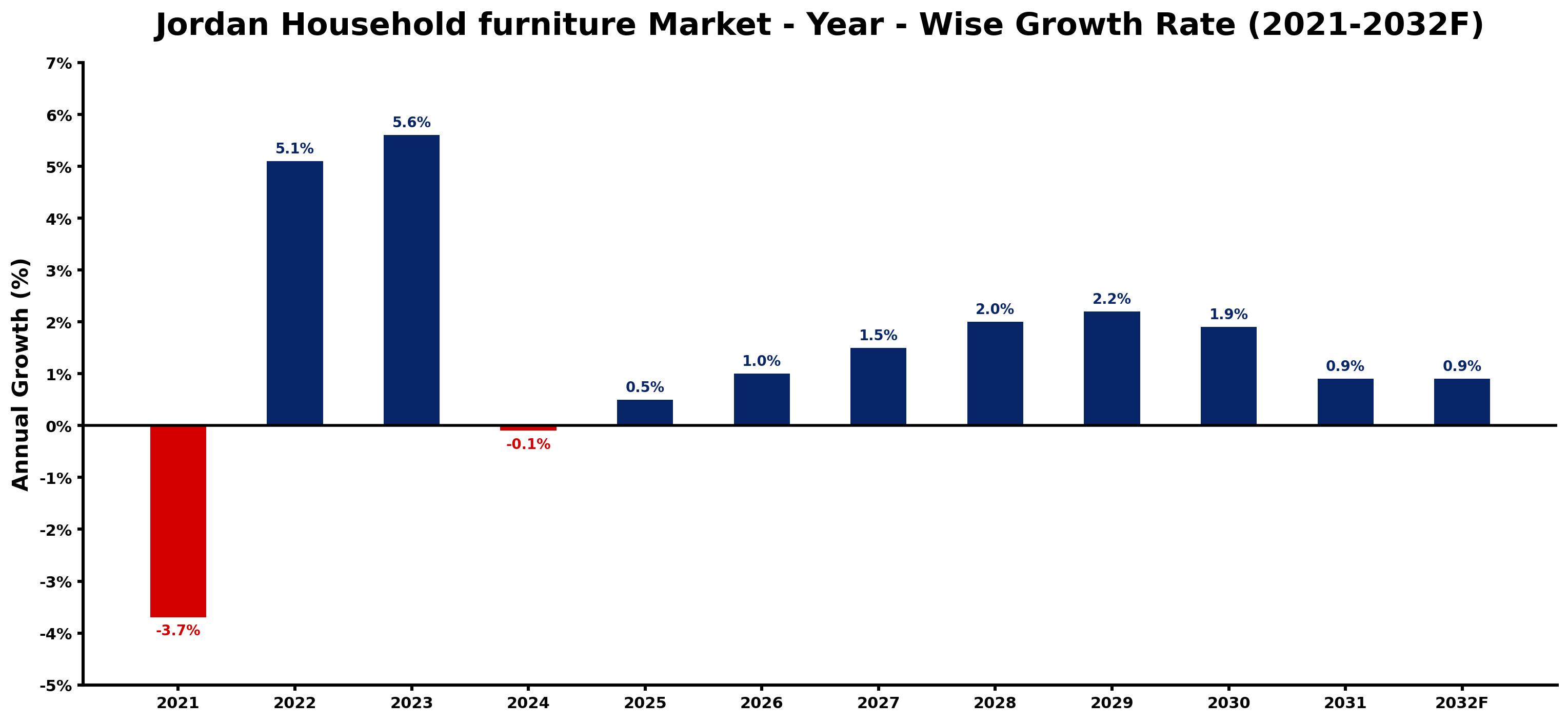
The table below presents the year wise growth rates along with the key drivers influencing the market
| Year | Growth Rate | Major Drivers |
| 2021 | -3.7% | Increased import tariffs on raw materials significantly escalated costs, leading to reduced consumer purchasing power in the furniture sector. |
| 2022 | 5.1% | E-commerce platforms expanded, offering diverse furniture ranges to tech-savvy consumers. |
| 2023 | 5.6% | Local artisans gained recognition, blending traditional crafts with modern design aesthetics. |
| 2024 | -0.1% | Increased competition from affordable imported furniture diminished local market share and consumer interest. |
| 2025 | 0.5% | Rising urbanization rates increased demand for compact, multifunctional furniture solutions. |
| 2026 | 1.0% | Interest in home renovations surged as people prioritized comfort in living spaces. |
| 2027 | 1.5% | Robust real estate developments created opportunities for bulk furniture contracts with developers. |
| 2028 | 2.0% | Collaborations with interior designers became crucial for brands targeting upscale consumers. |
| 2029 | 2.2% | Technological integration in furniture designs attracted younger demographics seeking innovation. |
| 2030 | 1.9% | Post-pandemic lifestyles emphasized leisure furniture, balancing work-from-home and relaxation needs. |
| 2031 | 0.9% | Regional economic growth fueled disposable income, amplifying luxury furniture purchases. |
| 2032 | 0.9% | Cultural exchanges fostered diverse design influences, enriching the local furniture market offerings. |
Note - Market size estimations and growth projections presented in this report are based on 6Wresearch's advanced forecasting approach, validated with industry datasets as of June 2026.
Jordan Household furniture Market Synopsis
The Jordan Household furniture Market is projected to reach 1.0% and witness significant growth during the forecast period (2026-2032). This market is defined by a distinct shift towards modern and functional furniture solutions that align with the evolving lifestyles of consumers in Jordan. As disposable incomes rise and urbanization accelerates, there is a palpable demand for high-quality, aesthetically pleasing furniture that seamlessly fits into contemporary living spaces. Both local manufacturers and international brands are actively participating in this competitive landscape, with a notable increase in interest towards minimalist and Scandinavian styles that prioritize simplicity and effectiveness.
Jordan Household furniture Market Trends and Opportunities
The Jordan Household furniture Market is currently witnessing several compelling trends. A significant movement towards sustainability is observed, as consumers increasingly prefer eco-friendly furniture options made from recycled materials and produced through environmentally responsible methods. This increasing awareness of sustainability encourages consumers to make more conscientious purchasing decisions, ultimately shaping their preferences.
Moreover, the growing trend of multifunctional furniture designs has gained traction, particularly in urban areas where living spaces are compact. Consumers are actively seeking versatile furniture that maximizes utility without sacrificing aesthetics. The combination of these trends indicates a market poised for innovation, with opportunities for brands that can offer modern, stylish, and multifunctional solutions.
Jordan Household furniture Market Challenges and Restraints
Despite the promising growth trajectory of the Jordan Household furniture Market, several challenges persist. Intense competition from both local and international brands heightens the need for companies to differentiate their offerings continually. Consumer preferences are also increasingly dynamic, necessitating agile strategies that can adapt to evolving trends.
Additionally, economic uncertainties impact consumer spending patterns, forcing furniture companies to remain vigilant about market conditions. Challenges related to raw material sourcing and supply chain management pose additional hurdles, as do regulatory policies concerning import restrictions and taxation, which can greatly affect pricing strategies and profitability.
Jordan Household furniture Market Investment Opportunities
Opportunities for investment in the Jordan Household furniture Market are robust, largely due to the evolving preferences of an affluent and design-conscious consumer base. Companies can explore the high-end segment by offering customizable furniture solutions that reflect individual tastes and preferences. The burgeoning online retail sector also presents potential growth avenues, as more consumers gravitate towards e-commerce for their furniture purchases.
Investment in sustainable products has the potential to resonate well with environmentally aware consumers. Collaborating with local artisans to create unique, handcrafted pieces can provide differentiation in a crowded market. Overall, ventures focusing on innovation in design, sustainability, and e-commerce capabilities are likely to yield significant returns as the market continues to expand.
Jordan Household furniture Market Government Investment and Initiatives
Government policy plays a crucial role in shaping the Jordan Household furniture Market. Regulations outlining quality standards for furniture products ensure safety and durability, addressing consumer concerns and fostering trust. Import tariffs are strategically implemented to protect local manufacturers, encouraging domestic production and fortifying the market against foreign competition.
In addition, the Jordanian government is focused on promoting environmentally sustainable practices within the furniture industry. Initiatives supporting eco-friendly production and the use of sustainable materials signal a commitment to both consumer safety and environmental stewardship. These policies are pivotal in encouraging responsible manufacturing, which is essential for market growth and consumer satisfaction.
Jordan Household furniture Market Latest Developments (May 2025 - June 2026)
During the period from May 2025 to June 2026, the Jordan Household furniture Market has displayed notable developments driven by both consumer trends and technological advancements. There has been a marked increase in the adoption of online sales channels, with many retailers enhancing their digital platforms to improve customer engagement and streamline purchasing experiences. This shift has been particularly important in light of evolving consumer behaviors towards convenience and accessibility.
The interest in sustainable furniture options has grown, prompting businesses to integrate eco-friendly practices into their operations. Trade shows and industry presentations have increasingly highlighted sustainability as a key focus area, reflecting the market's response to consumer demands for environmentally responsible products. Additionally, advancements in smart furniture technology have begun to emerge, allowing for greater integration of technology into household furniture solutions.
Jordan Household furniture Market - Key Attractiveness of the Report
- 10 Years of Market Numbers
- Historical Data Starting from 2022 to 2025
- Base Year: 2025
- Forecast Data until 2032
- Key Performance Indicators Impacting the Market
- Major Upcoming Developments and Projects
Key Highlights of the Report:
- Jordan Household furniture Market Outlook
- Market Size of Jordan Household furniture Market, 2025
- Forecast of Jordan Household furniture Market, 2032F
- Historical Data and Forecast of Jordan Household furniture Revenues & Volume for the Period 2022-2032F
- Jordan Household furniture Market Trend Evolution
- Jordan Household furniture Market Drivers and Challenges
- Jordan Household furniture Price Trends
- Jordan Household furniture Porter's Five Forces
- Jordan Household furniture Industry Life Cycle
- Historical Data and Forecast of Jordan Household furniture Market Revenues & Volume By Types for the Period 2022-2032F
- Historical Data and Forecast of Jordan Household furniture Market Revenues & Volume By Wood Furniture for the Period 2022-2032F
- Historical Data and Forecast of Jordan Household furniture Market Revenues & Volume By Metal Furniture for the Period 2022-2032F
- Historical Data and Forecast of Jordan Household furniture Market Revenues & Volume By Plastic Furniture for the Period 2022-2032F
- Historical Data and Forecast of Jordan Household furniture Market Revenues & Volume By Others for the Period 2022-2032F
- Historical Data and Forecast of Jordan Household furniture Market Revenues & Volume By Area of Use for the Period 2022-2032F
- Historical Data and Forecast of Jordan Household furniture Market Revenues & Volume By ?Bedroom Furniture for the Period 2022-2032F
- Historical Data and Forecast of Jordan Household furniture Market Revenues & Volume By Living Room Furniture for the Period 2022-2032F
- Historical Data and Forecast of Jordan Household furniture Market Revenues & Volume By Dining Room Furniture for the Period 2022-2032F
- Historical Data and Forecast of Jordan Household furniture Market Revenues & Volume By Household Furniture for the Period 2022-2032F
- Historical Data and Forecast of Jordan Household furniture Market Revenues & Volume By Others for the Period 2022-2032F
- Jordan Household furniture Import Export Trade Statistics
- Market Opportunity Assessment By Types
- Market Opportunity Assessment By Area of Use
- Jordan Household furniture Top Companies Market Share
- Jordan Household furniture Competitive Benchmarking By Technical and Operational Parameters
- Jordan Household furniture Company Profiles
- Jordan Household furniture Key Strategic Recommendations






































