Jordan Natural Fragrance Market Size, Share & Growth Rate
The Jordan Natural Fragrance Market was estimated at USD 413 Million in 2025 and is projected to reach USD 548 Million by 2032, growing at a CAGR of 4.1% from 2026 to 2032. This upward trajectory reflects a broader trend among Jordanian consumers favoring products derived from natural ingredients. As health and environmental consciousness rise, demand for organic and clean beauty products, particularly natural fragrances, is surging across various sectors, including personal care and household applications.
Jordan Natural Fragrance Market Year-wise Growth Rate and Key Drivers
This graph highlights how the Jordan Natural Fragrance Market has steadily grown over the years, supported by major growth factors.
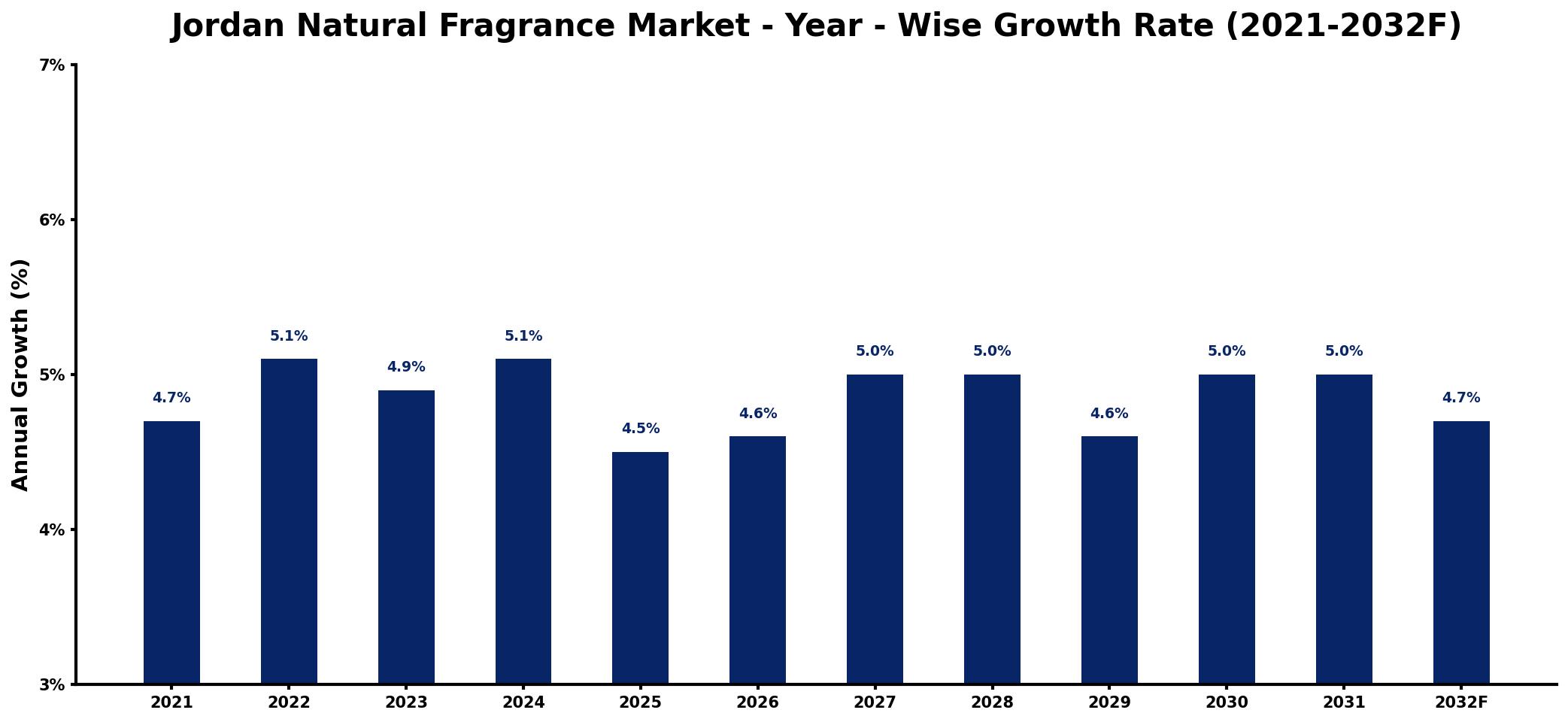
The table below presents the year‑wise growth rates along with the key drivers influencing the market
| Year | Growth Rate | Major Drivers |
| 2021 | 4.7% | Increased consumer interest in wellness |
| 2022 | 5.1% | Expansion of eco-friendly products |
| 2023 | 4.9% | Growth in online retail channels |
| 2024 | 5.1% | Rising popularity of artisanal offerings |
| 2025 | 4.5% | Emergence of sustainable sourcing practices |
| 2026 | 4.6% | Investment in local production facilities |
| 2027 | 5.0% | increased overall sector activity |
| 2028 | 5.0% | Strengthening of brand loyalty programs |
| 2029 | 4.6% | Increase in cross-industry collaborations |
| 2030 | 5.0% | improved raw material availability |
| 2031 | 5.0% | Enhanced focus on ethical sourcing |
| 2032 | 4.7% | Development of innovative packaging solutions |
Note: Market size estimations and growth projections presented in this report are based on 6Wresearch's proprietary forecasting methodology, utilizing the latest available industry data, government publications, and primary research inputs.
Jordan Natural Fragrance Market Synopsis
In Jordan, the demand for natural fragrances is heavily influenced by a cultural affinity for aromatic plant-based products. As a result, local production is beginning to flourish, tapping into the rich biodiversity of native flora, which supports the authenticity and appeal of homegrown fragrances.
The market is further bolstered by consumer education around the health implications of synthetic fragrances, leading to a marked shift toward products that emphasize purity and natural origins. This increasing awareness is complemented by a growing trend in sustainable consumption, where consumers are more inclined to support brands that prioritize eco-friendly practices.
Jordan Natural Fragrance Market Key Takeaways
- Jordan's natural fragrance market is seeing robust growth driven by a shift towards organic products.
- Consumer awareness of health risks associated with synthetic fragrances is propelling demand for natural alternatives.
- Local aromatic plant cultivation is gaining momentum, enhancing the authenticity of natural fragrance offerings.
- Government policies are favoring sustainable sourcing, ensuring product safety and quality in the market.
- Investment in infrastructure and skilled professionals is critical for the growth and reliability of the market.
Evaluation of Restraints in Jordan Natural Fragrance Market
Despite its growth, the Jordan Natural Fragrance Market faces significant challenges. Infrastructure inadequacies for the extraction and processing of natural ingredients remain a critical barrier. This is compounded by the need for substantial investment to develop reliable facilities capable of meeting increasing demand. Additionally, the market requires skilled professionals to manage operations efficiently, which presents a talent acquisition challenge. Regulatory compliance adds another layer of complexity, as companies strive to meet environmental standards and ensure product authenticity amidst competition from synthetic alternatives.
Jordan Natural Fragrance Market Trends
Current trends in the Jordan Natural Fragrance Market reflect a growing consumer preference for transparency and sustainability. Brands are increasingly showcasing their sourcing practices, emphasizing the use of locally sourced ingredients to bolster authenticity. Furthermore, the rise of social media and e-commerce is shaping how consumers discover and purchase natural fragrances, with online platforms becoming pivotal in brand outreach and consumer engagement. Emerging innovations in extraction technologies are also enhancing the quality and range of natural fragrance offerings.
Jordan Natural Fragrance Market Opportunities
The market presents considerable opportunities, particularly in the realm of product diversification. There is a growing potential for natural fragrances to penetrate niche markets such as aromatherapy and eco-friendly household products. Additionally, as the global demand for sustainable goods rises, Jordanian producers have a unique opportunity to export their locally sourced fragrances, tapping into international markets looking for authentic natural products. Collaborations with local artisans could further enhance product offerings and brand storytelling.
Government Initiatives in the Jordan Natural Fragrance Market
The Jordanian government has implemented various policies aimed at promoting sustainable practices within the natural fragrance sector. Regulations are in place to govern the extraction and labeling of natural fragrances, ensuring quality and consumer safety. Support initiatives also aim to encourage the cultivation of local aromatic plants, preserving traditional crafts and promoting local economies. These government actions not only protect consumers but also bolster the overall market infrastructure necessary for growth.
Future Insights of the Jordan Natural Fragrance Market
Looking ahead to 2026-2032, the Jordan Natural Fragrance Market is poised for significant expansion. Consumer preferences for organic and non-toxic products will continue to drive growth, as awareness of health issues related to synthetic ingredients expands. Furthermore, advancements in extraction and processing technologies will likely improve product quality and availability. As sustainability becomes a dominant value among consumers, companies that prioritize eco-friendly practices and local sourcing will find themselves well-positioned for success.
Jordan Natural Fragrance Market Latest Developments (2025 - 2026)
Recent developments in the Jordan Natural Fragrance Market include increased collaboration between local producers and research institutions to enhance extraction techniques. Additionally, initiatives to promote Jordanian natural fragrances in international markets are gaining traction, with various stakeholders exploring opportunities for participation in global trade fairs. There is also a noticeable uptick in consumer engagement through digital platforms, with brands leveraging social media to share their sustainability stories and connect with a broader audience.
Jordan Natural Fragrance Market - Key Attractiveness of the Report
- 10 Years of Market Numbers
- Historical Data Starting from 2022 to 2025
- Base Year: 2025
- Forecast Data until 2032
- Key Performance Indicators Impacting the Market
- Major Upcoming Developments and Projects
Key Highlights of the Report:
- Jordan Natural Fragrance Market Outlook
- Market Size of Jordan Natural Fragrance Market, 2025
- Forecast of Jordan Natural Fragrance Market, 2032
- Historical Data and Forecast of Jordan Natural Fragrance Revenues & Volume for the Period 2022-2032F
- Jordan Natural Fragrance Market Trend Evolution
- Jordan Natural Fragrance Market Drivers and Challenges
- Jordan Natural Fragrance Price Trends
- Jordan Natural Fragrance Porter's Five Forces
- Jordan Natural Fragrance Industry Life Cycle
- Historical Data and Forecast of Jordan Natural Fragrance Market Revenues & Volume By Ingredient for the Period 2022-2032F
- Historical Data and Forecast of Jordan Natural Fragrance Market Revenues & Volume By Essential Oils for the Period 2022-2032F
- Historical Data and Forecast of Jordan Natural Fragrance Market Revenues & Volume By Natural Extracts for the Period 2022-2032F
- Historical Data and Forecast of Jordan Natural Fragrance Market Revenues & Volume By Type for the Period 2022-2032F
- Historical Data and Forecast of Jordan Natural Fragrance Market Revenues & Volume By Top note for the Period 2022-2032F
- Historical Data and Forecast of Jordan Natural Fragrance Market Revenues & Volume By Middle Note for the Period 2022-2032F
- Historical Data and Forecast of Jordan Natural Fragrance Market Revenues & Volume By Base Note for the Period 2022-2032F
- Historical Data and Forecast of Jordan Natural Fragrance Market Revenues & Volume By Application for the Period 2022-2032F
- Historical Data and Forecast of Jordan Natural Fragrance Market Revenues & Volume By Fine Fragrances for the Period 2022-2032F
- Historical Data and Forecast of Jordan Natural Fragrance Market Revenues & Volume By Personal Care & Cosmetics for the Period 2022-2032F
- Historical Data and Forecast of Jordan Natural Fragrance Market Revenues & Volume By Household Care for the Period 2022-2032F
- Jordan Natural Fragrance Import Export Trade Statistics
- Market Opportunity Assessment By Ingredient
- Market Opportunity Assessment By Type
- Market Opportunity Assessment By Application
- Jordan Natural Fragrance Top Companies Market Share
- Jordan Natural Fragrance Competitive Benchmarking By Technical and Operational Parameters
- Jordan Natural Fragrance Company Profiles
- Jordan Natural Fragrance Key Strategic Recommendations






































