Kazakhstan 5G Core Market Size, Share & Growth Rate
The Kazakhstan 5G Core Market was estimated at USD 897 Million in 2025 and is projected to reach USD 1318 Million by 2032, growing at a CAGR of 5.7% from 2026 to 2032. This growth trajectory is fueled by the increasing demand for high-speed connectivity and advanced network capabilities across multiple sectors. As industries such as healthcare, manufacturing, and smart cities look to leverage 5G technologies, telecom operators are investing significantly in the necessary infrastructure upgrades to support this transition.
Kazakhstan 5G Core Market Year-wise Growth Rate and Key Drivers
This graph highlights how the Kazakhstan 5G Core Market has steadily grown over the years, supported by major growth factors.
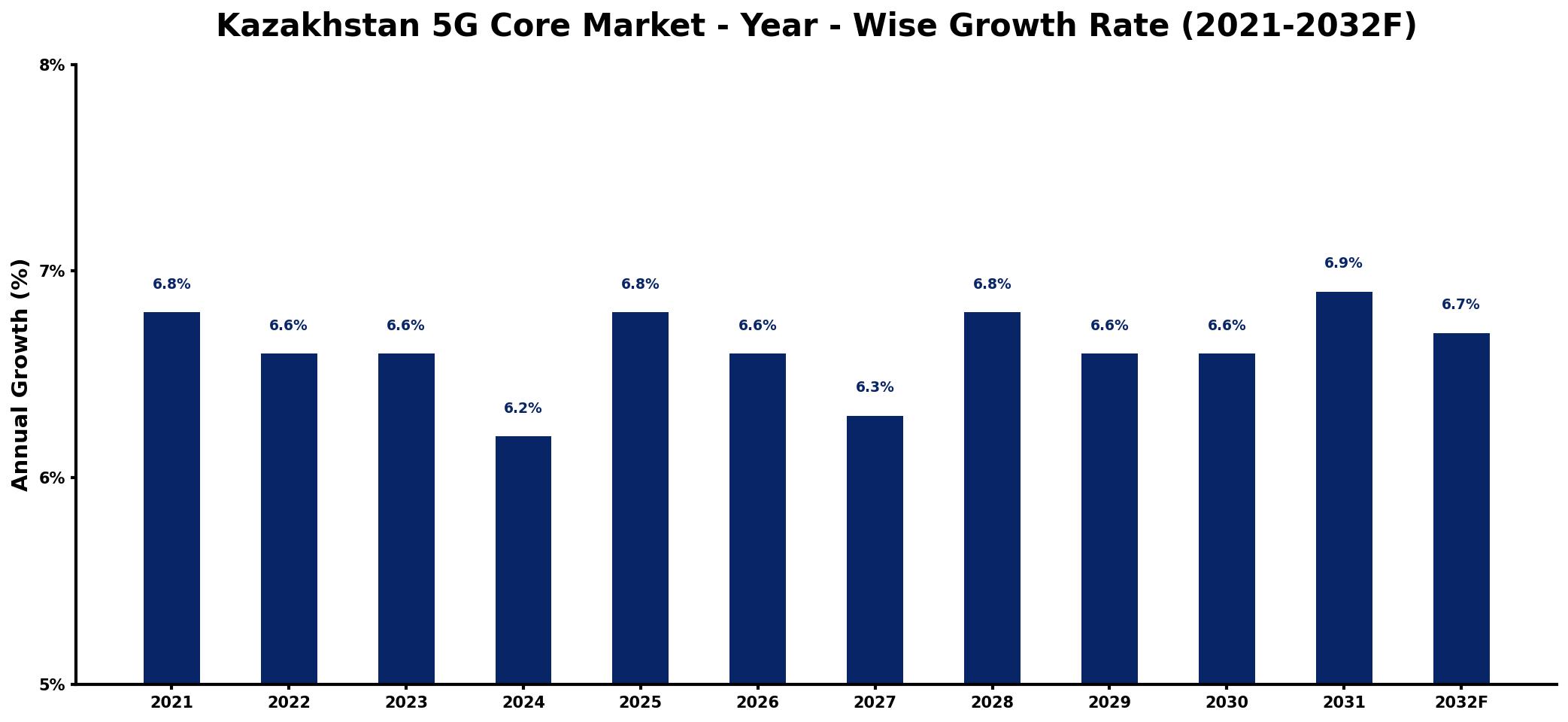
The table below presents the year‑wise growth rates along with the key drivers influencing the market
| Year | Growth Rate | Major Drivers |
| 2021 | 6.8% | increased investment in telecommunications infrastructure |
| 2022 | 6.6% | growing demand for smart devices |
| 2023 | 6.6% | expansion of digital services market |
| 2024 | 6.2% | rising interest in IoT applications |
| 2025 | 6.8% | boost in mobile data consumption |
| 2026 | 6.6% | enhanced focus on cybersecurity measures |
| 2027 | 6.3% | development of smart city projects |
| 2028 | 6.8% | emergence of new tech startups |
| 2029 | 6.6% | greater collaboration with international partners |
| 2030 | 6.6% | increased government support for innovation |
| 2031 | 6.9% | growing adoption of augmented reality |
| 2032 | 6.7% | growing emerging market penetration |
Note: Market size estimations and growth projections presented in this report are based on 6Wresearch's proprietary forecasting methodology, utilizing the latest available industry data, government publications, and primary research inputs.
Kazakhstan 5G Core Market Synopsis
In Kazakhstan, the rollout of 5G technology is not just a trend but a necessity to meet the rising demand for rapid data services. As businesses and government entities alike pursue digital transformation, the urgency to implement 5G core networks becomes increasingly vital.
The focus on developing secure, efficient 5G core networks is particularly pronounced, as various industries adapt to new technological paradigms. The integration of advanced concepts such as network slicing and edge computing is on the rise, presenting new opportunities for operational efficiencies and innovative applications.
Kazakhstan 5G Core Market Key Takeaways
- The market is projected to grow significantly, reaching USD 1318 Million by 2032.
- High-speed connectivity demand across industries is a major growth driver.
- Telecom operators are focused on infrastructure investments to support 5G deployment.
- Technologies like network slicing and edge computing are essential for market expansion.
- Government support plays a crucial role in fostering a conducive environment for 5G development.
Evaluation of Restraints in Kazakhstan 5G Core Market
The Kazakhstan 5G Core Market faces several critical restraints that could hinder its potential growth. A primary concern is the need for a robust infrastructure that can adequately support the high demands of 5G technology. Additionally, seamless integration with existing networks poses challenges, as does the increasing need for advanced security measures to combat potential cyber threats. Regulatory complexities may also slow down the adoption and deployment process, necessitating careful navigation by telecom providers. Furthermore, the availability of a skilled workforce to effectively implement and manage these new networks remains a pressing issue. The significant investment required for infrastructure upgrades adds another layer of complexity that players in this market must contend with.
Kazakhstan 5G Core Market Trends
Several emerging trends are shaping the Kazakhstan 5G Core Market. The transition to cloud-native 5G core networks is gaining momentum, offering enhanced scalability and flexibility for service providers. In parallel, the integration of edge computing capabilities is becoming a focal point, designed to support low-latency applications essential for IoT and smart city initiatives. Network slicing is also being implemented to optimize resource allocation across diverse applications, thereby improving overall network efficiency. Furthermore, heightened focus on cybersecurity is driving service providers to implement advanced security protocols within their core networks.
Kazakhstan 5G Core Market Opportunities
The Kazakhstan 5G Core Market presents a wealth of genuine growth and investment opportunities for stakeholders. As the demand for high-speed connectivity continues to rise, the development and deployment of advanced 5G core infrastructure become increasingly critical. Companies can capitalize on this opportunity by investing in cutting-edge solutions such as virtualized networks and edge computing capabilities. Forming strategic partnerships with local telecom operators and leveraging government initiatives aimed at enhancing digital connectivity can further amplify market potential. By positioning themselves to meet the evolving needs of various industries, telecom companies can secure long-term growth and profitability.
Government Initiatives in the Kazakhstan 5G Core Market
The government of Kazakhstan is actively promoting 5G technology adoption through a series of strategic policies and initiatives. By allocating spectrum bands for 5G deployment, the government is facilitating the essential groundwork for telecom operators to invest in building robust 5G infrastructure. Additionally, efforts to establish comprehensive regulations concerning data privacy and cybersecurity are underway, ensuring the protection of user information in the evolving digital landscape. Collaborative efforts with industry stakeholders are also being prioritized to encourage innovation and research in the 5G sector, ultimately creating a supportive ecosystem for market growth.
Future Insights of the Kazakhstan 5G Core Market
Looking ahead to 2026-2032, the Kazakhstan 5G Core Market is set to witness significant advancements as the country invests heavily in upgrading its telecommunications infrastructure. The growing proliferation of IoT devices is creating an increasing demand for advanced network capabilities, which 5G is uniquely equipped to provide. As major telecom operators accelerate the rollout of 5G networks, consumer and enterprise adoption is expected to surge. Furthermore, the government's ongoing commitment to digitalization across various industries will likely drive demand for enhanced 5G services, solidifying Kazakhstan's position as a pivotal player in the regional 5G landscape.
Kazakhstan 5G Core Market Latest Developments (2025 - 2026)
Recent developments in the Kazakhstan 5G Core Market highlight a clear direction toward enhancing digital infrastructure. Telecom operators are exploring advanced technologies to ensure effective deployment of 5G services while prioritizing security measures to protect user data. Government agencies are increasingly collaborating with industry stakeholders to refine regulatory frameworks that support rapid 5G adoption. Additionally, initiatives aimed at public awareness and education about the benefits of 5G technology are gaining traction, indicating a growing acceptance among consumers and businesses alike.
Kazakhstan 5G Core Market - Key Attractiveness of the Report
- 10 Years of Market Numbers
- Historical Data Starting from 2022 to 2025
- Base Year: 2025
- Forecast Data until 2032
- Key Performance Indicators Impacting the Market
- Major Upcoming Developments and Projects
Key Highlights of the Report:
- Kazakhstan 5G Core Market Outlook
- Market Size of Kazakhstan 5G Core Market, 2025
- Forecast of Kazakhstan 5G Core Market, 2032
- Historical Data and Forecast of Kazakhstan 5G Core Revenues & Volume for the Period 2022-2032F
- Kazakhstan 5G Core Market Trend Evolution
- Kazakhstan 5G Core Market Drivers and Challenges
- Kazakhstan 5G Core Price Trends
- Kazakhstan 5G Core Porter's Five Forces
- Kazakhstan 5G Core Industry Life Cycle
- Historical Data and Forecast of Kazakhstan 5G Core Market Revenues & Volume By Component for the Period 2022-2032F
- Historical Data and Forecast of Kazakhstan 5G Core Market Revenues & Volume By Solutions for the Period 2022-2032F
- Historical Data and Forecast of Kazakhstan 5G Core Market Revenues & Volume By Services for the Period 2022-2032F
- Historical Data and Forecast of Kazakhstan 5G Core Market Revenues & Volume By Network Function for the Period 2022-2032F
- Historical Data and Forecast of Kazakhstan 5G Core Market Revenues & Volume By Access for the Period 2022-2032F
- Historical Data and Forecast of Kazakhstan 5G Core Market Revenues & Volume By Mobility Management Function for the Period 2022-2032F
- Historical Data and Forecast of Kazakhstan 5G Core Market Revenues & Volume By Policy Control Function for the Period 2022-2032F
- Historical Data and Forecast of Kazakhstan 5G Core Market Revenues & Volume By Unified Data Management for the Period 2022-2032F
- Historical Data and Forecast of Kazakhstan 5G Core Market Revenues & Volume By Deployment Model for the Period 2022-2032F
- Historical Data and Forecast of Kazakhstan 5G Core Market Revenues & Volume By Cloud for the Period 2022-2032F
- Historical Data and Forecast of Kazakhstan 5G Core Market Revenues & Volume By On-premises for the Period 2022-2032F
- Historical Data and Forecast of Kazakhstan 5G Core Market Revenues & Volume By End User for the Period 2022-2032F
- Historical Data and Forecast of Kazakhstan 5G Core Market Revenues & Volume By Telecom Operators for the Period 2022-2032F
- Historical Data and Forecast of Kazakhstan 5G Core Market Revenues & Volume By Enterprises for the Period 2022-2032F
- Kazakhstan 5G Core Import Export Trade Statistics
- Market Opportunity Assessment By Component
- Market Opportunity Assessment By Network Function
- Market Opportunity Assessment By Deployment Model
- Market Opportunity Assessment By End User
- Kazakhstan 5G Core Top Companies Market Share
- Kazakhstan 5G Core Competitive Benchmarking By Technical and Operational Parameters
- Kazakhstan 5G Core Company Profiles
- Kazakhstan 5G Core Key Strategic Recommendations






































