Kazakhstan Agriculture Market Size, Share & Growth Rate
The Kazakhstan Agriculture Market was estimated at USD 390 Million in 2025 and is projected to reach USD 529 Million by 2032, growing at a CAGR of 4.5% from 2026 to 2032. This growth is largely driven by increasing domestic and international demand for high-quality agricultural products, coupled with government initiatives aimed at modernizing the sector. The emphasis on sustainable farming practices and technological advancements is further propelling the market towards this favorable trajectory.
Kazakhstan Agriculture Market Year-wise Growth Rate and Key Drivers
This graph highlights how the Kazakhstan Agriculture Market has steadily grown over the years, supported by major growth factors.
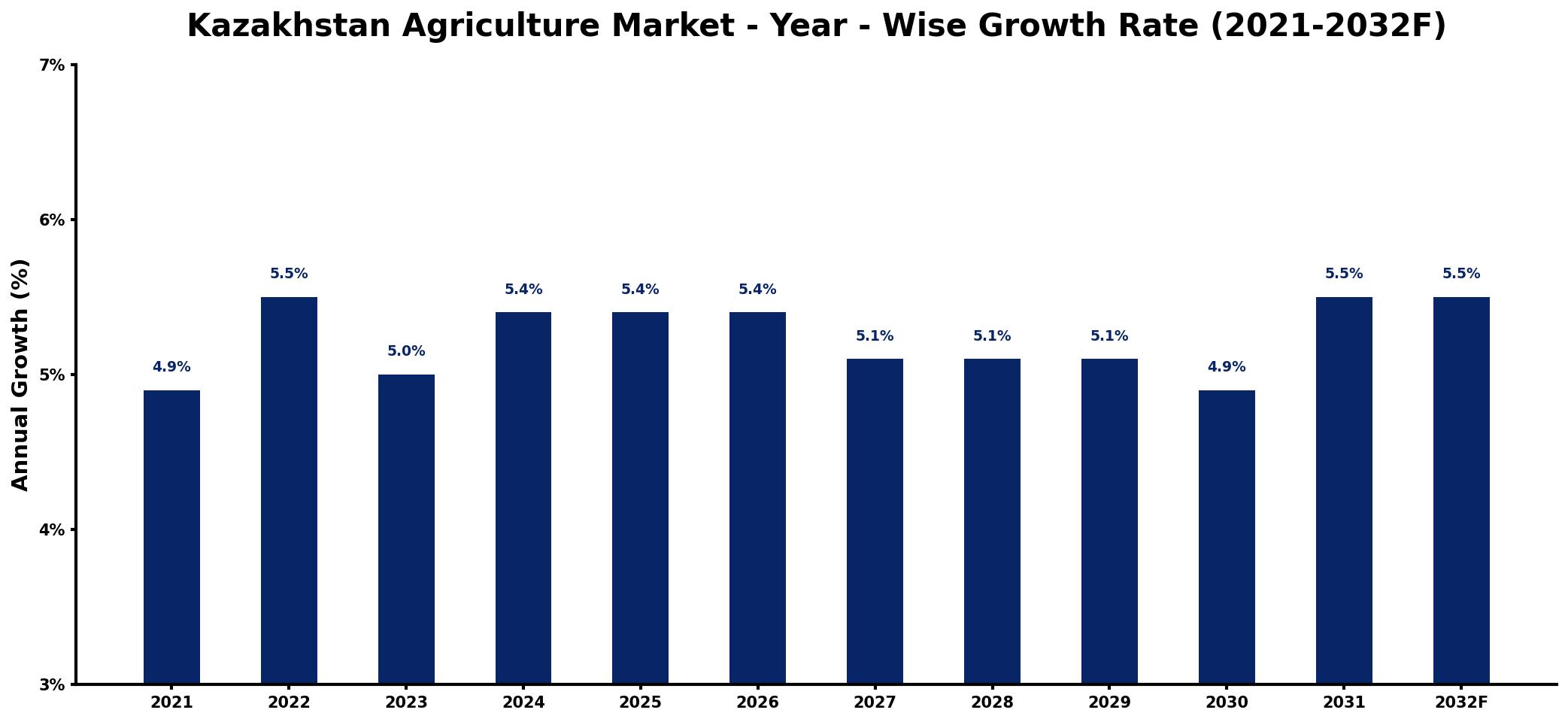
The table below presents the year‑wise growth rates along with the key drivers influencing the market
| Year | Growth Rate | Major Drivers |
| 2021 | 4.9% | Increased investment in technology |
| 2022 | 5.5% | Rising demand for organic products |
| 2023 | 5.0% | Expansion of export markets |
| 2024 | 5.4% | Growth in sustainable practices |
| 2025 | 5.4% | Enhanced irrigation infrastructure projects |
| 2026 | 5.4% | Development of agro-processing facilities |
| 2027 | 5.1% | Strong consumer preference for local |
| 2028 | 5.1% | Improved supply chain efficiencies |
| 2029 | 5.1% | Increased government support programs |
| 2030 | 4.9% | growing commercial sector adoption |
| 2031 | 5.5% | Rising interest in agritech innovations |
| 2032 | 5.5% | Emergence of new farming techniques |
Note: Market size estimations and growth projections presented in this report are based on 6Wresearch's proprietary forecasting methodology, utilizing the latest available industry data, government publications, and primary research inputs.
Kazakhstan Agriculture Market Synopsis
In recent years, the Kazakhstan agriculture market has gained momentum, largely due to the country's vast arable land and rich resources. However, as the market evolves, there is a clear transition towards sustainability, organic farming, and enhanced technological integration that promises to reshape the industry landscape.
The current focus on improving agricultural practices is not just a trend but a necessary shift to meet the growing needs of both local and international consumers. With supportive government policies and an increasing emphasis on infrastructure development, the sector stands at a pivotal juncture, presenting both opportunities and challenges ahead.
Kazakhstan Agriculture Market Key Takeaways
- Vast arable land and favorable climate conditions create a robust agricultural base.
- Government support is crucial for advancing technology and improving infrastructure.
- A growing demand for organic products is reshaping market dynamics.
- Investment in agribusiness and value-added processing is on the rise.
- Technological adoption, including precision agriculture, is enhancing productivity.
Evaluation of Restraints in Kazakhstan Agriculture Market
Despite its promising outlook, the Kazakhstan agriculture market faces significant constraints that impede its growth. A lack of access to modern technology and advanced machinery continues to limit productivity. Furthermore, inadequate infrastructure, particularly regarding storage and transportation, leads to considerable post-harvest losses. Weather variability also presents risks, affecting yields and livestock health, which can destabilize the market. These factors underline the urgent need for coordinated efforts to improve the overall efficiency and efficacy of the sector.
Kazakhstan Agriculture Market Trends
The trends within the Kazakhstan agriculture market are increasingly leaning towards sustainable and organic farming practices. This shift is driven by a combination of consumer demand for healthier options and government initiatives aimed at promoting ecological farming methods. Furthermore, there's a growing interest in the integration of technology, such as precision agriculture tools and data analytics, which are being embraced to refine farming operations and boost yield outcomes. Such innovations not only enhance the efficiency of farming but also position Kazakhstan competitively on the global agricultural stage.
Kazakhstan Agriculture Market Opportunities
Investment opportunities in the Kazakhstan agriculture market are abundant, particularly in areas such as agribusiness development and value-added processing. The increasing demand for organic produce offers a lucrative niche for investors seeking to capitalize on consumer trends. Additionally, infrastructure enhancement projects, including irrigation systems and improved storage facilities, are vital for increasing efficiency and productivity. The intersection of government support and private investment is expected to drive innovation and expand the market's capabilities significantly.
Government Initiatives in the Kazakhstan Agriculture Market
The government of Kazakhstan has implemented a range of policies designed to bolster the agriculture sector. These include providing financial assistance and subsidies to farmers, promoting technological advancements, and enhancing infrastructure, particularly in irrigation and road systems. Furthermore, there is a strong focus on sustainability and efficiency improvements, with ongoing reforms aimed at facilitating the development of agribusinesses and increasing export competitiveness. Such initiatives reflect a commitment to fostering a vibrant, future-ready agricultural landscape.
Future Insights of the Kazakhstan Agriculture Market
Looking ahead to 2026-2032, the Kazakhstan agriculture market is poised for significant transformation. With a strong emphasis on governmental support and technological integration, the market is likely to capitalize on its agricultural strengths. The anticipated growth in wheat, livestock, and dairy production is set against a backdrop of increasing global demand, further incentivizing investment. While challenges such as climate change persist, the shift towards sustainable practices and the adoption of precision farming techniques will be crucial in enhancing competitiveness and ensuring long-term viability.
Kazakhstan Agriculture Market Latest Developments (2025 - 2026)
Recent developments in the Kazakhstan agriculture market indicate a sustained commitment to modernization and efficiency. Various initiatives are underway to enhance infrastructure, particularly in irrigation and logistics, aimed at reducing post-harvest losses and improving access to markets. Additionally, there has been an increased focus on fostering small-scale farmers, enabling them to adopt modern practices and contribute to the overall agricultural output. Overall, the sector is evolving to meet contemporary challenges while laying the groundwork for sustainable growth.
Kazakhstan Agriculture Market - Key Attractiveness of the Report
- 10 Years of Market Numbers
- Historical Data Starting from 2022 to 2025
- Base Year: 2025
- Forecast Data until 2032
- Key Performance Indicators Impacting the Market
- Major Upcoming Developments and Projects
Key Highlights of the Report:
- Kazakhstan Agriculture Market Outlook
- Market Size of Kazakhstan Agriculture Market, 2025
- Forecast of Kazakhstan Agriculture Market, 2032
- Historical Data and Forecast of Kazakhstan Agriculture Revenues & Volume for the Period 2022-2032F
- Kazakhstan Agriculture Market Trend Evolution
- Kazakhstan Agriculture Market Drivers and Challenges
- Kazakhstan Agriculture Price Trends
- Kazakhstan Agriculture Porter's Five Forces
- Kazakhstan Agriculture Industry Life Cycle
- Historical Data and Forecast of Kazakhstan Agriculture Market Revenues & Volume By Type for the Period 2022-2032F
- Historical Data and Forecast of Kazakhstan Agriculture Market Revenues & Volume By Animal Produce for the Period 2022-2032F
- Historical Data and Forecast of Kazakhstan Agriculture Market Revenues & Volume By Crop Production for the Period 2022-2032F
- Historical Data and Forecast of Kazakhstan Agriculture Market Revenues & Volume By Distribution Channel for the Period 2022-2032F
- Historical Data and Forecast of Kazakhstan Agriculture Market Revenues & Volume By Supermarkets/Hypermarkets for the Period 2022-2032F
- Historical Data and Forecast of Kazakhstan Agriculture Market Revenues & Volume By Convenience Stores for the Period 2022-2032F
- Historical Data and Forecast of Kazakhstan Agriculture Market Revenues & Volume By E-Commerce for the Period 2022-2032F
- Historical Data and Forecast of Kazakhstan Agriculture Market Revenues & Volume By Others for the Period 2022-2032F
- Historical Data and Forecast of Kazakhstan Agriculture Market Revenues & Volume By Nature for the Period 2022-2032F
- Historical Data and Forecast of Kazakhstan Agriculture Market Revenues & Volume By Organic for the Period 2022-2032F
- Historical Data and Forecast of Kazakhstan Agriculture Market Revenues & Volume By Conventional for the Period 2022-2032F
- Kazakhstan Agriculture Import Export Trade Statistics
- Market Opportunity Assessment By Type
- Market Opportunity Assessment By Distribution Channel
- Market Opportunity Assessment By Nature
- Kazakhstan Agriculture Top Companies Market Share
- Kazakhstan Agriculture Competitive Benchmarking By Technical and Operational Parameters
- Kazakhstan Agriculture Company Profiles
- Kazakhstan Agriculture Key Strategic Recommendations






































