Kazakhstan Armored Vehicle Market Size, Share & Growth Rate
The Kazakhstan Armored Vehicle Market was estimated at USD 1347 Million in 2025 and is projected to reach USD 1924 Million by 2032, growing at a CAGR of 5.2% from 2026 to 2032. This growth trajectory is largely fueled by increasing defense expenditure and an ongoing commitment to modernizing military capabilities amid heightened regional security concerns. Moreover, domestic manufacturers are playing a crucial role in meeting the evolving needs of the Kazakhstan armed forces, which are seeking advanced armored solutions for border security and counter-terrorism operations.
Kazakhstan Armored Vehicle Market Year-wise Growth Rate and Key Drivers
This graph highlights how the Kazakhstan Armored Vehicle Market has steadily grown over the years, supported by major growth factors.
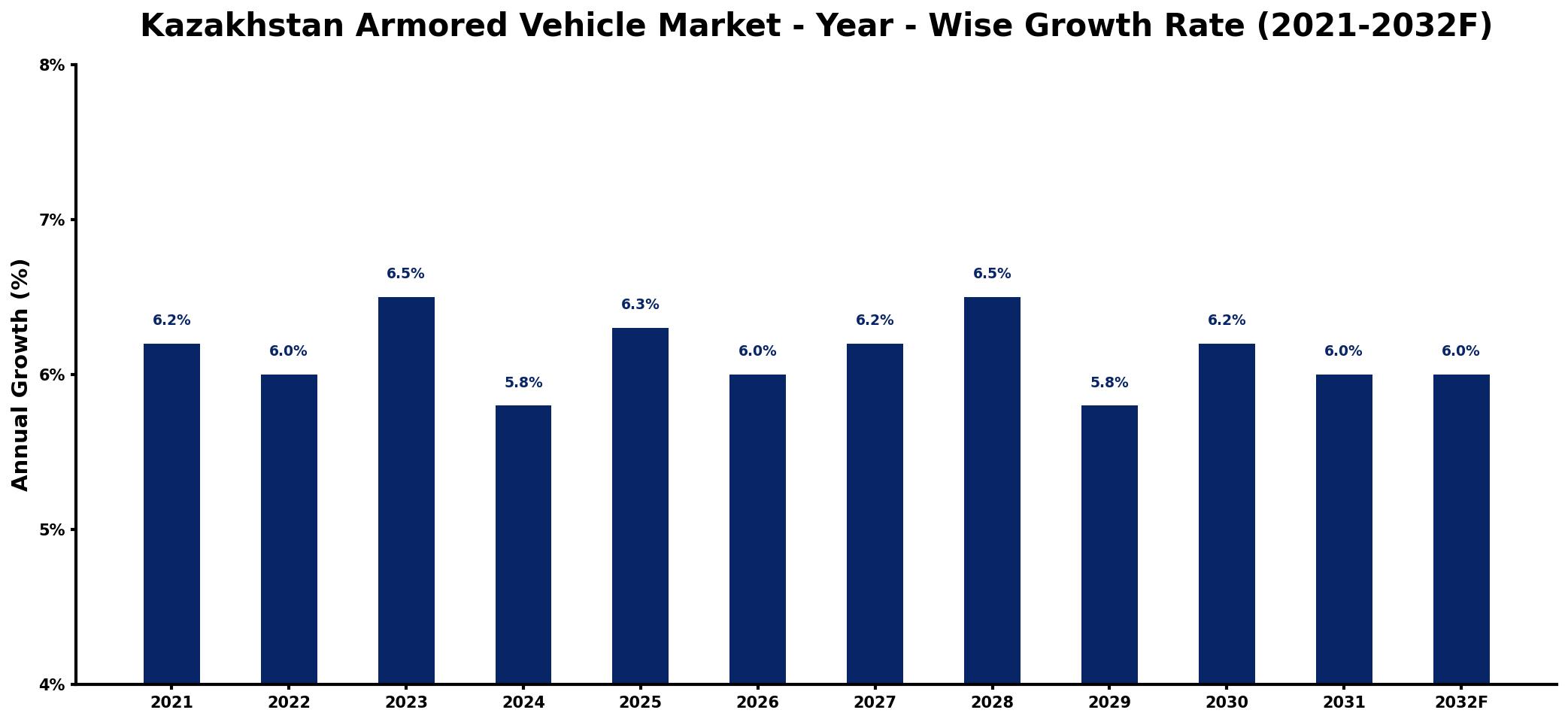
The table below presents the year‑wise growth rates along with the key drivers influencing the market
| Year | Growth Rate | Major Drivers |
| 2021 | 6.2% | Increased defense spending initiatives |
| 2022 | 6.0% | Growing regional security concerns |
| 2023 | 6.5% | Expansion of military modernization programs |
| 2024 | 5.8% | Rising geopolitical tensions influence procurement |
| 2025 | 6.3% | Strengthened partnerships with allies |
| 2026 | 6.0% | Investment in domestic manufacturing capabilities |
| 2027 | 6.2% | Demand for enhanced personnel protection |
| 2028 | 6.5% | Emergence of new technological advancements |
| 2029 | 5.8% | Focus on counter-terrorism operations |
| 2030 | 6.2% | Increased participation in joint exercises |
| 2031 | 6.0% | Support for export-driven growth strategies |
| 2032 | 6.0% | Growing interest in multi-role platforms |
Note: Market size estimations and growth projections presented in this report are based on 6Wresearch's proprietary forecasting methodology, utilizing the latest available industry data, government publications, and primary research inputs.
Kazakhstan Armored Vehicle Market Synopsis
The demand for armored vehicles in Kazakhstan is rapidly increasing, driven by the nation's focus on enhancing its military readiness and ensuring national security. This need is reflected in the procurement strategies that prioritize locally produced armored solutions, thereby fostering indigenous industry growth.
In addition to bolstering domestic production, international collaborations have also become essential for technology transfer and innovation within the market. Such partnerships enable Kazakhstan to incorporate advanced features in armored vehicles that align with current global defense standards.
Kazakhstan Armored Vehicle Market Key Takeaways
- The market is primarily led by domestic manufacturers with support from international partners.
- Key drivers include military modernization, border security, and counter-terrorism efforts.
- Advanced technologies and customizable designs are increasingly in demand.
- Government policies are actively promoting local production and innovation.
- Investment opportunities are ripe for both local and international players seeking to capitalize on market growth.
Evaluation of Restraints in Kazakhstan Armored Vehicle Market
Despite the promising growth outlook, the Kazakhstan Armored Vehicle Market faces several limitations. Intense competition from established international suppliers presents a challenge for domestic manufacturers seeking to expand market share. Limited production capabilities necessitate significant investments in research and development, crucial for keeping pace with rapid technological advancements in armored vehicles. Furthermore, navigating complex regulatory frameworks and establishing robust relationships with government procurement agencies can hinder operational efficiency and market entry for new players.
Kazakhstan Armored Vehicle Market Trends
Several trends are reshaping the Kazakhstan Armored Vehicle Market. Firstly, there is a marked shift towards adopting advanced communication systems and electronic warfare capabilities within armored vehicles, enhancing their operational effectiveness. Additionally, increased mobility and modular designs are gaining traction as the armed forces seek versatile solutions tailored to specific operational needs. These trends are indicative of a broader effort to align military equipment with contemporary security challenges.
Kazakhstan Armored Vehicle Market Opportunities
The market offers substantial investment opportunities for stakeholders looking to enter or expand their presence in Kazakhstan. Collaborations with domestic manufacturers to supply components or technology could yield significant returns. Additionally, the increasing need for maintenance and support services for existing armored vehicle fleets presents a lucrative avenue for growth. With a strong emphasis on modernizing military capabilities, the market stands as an attractive prospect for long-term investment.
Government Initiatives in the Kazakhstan Armored Vehicle Market
The Kazakhstan government is keenly focused on developing the armored vehicle sector through various supportive policies and initiatives. These efforts include providing incentives and subsidies to bolster domestic manufacturers, thereby nurturing a robust indigenous industry. The government is also committed to enhancing national security by investing in modern armored vehicles and fostering partnerships with international defense companies to facilitate technology transfer and capability enhancement.
Future Insights of the Kazakhstan Armored Vehicle Market
Looking ahead to 2026-2032, the Kazakhstan Armored Vehicle Market is poised for steady expansion, driven by sustained defense spending and modernization initiatives. The increasing necessity for advanced armored solutions in border security and counter-terrorism operations will remain central to market demand. Furthermore, collaborations with international defense manufacturers for technology transfer are likely to enhance local production capabilities. Overall, the market is on a growth trajectory, offering exciting opportunities for both domestic and foreign stakeholders.
Kazakhstan Armored Vehicle Market Latest Developments (2025 - 2026)
In recent months, the Kazakhstan Armored Vehicle Market has seen a series of strategic partnerships aimed at enhancing local manufacturing capabilities. Ongoing discussions between domestic firms and international defense contractors have focused on technology transfer, particularly in advanced armored vehicle systems. Additionally, the government has been actively promoting initiatives that align defense procurement with national security priorities, further solidifying the market's growth potential.
Kazakhstan Armored Vehicle Market - Key Attractiveness of the Report
- 10 Years of Market Numbers
- Historical Data Starting from 2022 to 2025
- Base Year: 2025
- Forecast Data until 2032
- Key Performance Indicators Impacting the Market
- Major Upcoming Developments and Projects
Key Highlights of the Report:
- Kazakhstan Armored Vehicle Market Outlook
- Market Size of Kazakhstan Armored Vehicle Market, 2025
- Forecast of Kazakhstan Armored Vehicle Market, 2032
- Historical Data and Forecast of Kazakhstan Armored Vehicle Revenues & Volume for the Period 2022-2032F
- Kazakhstan Armored Vehicle Market Trend Evolution
- Kazakhstan Armored Vehicle Market Drivers and Challenges
- Kazakhstan Armored Vehicle Price Trends
- Kazakhstan Armored Vehicle Porter's Five Forces
- Kazakhstan Armored Vehicle Industry Life Cycle
- Historical Data and Forecast of Kazakhstan Armored Vehicle Market Revenues & Volume By Platform for the Period 2022-2032F
- Historical Data and Forecast of Kazakhstan Armored Vehicle Market Revenues & Volume By Combat Vehicles for the Period 2022-2032F
- Historical Data and Forecast of Kazakhstan Armored Vehicle Market Revenues & Volume By Combat Support Vehicles for the Period 2022-2032F
- Historical Data and Forecast of Kazakhstan Armored Vehicle Market Revenues & Volume By Unmanned Armored Ground Vehicles for the Period 2022-2032F
- Historical Data and Forecast of Kazakhstan Armored Vehicle Market Revenues & Volume By Mobility for the Period 2022-2032F
- Historical Data and Forecast of Kazakhstan Armored Vehicle Market Revenues & Volume By Wheeled for the Period 2022-2032F
- Historical Data and Forecast of Kazakhstan Armored Vehicle Market Revenues & Volume By Tracked for the Period 2022-2032F
- Historical Data and Forecast of Kazakhstan Armored Vehicle Market Revenues & Volume By System for the Period 2022-2032F
- Historical Data and Forecast of Kazakhstan Armored Vehicle Market Revenues & Volume By Engine for the Period 2022-2032F
- Historical Data and Forecast of Kazakhstan Armored Vehicle Market Revenues & Volume By Drive System for the Period 2022-2032F
- Historical Data and Forecast of Kazakhstan Armored Vehicle Market Revenues & Volume By Ballistic Armor for the Period 2022-2032F
- Historical Data and Forecast of Kazakhstan Armored Vehicle Market Revenues & Volume By Turret Drives for the Period 2022-2032F
- Historical Data and Forecast of Kazakhstan Armored Vehicle Market Revenues & Volume By Ammunition Handling System for the Period 2022-2032F
- Historical Data and Forecast of Kazakhstan Armored Vehicle Market Revenues & Volume By Fire Control Systems (FCS) for the Period 2022-2032F
- Historical Data and Forecast of Kazakhstan Armored Vehicle Market Revenues & Volume By Armaments for the Period 2022-2032F
- Historical Data and Forecast of Kazakhstan Armored Vehicle Market Revenues & Volume By Countermeasure System for the Period 2022-2032F
- Kazakhstan Armored Vehicle Import Export Trade Statistics
- Market Opportunity Assessment By Platform
- Market Opportunity Assessment By Mobility
- Market Opportunity Assessment By System
- Kazakhstan Armored Vehicle Top Companies Market Share
- Kazakhstan Armored Vehicle Competitive Benchmarking By Technical and Operational Parameters
- Kazakhstan Armored Vehicle Company Profiles
- Kazakhstan Armored Vehicle Key Strategic Recommendations






































