Kazakhstan Auto Parts And Accessories Market Size, Share & Growth Rate
The Kazakhstan Auto Parts And Accessories Market was estimated at USD 1422 Million in 2025 and is projected to reach USD 2077 Million by 2032, growing at a CAGR of 5.6% from 2026 to 2032. This growth is largely attributed to the increasing number of vehicles on the roads and heightened consumer focus on vehicle maintenance and customization. Additionally, a burgeoning middle class with rising disposable incomes fuels the demand for both OEM and aftermarket parts in this dynamic market.
Kazakhstan Auto Parts And Accessories Market Year-wise Growth Rate and Key Drivers
This graph highlights how the Kazakhstan Auto Parts And Accessories Market has steadily grown over the years, supported by major growth factors.
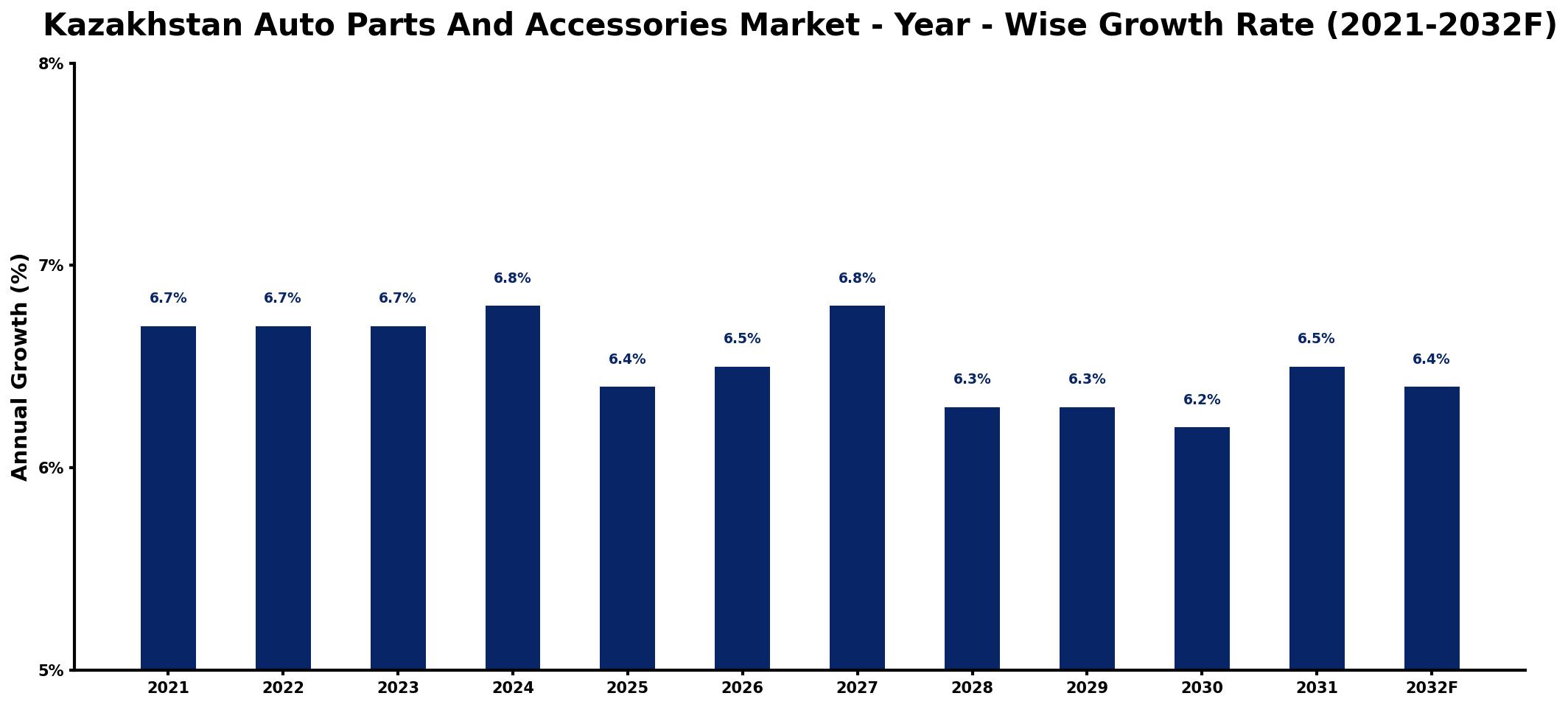
The table below presents the year‑wise growth rates along with the key drivers influencing the market
| Year | Growth Rate | Major Drivers |
| 2021 | 6.7% | Rising consumer vehicle ownership rates |
| 2022 | 6.7% | Increased investments in infrastructure |
| 2023 | 6.7% | Growth in e-commerce distribution channels |
| 2024 | 6.8% | Expansion of local manufacturing facilities |
| 2025 | 6.4% | Higher demand for electric vehicles |
| 2026 | 6.5% | Development of advanced logistics networks |
| 2027 | 6.8% | increased domestic production output |
| 2028 | 6.3% | stronger distribution network expansion |
| 2029 | 6.3% | Increase in fleet management solutions |
| 2030 | 6.2% | increased pharmaceutical industry usage |
| 2031 | 6.5% | strengthening underlying market demand |
| 2032 | 6.4% | expanding industrial usage applications |
Note: Market size estimations and growth projections presented in this report are based on 6Wresearch's proprietary forecasting methodology, utilizing the latest available industry data, government publications, and primary research inputs.
Kazakhstan Auto Parts And Accessories Market Synopsis
A noticeable increase in vehicle ownership in Kazakhstan has driven the auto parts and accessories market towards steady expansion. Consumers are increasingly investing in quality replacements and customizations, which has led to a diversified product offering that includes engines, batteries, and electronics among others.
The local automotive industry is maturing, supported by government initiatives aimed at enhancing local production capabilities. This is fostering a competitive environment for suppliers, both OEMs and aftermarket participants, who are keen to address the evolving needs of Kazakh consumers.
Kazakhstan Auto Parts And Accessories Market Key Takeaways
- The market is experiencing steady growth due to increasing vehicle ownership and maintenance needs.
- Rising disposable incomes are encouraging consumers to invest in aftermarket auto parts and accessories.
- Technological advancements are leading to a demand for high-quality and innovative auto parts.
- Online retail channels are becoming a primary shopping method for auto parts, reflecting consumer preferences for convenience.
- Government policies are favoring local manufacturing and providing investment incentives.
Evaluation of Restraints in Kazakhstan Auto Parts And Accessories Market
Despite its growth potential, the Kazakhstan Auto Parts and Accessories Market faces significant challenges. One critical issue is the prevalence of counterfeit products, which erodes consumer trust and could compromise vehicle safety. Furthermore, the importation of substandard parts poses safety risks and creates obstacles for legitimate suppliers. Supply chain disruptions, influenced by logistics challenges and fluctuating exchange rates, also hinder the timely delivery of parts, affecting overall market efficiency. To overcome these obstacles, industry stakeholders must prioritize robust quality control measures and remain agile in adapting to regulatory changes.
Kazakhstan Auto Parts And Accessories Market Trends
Several trends are currently shaping the Kazakhstan Auto Parts and Accessories Market. A marked shift towards environmentally friendly and sustainable auto parts is gaining traction among consumers who are increasingly eco-conscious. The rise of e-commerce is revolutionizing the way consumers purchase parts, with online platforms offering a broader selection and convenience. Moreover, partnerships between auto parts manufacturers and automotive companies are becoming prevalent, as firms seek to innovate and provide integrated solutions that meet consumer needs.
Kazakhstan Auto Parts And Accessories Market Opportunities
Investment opportunities abound in the Kazakhstan auto parts and accessories sector, particularly for businesses targeting the growing middle class. The demand for high-quality aftermarket products opens doors for innovative product development and niche market entry. Investing in online distribution channels can prove fruitful as consumer shopping habits evolve. Collaborations with local manufacturers will not only enhance supply chain efficiencies but also provide access to the growing demand for customized automotive solutions tailored to the Kazakh market.
Government Initiatives in the Kazakhstan Auto Parts And Accessories Market
The Kazakh government is actively fostering growth in the auto parts and accessories market through supportive policies, including import tariffs that encourage local manufacturing. Initiatives aimed at attracting foreign investment are complemented by tax incentives and subsidies for companies producing automotive components domestically. Regulations ensuring quality and safety standards for auto parts are also in place, creating a more competitive landscape for both local and international businesses.
Future Insights of the Kazakhstan Auto Parts And Accessories Market
The future of the Kazakhstan Auto Parts and Accessories Market looks promising, driven by an expanding automotive sector and increasing vehicle ownership. A favorable economic climate and rising disposable incomes will likely sustain growth, positioning the market for steady development. Additionally, ongoing governmental support for local manufacturing and foreign investment will further stimulate market dynamics. As innovation and technological advancements continue to shape the sector, both local and global players will find ample opportunities for growth in this evolving landscape.
Kazakhstan Auto Parts And Accessories Market Latest Developments (2025 - 2026)
Recently, the market has been witnessing a surge in interest toward sustainable and environmentally-friendly auto parts, reflecting a broader global trend. Additionally, various companies are beginning to explore collaborations aimed at integrating technology into traditional auto parts, enhancing functionality and user experience. The push for digital transformation has also led to a significant rise in online sales channels, responding to changing consumer preferences for convenience and variety.
Kazakhstan Auto Parts And Accessories Market - Key Attractiveness of the Report
- 10 Years of Market Numbers
- Historical Data Starting from 2022 to 2025
- Base Year: 2025
- Forecast Data until 2032
- Key Performance Indicators Impacting the Market
- Major Upcoming Developments and Projects
Key Highlights of the Report:
- Kazakhstan Auto Parts And Accessories Market Outlook
- Market Size of Kazakhstan Auto Parts And Accessories Market, 2025
- Forecast of Kazakhstan Auto Parts And Accessories Market, 2032
- Historical Data and Forecast of Kazakhstan Auto Parts And Accessories Revenues & Volume for the Period 2022-2032F
- Kazakhstan Auto Parts And Accessories Market Trend Evolution
- Kazakhstan Auto Parts And Accessories Market Drivers and Challenges
- Kazakhstan Auto Parts And Accessories Price Trends
- Kazakhstan Auto Parts And Accessories Porter's Five Forces
- Kazakhstan Auto Parts And Accessories Industry Life Cycle
- Historical Data and Forecast of Kazakhstan Auto Parts And Accessories Market Revenues & Volume By Product for the Period 2022-2032F
- Historical Data and Forecast of Kazakhstan Auto Parts And Accessories Market Revenues & Volume By Driveline & Powertrain for the Period 2022-2032F
- Historical Data and Forecast of Kazakhstan Auto Parts And Accessories Market Revenues & Volume By Interiors & Exteriors for the Period 2022-2032F
- Historical Data and Forecast of Kazakhstan Auto Parts And Accessories Market Revenues & Volume By Electronics for the Period 2022-2032F
- Historical Data and Forecast of Kazakhstan Auto Parts And Accessories Market Revenues & Volume By Bodies & Chassis for the Period 2022-2032F
- Historical Data and Forecast of Kazakhstan Auto Parts And Accessories Market Revenues & Volume By Wheel & Tires for the Period 2022-2032F
- Historical Data and Forecast of Kazakhstan Auto Parts And Accessories Market Revenues & Volume By Others for the Period 2022-2032F
- Historical Data and Forecast of Kazakhstan Auto Parts And Accessories Market Revenues & Volume By Application for the Period 2022-2032F
- Historical Data and Forecast of Kazakhstan Auto Parts And Accessories Market Revenues & Volume By OEMs for the Period 2022-2032F
- Historical Data and Forecast of Kazakhstan Auto Parts And Accessories Market Revenues & Volume By Aftermarket for the Period 2022-2032F
- Kazakhstan Auto Parts And Accessories Import Export Trade Statistics
- Market Opportunity Assessment By Product
- Market Opportunity Assessment By Application
- Kazakhstan Auto Parts And Accessories Top Companies Market Share
- Kazakhstan Auto Parts And Accessories Competitive Benchmarking By Technical and Operational Parameters
- Kazakhstan Auto Parts And Accessories Company Profiles
- Kazakhstan Auto Parts And Accessories Key Strategic Recommendations






































