Kazakhstan Automotive collision repair Market Size, Share & Growth Rate
The Kazakhstan Automotive collision repair Market was estimated at USD 561 Million in 2025 and is projected to reach USD 1038 Million by 2032, growing at a CAGR of 9.2% from 2026 to 2032. This growth trajectory is primarily fueled by the increasing vehicle ownership rates and heightened traffic incidents, which necessitate more frequent and diverse collision repair services. As urbanization expands and the economy develops, the demand for both independent and authorized repair shops is likely to strengthen, creating a more robust market landscape.
Kazakhstan Automotive collision repair Market Year-wise Growth Rate and Key Drivers
This graph highlights how the Kazakhstan Automotive collision repair Market has steadily grown over the years, supported by major growth factors.
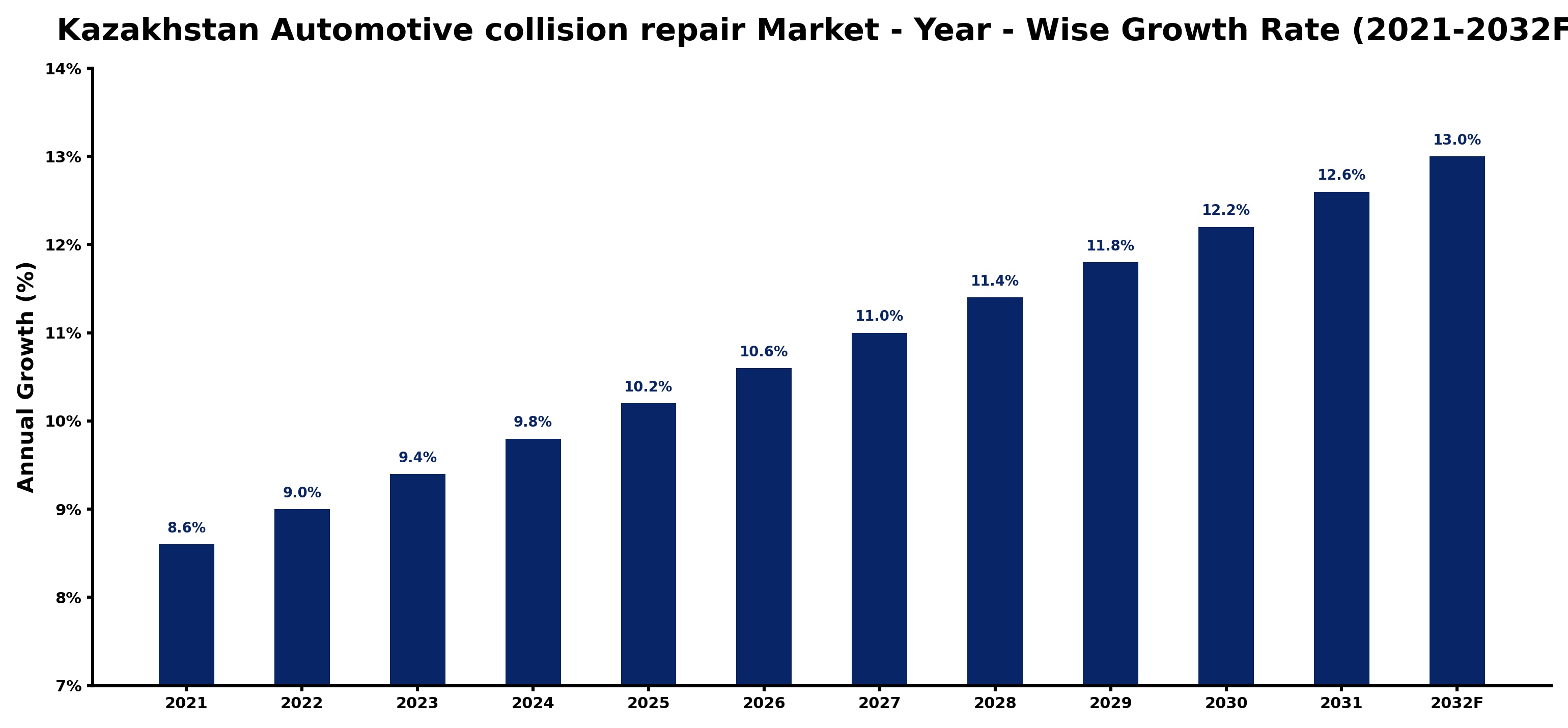
The table below presents the year‑wise growth rates along with the key drivers influencing the market
| Year | Growth Rate | Major Drivers |
| 2021 | 8.6% | Rising vehicle ownership rates |
| 2022 | 9.0% | Increased demand for repairs |
| 2023 | 9.4% | Technological advancements in repairs |
| 2024 | 9.8% | Expansion of service centers |
| 2025 | 10.2% | Growing awareness of safety |
| 2026 | 10.6% | Improved insurance coverage options |
| 2027 | 11.0% | Higher disposable income levels |
| 2028 | 11.4% | Increased urbanization driving demand |
| 2029 | 11.8% | Emergence of electric vehicles |
| 2030 | 12.2% | Enhanced customer service expectations |
| 2031 | 12.6% | Government incentives for repairs |
| 2032 | 13.0% | Sustainability trends influencing choices |
Note - Market size estimations and growth projections presented in this report are based on 6Wresearch’s advanced forecasting approach, validated with industry datasets as of June 2026.
Kazakhstan Automotive collision repair Market Synopsis
The rising number of vehicles on Kazakhstan's roads is the most significant factor shaping the automotive collision repair market today. As road traffic intensifies, so does the need for reliable and timely repair services that meet the increasing expectations of vehicle owners.
In addition to vehicle proliferation, advancements in repair technologies are reshaping how services are delivered. A marked shift towards incorporating high-tech tools and eco-friendly materials is enhancing repair quality and efficiency, aligning with broader sustainability goals within the industry.
Kazakhstan Automotive collision repair Market Key Takeaways
- Increasing vehicle ownership is driving demand for collision repair services across Kazakhstan.
- Technological advancements are improving the efficiency and quality of repair processes.
- There is a growing emphasis on environmentally sustainable practices within the repair industry.
- Partnerships with insurance companies are becoming vital for repair shops to enhance customer service.
- The market is witnessing a competitive landscape that favors high-quality workmanship and customer satisfaction.
Evaluation of Restraints in Kazakhstan Automotive collision repair Market
Despite its potential, the Kazakhstan automotive collision repair market faces significant constraints. One of the primary challenges is the scarcity of skilled technicians capable of utilizing modern repair technologies effectively. The fragmented nature of the industry, characterized by numerous small independent shops, complicates efforts to standardize repair processes, resulting in inconsistent service quality. Additionally, sourcing quality replacement parts remains a hurdle due to limited distribution networks, further impacting repair efficiency and customer satisfaction.
Kazakhstan Automotive collision repair Market Trends
Current trends indicate a shift toward adopting advanced technologies, including digital estimation tools and specialized repair equipment. Repair shops are increasingly focusing on enhancing turnaround times to meet customer expectations. Moreover, eco-friendly materials and practices are gaining traction, aligning with global sustainability trends. Collaboration with insurance companies is also on the rise, facilitating smoother communication and more efficient claims processing for customers.
Kazakhstan Automotive collision repair Market Opportunities
The collision repair market in Kazakhstan is ripe for investment opportunities, particularly in workshop infrastructure and advanced repair technologies. With the continuous rise in vehicle numbers, establishing modern repair facilities equipped with cutting-edge technology can offer substantial returns. Furthermore, government initiatives aimed at improving road safety enhance the investment climate, encouraging the establishment of professional repair services that meet stringent quality standards.
Government Initiatives in the Kazakhstan Automotive collision repair Market
Kazakhstan's government is actively involved in regulating the automotive collision repair market, focusing on safety, quality, and environmental sustainability. Regulations are in place to ensure that repair shops adhere to specific standards regarding equipment and technician training. Furthermore, the government is promoting the use of environmentally friendly practices, encouraging shops to adopt sustainable materials and techniques in their operations, thus fostering a culture of safety and responsibility in the industry.
Future Insights of the Kazakhstan Automotive collision repair Market
The future of the Kazakhstan automotive collision repair market looks promising, with anticipated steady growth through 2032. Factors such as increasing vehicle registrations, the emergence of electric vehicles, and evolving safety standards will create a need for specialized repair services. As technological advancements continue to revolutionize repair techniques, the market is set to embrace innovation, improving service delivery and customer experience. This evolution opens avenues for investment and expansion, making the sector increasingly attractive for new players.
Kazakhstan Automotive collision repair Market Latest Developments (May 2025 - June 2026)
Recent developments in the Kazakhstan automotive collision repair market indicate a strong shift towards technological integration. Many repair shops are beginning to adopt digital platforms for estimating repair costs and managing customer relationships. Additionally, environmental sustainability initiatives are gaining momentum, with several businesses exploring eco-friendly materials and practices. This transition reflects a growing awareness of environmental impacts among consumers and repair service providers alike.
Kazakhstan Automotive collision repair Market - Key Attractiveness of the Report
- 10 Years of Market Numbers
- Historical Data Starting from 2022 to 2025
- Base Year: 2025
- Forecast Data until 2032
- Key Performance Indicators Impacting the Market
- Major Upcoming Developments and Projects
Key Highlights of the Report:
- Kazakhstan Automotive collision repair Market Outlook
- Market Size of Kazakhstan Automotive collision repair Market, 2025
- Forecast of Kazakhstan Automotive collision repair Market, 2032
- Historical Data and Forecast of Kazakhstan Automotive collision repair Revenues & Volume for the Period 2022-2032F
- Kazakhstan Automotive collision repair Market Trend Evolution
- Kazakhstan Automotive collision repair Market Drivers and Challenges
- Kazakhstan Automotive collision repair Price Trends
- Kazakhstan Automotive collision repair Porter's Five Forces
- Kazakhstan Automotive collision repair Industry Life Cycle
- Historical Data and Forecast of Kazakhstan Automotive collision repair Market Revenues & Volume By Vehicle Type for the Period 2022-2032F
- Historical Data and Forecast of Kazakhstan Automotive collision repair Market Revenues & Volume By Light-duty for the Period 2022-2032F
- Historical Data and Forecast of Kazakhstan Automotive collision repair Market Revenues & Volume By Heavy-duty for the Period 2022-2032F
- Historical Data and Forecast of Kazakhstan Automotive collision repair Market Revenues & Volume By Product for the Period 2022-2032F
- Historical Data and Forecast of Kazakhstan Automotive collision repair Market Revenues & Volume By Paints & coatings for the Period 2022-2032F
- Historical Data and Forecast of Kazakhstan Automotive collision repair Market Revenues & Volume By Consumables for the Period 2022-2032F
- Historical Data and Forecast of Kazakhstan Automotive collision repair Market Revenues & Volume By Spare parts for the Period 2022-2032F
- Historical Data and Forecast of Kazakhstan Automotive collision repair Market Revenues & Volume By Service Channel for the Period 2022-2032F
- Historical Data and Forecast of Kazakhstan Automotive collision repair Market Revenues & Volume By DIY for the Period 2022-2032F
- Historical Data and Forecast of Kazakhstan Automotive collision repair Market Revenues & Volume By DIFM for the Period 2022-2032F
- Historical Data and Forecast of Kazakhstan Automotive collision repair Market Revenues & Volume By OE for the Period 2022-2032F
- Kazakhstan Automotive collision repair Import Export Trade Statistics
- Market Opportunity Assessment By Vehicle Type
- Market Opportunity Assessment By Product
- Market Opportunity Assessment By Service Channel
- Kazakhstan Automotive collision repair Top Companies Market Share
- Kazakhstan Automotive collision repair Competitive Benchmarking By Technical and Operational Parameters
- Kazakhstan Automotive collision repair Company Profiles
- Kazakhstan Automotive collision repair Key Strategic Recommendations






































