Kazakhstan Automotive Seat Belts Market Size, Share & Growth Rate
The Kazakhstan Automotive Seat Belts Market was estimated at USD 156 Million in 2025 and is projected to reach USD 218 Million by 2032, growing at a CAGR of 4.9% from 2026 to 2032. This growth trajectory is primarily driven by increasing public awareness regarding road safety and the government's stringent regulations mandating seat belt usage. Moreover, the rising incidence of road accidents emphasizes the necessity for advanced safety solutions, prompting manufacturers to innovate and improve seat belt technologies to meet evolving safety standards.
Kazakhstan Automotive Seat Belts Market Year-wise Growth Rate and Key Drivers
This graph highlights how the Kazakhstan Automotive Seat Belts Market has steadily grown over the years, supported by major growth factors.
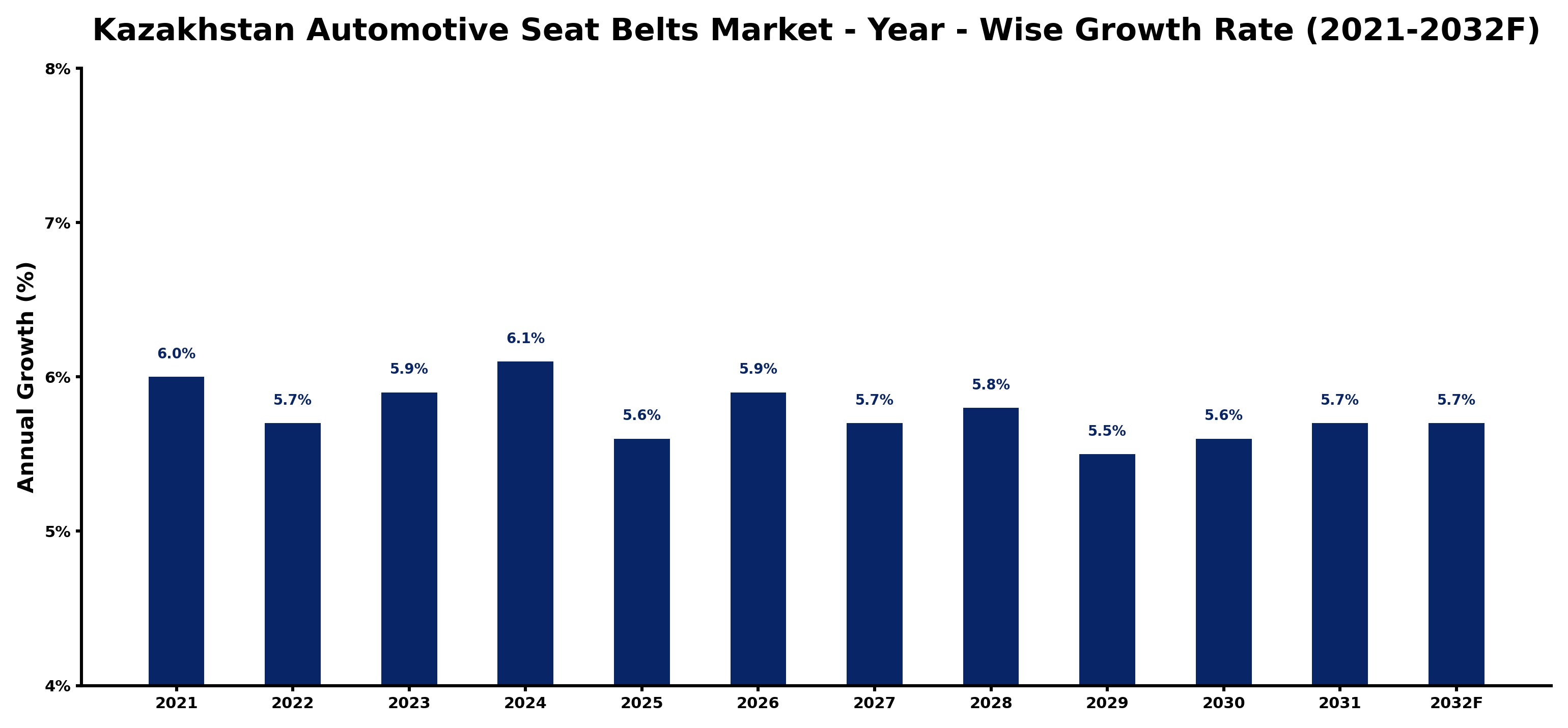
The table below presents the year‑wise growth rates along with the key drivers influencing the market
| Year | Growth Rate | Major Drivers |
| 2021 | 6.0% | Rising vehicle production rates |
| 2022 | 5.7% | Increased safety regulations implemented |
| 2023 | 5.9% | Consumer awareness of safety heightened |
| 2024 | 6.1% | Technological advancements in manufacturing |
| 2025 | 5.6% | Growing demand for electric vehicles |
| 2026 | 5.9% | Enhanced automotive safety features developed |
| 2027 | 5.7% | Expansion of automotive aftermarket services |
| 2028 | 5.8% | Rising disposable income levels observed |
| 2029 | 5.5% | Increased investment in infrastructure projects |
| 2030 | 5.6% | Growing urbanization driving vehicle sales |
| 2031 | 5.7% | Strengthened partnerships with automotive manufacturers |
| 2032 | 5.7% | Sustainability trends influencing consumer choices |
Note - Market size estimations and growth projections presented in this report are based on 6Wresearch's advanced forecasting approach, validated with industry datasets as of June 2026.
Kazakhstan Automotive Seat Belts Market Synopsis
The Kazakhstan Automotive Seat Belts Market is undergoing significant transformation, fueled by both consumer demand for enhanced safety features and government regulations that prioritize occupant protection. With a clear shift towards integrating smart technologies into seat belts, the market is evolving to offer products that not only meet but exceed international safety standards.
Currently, the landscape is marked by a push for lightweight and durable materials, designed to improve comfort while contributing to vehicle fuel efficiency. As the automotive sector expands within Kazakhstan, so too does the focus on passenger safety, presenting a unique opportunity for growth and development within this niche market.
Kazakhstan Automotive Seat Belts Market Key Takeaways
- The market is driven by increased government regulations promoting mandatory seat belt usage.
- Consumer preference is shifting toward vehicles equipped with advanced safety features, including smart seat belts.
- Ongoing R&D investments are crucial for developing innovative seat belt technologies that enhance safety.
- Challenges such as competition from international brands and counterfeit products persist in the market.
- The growing automotive sector in Kazakhstan presents lucrative investment opportunities for manufacturers and suppliers.
Evaluation of Restraints in Kazakhstan Automotive Seat Belts Market
Despite the encouraging growth, several restraints pose challenges to the Kazakhstan Automotive Seat Belts Market. One significant issue is the increasing competition from international manufacturers that bring advanced safety technologies to the fore, often at lower costs. Additionally, fluctuating prices of raw materials can hinder profitability for local manufacturers, impacting their ability to invest in quality and innovation. Consumer awareness regarding the importance of seat belt use remains limited, which in turn affects market penetration. Furthermore, the issue of counterfeit seat belts can undermine confidence in product safety and efficacy, necessitating collective efforts from stakeholders to enhance enforcement of safety regulations and promote authentic products.
Kazakhstan Automotive Seat Belts Market Trends
The market is increasingly gravitating towards the incorporation of advanced technology within seat belts. Features such as sensors and pretensioners are gaining traction, reflecting a broader consumer demand for enhanced vehicle safety. Additionally, there's a noticeable trend toward developing lightweight materials that not only improve safety but also optimize fuel efficiency, addressing dual consumer concerns regarding safety and economy. Furthermore, the government's proactive stance on road safety is creating a conducive environment for innovative solutions, ensuring that seat belts are not only a regulatory requirement but also a focal point for automotive safety advancements.
Kazakhstan Automotive Seat Belts Market Opportunities
Investment prospects in the Kazakhstan Automotive Seat Belts Market are promising, especially as regulatory requirements for vehicle safety tighten. The burgeoning middle class, combined with rising disposable incomes, suggests a higher willingness to invest in vehicle safety features, including high-quality seat belts. Opportunities abound for developing innovative products, particularly those that integrate smart technology or offer customizable features for improved comfort. Furthermore, partnerships with automotive manufacturers could enhance distribution channels and market penetration, creating substantial returns on investment in this evolving sector.
Government Initiatives in the Kazakhstan Automotive Seat Belts Market
The Kazakhstan government has enacted mandatory seat belt usage laws, aiming to significantly reduce traffic-related fatalities and injuries. These regulations not only mandate the use of seat belts for all vehicle occupants but also enforce stringent manufacturing standards to ensure that all seat belts available in the market meet established safety criteria. Monitoring and enforcement of these regulations are crucial for ensuring compliance, reflecting the government's commitment to enhancing road safety across the nation.
Future Insights of the Kazakhstan Automotive Seat Belts Market
Looking ahead, the Kazakhstan Automotive Seat Belts Market is set for substantial growth, driven by heightened safety awareness and regulatory pressures. As vehicle ownership rises, coupled with improvements in road safety initiatives, demand for advanced seat belt solutions is expected to increase. Technological advancements in materials and design will likely lead to new product offerings, further propelling market expansion. By 2032, the emphasis on safety will ensure that the market not only grows in size but also in the quality of products available, solidifying its importance in the overall automotive landscape of Kazakhstan.
Kazakhstan Automotive Seat Belts Market Latest Developments (May 2025 - June 2026)
Recent developments in the Kazakhstan Automotive Seat Belts Market indicate a proactive shift towards integrating smart technologies into seat belt designs. Manufacturers are increasingly focused on R&D initiatives that aim to create more efficient, reliable, and technologically advanced seat belts. Additionally, the market is witnessing collaborations between automotive companies and tech firms to introduce features such as real-time monitoring and feedback systems. The government's ongoing efforts to enhance enforcement of road safety regulations are also expected to drive further innovations and improvements in the automotive safety sector.
Kazakhstan Automotive Seat Belts Market - Key Attractiveness of the Report
- 10 Years of Market Numbers
- Historical Data Starting from 2022 to 2025
- Base Year: 2025
- Forecast Data until 2032
- Key Performance Indicators Impacting the Market
- Major Upcoming Developments and Projects
Key Highlights of the Report:
- Kazakhstan Automotive Seat Belts Market Outlook
- Market Size of Kazakhstan Automotive Seat Belts Market, 2025
- Forecast of Kazakhstan Automotive Seat Belts Market, 2032
- Historical Data and Forecast of Kazakhstan Automotive Seat Belts Revenues & Volume for the Period 2022-2032F
- Kazakhstan Automotive Seat Belts Market Trend Evolution
- Kazakhstan Automotive Seat Belts Market Drivers and Challenges
- Kazakhstan Automotive Seat Belts Price Trends
- Kazakhstan Automotive Seat Belts Porter's Five Forces
- Kazakhstan Automotive Seat Belts Industry Life Cycle
- Historical Data and Forecast of Kazakhstan Automotive Seat Belts Market Revenues & Volume By Type for the Period 2022-2032F
- Historical Data and Forecast of Kazakhstan Automotive Seat Belts Market Revenues & Volume By 2-point Seatbelt for the Period 2022-2032F
- Historical Data and Forecast of Kazakhstan Automotive Seat Belts Market Revenues & Volume By 3-point Seatbelt for the Period 2022-2032F
- Historical Data and Forecast of Kazakhstan Automotive Seat Belts Market Revenues & Volume By Vehicle for the Period 2022-2032F
- Historical Data and Forecast of Kazakhstan Automotive Seat Belts Market Revenues & Volume By Passenger Cars for the Period 2022-2032F
- Historical Data and Forecast of Kazakhstan Automotive Seat Belts Market Revenues & Volume By Light Commercial Vehicles for the Period 2022-2032F
- Historical Data and Forecast of Kazakhstan Automotive Seat Belts Market Revenues & Volume By Heavy Commercial Vehicles for the Period 2022-2032F
- Historical Data and Forecast of Kazakhstan Automotive Seat Belts Market Revenues & Volume By Component for the Period 2022-2032F
- Historical Data and Forecast of Kazakhstan Automotive Seat Belts Market Revenues & Volume By Webbing strap for the Period 2022-2032F
- Historical Data and Forecast of Kazakhstan Automotive Seat Belts Market Revenues & Volume By Retractor for the Period 2022-2032F
- Historical Data and Forecast of Kazakhstan Automotive Seat Belts Market Revenues & Volume By Buckle for the Period 2022-2032F
- Historical Data and Forecast of Kazakhstan Automotive Seat Belts Market Revenues & Volume By Tongue for the Period 2022-2032F
- Historical Data and Forecast of Kazakhstan Automotive Seat Belts Market Revenues & Volume By Pillar Loop for the Period 2022-2032F
- Historical Data and Forecast of Kazakhstan Automotive Seat Belts Market Revenues & Volume By Distribution Channels for the Period 2022-2032F
- Historical Data and Forecast of Kazakhstan Automotive Seat Belts Market Revenues & Volume By OEM for the Period 2022-2032F
- Historical Data and Forecast of Kazakhstan Automotive Seat Belts Market Revenues & Volume By Aftermarket for the Period 2022-2032F
- Kazakhstan Automotive Seat Belts Import Export Trade Statistics
- Market Opportunity Assessment By Type
- Market Opportunity Assessment By Vehicle
- Market Opportunity Assessment By Component
- Market Opportunity Assessment By Distribution Channels
- Kazakhstan Automotive Seat Belts Top Companies Market Share
- Kazakhstan Automotive Seat Belts Competitive Benchmarking By Technical and Operational Parameters
- Kazakhstan Automotive Seat Belts Company Profiles
- Kazakhstan Automotive Seat Belts Key Strategic Recommendations






































