Kazakhstan Ballast Water Treatment Market Size, Share & Growth Rate
The Kazakhstan Ballast Water Treatment Market was estimated at USD 184 Million in 2025 and is projected to reach USD 252 Million by 2032, growing at a CAGR of 4.6% from 2026 to 2032. This upward trajectory is primarily driven by stringent international regulations aimed at mitigating the ecological risks associated with invasive species spread through ballast water. As Kazakhstan enhances its maritime trade, particularly in the Caspian Sea, compliance with these regulations is becoming increasingly critical, prompting a surge in demand for sophisticated ballast water treatment systems.
Kazakhstan Ballast Water Treatment Market Year-wise Growth Rate and Key Drivers
This graph highlights how the Kazakhstan Ballast Water Treatment Market has steadily grown over the years, supported by major growth factors.
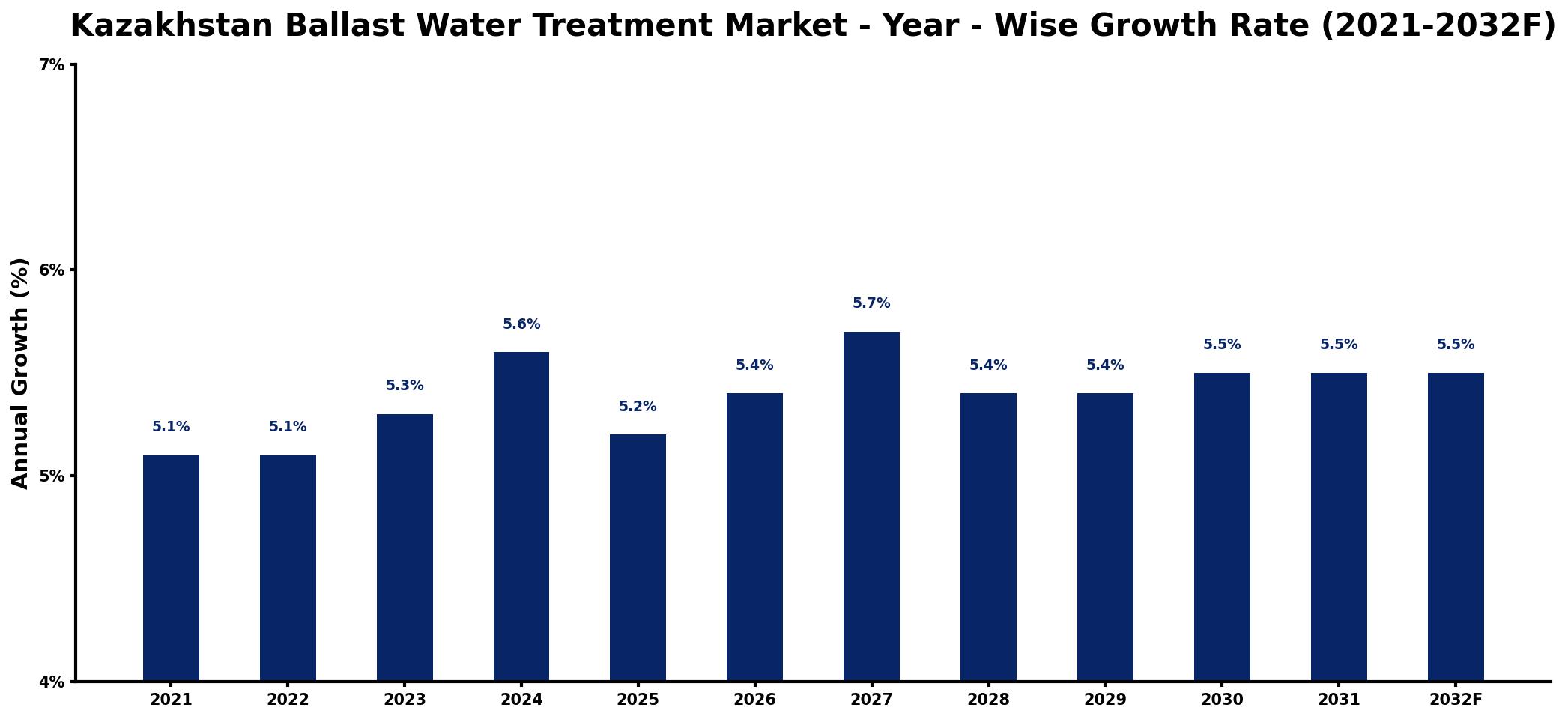
The table below presents the year‑wise growth rates along with the key drivers influencing the market
| Year | Growth Rate | Major Drivers |
| 2021 | 5.1% | Increased maritime regulatory requirements |
| 2022 | 5.1% | Growing shipping industry investments |
| 2023 | 5.3% | Expansion of port infrastructure projects |
| 2024 | 5.6% | Rising environmental sustainability awareness |
| 2025 | 5.2% | Technological advancements in compliance |
| 2026 | 5.4% | Enhanced international trade agreements |
| 2027 | 5.7% | Demand for eco-friendly solutions |
| 2028 | 5.4% | Strengthened government enforcement policies |
| 2029 | 5.4% | Increased shipping fleet modernization |
| 2030 | 5.5% | Growing global environmental initiatives |
| 2031 | 5.5% | Rising consumer demand for sustainability |
| 2032 | 5.5% | growing commercial sector adoption |
Note: Market size estimations and growth projections presented in this report are based on 6Wresearch's proprietary forecasting methodology, utilizing the latest available industry data, government publications, and primary research inputs.
Kazakhstan Ballast Water Treatment Market Synopsis
The ballast water treatment market in Kazakhstan is rapidly evolving, driven by the need to adhere to international maritime laws. As shipping activity expands, particularly in major ports, the urgency to implement effective treatment solutions to protect local aquatic ecosystems has intensified. This market is now seen as a vital component of the country's commitment to sustainable environmental practices.
Kazakhstan's strategic position along the Caspian Sea enhances its significance in the ballast water treatment landscape. The nation is not only working to comply with international standards set by the International Maritime Organization (IMO) but is also focused on fostering technological innovation to ensure the efficacy and reliability of these treatment systems in varying environmental conditions.
Kazakhstan Ballast Water Treatment Market Key Takeaways
- Rapidly growing demand for ballast water treatment systems driven by international regulations.
- Kazakhstan's strategic maritime location enhances the relevance of ballast water management.
- Increased focus on innovative and cost-effective treatment solutions to meet compliance requirements.
- Government policies are strongly aligned with international environmental standards.
- Technological advancements are crucial for improving treatment efficacy and operational reliability.
Evaluation of Restraints in Kazakhstan Ballast Water Treatment Market
Despite the promising growth of the ballast water treatment market in Kazakhstan, several restraints hinder its full potential. One major limitation is the complexity of adhering to evolving international regulations, which can create uncertainty for shipowners and operators. Additionally, the market struggles with the high operational costs associated with implementing cutting-edge treatment technologies. Many companies also face challenges in standardizing technologies that perform reliably across the diverse conditions found in the Caspian Sea, ultimately impacting their market acceptance and implementation.
Kazakhstan Ballast Water Treatment Market Trends
Emerging trends in the Kazakhstan ballast water treatment market include a shift towards more environmentally friendly technologies, such as electrochlorination and UV treatment systems. There is also a notable increase in partnerships and collaborations aimed at technological advancements and knowledge sharing among stakeholders in the maritime industry. The emphasis on digital solutions, such as remote monitoring and data analytics, is shaping how treatment systems are managed, improving efficiency and compliance tracking.
Kazakhstan Ballast Water Treatment Market Opportunities
The Kazakhstan ballast water treatment market presents significant growth and investment opportunities. With increasing international trade and maritime traffic, there is a strong demand for innovative treatment solutions that meet regulatory requirements. Furthermore, as the Kazakhstani government continues to strengthen its environmental policies, businesses that focus on R&D for advanced treatment technologies will find a favorable landscape for growth. Additionally, investment in training and support services for operators can enhance system efficacy and reliability, further bolstering market expansion.
Government Initiatives in the Kazakhstan Ballast Water Treatment Market
The Kazakhstani government is actively implementing policies that promote environmental sustainability in maritime operations. These regulations prioritize the adoption of advanced ballast water treatment technologies to comply with international standards. Financial incentives and support programs aimed at facilitating technological upgrades are being explored to bolster compliance among shipowners and operators. This governmental commitment underscores Kazakhstan's strategic approach to protecting its aquatic ecosystems while enabling robust maritime trade.
Future Insights of the Kazakhstan Ballast Water Treatment Market
Looking ahead to the period from 2026 to 2032, the Kazakhstan ballast water treatment market is poised for robust growth. Factors such as the increasing complexity of international compliance requirements and the ongoing expansion of maritime trade will drive the need for reliable treatment solutions. Additionally, the continuous advancement of treatment technologies will play a pivotal role in enhancing system performance. As stakeholders in the industry adapt to these changes, the market is expected to witness significant innovation and investment, solidifying its place as a critical component of Kazakhstan's environmental strategy.
Kazakhstan Ballast Water Treatment Market Latest Developments (2025 - 2026)
Recent developments in the Kazakhstan ballast water treatment market indicate an increasing focus on technological collaboration and innovation. Industry stakeholders are actively engaging in discussions to optimize existing treatment technologies and explore new solutions that align with international standards. There is a growing recognition of the importance of research initiatives aimed at improving treatment efficacy in diverse environmental conditions, ensuring that Kazakhstan can effectively safeguard its marine ecosystems while advancing its maritime economy.
Kazakhstan Ballast Water Treatment Market - Key Attractiveness of the Report
- 10 Years of Market Numbers
- Historical Data Starting from 2022 to 2025
- Base Year: 2025
- Forecast Data until 2032
- Key Performance Indicators Impacting the Market
- Major Upcoming Developments and Projects
Key Highlights of the Report:
- Kazakhstan Ballast Water Treatment Market Outlook
- Market Size of Kazakhstan Ballast Water Treatment Market, 2025
- Forecast of Kazakhstan Ballast Water Treatment Market, 2032
- Historical Data and Forecast of Kazakhstan Ballast Water Treatment Revenues & Volume for the Period 2022-2032F
- Kazakhstan Ballast Water Treatment Market Trend Evolution
- Kazakhstan Ballast Water Treatment Market Drivers and Challenges
- Kazakhstan Ballast Water Treatment Price Trends
- Kazakhstan Ballast Water Treatment Porter's Five Forces
- Kazakhstan Ballast Water Treatment Industry Life Cycle
- Historical Data and Forecast of Kazakhstan Ballast Water Treatment Market Revenues & Volume By Technology for the Period 2022-2032F
- Historical Data and Forecast of Kazakhstan Ballast Water Treatment Market Revenues & Volume By Physical Disinfection for the Period 2022-2032F
- Historical Data and Forecast of Kazakhstan Ballast Water Treatment Market Revenues & Volume By Mechanical Method for the Period 2022-2032F
- Historical Data and Forecast of Kazakhstan Ballast Water Treatment Market Revenues & Volume By Chemical Method for the Period 2022-2032F
- Historical Data and Forecast of Kazakhstan Ballast Water Treatment Market Revenues & Volume By Service for the Period 2022-2032F
- Historical Data and Forecast of Kazakhstan Ballast Water Treatment Market Revenues & Volume By Installation & Calibration for the Period 2022-2032F
- Historical Data and Forecast of Kazakhstan Ballast Water Treatment Market Revenues & Volume By Performance Measurement for the Period 2022-2032F
- Historical Data and Forecast of Kazakhstan Ballast Water Treatment Market Revenues & Volume By Recommissioning for the Period 2022-2032F
- Kazakhstan Ballast Water Treatment Import Export Trade Statistics
- Market Opportunity Assessment By Technology
- Market Opportunity Assessment By Service
- Kazakhstan Ballast Water Treatment Top Companies Market Share
- Kazakhstan Ballast Water Treatment Competitive Benchmarking By Technical and Operational Parameters
- Kazakhstan Ballast Water Treatment Company Profiles
- Kazakhstan Ballast Water Treatment Key Strategic Recommendations






































