Kazakhstan BBQ Charcoal Market Size Growth Rate
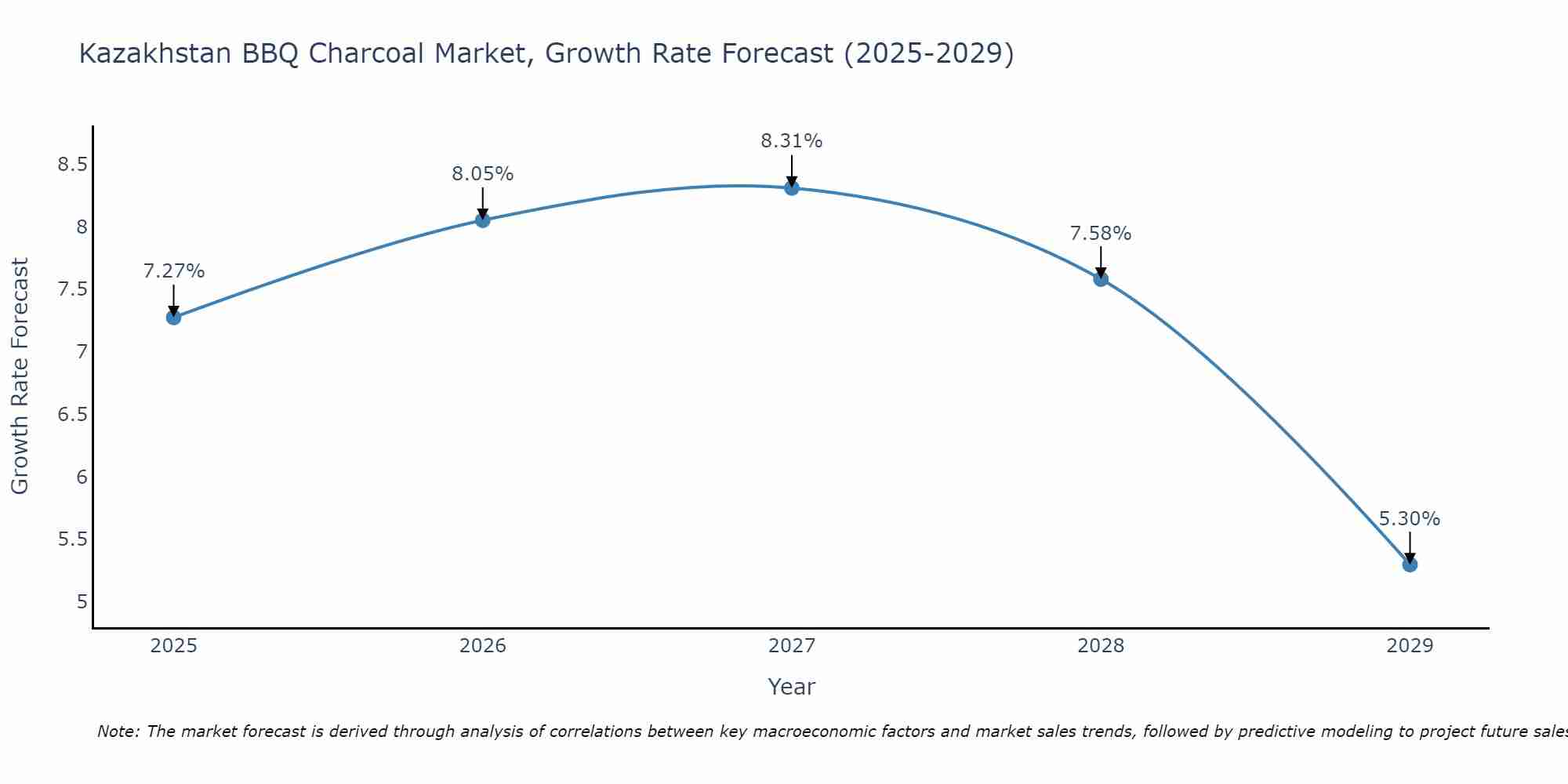
The Kazakhstan BBQ Charcoal Market is projected to witness mixed growth rate patterns during 2025 to 2029. Growth accelerates to 8.31% in 2027, following an initial rate of 7.27%, before easing to 5.30% at the end of the period.
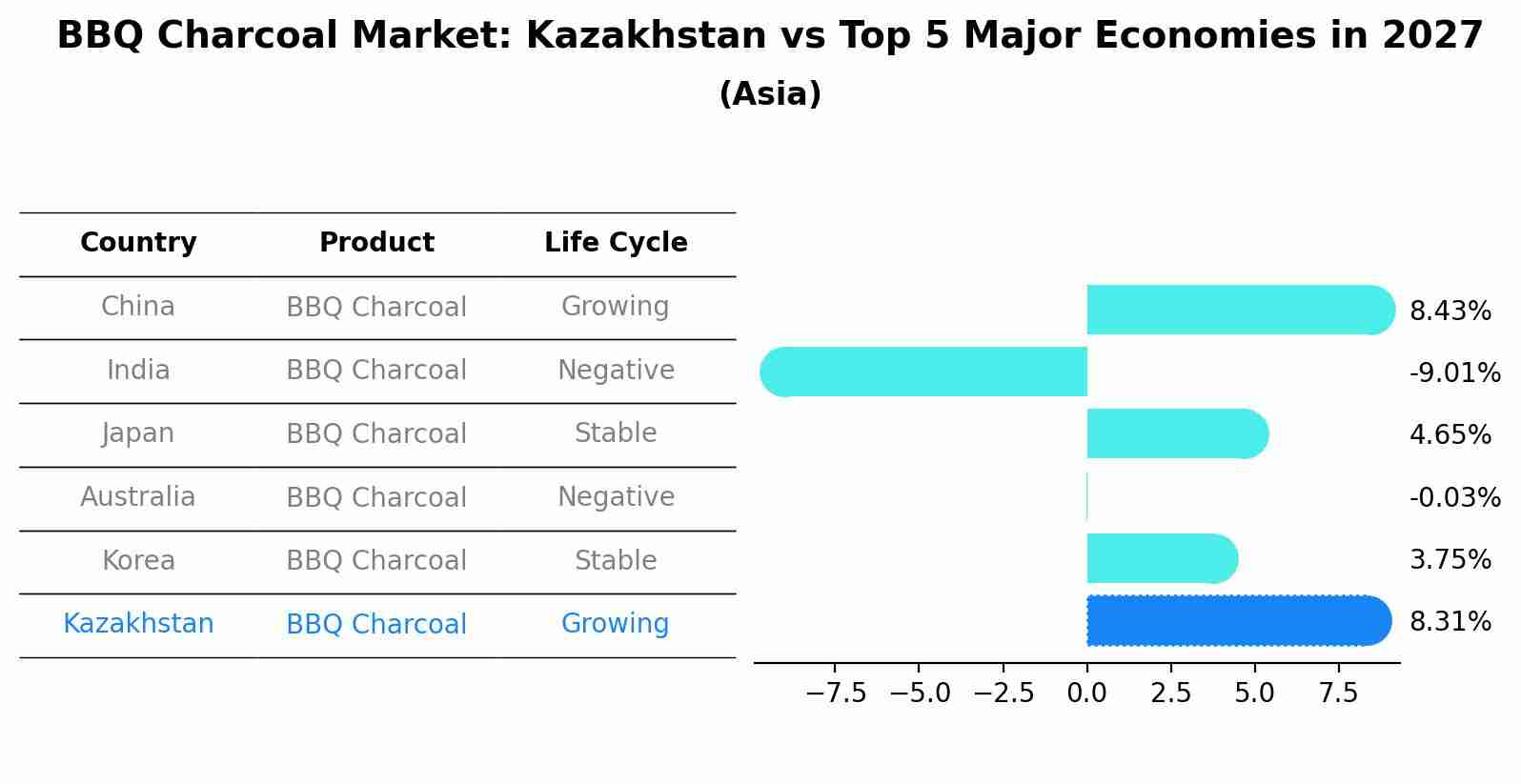
BBQ Charcoal Market: Kazakhstan vs Top 5 Major Economies in 2027 (Asia)
The BBQ Charcoal market in Kazakhstan is projected to grow at a growing growth rate of 8.31% by 2027, within the Asia region led by China, along with other countries like India, Japan, Australia and South Korea, collectively shaping a dynamic and evolving market environment driven by innovation and increasing adoption of emerging technologies.
Kazakhstan BBQ Charcoal Market Overview
Kazakhstan BBQ charcoal market is thriving due to the popularity of outdoor grilling and barbecuing. The market is driven by consumer demand for high-quality charcoal that provides better heat and longer burn times. Additionally, the rise in disposable income and the trend towards outdoor leisure activities contribute to market growth.
Drivers of the market
The Kazakhstan BBQ charcoal market is witnessing steady growth driven by the rising popularity of outdoor cooking and recreational activities. BBQ charcoal is preferred by consumers for its high heat output, long burning time, and characteristic smoky flavor imparted to grilled food. With increasing disposable incomes and a growing culture of outdoor dining and social gatherings, the demand for BBQ charcoal is on the rise.
Challenges of the market
The BBQ charcoal market in Kazakhstan encounters challenges associated with sustainability, resource management, and market competition. Traditional charcoal production methods often involve unsustainable harvesting practices, deforestation, and environmental degradation. Addressing these challenges requires promoting sustainable forestry practices, implementing efficient charcoal production technologies, and raising consumer awareness about the environmental impact of charcoal consumption. Moreover, market competition from alternative grilling fuels and regulatory constraints on charcoal production and distribution pose additional challenges for market players.
Government Policy of the market
Environmental policies regulate the production and use of BBQ charcoal to minimize deforestation and promote sustainable practices. The government supports the production of eco-friendly charcoal alternatives and provides guidelines for responsible charcoal manufacturing.
Key Highlights of the Report:
- Kazakhstan BBQ Charcoal Market Outlook
- Market Size of Kazakhstan BBQ Charcoal Market, 2024
- Forecast of Kazakhstan BBQ Charcoal Market, 2031
- Historical Data and Forecast of Kazakhstan BBQ Charcoal Revenues & Volume for the Period 2021-2031
- Kazakhstan BBQ Charcoal Market Trend Evolution
- Kazakhstan BBQ Charcoal Market Drivers and Challenges
- Kazakhstan BBQ Charcoal Price Trends
- Kazakhstan BBQ Charcoal Porter's Five Forces
- Kazakhstan BBQ Charcoal Industry Life Cycle
- Historical Data and Forecast of Kazakhstan BBQ Charcoal Market Revenues & Volume By Form for the Period 2021-2031
- Historical Data and Forecast of Kazakhstan BBQ Charcoal Market Revenues & Volume By Briquettes BBQ Charcoal for the Period 2021-2031
- Historical Data and Forecast of Kazakhstan BBQ Charcoal Market Revenues & Volume By Lump Wood BBQ Charcoal for the Period 2021-2031
- Historical Data and Forecast of Kazakhstan BBQ Charcoal Market Revenues & Volume By Sales Channel for the Period 2021-2031
- Historical Data and Forecast of Kazakhstan BBQ Charcoal Market Revenues & Volume By Direct BBQ Charcoal Sales for the Period 2021-2031
- Historical Data and Forecast of Kazakhstan BBQ Charcoal Market Revenues & Volume By Retail BBQ Charcoal Sales for the Period 2021-2031
- Historical Data and Forecast of Kazakhstan BBQ Charcoal Market Revenues & Volume By End User for the Period 2021-2031
- Historical Data and Forecast of Kazakhstan BBQ Charcoal Market Revenues & Volume By BBQ Charcoal for Hotels, Restaurants and Catering (HoReCa) for the Period 2021-2031
- Historical Data and Forecast of Kazakhstan BBQ Charcoal Market Revenues & Volume By BBQ Charcoal for Households for the Period 2021-2031
- Historical Data and Forecast of Kazakhstan BBQ Charcoal Market Revenues & Volume By Source for the Period 2021-2031
- Historical Data and Forecast of Kazakhstan BBQ Charcoal Market Revenues & Volume By BBQ Charcoal made from Agricultural Waste for the Period 2021-2031
- Historical Data and Forecast of Kazakhstan BBQ Charcoal Market Revenues & Volume By BBQ Charcoal made from Coconut Shells for the Period 2021-2031
- Historical Data and Forecast of Kazakhstan BBQ Charcoal Market Revenues & Volume By BBQ Charcoal made from Nutshells for the Period 2021-2031
- Historical Data and Forecast of Kazakhstan BBQ Charcoal Market Revenues & Volume By BBQ Charcoal made from Hardwood for the Period 2021-2031
- Historical Data and Forecast of Kazakhstan BBQ Charcoal Market Revenues & Volume By BBQ Charcoal made from Bamboo for the Period 2021-2031
- Kazakhstan BBQ Charcoal Import Export Trade Statistics
- Market Opportunity Assessment By Form
- Market Opportunity Assessment By Sales Channel
- Market Opportunity Assessment By End User
- Market Opportunity Assessment By Source
- Kazakhstan BBQ Charcoal Top Companies Market Share
- Kazakhstan BBQ Charcoal Competitive Benchmarking By Technical and Operational Parameters
- Kazakhstan BBQ Charcoal Company Profiles
- Kazakhstan BBQ Charcoal Key Strategic Recommendations






































