Kazakhstan Bulletproof Vest Market Summary
The kazakhstan bulletproof vest market was estimated at USD 191 Million in 2025 and is projected to reach USD 265 Million by 2032, growing at a CAGR of 5.7% from 2026 to 2032.
Kazakhstan Bulletproof Vest Market Year-wise Growth Rate and Key Drivers
This graph highlights how the Kazakhstan Bulletproof Vest Market has steadily grown over the past five years, supported by major growth factors.
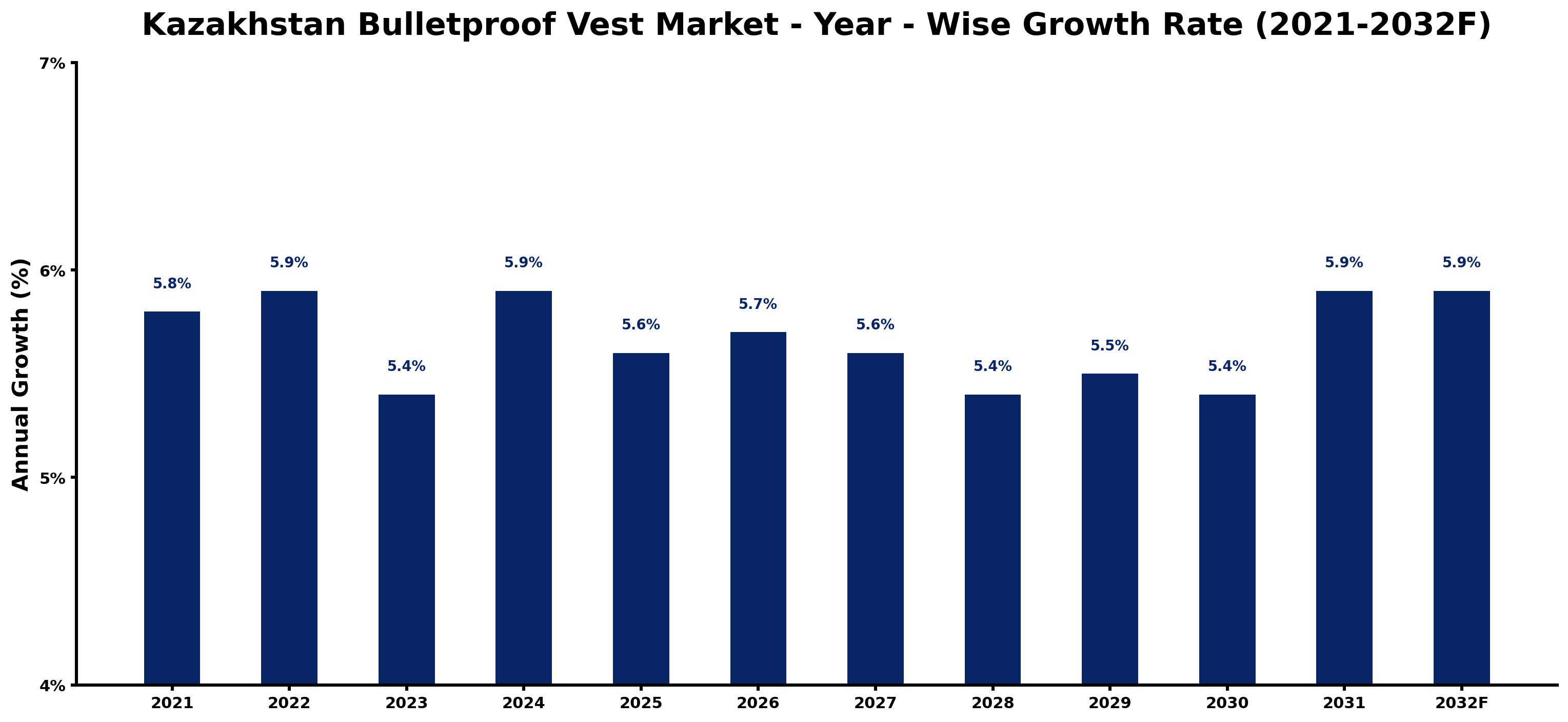
The table below presents the year wise growth rates along with the key drivers influencing the market
| Year | Growth Rate | Major Drivers |
| 2021 | 5.8% | The ongoing geopolitical tensions in Central Asia underscore security needs across the region. |
| 2022 | 5.9% | Local manufacturers begin to enhance product offerings, focusing on quality and affordability. |
| 2023 | 5.4% | Rising crime rates in urban areas lead to increased interest in personal protection gear. |
| 2024 | 5.9% | Corporate security budgets expand, reflecting heightened concerns over employee safety and risk. |
| 2025 | 5.6% | International collaborations introduce advanced materials and technologies to local production facilities. |
| 2026 | 5.7% | Public awareness campaigns emphasize the importance of protective gear in hostile environments. |
| 2027 | 5.6% | Military procurement processes undergo reform, streamlining acquisitions for efficiency and effectiveness. |
| 2028 | 5.4% | Local law enforcement agencies prioritize bulletproof vest purchases amid rising public safety concerns. |
| 2029 | 5.5% | E-commerce platforms expand, making protective equipment more accessible to a wider audience. |
| 2030 | 5.4% | Innovative startups emerge, focusing on custom designs that cater to diverse consumer needs. |
| 2031 | 5.9% | Export opportunities arise as Kazakhstan establishes itself as a regional manufacturing hub. |
| 2032 | 5.9% | Sustainability trends influence material sourcing, driving demand for eco-friendly protective solutions. |
Note - Market size estimations and growth projections presented in this report are based on 6Wresearch's advanced forecasting approach, validated with industry datasets as of June 2026.
Kazakhstan Bulletproof Vest Market Synopsis
The Kazakhstan Bulletproof Vest Market is projected to reach 5.7% and witness significant growth during the forecast period (2026-2032). This growth trajectory is primarily driven by escalating concerns over safety due to rising terrorist activities, ongoing military conflicts, as well as an increase in demand from law enforcement agencies. Furthermore, the government's heightened investment in border security initiatives is expected to further boost the market. Alongside these factors, the advancements in technology leading to the development of lightweight, durable fabrics and ballistic plates are also pivotal in shaping the future of protective clothing in Kazakhstan.
Kazakhstan Bulletproof Vest Market Growth Drivers
The demand for bulletproof vests in Kazakhstan has surged, influenced by several crucial drivers:
- Increased terrorist activities in Kazakhstan have escalated concerns for personal safety, prompting a higher demand for protective gear among citizens.
- Growing awareness regarding personal security has led individuals to consider high-quality body armor solutions, particularly those made from advanced materials such as Kevlar and Dyneema.
- Local manufacturers in Kazakhstan are responding to this market need by offering innovative bulletproof vest solutions, which are equipped with features such as stab resistance and flame retardant properties.
- There is a notable trend of international vendors targeting the Kazakhstan market due to its expansive potential customer base, driven by favorable import regulations.
- Policy changes in various countries mandating the use of body armor for law enforcement officers during public duties and high-risk events have also influenced the growth dynamics of the Kazakhstan Bulletproof Vest Market.
Kazakhstan Bulletproof Vest Market Challenges and Restraints
While the Kazakhstan Bulletproof Vest Market is on a growth path, it faces several challenges that may hinder its progress:
- High manufacturing costs associated with advanced materials can limit the affordability of bulletproof vests for some segments of the population.
- The market struggles with a lack of awareness about the benefits of personal protective equipment, particularly in less urbanized regions.
- Regulatory hurdles and lengthy approval processes for new products can delay the entry of innovative solutions into the market.
- Market saturation in certain segments may lead to intense competition and price wars among suppliers, impacting profit margins.
- The fluctuating economic conditions could affect public sector budgets allocated to law enforcement agencies, consequently impacting their purchasing capacity.
Kazakhstan Bulletproof Vest Market Government Investment and Initiatives
The government of Kazakhstan has recognized the necessity of enhancing national security, which includes investing in protective gear for law enforcement. Initiatives aimed at bolstering border security through increased funding have underscored the importance of equipping law enforcement with adequate protective apparel. Various government policies have been introduced to encourage public spending on security measures, including body armor. Additionally, incentives for the local manufacturing of bulletproof vests are being considered to foster domestic production capabilities, thus reducing reliance on imports. These strategic investments and policies are pivotal in driving the growth of the Kazakhstan Bulletproof Vest Market.
Kazakhstan Bulletproof Vest Market Latest Developments (May 2025 - June 2026)
Recent developments in the Kazakhstan Bulletproof Vest Market indicate a pronounced shift towards enhanced safety measures and technology innovations. Between May 2025 and June 2026, the focus has been on refining the designs of bulletproof vests to incorporate user-friendly features that cater to the needs of various governmental and civilian sectors. Collaborative efforts between local firms and international suppliers have increased, facilitating knowledge transfer and technology sharing. There is also a growing emphasis on research and development in the field of protective fabrics, contributing to the production of lighter and more effective bulletproof vests. This period has seen a rise in marketing campaigns aimed at raising awareness of personal protective equipment and its significance in enhancing safety among the populace.
Kazakhstan Bulletproof Vest Market - Key Attractiveness of the Report
- 10 Years of Market Numbers
- Historical Data Starting from 2022 to 2025
- Base Year: 2025
- Forecast Data until 2032
- Key Performance Indicators Impacting the Market
- Major Upcoming Developments and Projects
Key Highlights of the Report:
- Kazakhstan Bulletproof Vest Market Outlook
- Market Size of Kazakhstan Bulletproof Vest Market, 2025
- Forecast of Kazakhstan Bulletproof Vest Market, 2032F
- Historical Data and Forecast of Kazakhstan Bulletproof Vest Revenues & Volume for the Period 2022-2032F
- Kazakhstan Bulletproof Vest Market Trend Evolution
- Kazakhstan Bulletproof Vest Market Drivers and Challenges
- Kazakhstan Bulletproof Vest Price Trends
- Kazakhstan Bulletproof Vest Porter's Five Forces
- Kazakhstan Bulletproof Vest Industry Life Cycle
- Historical Data and Forecast of Kazakhstan Bulletproof Vest Market Revenues & Volume By Type for the Period 2022-2032F
- Historical Data and Forecast of Kazakhstan Bulletproof Vest Market Revenues & Volume By Soft Vest for the Period 2022-2032F
- Historical Data and Forecast of Kazakhstan Bulletproof Vest Market Revenues & Volume By Hard Vest for the Period 2022-2032F
- Historical Data and Forecast of Kazakhstan Bulletproof Vest Market Revenues & Volume By Purpose for the Period 2022-2032F
- Historical Data and Forecast of Kazakhstan Bulletproof Vest Market Revenues & Volume By Military for the Period 2022-2032F
- Historical Data and Forecast of Kazakhstan Bulletproof Vest Market Revenues & Volume By Civilian for the Period 2022-2032F
- Kazakhstan Bulletproof Vest Import Export Trade Statistics
- Market Opportunity Assessment By Type
- Market Opportunity Assessment By Purpose
- Kazakhstan Bulletproof Vest Top Companies Market Share
- Kazakhstan Bulletproof Vest Competitive Benchmarking By Technical and Operational Parameters
- Kazakhstan Bulletproof Vest Company Profiles
- Kazakhstan Bulletproof Vest Key Strategic Recommendations






































