Kazakhstan Car Air Fresheners Market Size, Share & Growth Rate
The Kazakhstan Car Air Fresheners Market was estimated at USD 361 Million in 2025 and is projected to reach USD 646 Million by 2032, growing at a CAGR of 8.7% from 2026 to 2032. This trajectory is primarily driven by the booming automotive sector, as more consumers acquire vehicles and seek to personalize their driving experiences. Additionally, the increasing disposable income among the populace allows for greater spending on comfort-enhancing products, including car air fresheners that cater to a growing desire for pleasant driving environments.
Kazakhstan Car Air Fresheners Market Year-wise Growth Rate and Key Drivers
This graph highlights how the Kazakhstan Car Air Fresheners Market has steadily grown over the years, supported by major growth factors.
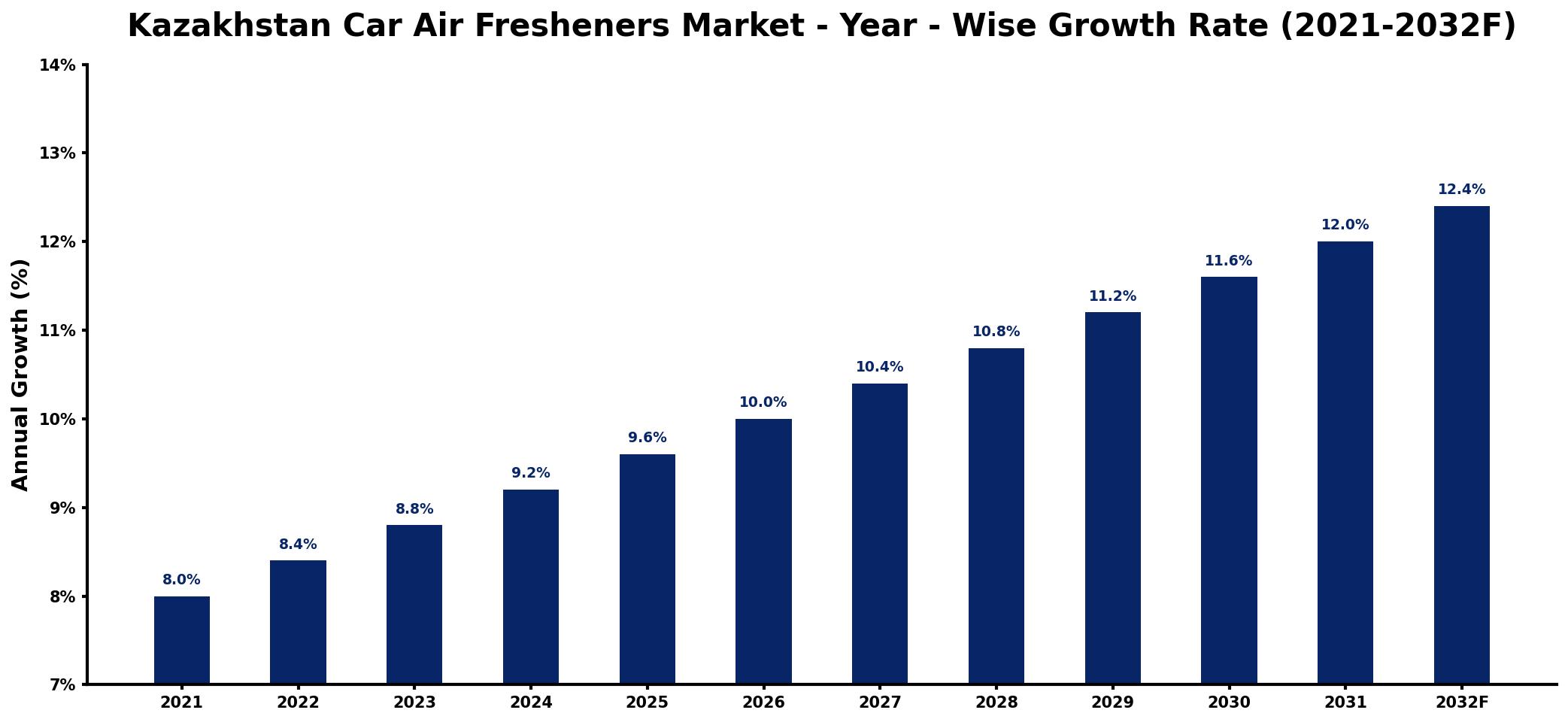
The table below presents the year‑wise growth rates along with the key drivers influencing the market
| Year | Growth Rate | Major Drivers |
| 2021 | 8.0% | Rising consumer disposable income |
| 2022 | 8.4% | Increased urbanization and mobility |
| 2023 | 8.8% | Growth in automotive industry sales |
| 2024 | 9.2% | Expansion of retail distribution channels |
| 2025 | 9.6% | Shift towards premium lifestyle products |
| 2026 | 10.0% | Growing awareness of wellness trends |
| 2027 | 10.4% | Increase in online shopping preferences |
| 2028 | 10.8% | Diverse product innovation and offerings |
| 2029 | 11.2% | Rising demand for convenience products |
| 2030 | 11.6% | Sustainability trends influencing purchases |
| 2031 | 12.0% | Enhancements in marketing strategies |
| 2032 | 12.4% | rising end-use demand growth |
Note: Market size estimations and growth projections presented in this report are based on 6Wresearch's proprietary forecasting methodology, utilizing the latest available industry data, government publications, and primary research inputs.
Kazakhstan Car Air Fresheners Market Synopsis
In recent years, the Kazakhstan Car Air Fresheners Market has witnessed a notable uptick in demand, reflecting a shift towards products that enhance vehicle aesthetics and comfort. Consumers are now more inclined to invest in air fresheners that not only improve the interior ambiance but also align with their personal style preferences.
As a reflection of changing consumer behavior, there's a growing inclination towards eco-friendly options that promise both sustainability and safety. This trend signals a significant transformation in the market, with consumers opting for air fresheners that are free from harsh chemicals and packaged with sustainability in mind.
Kazakhstan Car Air Fresheners Market Key Takeaways
- The market is evolving to include a variety of eco-friendly and natural air freshener products.
- Customization and personalization are becoming important factors influencing consumer purchasing decisions.
- Innovative technologies, such as smart air fresheners controlled via smartphone apps, are emerging in the market.
- Price sensitivity remains an important consideration, influencing competition and product positioning.
- Expansion of distribution channels is vital for reaching underserved markets, particularly in rural areas.
Evaluation of Restraints in Kazakhstan Car Air Fresheners Market
While the Kazakhstan Car Air Fresheners Market is poised for growth, several restraints present challenges to stakeholders. A primary concern is the intense competition from both domestic and international brands, compelling companies to continually innovate and differentiate their products. Additionally, the fluctuating preferences among consumers necessitate that brands remain agile and responsive to market trends. Price sensitivity can also steer consumers towards lower-cost alternatives, impacting premium product sales. Furthermore, navigating distribution logistics, particularly in remote regions, remains a persistent hurdle that can limit market reach and growth potential.
Kazakhstan Car Air Fresheners Market Trends
The market is currently experiencing a pronounced trend towards eco-friendly and natural air fresheners, driven by consumer demand for products free of harmful chemicals. Additionally, innovative product offerings with unique, long-lasting fragrances are gaining traction, enhancing the driving experience. Customization options that allow users to choose scents reflecting their personal taste are becoming increasingly popular. Moreover, the integration of technology in air fresheners, such as Bluetooth connectivity and app controls, indicates a shift towards smart, user-friendly solutions that cater to the tech-savvy consumer.
Kazakhstan Car Air Fresheners Market Opportunities
Given the rising car ownership rates in Kazakhstan, there are ample opportunities for investment in the car air fresheners market. Companies can tap into the growing trend for sustainable products by developing innovative, eco-friendly air fresheners. Strategic partnerships with local retailers or e-commerce platforms can enhance market penetration and broaden distribution channels. Furthermore, targeted marketing campaigns aimed at increasing brand awareness and emphasizing unique selling propositions can position products favorably in a competitive landscape, thus leveraging the demand for enhanced driving experiences.
Government Initiatives in the Kazakhstan Car Air Fresheners Market
The government of Kazakhstan has enacted various regulations aimed at ensuring consumer safety and environmental protection in the car air fresheners market. These include stringent labeling requirements that inform consumers about product ingredients and potential hazards. Moreover, restrictions are in place concerning the import and sale of counterfeit or substandard products, thus aiming to uphold quality standards. Such government initiatives not only promote transparency and consumer awareness but also encourage a shift towards sustainable practices within the market.
Future Insights of the Kazakhstan Car Air Fresheners Market
Looking ahead to 2026-2032, the Kazakhstan Car Air Fresheners Market is set to flourish, buoyed by increasing car ownership, heightened disposable incomes, and a growing consumer focus on vehicle hygiene and comfort. The anticipated introduction of innovative product types, especially eco-friendly and long-lasting options, coupled with strategic marketing initiatives, will likely foster a robust competitive environment. As awareness around the benefits of maintaining a pleasant driving atmosphere continues to rise, the market is expected to see sustained growth, aligning with broader trends in consumer behavior and automotive advancements.
Kazakhstan Car Air Fresheners Market Latest Developments (2025 - 2026)
In the period between & and June 2026, the Kazakhstan Car Air Fresheners Market has shown dynamic activity, with several brands introducing new product lines focused on eco-friendliness and innovative technology. There has been a notable increase in smart air fresheners that provide consumers with the ability to control fragrance levels through mobile applications. Additionally, marketing campaigns highlighting the importance of vehicle hygiene and wellness have gained traction, resonating well with the increasingly health-conscious consumer base.
Kazakhstan Car Air Fresheners Market - Key Attractiveness of the Report
- 10 Years of Market Numbers
- Historical Data Starting from 2022 to 2025
- Base Year: 2025
- Forecast Data until 2032
- Key Performance Indicators Impacting the Market
- Major Upcoming Developments and Projects
Key Highlights of the Report:
- Kazakhstan Car Air Fresheners Market Outlook
- Market Size of Kazakhstan Car Air Fresheners Market, 2025
- Forecast of Kazakhstan Car Air Fresheners Market, 2032
- Historical Data and Forecast of Kazakhstan Car Air Fresheners Revenues & Volume for the Period 2022-2032F
- Kazakhstan Car Air Fresheners Market Trend Evolution
- Kazakhstan Car Air Fresheners Market Drivers and Challenges
- Kazakhstan Car Air Fresheners Price Trends
- Kazakhstan Car Air Fresheners Porter's Five Forces
- Kazakhstan Car Air Fresheners Industry Life Cycle
- Historical Data and Forecast of Kazakhstan Car Air Fresheners Market Revenues & Volume By Product for the Period 2022-2032F
- Historical Data and Forecast of Kazakhstan Car Air Fresheners Market Revenues & Volume By Gel & Cans for the Period 2022-2032F
- Historical Data and Forecast of Kazakhstan Car Air Fresheners Market Revenues & Volume By Spray/Aerosol for the Period 2022-2032F
- Historical Data and Forecast of Kazakhstan Car Air Fresheners Market Revenues & Volume By Paper Car Air Fresheners for the Period 2022-2032F
- Historical Data and Forecast of Kazakhstan Car Air Fresheners Market Revenues & Volume By Vents & Clips for the Period 2022-2032F
- Historical Data and Forecast of Kazakhstan Car Air Fresheners Market Revenues & Volume By End-User for the Period 2022-2032F
- Historical Data and Forecast of Kazakhstan Car Air Fresheners Market Revenues & Volume By Sports Car for the Period 2022-2032F
- Historical Data and Forecast of Kazakhstan Car Air Fresheners Market Revenues & Volume By Mid-range Car for the Period 2022-2032F
- Historical Data and Forecast of Kazakhstan Car Air Fresheners Market Revenues & Volume By SUV for the Period 2022-2032F
- Historical Data and Forecast of Kazakhstan Car Air Fresheners Market Revenues & Volume By Others for the Period 2022-2032F
- Historical Data and Forecast of Kazakhstan Car Air Fresheners Market Revenues & Volume By Fragrance for the Period 2022-2032F
- Historical Data and Forecast of Kazakhstan Car Air Fresheners Market Revenues & Volume By Scented for the Period 2022-2032F
- Historical Data and Forecast of Kazakhstan Car Air Fresheners Market Revenues & Volume By UnScented for the Period 2022-2032F
- Kazakhstan Car Air Fresheners Import Export Trade Statistics
- Market Opportunity Assessment By Product
- Market Opportunity Assessment By End-User
- Market Opportunity Assessment By Fragrance
- Kazakhstan Car Air Fresheners Top Companies Market Share
- Kazakhstan Car Air Fresheners Competitive Benchmarking By Technical and Operational Parameters
- Kazakhstan Car Air Fresheners Company Profiles
- Kazakhstan Car Air Fresheners Key Strategic Recommendations






































