Kazakhstan Cellulose Acetate Fiber Market Size, Share & Growth Rate
The Kazakhstan Cellulose Acetate Fiber Market was estimated at USD 582 Million in 2025 and is projected to reach USD 828 Million by 2032, growing at a CAGR of 5.2% from 2026 to 2032. This growth trajectory is largely fueled by a burgeoning consumer preference for sustainable and eco-friendly textile materials. As industries across the board—from fashion to automotive—embrace greener alternatives, the shift to biodegradable cellulose acetate fibers is becoming increasingly apparent, signaling a long-term transformation in material sourcing within Kazakhstan.
Kazakhstan Cellulose Acetate Fiber Market Year-wise Growth Rate and Key Drivers
This graph highlights how the Kazakhstan Cellulose Acetate Fiber Market has steadily grown over the years, supported by major growth factors.
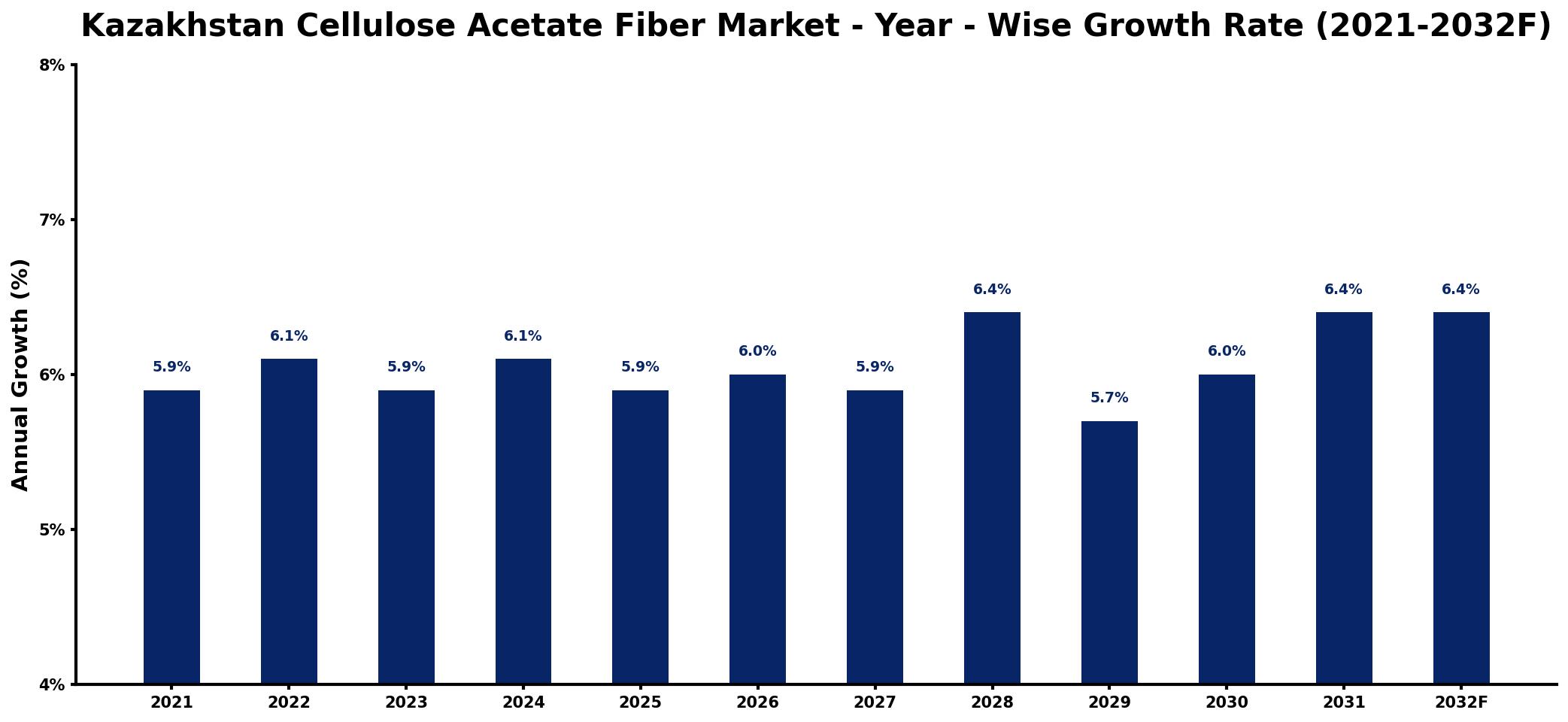
The table below presents the year‑wise growth rates along with the key drivers influencing the market
| Year | Growth Rate | Major Drivers |
| 2021 | 5.9% | Rising textile manufacturing demand |
| 2022 | 6.1% | Increased fashion industry investments |
| 2023 | 5.9% | Growing environmental sustainability focus |
| 2024 | 6.1% | Expansion of nonwoven applications |
| 2025 | 5.9% | Boost in automotive sector usage |
| 2026 | 6.0% | Higher consumer preference shifts |
| 2027 | 5.9% | Emergence of new market players |
| 2028 | 6.4% | Strengthened export opportunities globally |
| 2029 | 5.7% | Technological advancements in production |
| 2030 | 6.0% | Enhanced product performance requirements |
| 2031 | 6.4% | Growing health and hygiene awareness |
| 2032 | 6.4% | Rising demand for biodegradable materials |
Note: Market size estimations and growth projections presented in this report are based on 6Wresearch's proprietary forecasting methodology, utilizing the latest available industry data, government publications, and primary research inputs.
Kazakhstan Cellulose Acetate Fiber Market Synopsis
Recently, the Kazakhstan Cellulose Acetate Fiber market has gained momentum due to heightened awareness regarding environmental sustainability. This enthusiasm contrasts with the historical reliance on synthetic fibers, which are increasingly viewed unfavorably due to their ecological footprint. Looking ahead, the market is set to flourish further as innovations in production techniques and product applications come into play, solidifying cellulose acetates position in the industry.
The current momentum indicates a keen interest from both consumers and manufacturers alike in adopting cellulose acetate fibers. This is particularly relevant as companies strive to align their product offerings with sustainability goals. In a market ripe for investment and innovation, the transition toward eco-friendly fibers represents not just a trend, but a necessary pivot for long-term viability.
Kazakhstan Cellulose Acetate Fiber Market Key Takeaways
- The market reflects a growing consumer preference for sustainable and biodegradable materials.
- Innovative product development is crucial for meeting the evolving needs of the textile industry.
- Investments in research and development are shaping the future of cellulose acetate fibers.
- Government initiatives are fostering a supportive environment for industrial growth and sustainability.
- Limited domestic production capacity and raw material reliance remain critical issues to address.
Evaluation of Restraints in Kazakhstan Cellulose Acetate Fiber Market
Several factors are currently holding back the Kazakhstan Cellulose Acetate Fiber market from achieving its full potential. A significant challenge is the strong competition from cheaper synthetic fibers, which can hinder market penetration for more sustainable options. Additionally, fluctuations in raw material prices create uncertainty for manufacturers, complicating production planning and cost management. Finally, the necessity for continuous technological advancements to improve product quality puts pressure on producers to adapt swiftly while maintaining profitability, especially within a competitive landscape.
Kazakhstan Cellulose Acetate Fiber Market Trends
Several trends are currently reshaping the Kazakhstan Cellulose Acetate Fiber market. Firstly, there is a noticeable shift toward fibers that offer enhanced properties such as moisture-wicking and antibacterial features, which are becoming essential in both healthcare and fashion sectors. Manufacturers are increasingly focusing on sustainability, adopting innovative processes to create biodegradable products without compromising quality. Additionally, the rise of eco-conscious consumerism is pushing companies to incorporate cellulose acetate fibers into their portfolios, thereby expanding their market reach.
Kazakhstan Cellulose Acetate Fiber Market Opportunities
The market presents a variety of attractive opportunities for growth and investment. With increasing demand in textiles, healthcare, and even electronics, cellulose acetate fibers are positioned well as a biodegradable alternative. Investors can benefit from establishing local manufacturing facilities or partnering with domestic textile companies to promote the use of these fibers. Furthermore, advancing research and development efforts could unlock new applications, creating additional revenue streams in an evolving market landscape.
Government Initiatives in the Kazakhstan Cellulose Acetate Fiber Market
The government of Kazakhstan is actively promoting the cellulose acetate fiber market through policies aimed at enhancing domestic production capabilities and encouraging sustainable practices. Initiatives include tax incentives and subsidies designed to attract foreign investment in the sector. Additionally, regulations focused on environmental sustainability ensure that production processes align with global standards, fostering competitiveness. Such supportive policies are expected to drive innovation and economic growth within the cellulose acetate fiber industry.
Future Insights of the Kazakhstan Cellulose Acetate Fiber Market
Looking ahead to 2026-2032, the Kazakhstan Cellulose Acetate Fiber market is anticipated to continue its upward trajectory. The increasing awareness of environmental issues, combined with a societal shift towards sustainable fashion, is propelling the adoption of cellulose acetate fibers. Moreover, the unique properties of these fibers—such as breathability and softness—will enhance their appeal across multiple applications. As the market evolves, companies that leverage sustainable practices and innovative product development will be well-positioned for success.
Kazakhstan Cellulose Acetate Fiber Market Latest Developments (2025 - 2026)
In recent months, the Kazakhstan Cellulose Acetate Fiber market has seen a flurry of activity focused on sustainability and innovation. Manufacturers are increasingly collaborating to enhance their product offerings and invest in advanced production technologies. Additionally, there have been notable movements towards increasing domestic production capacities, aimed at reducing reliance on imports. The trend towards eco-friendly materials continues to gain traction, influencing new product development strategies across sectors.
Kazakhstan Cellulose Acetate Fiber Market - Key Attractiveness of the Report
- 10 Years of Market Numbers
- Historical Data Starting from 2022 to 2025
- Base Year: 2025
- Forecast Data until 2032
- Key Performance Indicators Impacting the Market
- Major Upcoming Developments and Projects
Key Highlights of the Report:
- Kazakhstan Cellulose Acetate Fiber Market Outlook
- Market Size of Kazakhstan Cellulose Acetate Fiber Market, 2025
- Forecast of Kazakhstan Cellulose Acetate Fiber Market, 2032
- Historical Data and Forecast of Kazakhstan Cellulose Acetate Fiber Revenues & Volume for the Period 2022-2032F
- Kazakhstan Cellulose Acetate Fiber Market Trend Evolution
- Kazakhstan Cellulose Acetate Fiber Market Drivers and Challenges
- Kazakhstan Cellulose Acetate Fiber Price Trends
- Kazakhstan Cellulose Acetate Fiber Porter's Five Forces
- Kazakhstan Cellulose Acetate Fiber Industry Life Cycle
- Historical Data and Forecast of Kazakhstan Cellulose Acetate Fiber Market Revenues & Volume By Type for the Period 2022-2032F
- Historical Data and Forecast of Kazakhstan Cellulose Acetate Fiber Market Revenues & Volume By Plastic for the Period 2022-2032F
- Historical Data and Forecast of Kazakhstan Cellulose Acetate Fiber Market Revenues & Volume By Fiber for the Period 2022-2032F
- Historical Data and Forecast of Kazakhstan Cellulose Acetate Fiber Market Revenues & Volume By Application for the Period 2022-2032F
- Historical Data and Forecast of Kazakhstan Cellulose Acetate Fiber Market Revenues & Volume By Photographic Films for the Period 2022-2032F
- Historical Data and Forecast of Kazakhstan Cellulose Acetate Fiber Market Revenues & Volume By Cigarette Filters for the Period 2022-2032F
- Historical Data and Forecast of Kazakhstan Cellulose Acetate Fiber Market Revenues & Volume By Tapes & Labels for the Period 2022-2032F
- Historical Data and Forecast of Kazakhstan Cellulose Acetate Fiber Market Revenues & Volume By Textiles & Apparel for the Period 2022-2032F
- Kazakhstan Cellulose Acetate Fiber Import Export Trade Statistics
- Market Opportunity Assessment By Type
- Market Opportunity Assessment By Application
- Kazakhstan Cellulose Acetate Fiber Top Companies Market Share
- Kazakhstan Cellulose Acetate Fiber Competitive Benchmarking By Technical and Operational Parameters
- Kazakhstan Cellulose Acetate Fiber Company Profiles
- Kazakhstan Cellulose Acetate Fiber Key Strategic Recommendations






































