Kazakhstan Cellulose Esters Market: Import Trend Analysis
In the Kazakhstan cellulose esters market, the import trend experienced significant growth from 2020 to 2024, with a remarkable CAGR of 500.0%. This surge in imports indicates a strong import momentum and a notable demand shift within the market, reflecting positively on the country`s trade performance during this period.
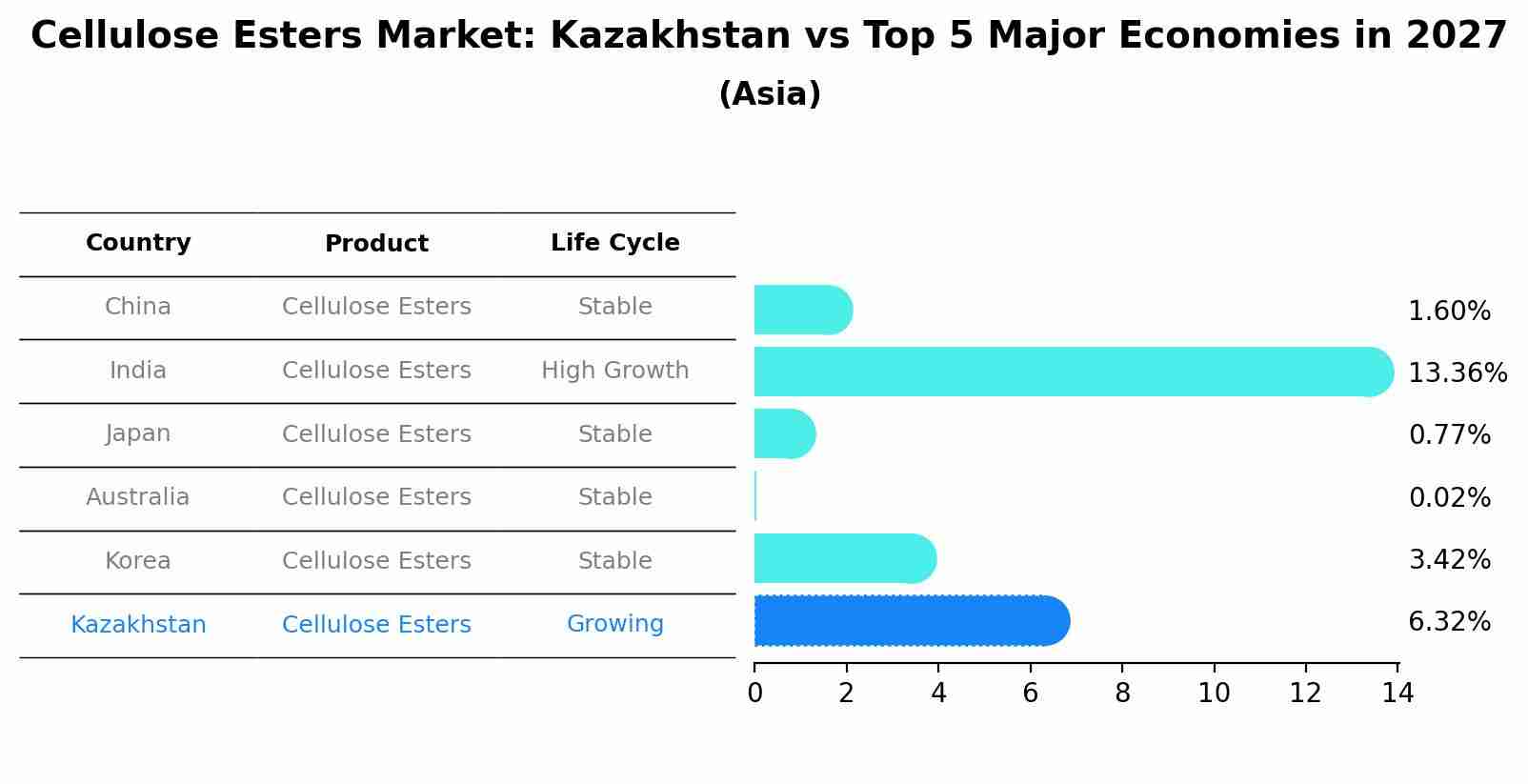
Cellulose Esters Market: Kazakhstan vs Top 5 Major Economies in 2027 (Asia)
By 2027, the Cellulose Esters market in Kazakhstan is anticipated to reach a growth rate of 6.32%, as part of an increasingly competitive Asia region, where China remains at the forefront, supported by India, Japan, Australia and South Korea, driving innovations and market adoption across sectors.
Kazakhstan Cellulose Esters Market Overview
Kazakhstan cellulose esters market is expanding due to their versatile applications in coatings, plastics, films, and textiles. Cellulose esters are derived from natural cellulose and are used to enhance the properties of various products. The market is driven by the growing demand for environmentally friendly and biodegradable materials, advancements in production technologies, and increased industrial activities. The push for sustainable and renewable resources is also supporting market growth.
Drivers of the market
The Kazakhstan cellulose esters market is experiencing steady growth driven by the increasing demand for cellulose-based materials in various industrial applications. Cellulose esters are widely used as film formers, thickeners, binders, and coatings in industries such as pharmaceuticals, food and beverages, cosmetics, and textiles. The growing preference for eco-friendly and biodegradable materials, coupled with stringent regulations regarding the use of synthetic polymers, is driving the adoption of cellulose esters. Moreover, technological advancements in cellulose ester production, such as solvent-free processing and green chemistry methods, are further propelling market growth by offering sustainable and high-performance solutions.
Challenges of the market
The cellulose esters market in Kazakhstan faces challenges related to the availability of raw materials, such as cellulose derivatives and chemical reagents, for esterification processes. Quality control and consistency in product specifications, such as viscosity, solubility, and film-forming properties, are essential for meeting customer requirements in applications such as coatings, films, and specialty polymers. Moreover, regulatory compliance requirements and environmental considerations in chemical processing pose challenges for market participants.
Government Policy of the market
The cellulose esters market benefits from government support for the chemical industry, including research grants and subsidies. Regulatory standards ensure product safety and environmental compliance, fostering a stable market environment.
Key Highlights of the Report:
- Kazakhstan Cellulose Esters Market Outlook
- Market Size of Kazakhstan Cellulose Esters Market, 2024
- Forecast of Kazakhstan Cellulose Esters Market, 2031
- Historical Data and Forecast of Kazakhstan Cellulose Esters Revenues & Volume for the Period 2021-2031
- Kazakhstan Cellulose Esters Market Trend Evolution
- Kazakhstan Cellulose Esters Market Drivers and Challenges
- Kazakhstan Cellulose Esters Price Trends
- Kazakhstan Cellulose Esters Porter's Five Forces
- Kazakhstan Cellulose Esters Industry Life Cycle
- Historical Data and Forecast of Kazakhstan Cellulose Esters Market Revenues & Volume By Type for the Period 2021-2031
- Historical Data and Forecast of Kazakhstan Cellulose Esters Market Revenues & Volume By Cellulose acetate for the Period 2021-2031
- Historical Data and Forecast of Kazakhstan Cellulose Esters Market Revenues & Volume By Cellulose acetate propionate for the Period 2021-2031
- Historical Data and Forecast of Kazakhstan Cellulose Esters Market Revenues & Volume By Cellulose acetate butyrate for the Period 2021-2031
- Historical Data and Forecast of Kazakhstan Cellulose Esters Market Revenues & Volume By Cellulose nitrate for the Period 2021-2031
- Historical Data and Forecast of Kazakhstan Cellulose Esters Market Revenues & Volume By Others for the Period 2021-2031
- Historical Data and Forecast of Kazakhstan Cellulose Esters Market Revenues & Volume By Applications for the Period 2021-2031
- Historical Data and Forecast of Kazakhstan Cellulose Esters Market Revenues & Volume By Coatings for the Period 2021-2031
- Historical Data and Forecast of Kazakhstan Cellulose Esters Market Revenues & Volume By Films and tapes for the Period 2021-2031
- Historical Data and Forecast of Kazakhstan Cellulose Esters Market Revenues & Volume By Cigarette filters for the Period 2021-2031
- Historical Data and Forecast of Kazakhstan Cellulose Esters Market Revenues & Volume By Inks for the Period 2021-2031
- Historical Data and Forecast of Kazakhstan Cellulose Esters Market Revenues & Volume By Plasticizers for the Period 2021-2031
- Historical Data and Forecast of Kazakhstan Cellulose Esters Market Revenues & Volume By Others for the Period 2021-2031
- Kazakhstan Cellulose Esters Import Export Trade Statistics
- Market Opportunity Assessment By Type
- Market Opportunity Assessment By Applications
- Kazakhstan Cellulose Esters Top Companies Market Share
- Kazakhstan Cellulose Esters Competitive Benchmarking By Technical and Operational Parameters
- Kazakhstan Cellulose Esters Company Profiles
- Kazakhstan Cellulose Esters Key Strategic Recommendations






































