Kazakhstan Cloud Security Market Size & Growth Rate (2026-2032)
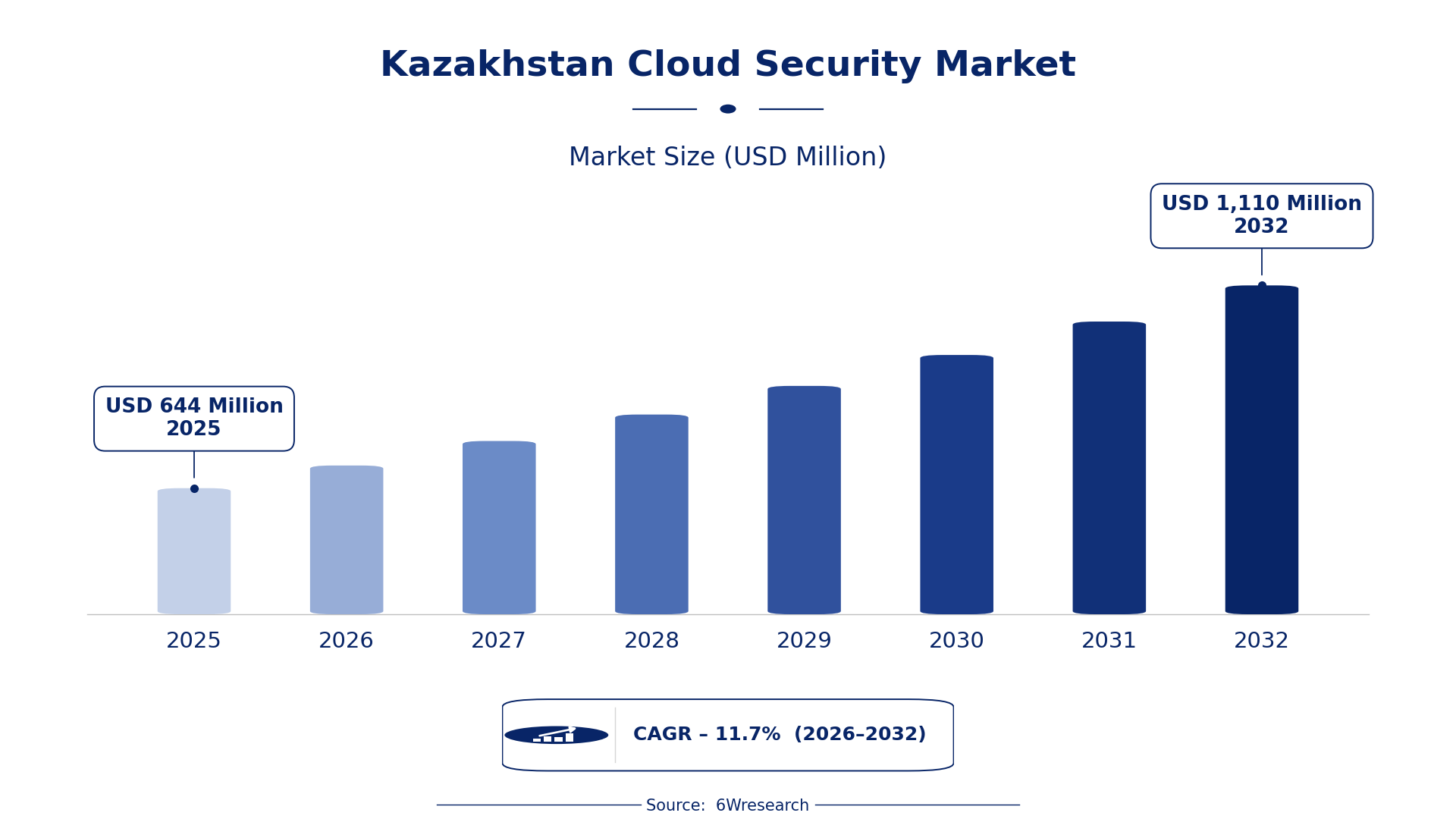
The Kazakhstan Cloud Security Market was estimated at USD 644 Million in 2025 and is projected to reach USD 1110 Million by 2032, growing at a CAGR of 11.7% from 2026 to 2032.
Kazakhstan Cloud Security Market Synopsis
As Kazakhstan's digital economy expands, the demand for cloud security solutions is surging. Organizations are adopting cloud technologies to enhance operational efficiency, which has inevitably increased their vulnerability to cyber threats, underscoring the need for robust security frameworks.
In light of the growing cyber threat landscape, businesses are prioritizing security measures, leading to a considerable increase in investments in cloud security. Threat detection, data encryption, and access control systems are now essentials in the security arsenal of organizations across various sectors.
Kazakhstan Cloud Security Market Year-wise Growth Rate and Key Drivers
This graph illustrates the annual growth rates of the Kazakhstan Cloud Security Market from 2021 to 2032, highlighting a steady upward trajectory and projected expansion over the forecast period.
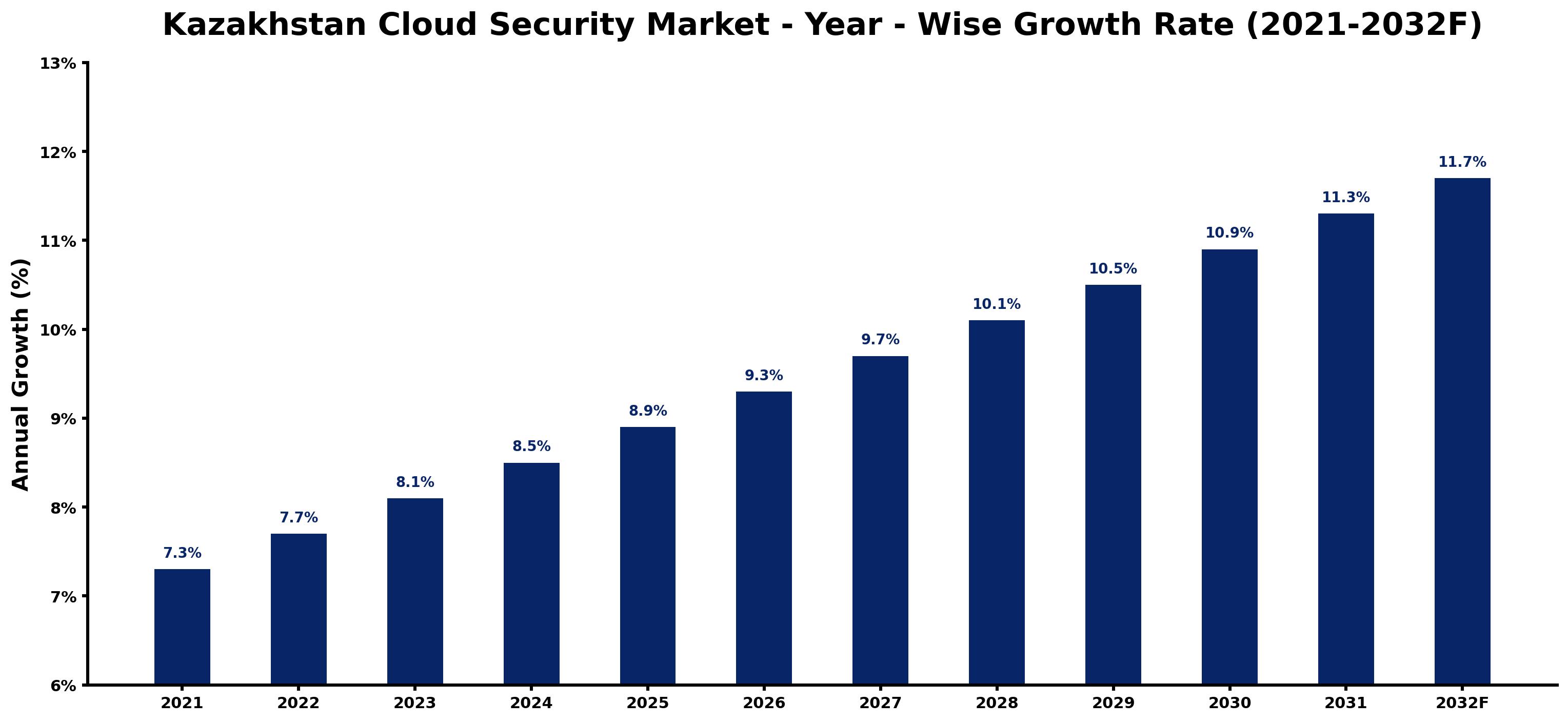
The table below presents the year‑wise growth rates along with the key drivers influencing the market
| Year | Growth Rate | Major Drivers |
| 2021 | 7.3% | Government's cybersecurity policy boosting cloud adoption. |
| 2022 | 7.7% | Increased cyber threats prompting businesses to strengthen security. |
| 2023 | 8.1% | Growing reliance on remote work elevating cloud security concerns. |
| 2024 | 8.5% | Local regulatory frameworks mandating data protection measures. |
| 2025 | 8.9% | Investment in digital infrastructure enhancing cloud security services. |
| 2026 | 9.3% | Rise of fintech startups increasing cloud security demand. |
| 2027 | 9.7% | Educational programs promoting awareness of cyber risks. |
| 2028 | 10.1% | Partnerships with global tech firms improving security offerings. |
| 2029 | 10.5% | Expanding IoT networks necessitating robust cloud solutions. |
| 2030 | 10.9% | Increased data residency requirements driving local cloud usage. |
| 2031 | 11.3% | Legislation promoting digital identity solutions enhancing security. |
| 2032 | 11.7% | Growing public sector investments in cyber defense technologies. |
Note: Market size estimations and growth projections presented in this report are based on 6Wresearch's proprietary forecasting methodology, utilizing the latest available industry data, government publications, and primary research inputs.
Kazakhstan Cloud Security Market Key Takeaways
Below are some of the specific key takeaways from the market, including:
- Cybersecurity threats are rising, leading organizations to adopt cloud security solutions at an accelerated pace.
- Government policies are being implemented to strengthen data protection and compliance standards.
- The market's growth trajectory indicates a burgeoning investment in threat detection and mitigation strategies.
- Cloud security frameworks are evolving to incorporate artificial intelligence and machine learning for better threat identification.
- Increased collaboration among cloud service providers is enhancing overall security infrastructure.
Evaluation of Restraints in Kazakhstan Cloud Security Market
Despite its promising growth, the Kazakhstan Cloud Security Market faces notable restraints. A prevalent concern is the high cost associated with implementing advanced security solutions, which can deter smaller organizations from adopting these necessary measures. on top of that, there is a lack of skilled cybersecurity professionals, making it difficult for businesses to effectively integrate and manage their cloud security systems. As regulations tighten, compliance becomes increasingly complex, adding another layer of challenge for organizations operating in this sector.
Kazakhstan Cloud Security Market Trends
The shift towards remote work and the increased reliance on digital platforms have amplified the need for robust cloud security. Organizations are embracing multi-cloud strategies, which are driving demand for integrated security solutions that can operate across various platforms. Additionally, the incorporation of artificial intelligence and machine learning into security practices is becoming more prevalent, enhancing the ability to detect and respond to threats swiftly.
Kazakhstan Cloud Security Market Opportunities
The market offers numerous growth avenues, particularly for vendors providing innovative cloud security solutions. Opportunities exist in developing specialized security products tailored to specific industries, such as finance and healthcare, which are often subject to stricter compliance and data protection standards. on top of that, public-private partnerships can pave the way for enhanced investment in security infrastructure, fostering a more secure digital environment across the nation.
Government Initiatives in the Kazakhstan Cloud Security Market
The government of Kazakhstan is actively shaping the cloud security environment through regulatory frameworks and policy initiatives aimed at enhancing data protection. With a focus on aligning with international security standards, the government has been instrumental in guiding businesses towards adopting better security practices, which is crucial for protecting both public and private data.
- A regulatory framework introduced in 2025 mandating enhanced data protection protocols for cloud service providers.
- An ongoing initiative focused on public sector digital transformation, emphasizing secure cloud adoption.
- A national cybersecurity strategy initiated in late 2023 that includes funding for advanced security measures.
- Planned workshops and training programs aimed at developing the cybersecurity workforce by 2026.
Future Insights of the Kazakhstan Cloud Security Market
Looking ahead to 2026-2032, the Kazakhstan Cloud Security Market is expected to expand significantly. As the digital economy matures, a greater emphasis will be placed on security solutions that adapt to evolving threats. The interplay between regulatory pressures and technological advancements will likely accelerate the development of innovative security frameworks, making compliance easier and more efficient for businesses.
Kazakhstan Cloud Security Market Latest Developments
In the past year, the Kazakhstan Cloud Security Market has witnessed considerable activity, indicating a strong commitment to enhancing cybersecurity. Investments in new technologies and collaborative efforts among industry players have been particularly notable, with various initiatives aimed at addressing emerging threats.
- A leading regional operator launched a new cloud security solution in early 2025, focusing on encryption and access control features.
- A collaborative project among major technology vendors is currently underway, aimed at developing shared threat intelligence platforms to enhance security posture.
- By mid-2026, a major initiative focused on integrating AI technologies into existing cloud security frameworks is expected to commence.
- A recent partnership established between government agencies and private firms is now in its rollout phase, aimed at enhancing data protection across critical infrastructure.
Kazakhstan Cloud Security Market - Key Attractiveness of the Report
- 10 Years of Market Numbers
- Historical Data Starting from 2022 to 2025
- Base Year: 2025
- Forecast Data until 2032
- Key Performance Indicators Impacting the Market
- Major Upcoming Developments and Projects
Key Highlights of the Report:
- Kazakhstan Cloud Security Market Outlook
- Market Size of Kazakhstan Cloud Security Market, 2025
- Forecast of Kazakhstan Cloud Security Market, 2032
- Historical Data and Forecast of Kazakhstan Cloud Security Revenues & Volume for the Period 2022-2032F
- Kazakhstan Cloud Security Market Trend Evolution
- Kazakhstan Cloud Security Market Drivers and Challenges
- Kazakhstan Cloud Security Price Trends
- Kazakhstan Cloud Security Porter's Five Forces
- Kazakhstan Cloud Security Industry Life Cycle
- Historical Data and Forecast of Kazakhstan Cloud Security Market Revenues & Volume By Application for the Period 2022-2032F
- Historical Data and Forecast of Kazakhstan Cloud Security Market Revenues & Volume By Visibility for the Period 2022-2032F
- Historical Data and Forecast of Kazakhstan Cloud Security Market Revenues & Volume By Risk Assessment for the Period 2022-2032F
- Historical Data and Forecast of Kazakhstan Cloud Security Market Revenues & Volume By User for the Period 2022-2032F
- Historical Data and Forecast of Kazakhstan Cloud Security Market Revenues & Volume By Data Governance for the Period 2022-2032F
- Historical Data and Forecast of Kazakhstan Cloud Security Market Revenues & Volume By Vertical for the Period 2022-2032F
- Historical Data and Forecast of Kazakhstan Cloud Security Market Revenues & Volume By BFSI for the Period 2022-2032F
- Historical Data and Forecast of Kazakhstan Cloud Security Market Revenues & Volume By IT for the Period 2022-2032F
- Historical Data and Forecast of Kazakhstan Cloud Security Market Revenues & Volume By ITeS for the Period 2022-2032F
- Historical Data and Forecast of Kazakhstan Cloud Security Market Revenues & Volume By Retail for the Period 2022-2032F
- Historical Data and Forecast of Kazakhstan Cloud Security Market Revenues & Volume By Organization Size for the Period 2022-2032F
- Historical Data and Forecast of Kazakhstan Cloud Security Market Revenues & Volume By Large Enterprises for the Period 2022-2032F
- Historical Data and Forecast of Kazakhstan Cloud Security Market Revenues & Volume By SMEs for the Period 2022-2032F
- Historical Data and Forecast of Kazakhstan Cloud Security Market Revenues & Volume By Security Type for the Period 2022-2032F
- Historical Data and Forecast of Kazakhstan Cloud Security Market Revenues & Volume By Perimeter Security for the Period 2022-2032F
- Historical Data and Forecast of Kazakhstan Cloud Security Market Revenues & Volume By Network Security for the Period 2022-2032F
- Historical Data and Forecast of Kazakhstan Cloud Security Market Revenues & Volume By Endpoint Security for the Period 2022-2032F
- Historical Data and Forecast of Kazakhstan Cloud Security Market Revenues & Volume By Application Security for the Period 2022-2032F
- Historical Data and Forecast of Kazakhstan Cloud Security Market Revenues & Volume By Others for the Period 2022-2032F
- Historical Data and Forecast of Kazakhstan Cloud Security Market Revenues & Volume By Service Model for the Period 2022-2032F
- Historical Data and Forecast of Kazakhstan Cloud Security Market Revenues & Volume By IaaS for the Period 2022-2032F
- Historical Data and Forecast of Kazakhstan Cloud Security Market Revenues & Volume By PaaS for the Period 2022-2032F
- Historical Data and Forecast of Kazakhstan Cloud Security Market Revenues & Volume By SaaS for the Period 2022-2032F
- Kazakhstan Cloud Security Import Export Trade Statistics
- Market Opportunity Assessment By Application
- Market Opportunity Assessment By Vertical
- Market Opportunity Assessment By Organization Size
- Market Opportunity Assessment By Security Type
- Market Opportunity Assessment By Service Model
- Kazakhstan Cloud Security Top Companies Market Share
- Kazakhstan Cloud Security Competitive Benchmarking By Technical and Operational Parameters
- Kazakhstan Cloud Security Company Profiles
- Kazakhstan Cloud Security Key Strategic Recommendations






































