Kazakhstan Computer Software Market Size, Share & Growth Rate
The Kazakhstan Computer Software Market was estimated at USD 428 Million in 2025 and is projected to reach USD 571 Million by 2032, growing at a CAGR of 4.2% from 2026 to 2032. This steady growth trajectory is predominantly fueled by the rapid digitization across industries, particularly in finance, healthcare, and education. As organizations increasingly prioritize digital transformation initiatives, the demand for tailored software solutions and cloud-based services continues to expand, positioning the market for sustained development.
Kazakhstan Computer Software Market Year-wise Growth Rate and Key Drivers
This graph highlights how the Kazakhstan Computer Software Market has steadily grown over the years, supported by major growth factors.
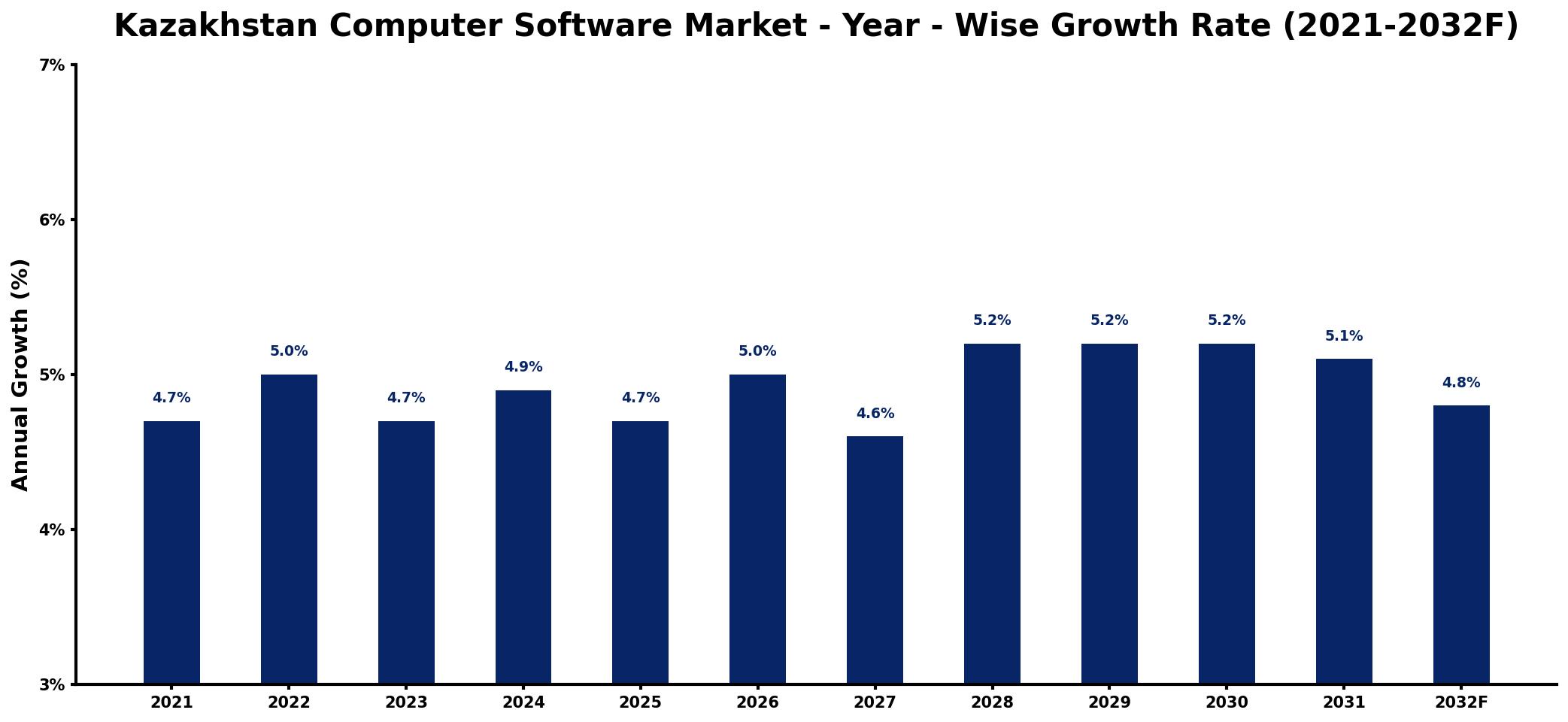
The table below presents the year‑wise growth rates along with the key drivers influencing the market
| Year | Growth Rate | Major Drivers |
| 2021 | 4.7% | Rising demand for automation solutions |
| 2022 | 5.0% | Increased investment in digital transformation |
| 2023 | 4.7% | Expansion of e-commerce platforms |
| 2024 | 4.9% | Growth in mobile application development |
| 2025 | 4.7% | Adoption of cloud computing services |
| 2026 | 5.0% | Surge in cybersecurity investments |
| 2027 | 4.6% | Acceleration of remote work technologies |
| 2028 | 5.2% | Enhanced focus on data analytics |
| 2029 | 5.2% | Development of artificial intelligence tools |
| 2030 | 5.2% | Emergence of smart city initiatives |
| 2031 | 5.1% | Boost in educational technology solutions |
| 2032 | 4.8% | Rising interest in sustainable tech |
Note: Market size estimations and growth projections presented in this report are based on 6Wresearch's proprietary forecasting methodology, utilizing the latest available industry data, government publications, and primary research inputs.
Kazakhstan Computer Software Market Synopsis
The Kazakhstan computer software market has recently gained momentum, reflecting a heightened focus on innovation and technology adoption. However, as the sector evolves, it faces pressing challenges such as cybersecurity threats and issues related to intellectual property protection that could hinder its growth potential.
Looking ahead, the market is poised to evolve even further with increasing government support and investment in digital infrastructure. This supportive environment provides fertile ground for growth, particularly as local companies seek to enhance their competitive edge through technology-driven solutions.
Kazakhstan Computer Software Market Key Takeaways
- The market is propelled by the increasing adoption of cloud computing and AI technologies.
- Strong government initiatives aim to bolster the IT sector and promote innovation.
- A growing emphasis on cybersecurity solutions is evident as data protection concerns rise.
- The market is characterized by a demand for customized software solutions tailored to specific business needs.
- Investment opportunities are abundant, particularly in enterprise software and SaaS models.
Evaluation of Restraints in Kazakhstan Computer Software Market
Several key restraints are currently affecting the Kazakhstan computer software market. A primary concern is the limited access to skilled software developers, which poses significant barriers to growth. This shortage not only increases operational costs but also impedes companies from effectively scaling their software solutions. Additionally, inadequate intellectual property protections create an uncertain environment for innovation, discouraging both domestic and foreign investments. The relatively small size of the local market further restricts the opportunities available for software companies, necessitating a strategic focus on international markets to achieve profitability.
Kazakhstan Computer Software Market Trends
The Kazakhstan computer software market is undergoing transformative changes driven by notable trends. A marked shift toward cloud computing solutions reflects businesses' desire for scalable and flexible IT infrastructures, allowing for efficient resource allocation. Furthermore, the integration of artificial intelligence and machine learning within software products is gaining traction, enhancing operational efficiency and productivity.
Additionally, the demand for cybersecurity software continues to surge, propelled by rising awareness around data protection and regulatory compliance. Notably, the growing interest in Software-as-a-Service (SaaS) models is altering the landscape, enabling companies to access vital software applications on a subscription basis.
Kazakhstan Computer Software Market Opportunities
With the ongoing digital transformation across various sectors, the Kazakhstan computer software market presents lucrative investment opportunities. Areas such as enterprise software development, cybersecurity solutions, and software development services are particularly ripe for investment. Furthermore, emerging technologies like artificial intelligence and cloud computing offer significant growth potential as businesses strive for competitive advantages. Investors can capitalize on the government's commitment to fostering innovation and technology, enhancing the viability of software initiatives across the region.
Government Initiatives in the Kazakhstan Computer Software Market
The government of Kazakhstan is actively supporting the growth of the computer software market through a series of initiatives and policies. The Digital Kazakhstan program is a cornerstone effort aimed at advancing the digital economy and enhancing digital infrastructure. Additionally, the government provides various incentives, such as tax breaks and grants, to promote competitiveness and encourage innovation within the software sector. Intellectual property rights regulations have also been established to protect innovations, creating a more favorable environment for software development and investment.
Future Insights of the Kazakhstan Computer Software Market
The outlook for the Kazakhstan computer software market from 2026 to 2032 is promising, driven by several key factors. The ongoing trend of increased digitalization across industries will likely continue, supported by robust government initiatives aimed at fostering IT sector growth. As companies increasingly invest in technology to enhance operational efficiency and productivity, the demand for innovative software solutions will further accelerate. The rise of cloud computing, artificial intelligence, and cybersecurity will continue to shape the market, enabling it to evolve in response to the dynamic needs of businesses in Kazakhstan.
Kazakhstan Computer Software Market Latest Developments (2025 - 2026)
Recent developments in the Kazakhstan computer software market highlight a forward momentum characterized by enhanced collaboration between government and private sectors. Increased focus on digital skills training and workforce development is being emphasized as a means to address the skills shortage in the software development space. Additionally, investments in cybersecurity measures are becoming more prevalent as businesses recognize the critical need for data protection. The overall trend reflects a commitment to fostering a resilient and innovative software ecosystem.
Kazakhstan Computer Software Market - Key Attractiveness of the Report
- 10 Years of Market Numbers
- Historical Data Starting from 2022 to 2025
- Base Year: 2025
- Forecast Data until 2032
- Key Performance Indicators Impacting the Market
- Major Upcoming Developments and Projects
Key Highlights of the Report:
- Kazakhstan Computer Software Market Outlook
- Market Size of Kazakhstan Computer Software Market, 2025
- Forecast of Kazakhstan Computer Software Market, 2032
- Historical Data and Forecast of Kazakhstan Computer Software Revenues & Volume for the Period 2022-2032F
- Kazakhstan Computer Software Market Trend Evolution
- Kazakhstan Computer Software Market Drivers and Challenges
- Kazakhstan Computer Software Price Trends
- Kazakhstan Computer Software Porter's Five Forces
- Kazakhstan Computer Software Industry Life Cycle
- Historical Data and Forecast of Kazakhstan Computer Software Market Revenues & Volume By Type for the Period 2022-2032F
- Historical Data and Forecast of Kazakhstan Computer Software Market Revenues & Volume By Operating Systems & Productivity Software Publishing for the Period 2022-2032F
- Historical Data and Forecast of Kazakhstan Computer Software Market Revenues & Volume By Database, Storage & Backup Software Publishing for the Period 2022-2032F
- Historical Data and Forecast of Kazakhstan Computer Software Market Revenues & Volume By Business Analytics & Enterprise Software for the Period 2022-2032F
- Historical Data and Forecast of Kazakhstan Computer Software Market Revenues & Volume By Video Game Software for the Period 2022-2032F
- Historical Data and Forecast of Kazakhstan Computer Software Market Revenues & Volume By Design for the Period 2022-2032F
- Historical Data and Forecast of Kazakhstan Computer Software Market Revenues & Volume By Editing & Rendering Software for the Period 2022-2032F
- Historical Data and Forecast of Kazakhstan Computer Software Market Revenues & Volume By Application for the Period 2022-2032F
- Historical Data and Forecast of Kazakhstan Computer Software Market Revenues & Volume By Personal for the Period 2022-2032F
- Historical Data and Forecast of Kazakhstan Computer Software Market Revenues & Volume By Business/Commercial for the Period 2022-2032F
- Historical Data and Forecast of Kazakhstan Computer Software Market Revenues & Volume By Industrial for the Period 2022-2032F
- Historical Data and Forecast of Kazakhstan Computer Software Market Revenues & Volume By Industry Verticals for the Period 2022-2032F
- Historical Data and Forecast of Kazakhstan Computer Software Market Revenues & Volume By BFSI for the Period 2022-2032F
- Historical Data and Forecast of Kazakhstan Computer Software Market Revenues & Volume By Media & Entertainment for the Period 2022-2032F
- Historical Data and Forecast of Kazakhstan Computer Software Market Revenues & Volume By IT & Telecommunications for the Period 2022-2032F
- Historical Data and Forecast of Kazakhstan Computer Software Market Revenues & Volume By Energy & Utilities for the Period 2022-2032F
- Historical Data and Forecast of Kazakhstan Computer Software Market Revenues & Volume By Government & Public Sector for the Period 2022-2032F
- Historical Data and Forecast of Kazakhstan Computer Software Market Revenues & Volume By Retail & Consumer Goods for the Period 2022-2032F
- Historical Data and Forecast of Kazakhstan Computer Software Market Revenues & Volume By Manufacturing for the Period 2022-2032F
- Historical Data and Forecast of Kazakhstan Computer Software Market Revenues & Volume By Others for the Period 2022-2032F
- Kazakhstan Computer Software Import Export Trade Statistics
- Market Opportunity Assessment By Type
- Market Opportunity Assessment By Application
- Market Opportunity Assessment By Industry Verticals
- Kazakhstan Computer Software Top Companies Market Share
- Kazakhstan Computer Software Competitive Benchmarking By Technical and Operational Parameters
- Kazakhstan Computer Software Company Profiles
- Kazakhstan Computer Software Key Strategic Recommendations






































