Kazakhstan Data Classification Market Size & Growth Rate (2026-2032)
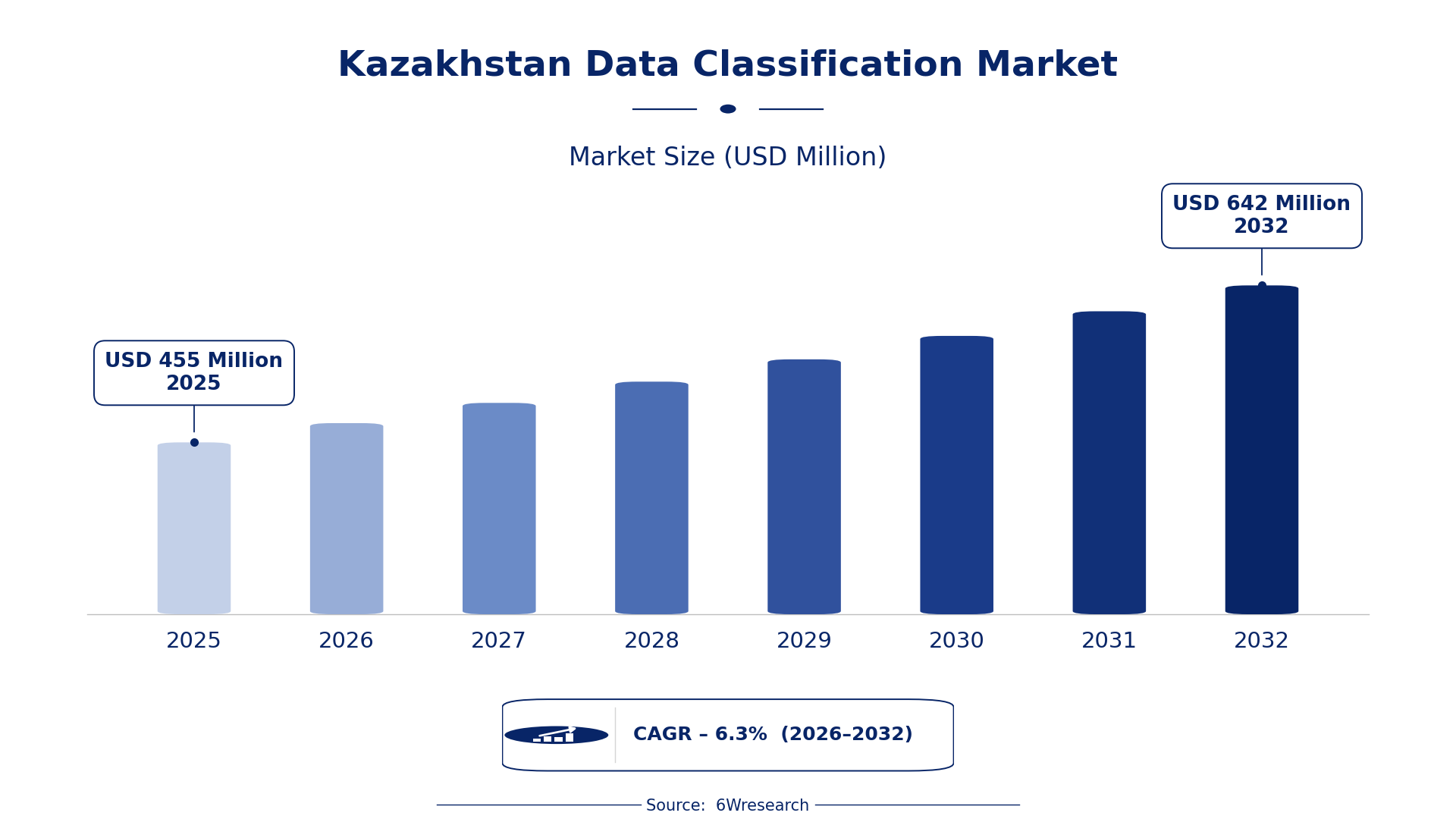
The Kazakhstan Data Classification Market was estimated at USD 455 Million in 2025 and is projected to reach USD 642 Million by 2032, growing at a CAGR of 6.3% from 2026 to 2032.
Kazakhstan Data Classification Market Synopsis
The regulatory compliance requirements stand as the most influential force in shaping the Kazakhstan Data Classification Market. Organizations are increasingly prioritizing data classification to meet local and international standards, safeguarding sensitive information while maintaining operational efficiency.
With the rise in data governance initiatives, businesses are acknowledging the need for structured data management systems. These solutions not only help mitigate risks but also ensure organizations can manage their data according to its sensitivity, thereby facilitating more strategic decision-making.
Kazakhstan Data Classification Market Year-wise Growth Rate and Key Drivers
This graph illustrates the annual growth rates of the Kazakhstan Data Classification Market from 2021 to 2032, highlighting a steady upward trajectory and projected expansion over the forecast period.
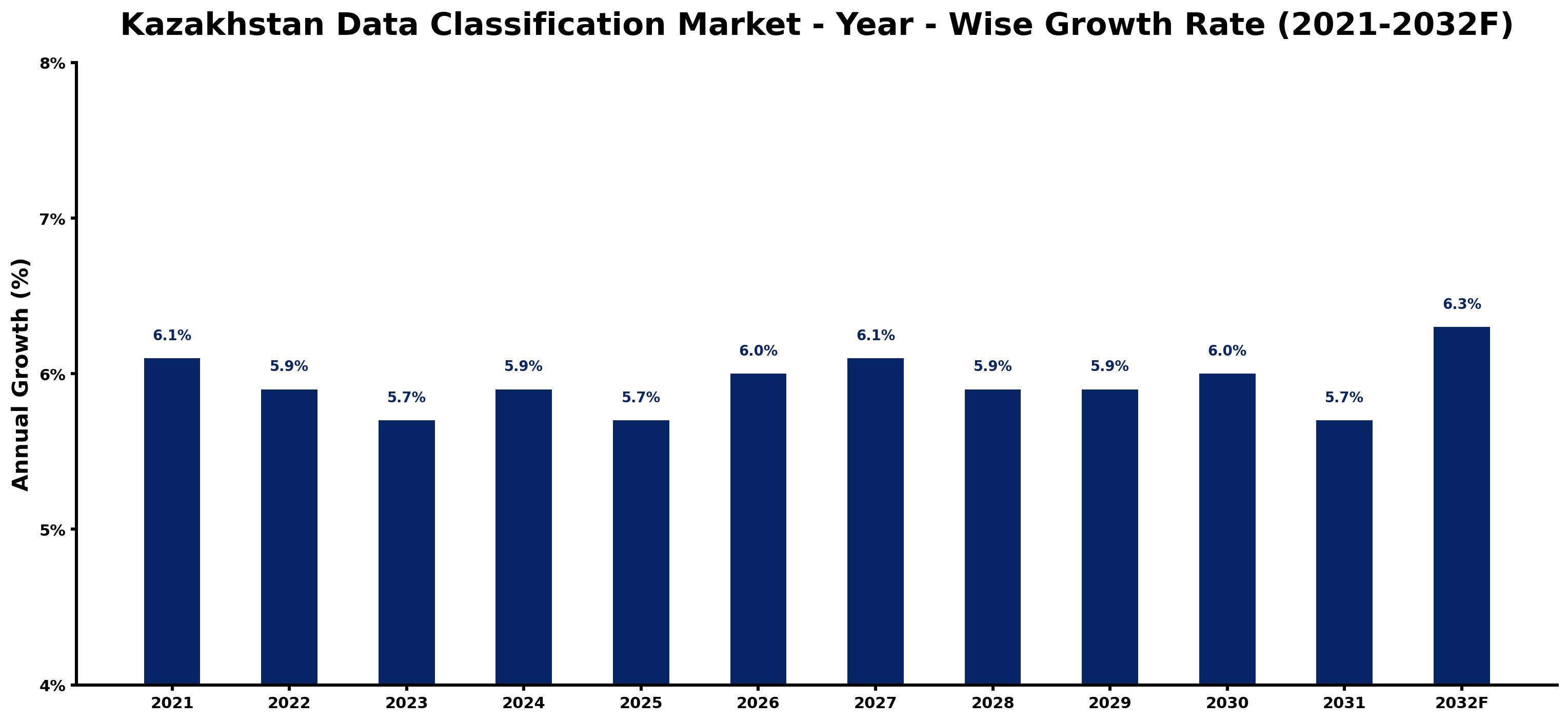
The table below presents the year‑wise growth rates along with the key drivers influencing the market
| Year | Growth Rate | Major Drivers |
| 2021 | 6.1% | Kazakhstan's digital transformation strategy boosts data management needs. |
| 2022 | 5.9% | New data protection laws enhance demand for classification services. |
| 2023 | 5.7% | Increased cybersecurity threats prompt tighter data regulations. |
| 2024 | 5.9% | Growing e-commerce sector drives demand for data organization. |
| 2025 | 5.7% | Government investment in technology fosters data classification services. |
| 2026 | 6.0% | Local firms adopting cloud solutions need effective data classification. |
| 2027 | 6.1% | Emergence of AI applications necessitates structured data frameworks. |
| 2028 | 5.9% | Telecommunication advancements increase data volume requiring classification. |
| 2029 | 5.9% | Rising fintech sector demands improved data handling practices. |
| 2030 | 6.0% | Growing consumer privacy awareness spurs data protection initiatives. |
| 2031 | 5.7% | Government partnerships with tech firms enhance market capabilities. |
| 2032 | 6.3% | Increased focus on analytics drives sophisticated data classification. |
Note: Market size estimations and growth projections presented in this report are based on 6Wresearch's proprietary forecasting methodology, utilizing the latest available industry data, government publications, and primary research inputs.
Kazakhstan Data Classification Market Key Takeaways
Below are some of the specific key takeaways from the market, including:
- Growing regulatory pressures are driving businesses to adopt comprehensive data classification solutions.
- Implementations are increasingly focused on protecting sensitive information from data breaches.
- Organizations are developing data governance policies that align with both local and international standards.
- Advanced data classification technologies are being integrated to improve operational efficiencies.
- Investment in training and resources is crucial for maintaining effective data classification practices.
Evaluation of Restraints in Kazakhstan Data Classification Market
Several factors hinder the potential growth of the Kazakhstan Data Classification Market. Organizations often grapple with the complexity of implementing consistent classification practices across diverse data sources. This inconsistency can lead to compliance challenges, especially as businesses navigate stringent data protection regulations like GDPR and local data sovereignty laws. Additionally, the resource-intensive nature of effective data classification poses a barrier, as organizations must allocate significant time and expertise to establish robust governance structures.
Kazakhstan Data Classification Market Trends
There is a noticeable shift towards automation in data classification processes. Businesses are increasingly relying on AI and machine learning algorithms to enhance accuracy and efficiency. on top of that, organizations are prioritizing real-time data monitoring, enabling quicker responses to potential security threats. The emphasis on cross-platform integration is also growing, ensuring that data classification tools can seamlessly work across various environments and platforms.
Kazakhstan Data Classification Market Opportunities
The potential for growth in this market is significant. Organizations are seeking solutions that not only meet compliance requirements but also improve their overall data management strategies. There are ample opportunities for technology vendors to develop customized data classification tools tailored to specific industry needs. Additionally, public awareness campaigns aimed at educating organizations about the importance of data governance will further stimulate market growth.
Government Initiatives in the Kazakhstan Data Classification Market
The Kazakhstan government is actively shaping the data classification market through various regulatory initiatives. By emphasizing the importance of data governance and security, these policies encourage organizations to adopt classification solutions that comply with national and international standards. The government's focus on funding and promoting data management initiatives is crucial for fostering a secure data environment.
- A regulatory framework established in 2023 mandates data classification for all businesses, ensuring compliance with local laws.
- Currently, a national program is underway that provides funding for businesses to implement advanced data classification solutions.
- A public awareness initiative launched in early 2025 aims to educate organizations about the critical role of data governance.
- Plans are in place for a comprehensive review of data protection regulations by 2026, potentially leading to stricter compliance measures.
Future Insights of the Kazakhstan Data Classification Market
Looking ahead to 2026-2032, the Kazakhstan Data Classification Market is set to experience substantial transformation. Organizations will increasingly adopt integrated solutions that encompass various aspects of data governance. Additionally, as technological advancements continue, we can expect to see a rise in intelligent classification tools capable of adapting to changing regulations and business environments. As companies strive to strengthen their data security posture, the demand for tailored classification solutions will only intensify.
Kazakhstan Data Classification Market Latest Developments
Recent activity in the Kazakhstan Data Classification Market indicates a growing focus on innovation and compliance. Over the past year, businesses have made significant strides in enhancing their data governance frameworks. The introduction of new technologies and collaborative initiatives has further accelerated this progress.
- An initiative launched in early 2024 focused on developing a national data classification framework now aims to streamline compliance for organizations.
- A partnership between leading tech firms is currently underway to create advanced automated classification tools expected to debut in late 2025.
- A major regional conference focused on data governance was held in Q2 2025, attracting stakeholders from various sectors to discuss best practices.
- A product rollout of enhanced data classification software is set to begin in mid-2026, offering organizations more sophisticated options for compliance.
Kazakhstan Data Classification Market - Key Attractiveness of the Report
- 10 Years of Market Numbers
- Historical Data Starting from 2022 to 2025
- Base Year: 2025
- Forecast Data until 2032
- Key Performance Indicators Impacting the Market
- Major Upcoming Developments and Projects
Key Highlights of the Report:
- Kazakhstan Data Classification Market Outlook
- Market Size of Kazakhstan Data Classification Market, 2025
- Forecast of Kazakhstan Data Classification Market, 2032
- Historical Data and Forecast of Kazakhstan Data Classification Revenues & Volume for the Period 2022-2032F
- Kazakhstan Data Classification Market Trend Evolution
- Kazakhstan Data Classification Market Drivers and Challenges
- Kazakhstan Data Classification Price Trends
- Kazakhstan Data Classification Porter's Five Forces
- Kazakhstan Data Classification Industry Life Cycle
- Historical Data and Forecast of Kazakhstan Data Classification Market Revenues & Volume By Component for the Period 2022-2032F
- Historical Data and Forecast of Kazakhstan Data Classification Market Revenues & Volume By Solutions (Standalone and Integrated) for the Period 2022-2032F
- Historical Data and Forecast of Kazakhstan Data Classification Market Revenues & Volume By Services for the Period 2022-2032F
- Historical Data and Forecast of Kazakhstan Data Classification Market Revenues & Volume By Application for the Period 2022-2032F
- Historical Data and Forecast of Kazakhstan Data Classification Market Revenues & Volume By Access Control for the Period 2022-2032F
- Historical Data and Forecast of Kazakhstan Data Classification Market Revenues & Volume By GRC for the Period 2022-2032F
- Historical Data and Forecast of Kazakhstan Data Classification Market Revenues & Volume By Web for the Period 2022-2032F
- Historical Data and Forecast of Kazakhstan Data Classification Market Revenues & Volume By Mobile & Email Protection for the Period 2022-2032F
- Historical Data and Forecast of Kazakhstan Data Classification Market Revenues & Volume By Centralized Management for the Period 2022-2032F
- Historical Data and Forecast of Kazakhstan Data Classification Market Revenues & Volume By Methodology for the Period 2022-2032F
- Historical Data and Forecast of Kazakhstan Data Classification Market Revenues & Volume By Content-based Classification for the Period 2022-2032F
- Historical Data and Forecast of Kazakhstan Data Classification Market Revenues & Volume By Context-based Classification for the Period 2022-2032F
- Historical Data and Forecast of Kazakhstan Data Classification Market Revenues & Volume By User-based Classification for the Period 2022-2032F
- Historical Data and Forecast of Kazakhstan Data Classification Market Revenues & Volume By Vertical for the Period 2022-2032F
- Historical Data and Forecast of Kazakhstan Data Classification Market Revenues & Volume By BFSI for the Period 2022-2032F
- Historical Data and Forecast of Kazakhstan Data Classification Market Revenues & Volume By Healthcare and Lifesciences for the Period 2022-2032F
- Historical Data and Forecast of Kazakhstan Data Classification Market Revenues & Volume By Government and Defense for the Period 2022-2032F
- Historical Data and Forecast of Kazakhstan Data Classification Market Revenues & Volume By Education for the Period 2022-2032F
- Historical Data and Forecast of Kazakhstan Data Classification Market Revenues & Volume By Telecom for the Period 2022-2032F
- Historical Data and Forecast of Kazakhstan Data Classification Market Revenues & Volume By Media and Entertainment for the Period 2022-2032F
- Historical Data and Forecast of Kazakhstan Data Classification Market Revenues & Volume By Others (Retail and Ecommerce, Manufacturing, and Energy and Utilities) for the Period 2022-2032F
- Kazakhstan Data Classification Import Export Trade Statistics
- Market Opportunity Assessment By Component
- Market Opportunity Assessment By Application
- Market Opportunity Assessment By Methodology
- Market Opportunity Assessment By Vertical
- Kazakhstan Data Classification Top Companies Market Share
- Kazakhstan Data Classification Competitive Benchmarking By Technical and Operational Parameters
- Kazakhstan Data Classification Company Profiles
- Kazakhstan Data Classification Key Strategic Recommendations






































