Kazakhstan Digital Remittance Market Size Growth Rate
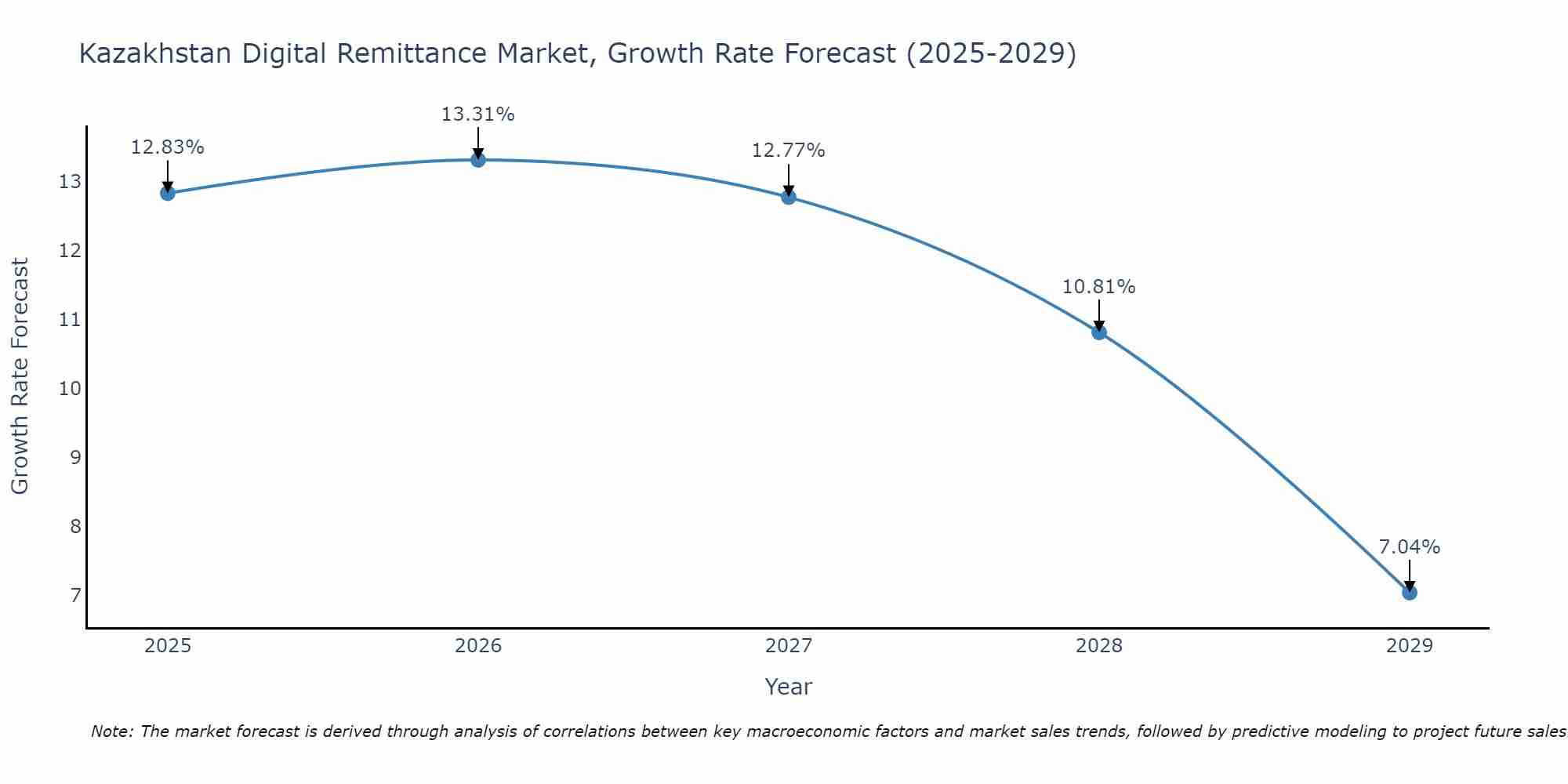
The Kazakhstan Digital Remittance Market is projected to witness mixed growth rate patterns during 2025 to 2029. Growth accelerates to 13.31% in 2026, following an initial rate of 12.83%, before easing to 7.04% at the end of the period.
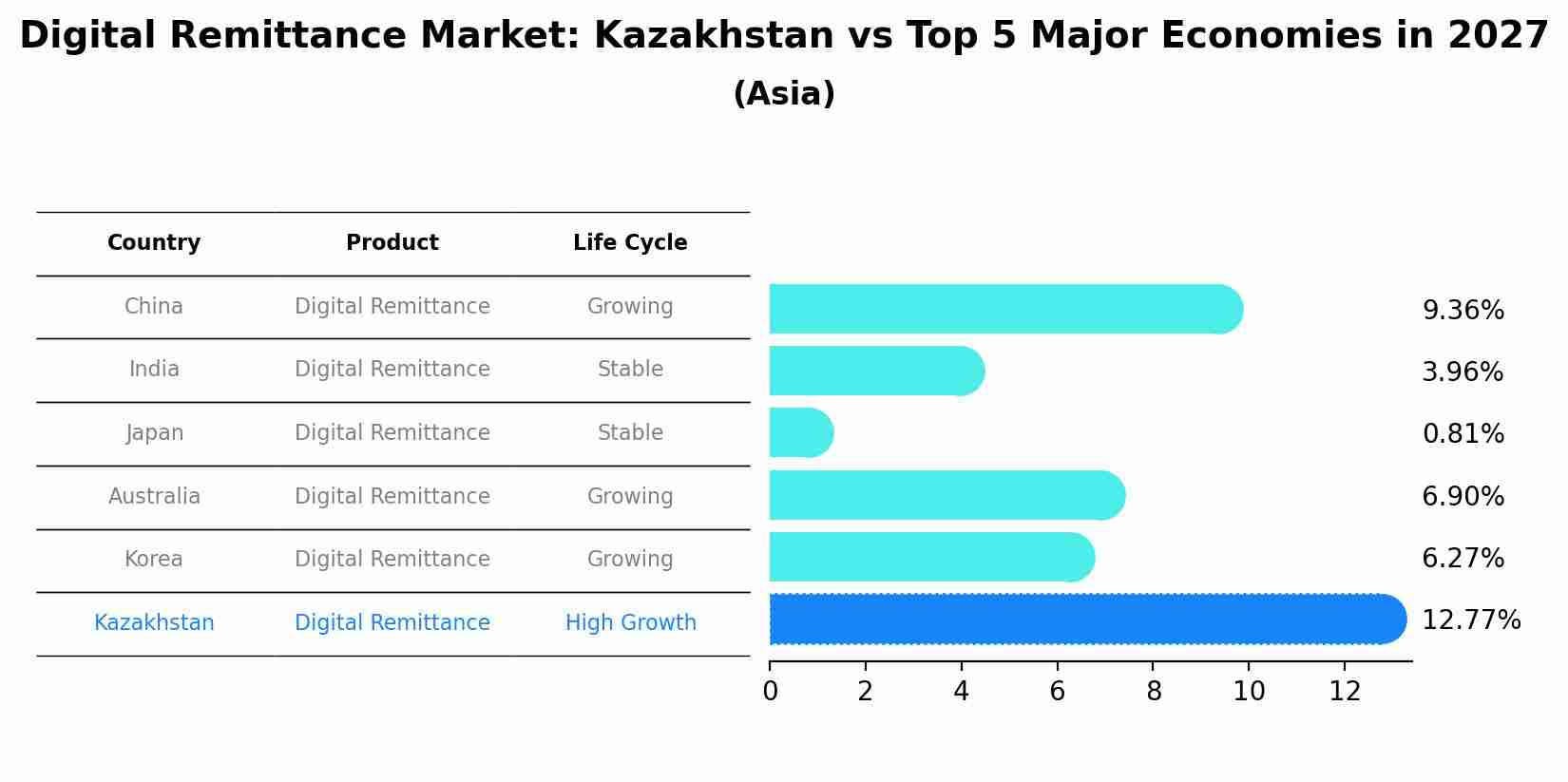
Digital Remittance Market: Kazakhstan vs Top 5 Major Economies in 2027 (Asia)
The Digital Remittance market in Kazakhstan is projected to grow at a high growth rate of 12.77% by 2027, within the Asia region led by China, along with other countries like India, Japan, Australia and South Korea, collectively shaping a dynamic and evolving market environment driven by innovation and increasing adoption of emerging technologies.
Kazakhstan Digital Remittance Market Overview
The digital remittance market in Kazakhstan is witnessing rapid expansion driven by the increasing adoption of online payment platforms and mobile money services. As more people seek convenient and cost-effective ways to send money domestically and internationally, digital remittance providers are innovating to offer seamless transfer experiences and competitive exchange rates. Government initiatives to promote financial inclusion are also contributing to the growth of the digital remittance market in Kazakhstan.
Drivers of the market
The digital remittance market in Kazakhstan is witnessing robust growth, driven by several key drivers. Firstly, the increasing globalization and mobility of the workforce are driving demand for fast, convenient, and cost-effective remittance solutions. Digital remittance platforms offer users the ability to transfer money internationally in real-time or within a short timeframe, bypassing traditional banking channels and reducing transaction costs. Moreover, the growing penetration of smartphones and internet connectivity, especially in rural and remote areas, is expanding the reach of digital remittance services to a broader population base. Additionally, the COVID-19 pandemic has accelerated the adoption of digital payment solutions, including remittances, as consumers and businesses seek contactless and remote transaction options. Furthermore, regulatory initiatives aimed at promoting financial inclusion, reducing remittance costs, and combating money laundering and fraud are creating a favorable regulatory environment for digital remittance providers in Kazakhstan. Overall, the combination of changing consumer preferences, technological advancements, and regulatory support is driving the growth of the digital remittance market in Kazakhstan.
Challenges of the market
Challenges in the digital remittance market in Kazakhstan include regulatory compliance and trust issues. Stringent financial regulations and anti-money laundering (AML) laws can complicate the operations of digital remittance providers. Moreover, building trust among users, especially in rural and underserved areas, where digital literacy might be low, is crucial for market penetration and growth.
Government Policy of the market
For the digital remittance market, the government has supported initiatives to enhance the efficiency and security of cross-border money transfers through digital channels. Policies have been introduced to regulate digital remittance services and promote competition and innovation in this sector.
Key Highlights of the Report:
- Kazakhstan Digital Remittance Market Outlook
- Market Size of Kazakhstan Digital Remittance Market, 2024
- Forecast of Kazakhstan Digital Remittance Market, 2031
- Historical Data and Forecast of Kazakhstan Digital Remittance Revenues & Volume for the Period 2018 - 2031
- Kazakhstan Digital Remittance Market Trend Evolution
- Kazakhstan Digital Remittance Market Drivers and Challenges
- Kazakhstan Digital Remittance Price Trends
- Kazakhstan Digital Remittance Porter's Five Forces
- Kazakhstan Digital Remittance Industry Life Cycle
- Historical Data and Forecast of Kazakhstan Digital Remittance Market Revenues & Volume By Type for the Period 2018 - 2031
- Historical Data and Forecast of Kazakhstan Digital Remittance Market Revenues & Volume By Inward Digital Remittance for the Period 2018 - 2031
- Historical Data and Forecast of Kazakhstan Digital Remittance Market Revenues & Volume By Outward Digital Remittance for the Period 2018 - 2031
- Historical Data and Forecast of Kazakhstan Digital Remittance Market Revenues & Volume By Channel for the Period 2018 - 2031
- Historical Data and Forecast of Kazakhstan Digital Remittance Market Revenues & Volume By Banks for the Period 2018 - 2031
- Historical Data and Forecast of Kazakhstan Digital Remittance Market Revenues & Volume By Money Transfer Operators for the Period 2018 - 2031
- Historical Data and Forecast of Kazakhstan Digital Remittance Market Revenues & Volume By Online Platforms for the Period 2018 - 2031
- Historical Data and Forecast of Kazakhstan Digital Remittance Market Revenues & Volume By Others for the Period 2018 - 2031
- Historical Data and Forecast of Kazakhstan Digital Remittance Market Revenues & Volume By End-use for the Period 2018 - 2031
- Historical Data and Forecast of Kazakhstan Digital Remittance Market Revenues & Volume By Migrant Labor Workforce for the Period 2018 - 2031
- Historical Data and Forecast of Kazakhstan Digital Remittance Market Revenues & Volume By Personal for the Period 2018 - 2031
- Historical Data and Forecast of Kazakhstan Digital Remittance Market Revenues & Volume By Small Businesses for the Period 2018 - 2031
- Historical Data and Forecast of Kazakhstan Digital Remittance Market Revenues & Volume By Others for the Period 2018 - 2031
- Kazakhstan Digital Remittance Import Export Trade Statistics
- Market Opportunity Assessment By Type
- Market Opportunity Assessment By Channel
- Market Opportunity Assessment By End-use
- Kazakhstan Digital Remittance Top Companies Market Share
- Kazakhstan Digital Remittance Competitive Benchmarking By Technical and Operational Parameters
- Kazakhstan Digital Remittance Company Profiles
- Kazakhstan Digital Remittance Key Strategic Recommendations






































