Kazakhstan Electrical and electronics Market Summary
The kazakhstan electrical and electronics market was estimated at USD 473 Million in 2025 and is projected to reach USD 685 Million by 2032, growing at a CAGR of 6.2% from 2026 to 2032.
Kazakhstan Electrical and electronics Market Year-wise Growth Rate and Key Drivers
This graph highlights how the Kazakhstan Electrical and electronics Market has steadily grown over the past five years, supported by major growth factors.
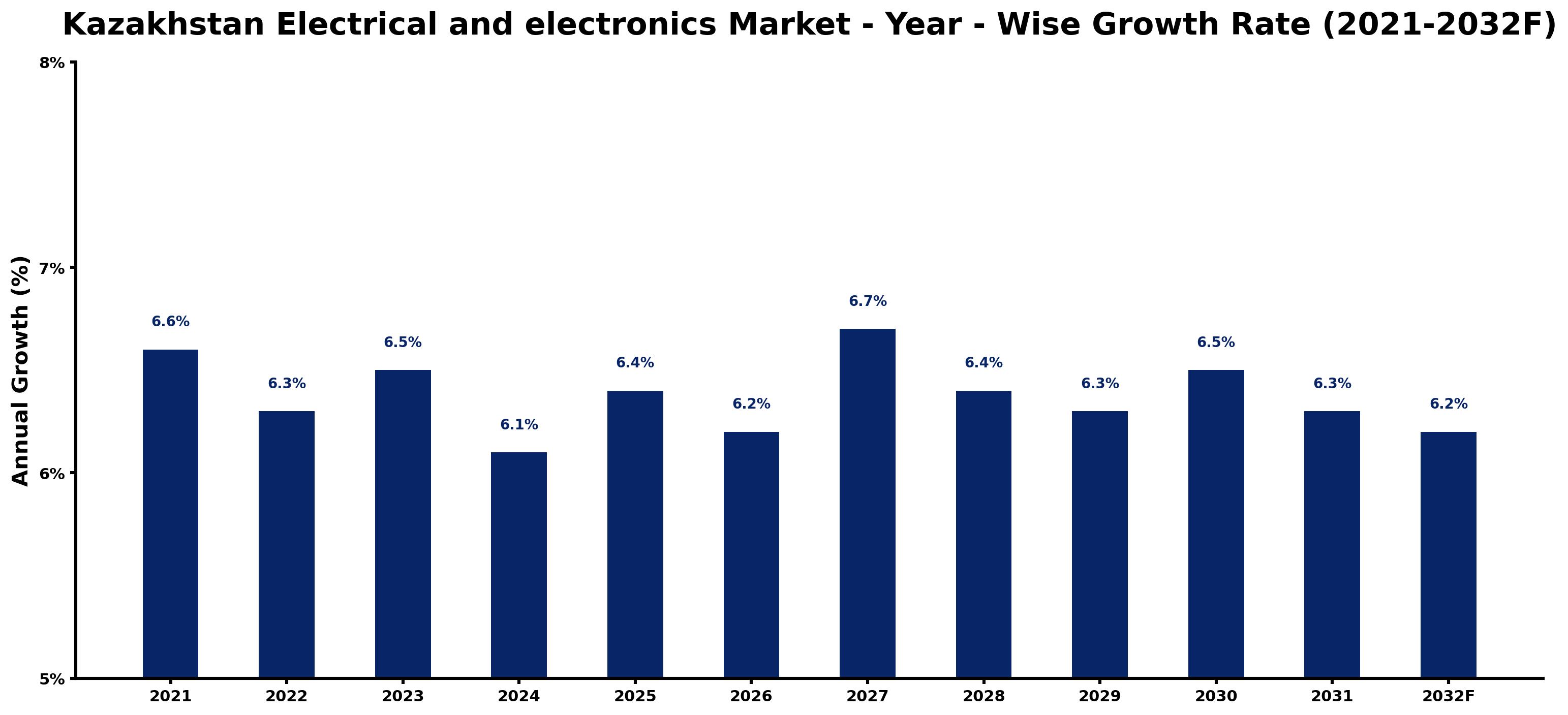
The table below presents the year wise growth rates along with the key drivers influencing the market
| Year | Growth Rate | Major Drivers |
| 2021 | 6.6% | Post-pandemic recovery spurred investments in renewable energy infrastructure across Kazakhstan. |
| 2022 | 6.3% | Local manufacturers began focusing on energy-efficient electronic products to meet market demand. |
| 2023 | 6.5% | Emerging tech startups introduced innovative electronic solutions, enhancing market competitiveness. |
| 2024 | 6.1% | Investment in smart grid technologies gained traction, improving energy distribution efficiency. |
| 2025 | 6.4% | Consumer preferences shifted toward smart home devices, driving product diversification. |
| 2026 | 6.2% | Collaborations between tech firms and educational institutions fostered skilled workforce development. |
| 2027 | 6.7% | Increased urbanization resulted in higher demand for reliable electrical infrastructure solutions. |
| 2028 | 6.4% | International partnerships expanded market access for Kazakh electronic manufacturers and suppliers. |
| 2029 | 6.3% | Local regulatory reforms promoted green technology adoption in the electrical sector. |
| 2030 | 6.5% | Research and development funding saw boosts, enhancing innovation within the electronics market. |
| 2031 | 6.3% | Consumer awareness campaigns led to greater interest in sustainable electronic products. |
| 2032 | 6.2% | Technological convergence of AI and electronics created new opportunities for market expansion. |
Note - Market size estimations and growth projections presented in this report are based on 6Wresearch's advanced forecasting approach, validated with industry datasets as of June 2026.
Kazakhstan Electrical and electronics Market Synopsis
The Kazakhstan Electrical and electronics Market is projected to reach 6.2% and witness significant growth during the forecast period (2026-2032). This growth is primarily driven by ongoing industrialization, urbanization, and substantial investments in infrastructure development across the nation. The market landscape is characterized by escalating demand for consumer electronics, home appliances, and diverse industrial equipment, which collectively contribute to the burgeoning electrical and electronics sector.
Kazakhstan Electrical and electronics Market Growth Drivers
A multitude of factors are fueling the expansion of the Kazakhstan Electrical and electronics Market. The increasing pace of urbanization is leading to heightened demand for modern electrical appliances and electronic devices as consumers seek to improve their living standards. Additionally, rapid industrial growth in sectors such as manufacturing and construction requires advanced electrical equipment. The government's commitment to bolstering renewable energy sources is a crucial driver, aligning with global sustainability trends and encouraging investments in green technologies.
- The urban population growth results in heightened demand for energy-efficient home appliances, as consumers prioritize sustainability.
- Ongoing infrastructure projects necessitate advanced electrical components and industrial equipment to support industrial activities.
- The transition towards digital solutions in various sectors is creating opportunities for smart and connected devices.
- Investment in renewable energy technologies, such as solar and wind, is reshaping the market landscape and driving innovation.
- The rising disposable income among consumers in Kazakhstan is leading to increased purchasing power for electronic goods and home appliances.
Kazakhstan Electrical and electronics Market Trends and Opportunities
The Kazakhstan Electrical and electronics market is aligning itself with global technology trends, showcasing a significant shift towards energy-efficient and environmentally friendly products. There is an increasing consumer awareness regarding sustainability, which propels demand for eco-friendly electronic devices. The market is also observing a growing trend towards smart home technologies, reflecting consumer preferences for convenience, efficiency, and energy savings.
- Consumers are increasingly seeking products with lower energy consumption, leading manufacturers to innovate in energy-saving technologies.
- The popularity of e-commerce platforms is revolutionizing the purchasing process, making it easier for consumers to access a wider range of products.
- Technological advancements in the production of electrical components are opening avenues for greater customization and improved functionality.
- Local industries are focusing on enhancing their product quality to compete with established international brands, thereby fostering innovation.
- The development of smart cities is driving demand for connected devices, reflecting the integration of technology into urban living.
Kazakhstan Electrical and electronics Market Challenges and Restraints
Despite the positive growth trajectory, the Kazakhstan Electrical and electronics Market faces several challenges that could hinder its expansion. Regulatory barriers, coupled with a lack of standardization, complicate market entry and compliance for new and existing businesses. Additionally, certain regions encounter persistent issues with infrastructure development and inconsistent access to reliable electricity supply, which can stifle growth and operational efficiency.
- Regulatory challenges often slow down the approval processes for new products, impacting the timely entry of innovations into the market.
- The presence of counterfeit goods undermines the market's integrity, posing risks for brands investing in quality and authenticity.
- Intellectual property rights violations deter foreign investments and diminish confidence among legitimate businesses.
- Competing against low-cost imports from neighboring countries can pressure local manufacturers to reduce prices without sacrificing quality.
- Rapid technological advancements necessitate continuous innovation, which may be resource-intensive for local firms with limited capabilities.
Kazakhstan Electrical and electronics Market Government Investment and Initiatives
The Kazakhstan government is actively supporting the electrical and electronics market through various policies and initiatives aimed at fostering growth and sustainability. These measures include promoting renewable energy resources to diminish reliance on traditional energy sources significantly. The government has outlined regulations to enhance energy efficiency in appliances and buildings, reflecting its commitment to sustainability and reductions in energy consumption.
- Public investment in infrastructure projects is aimed at improving overall connectivity and supporting industrial growth.
- Incentives for foreign investment are being introduced to attract international companies into the electrical and electronics sector.
- Public-private partnerships are encouraged, providing a framework for collaboration on technological advancements and innovations.
- Government policies are focused on enhancing local manufacturing capabilities, aiming to reduce import dependency.
- Training programs and educational initiatives are designed to enhance the technical skills of the workforce, supporting the sector's growth.
Kazakhstan Electrical and electronics Market Latest Developments (May 2025 - June 2026)
Recent developments in the Kazakhstan Electrical and electronics Market suggest a continued trajectory of innovation and adaptation. The focus on renewable energy and sustainability is gaining momentum, with various projects aimed at integrating solar and wind power into the national grid. The government has also enhanced its efforts to streamline regulatory processes, making it more feasible for businesses to introduce new technologies and products. Furthermore, local manufacturers are increasingly adopting digital solutions within their operations, reflecting a broader shift towards industrial digitalization.
- Enhanced regulatory frameworks have been established to facilitate smoother market entry for new technological innovations.
- Significant investments in renewable infrastructure are shaping the future landscape of the electrical sector.
- Companies are increasingly leveraging e-commerce to expand their market reach and improve consumer engagement.
- There is a growing emphasis on developing smart home technologies, aligning with global consumer demands for connectivity.
- The market is witnessing collaborative efforts between government and private sectors to develop sustainable practices and products.
Kazakhstan Electrical and electronics Market - Key Attractiveness of the Report
- 10 Years of Market Numbers
- Historical Data Starting from 2022 to 2025
- Base Year: 2025
- Forecast Data until 2032
- Key Performance Indicators Impacting the Market
- Major Upcoming Developments and Projects
Key Highlights of the Report:
- Kazakhstan Electrical and electronics Market Outlook
- Market Size of Kazakhstan Electrical and electronics Market, 2025
- Forecast of Kazakhstan Electrical and electronics Market, 2032F
- Historical Data and Forecast of Kazakhstan Electrical and electronics Revenues & Volume for the Period 2022-2032F
- Kazakhstan Electrical and electronics Market Trend Evolution
- Kazakhstan Electrical and electronics Market Drivers and Challenges
- Kazakhstan Electrical and electronics Price Trends
- Kazakhstan Electrical and electronics Porter's Five Forces
- Kazakhstan Electrical and electronics Industry Life Cycle
- Historical Data and Forecast of Kazakhstan Electrical and electronics Market Revenues & Volume By Type for the Period 2022-2032F
- Historical Data and Forecast of Kazakhstan Electrical and electronics Market Revenues & Volume By Electric Motors for the Period 2022-2032F
- Historical Data and Forecast of Kazakhstan Electrical and electronics Market Revenues & Volume By Primary And Storage Batteries for the Period 2022-2032F
- Historical Data and Forecast of Kazakhstan Electrical and electronics Market Revenues & Volume By Generators for the Period 2022-2032F
- Historical Data and Forecast of Kazakhstan Electrical and electronics Market Revenues & Volume By Semiconductors for the Period 2022-2032F
- Historical Data and Forecast of Kazakhstan Electrical and electronics Market Revenues & Volume By Household Appliances for the Period 2022-2032F
- Historical Data and Forecast of Kazakhstan Electrical and electronics Market Revenues & Volume By Applications for the Period 2022-2032F
- Historical Data and Forecast of Kazakhstan Electrical and electronics Market Revenues & Volume By Online for the Period 2022-2032F
- Historical Data and Forecast of Kazakhstan Electrical and electronics Market Revenues & Volume By Offline for the Period 2022-2032F
- Kazakhstan Electrical and electronics Import Export Trade Statistics
- Market Opportunity Assessment By Type
- Market Opportunity Assessment By Applications
- Kazakhstan Electrical and electronics Top Companies Market Share
- Kazakhstan Electrical and electronics Competitive Benchmarking By Technical and Operational Parameters
- Kazakhstan Electrical and electronics Company Profiles
- Kazakhstan Electrical and electronics Key Strategic Recommendations






































