Kazakhstan Foam Insulation Market: Import Trend Analysis
In the Kazakhstan foam insulation market, the import trend showed a growth rate of 3.3% from 2023 to 2024, with a compound annual growth rate (CAGR) of 8.83% for the period 2020-2024. This import momentum can be attributed to a steady demand shift towards energy-efficient construction materials in the region.
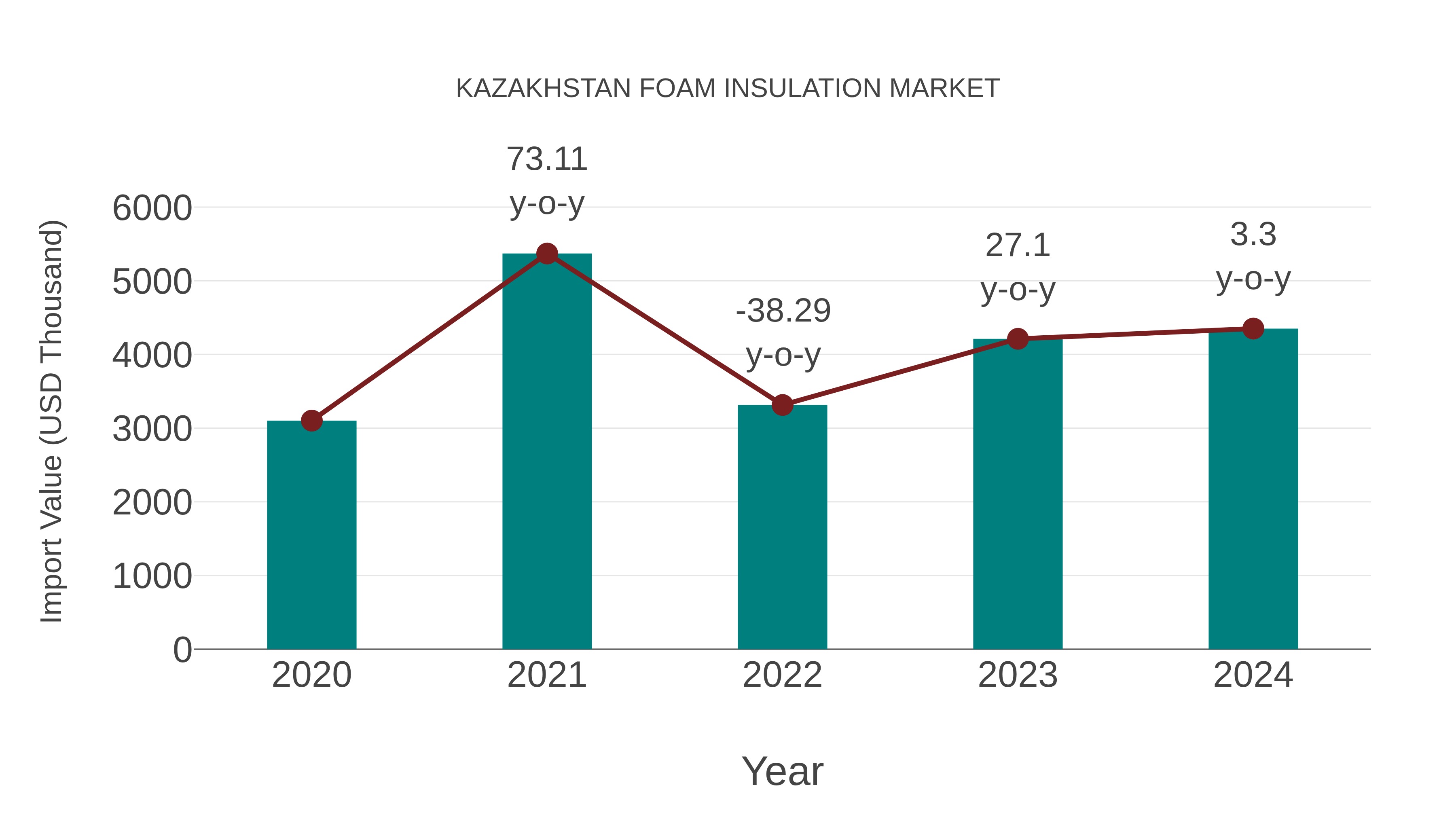
Kazakhstan Foam Insulation Market Overview
The Foam Insulation market in Kazakhstan is witnessing robust growth driven by the construction industry`s increasing focus on energy efficiency and sustainability. Foam insulation materials, such as expanded polystyrene (EPS) and polyurethane foam, offer superior thermal performance, moisture resistance, and ease of installation, making them preferred choices for building insulation applications.
Drivers of the market
The foam insulation market in Kazakhstan is driven by the need for energy-efficient building solutions to combat extreme weather conditions. The rising construction activities, both residential and commercial, are boosting the demand for foam insulation. Government regulations and incentives aimed at improving building energy efficiency are also contributing to market growth. Furthermore, the superior insulating properties of foam insulation materials, along with advancements in manufacturing techniques, are enhancing their adoption across various sectors.
Challenges of the market
The foam insulation market in Kazakhstan is challenged by environmental concerns regarding the production and disposal of foam products. Fluctuating prices of raw materials, such as polyurethane, impact production costs. Competition from traditional insulation materials and the need for compliance with stringent energy efficiency standards also pose significant challenges.
Government Policy of the market
Government policies in Kazakhstan for the foam insulation market aim to enhance energy efficiency in buildings. This includes building codes that mandate the use of high-quality insulation materials and financial incentives for retrofitting older buildings with modern insulation solutions.
Key Highlights of the Report:
- Kazakhstan Foam Insulation Market Outlook
- Market Size of Kazakhstan Foam Insulation Market, 2025
- Forecast of Kazakhstan Foam Insulation Market, 2032
- Historical Data and Forecast of Kazakhstan Foam Insulation Revenues & Volume for the Period 2022-2032F
- Kazakhstan Foam Insulation Market Trend Evolution
- Kazakhstan Foam Insulation Market Drivers and Challenges
- Kazakhstan Foam Insulation Price Trends
- Kazakhstan Foam Insulation Porter's Five Forces
- Kazakhstan Foam Insulation Industry Life Cycle
- Historical Data and Forecast of Kazakhstan Foam Insulation Market Revenues & Volume By Product Type for the Period 2022-2032F
- Historical Data and Forecast of Kazakhstan Foam Insulation Market Revenues & Volume By Polystyrene for the Period 2022-2032F
- Historical Data and Forecast of Kazakhstan Foam Insulation Market Revenues & Volume By Polyurethane & Polyisocyanurate for the Period 2022-2032F
- Historical Data and Forecast of Kazakhstan Foam Insulation Market Revenues & Volume By Polyolefin for the Period 2022-2032F
- Historical Data and Forecast of Kazakhstan Foam Insulation Market Revenues & Volume By Elastomeric for the Period 2022-2032F
- Historical Data and Forecast of Kazakhstan Foam Insulation Market Revenues & Volume By Phenolic for the Period 2022-2032F
- Historical Data and Forecast of Kazakhstan Foam Insulation Market Revenues & Volume By End Use Industry for the Period 2022-2032F
- Historical Data and Forecast of Kazakhstan Foam Insulation Market Revenues & Volume By Building & Construction for the Period 2022-2032F
- Historical Data and Forecast of Kazakhstan Foam Insulation Market Revenues & Volume By Transportation for the Period 2022-2032F
- Historical Data and Forecast of Kazakhstan Foam Insulation Market Revenues & Volume By Consumer Appliances for the Period 2022-2032F
- Kazakhstan Foam Insulation Import Export Trade Statistics
- Market Opportunity Assessment By Product Type
- Market Opportunity Assessment By End Use Industry
- Kazakhstan Foam Insulation Top Companies Market Share
- Kazakhstan Foam Insulation Competitive Benchmarking By Technical and Operational Parameters
- Kazakhstan Foam Insulation Company Profiles
- Kazakhstan Foam Insulation Key Strategic Recommendations






































