Kazakhstan Fruit Pulp Market: Import Trend Analysis
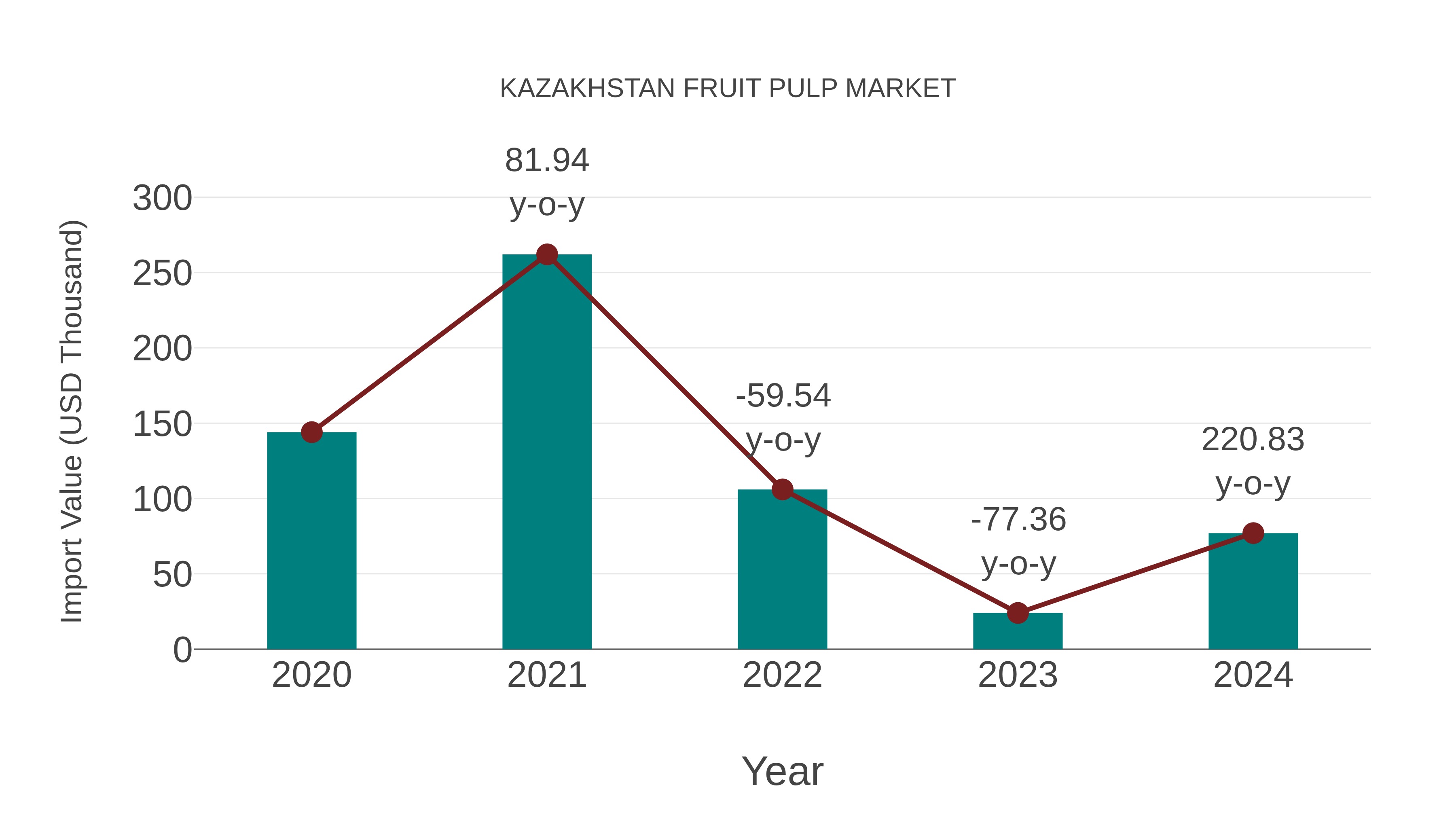
In the Kazakhstan fruit pulp market, the import trend experienced a notable surge from 2023 to 2024, with a growth rate of 220.83%. However, the compound annual growth rate (CAGR) for the period 2020-2024 stood at -14.49%. This significant growth in 2024 could be attributed to a potential shift in consumer preferences towards imported fruit pulp varieties, indicating a possible increase in demand or changes in trade policies that favored imports during that period.
Kazakhstan Fruit Pulp Market Overview
The fruit pulp market in Kazakhstan is driven by the growing demand for processed fruit products in the food and beverage industry. Fruit pulp is widely used as an ingredient in various applications such as juice production, dairy products, bakery items, and confectionery. Kazakhstan boasts abundant fruit resources, including apples, apricots, grapes, and berries, which serve as raw materials for fruit pulp manufacturers. The market is characterized by a focus on product quality, innovation, and diversification to meet consumer preferences and market trends.
Drivers of the market
The fruit pulp market in Kazakhstan is driven by the increasing demand for processed and convenience foods. Fruit pulp is widely used in the production of juices, jams, and bakery products, catering to the growing consumer preference for natural and healthy ingredients. The expansion of the food and beverage industry, along with the rising trend of health and wellness, supports the market growth. Additionally, advancements in fruit processing technologies improve the quality and shelf life of fruit pulp products.
Challenges of the market
The fruit pulp market in Kazakhstan faces challenges related to the limited availability of high-quality fruit raw materials, which affects the consistency and quality of fruit pulp products. Seasonal fluctuations and climatic conditions also impact fruit production, leading to supply chain disruptions. Moreover, the market struggles with competition from imported fruit pulp products, which often offer better quality and variety.
Government Policy of the market
The government supports the fruit pulp market by encouraging local production and export initiatives. Policies include subsidies for fruit processing facilities, quality standards for fruit pulp products, and marketing support to promote Kazakhstani fruit pulp in international markets.
Key Highlights of the Report:
- Kazakhstan Fruit Pulp Market Outlook
- Market Size of Kazakhstan Fruit Pulp Market, 2025
- Forecast of Kazakhstan Fruit Pulp Market, 2032
- Historical Data and Forecast of Kazakhstan Fruit Pulp Revenues & Volume for the Period 2022-2032F
- Kazakhstan Fruit Pulp Market Trend Evolution
- Kazakhstan Fruit Pulp Market Drivers and Challenges
- Kazakhstan Fruit Pulp Price Trends
- Kazakhstan Fruit Pulp Porter's Five Forces
- Kazakhstan Fruit Pulp Industry Life Cycle
- Historical Data and Forecast of Kazakhstan Fruit Pulp Market Revenues & Volume By Fruit Type for the Period 2022-2032F
- Historical Data and Forecast of Kazakhstan Fruit Pulp Market Revenues & Volume By Mango for the Period 2022-2032F
- Historical Data and Forecast of Kazakhstan Fruit Pulp Market Revenues & Volume By Strawberry for the Period 2022-2032F
- Historical Data and Forecast of Kazakhstan Fruit Pulp Market Revenues & Volume By Apple for the Period 2022-2032F
- Historical Data and Forecast of Kazakhstan Fruit Pulp Market Revenues & Volume By Guava for the Period 2022-2032F
- Historical Data and Forecast of Kazakhstan Fruit Pulp Market Revenues & Volume By Berries for the Period 2022-2032F
- Historical Data and Forecast of Kazakhstan Fruit Pulp Market Revenues & Volume By Citrus Fruits for the Period 2022-2032F
- Historical Data and Forecast of Kazakhstan Fruit Pulp Market Revenues & Volume By Others for the Period 2022-2032F
- Historical Data and Forecast of Kazakhstan Fruit Pulp Market Revenues & Volume By Form for the Period 2022-2032F
- Historical Data and Forecast of Kazakhstan Fruit Pulp Market Revenues & Volume By Liquid for the Period 2022-2032F
- Historical Data and Forecast of Kazakhstan Fruit Pulp Market Revenues & Volume By Powder for the Period 2022-2032F
- Historical Data and Forecast of Kazakhstan Fruit Pulp Market Revenues & Volume By Application for the Period 2022-2032F
- Historical Data and Forecast of Kazakhstan Fruit Pulp Market Revenues & Volume By Food and Beverages for the Period 2022-2032F
- Historical Data and Forecast of Kazakhstan Fruit Pulp Market Revenues & Volume By Distribution for the Period 2022-2032F
- Historical Data and Forecast of Kazakhstan Fruit Pulp Market Revenues & Volume By E-Commerce for the Period 2022-2032F
- Historical Data and Forecast of Kazakhstan Fruit Pulp Market Revenues & Volume By Convenience Stores for the Period 2022-2032F
- Historical Data and Forecast of Kazakhstan Fruit Pulp Market Revenues & Volume By Supermarkets/Hypermarkets for the Period 2022-2032F
- Historical Data and Forecast of Kazakhstan Fruit Pulp Market Revenues & Volume By Specialty Stores for the Period 2022-2032F
- Historical Data and Forecast of Kazakhstan Fruit Pulp Market Revenues & Volume By Others for the Period 2022-2032F
- Kazakhstan Fruit Pulp Import Export Trade Statistics
- Market Opportunity Assessment By Fruit Type
- Market Opportunity Assessment By Form
- Market Opportunity Assessment By Application
- Market Opportunity Assessment By Distribution
- Kazakhstan Fruit Pulp Top Companies Market Share
- Kazakhstan Fruit Pulp Competitive Benchmarking By Technical and Operational Parameters
- Kazakhstan Fruit Pulp Company Profiles
- Kazakhstan Fruit Pulp Key Strategic Recommendations






































