Kazakhstan Gamification Market Size, Share & Growth Rate
The Kazakhstan Gamification Market was estimated at USD 1312 Million in 2025 and is projected to reach USD 1874 Million by 2032, growing at a CAGR of 5.2% from 2026 to 2032. This growth trajectory is being driven by an increasing recognition of gamification's potential to elevate customer engagement and improve workforce productivity across key sectors, including education, healthcare, and retail. As more organizations leverage digital transformation initiatives, the adoption of gamified solutions is set to flourish, creating fertile ground for sustained market expansion.
Kazakhstan Gamification Market Year-wise Growth Rate and Key Drivers
This graph highlights how the Kazakhstan Gamification Market has steadily grown over the years, supported by major growth factors.
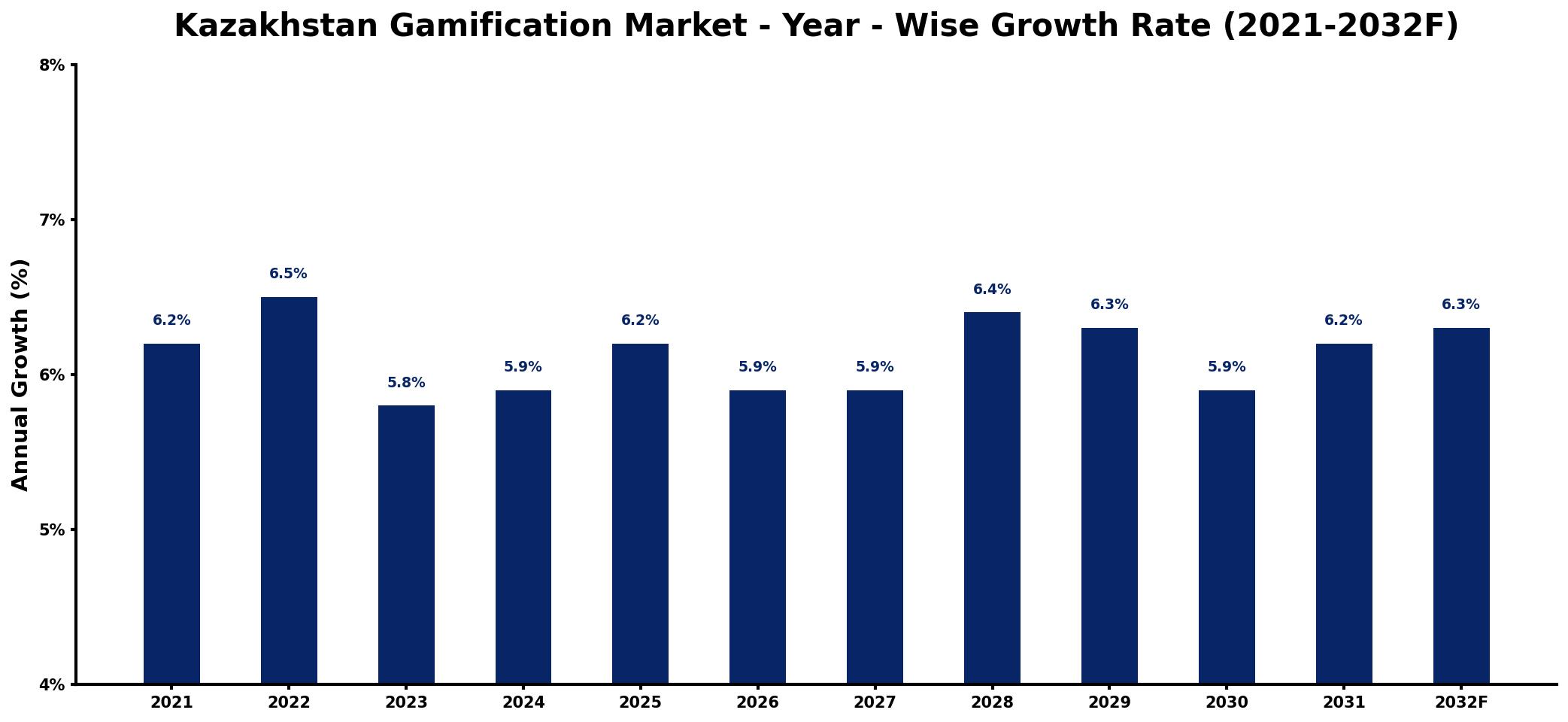
The table below presents the year‑wise growth rates along with the key drivers influencing the market
| Year | Growth Rate | Major Drivers |
| 2021 | 6.2% | increased corporate training investments |
| 2022 | 6.5% | growing popularity of e-learning |
| 2023 | 5.8% | expansion of mobile application usage |
| 2024 | 5.9% | rising demand for interactive content |
| 2025 | 6.2% | enhanced user engagement strategies |
| 2026 | 5.9% | growing focus on employee retention |
| 2027 | 5.9% | increased integration of technology |
| 2028 | 6.4% | increased capital investment inflows |
| 2029 | 6.3% | growing interest in behavioral analytics |
| 2030 | 5.9% | rising adoption of digital platforms |
| 2031 | 6.2% | increased emphasis on user experience |
| 2032 | 6.3% | growing investment in innovation |
Note: Market size estimations and growth projections presented in this report are based on 6Wresearch's proprietary forecasting methodology, utilizing the latest available industry data, government publications, and primary research inputs.
Kazakhstan Gamification Market Synopsis
In Kazakhstan, the demand for gamification solutions is intensifying, particularly in educational institutions where innovative teaching methods are increasingly sought after. Businesses are also recognizing the potential of gamification to enhance customer loyalty and streamline operational processes, leading to a broader application of gamified strategies across various sectors.
Moreover, the integration of gamification into employee training programs is gaining traction, helping organizations foster a more engaged and productive workforce. With a youthful, tech-savvy population, the appetite for interactive and engaging digital experiences is strong, further propelling the market forward.
Kazakhstan Gamification Market Key Takeaways
- The gamification market in Kazakhstan is increasingly adopted across education, healthcare, and retail sectors.
- Key drivers include enhanced engagement, productivity improvements, and innovative solutions tailored to local business needs.
- The market is supported by government initiatives aimed at fostering digital transformation.
- The rise of smartphone penetration is creating new opportunities for gamified experiences.
- Investment prospects remain robust as companies seek to enhance customer engagement through gamification.
Evaluation of Restraints in Kazakhstan Gamification Market
Despite the promising growth, the Kazakhstan Gamification Market faces significant challenges. One of the primary issues is the prevalent lack of awareness regarding gamification among local businesses, which often leads to hesitation in investing in these innovative solutions. Many organizations are still unfamiliar with how gamification can enhance employee engagement and improve customer loyalty, resulting in underutilized potential. Additionally, finding skilled professionals who can effectively implement and manage gamification strategies remains a barrier, further hindering the markets growth potential. Tackling these educational gaps and fostering a talent pool adept in gamification will be crucial for unlocking the full capabilities of this vibrant market.
Kazakhstan Gamification Market Trends
The market is witnessing notable trends, particularly the integration of gamification strategies into various business functions such as marketing, employee training, and customer engagement. A significant shift has occurred post-COVID-19, as businesses have sought innovative digital solutions to maintain connection with their customers in a remote environment. Furthermore, the increasing focus on personalized experiences is prompting organizations to develop gamified applications that cater specifically to user preferences, thereby enhancing user loyalty and participation. As digitalization accelerates, the embrace of gamification as a core business strategy is becoming more commonplace.
Kazakhstan Gamification Market Opportunities
Investment opportunities abound in the Kazakhstan Gamification Market, particularly in sectors ripe for interactive solutions. With a robust demand for engaging educational tools, there is a chance for growth in developing gamified platforms tailored to educational institutions. The healthcare sector also presents opportunities, as organizations increasingly look for methods to improve patient interaction and compliance. Investing in local startups that create innovative gamified applications or partnering with established businesses to integrate gamification strategies can lead to significant returns as the market continues to mature.
Government Initiatives in the Kazakhstan Gamification Market
While there are no direct policies specifically targeting the gamification market, the Kazakhstan government has introduced several initiatives aimed at enhancing the overall technology landscape. Programs like the Digital Kazakhstan initiative focus on modernizing the economy and fostering a supportive environment for tech companies. Such efforts to promote digital innovation indirectly benefit the gamification sector by creating favorable conditions for businesses to adopt and implement these interactive solutions. Furthermore, the governments commitment to encouraging entrepreneurship and foreign investments further positions Kazakhstan as a competitive player in the Central Asian technology market.
Future Insights of the Kazakhstan Gamification Market
The future of the Kazakhstan Gamification Market appears optimistic, with a strong potential for growth driven by increasing technological adoption across various industries. The continuous rise in smartphone usage among the youth population and the subsequent demand for engaging digital experiences will likely propel market expansion. Organizations are becoming more aware of the benefits of gamification, leading to increased investments in innovative solutions to enhance customer and employee interactions. As digital transformation initiatives gain momentum, the gamification market is expected to play a significant role in shaping the future business landscape in Kazakhstan.
Kazakhstan Gamification Market Latest Developments (2025 - 2026)
Recently, the Kazakhstan Gamification Market has seen a growing interest in integrating gamification into traditional business frameworks. Organizations across various sectors are experimenting with gamified strategies to enhance consumer experience and workforce engagement. Digital platforms focused on delivering gamified learning experiences have gained traction, reflecting a shift towards more interactive and user-centric business models. As local firms ramp up their digital capabilities, the overall momentum in the gamification sector is expected to continue.
Kazakhstan Gamification Market - Key Attractiveness of the Report
- 10 Years of Market Numbers
- Historical Data Starting from 2022 to 2025
- Base Year: 2025
- Forecast Data until 2032
- Key Performance Indicators Impacting the Market
- Major Upcoming Developments and Projects
Key Highlights of the Report:
- Kazakhstan Gamification Market Outlook
- Market Size of Kazakhstan Gamification Market, 2025
- Forecast of Kazakhstan Gamification Market, 2032
- Historical Data and Forecast of Kazakhstan Gamification Revenues & Volume for the Period 2022-2032F
- Kazakhstan Gamification Market Trend Evolution
- Kazakhstan Gamification Market Drivers and Challenges
- Kazakhstan Gamification Price Trends
- Kazakhstan Gamification Porter's Five Forces
- Kazakhstan Gamification Industry Life Cycle
- Historical Data and Forecast of Kazakhstan Gamification Market Revenues & Volume By Component for the Period 2022-2032F
- Historical Data and Forecast of Kazakhstan Gamification Market Revenues & Volume By Solution for the Period 2022-2032F
- Historical Data and Forecast of Kazakhstan Gamification Market Revenues & Volume By Services for the Period 2022-2032F
- Historical Data and Forecast of Kazakhstan Gamification Market Revenues & Volume By Deployment for the Period 2022-2032F
- Historical Data and Forecast of Kazakhstan Gamification Market Revenues & Volume By Cloud for the Period 2022-2032F
- Historical Data and Forecast of Kazakhstan Gamification Market Revenues & Volume By On-premises for the Period 2022-2032F
- Historical Data and Forecast of Kazakhstan Gamification Market Revenues & Volume By Organization Size for the Period 2022-2032F
- Historical Data and Forecast of Kazakhstan Gamification Market Revenues & Volume By SMEs for the Period 2022-2032F
- Historical Data and Forecast of Kazakhstan Gamification Market Revenues & Volume By Large Enterprises for the Period 2022-2032F
- Historical Data and Forecast of Kazakhstan Gamification Market Revenues & Volume By End-User for the Period 2022-2032F
- Historical Data and Forecast of Kazakhstan Gamification Market Revenues & Volume By Enterprise-Driven for the Period 2022-2032F
- Historical Data and Forecast of Kazakhstan Gamification Market Revenues & Volume By Consumer-Driven for the Period 2022-2032F
- Kazakhstan Gamification Import Export Trade Statistics
- Market Opportunity Assessment By Component
- Market Opportunity Assessment By Deployment
- Market Opportunity Assessment By Organization Size
- Market Opportunity Assessment By End-User
- Kazakhstan Gamification Top Companies Market Share
- Kazakhstan Gamification Competitive Benchmarking By Technical and Operational Parameters
- Kazakhstan Gamification Company Profiles
- Kazakhstan Gamification Key Strategic Recommendations






































