Kazakhstan Generator Market: Import Trend Analysis
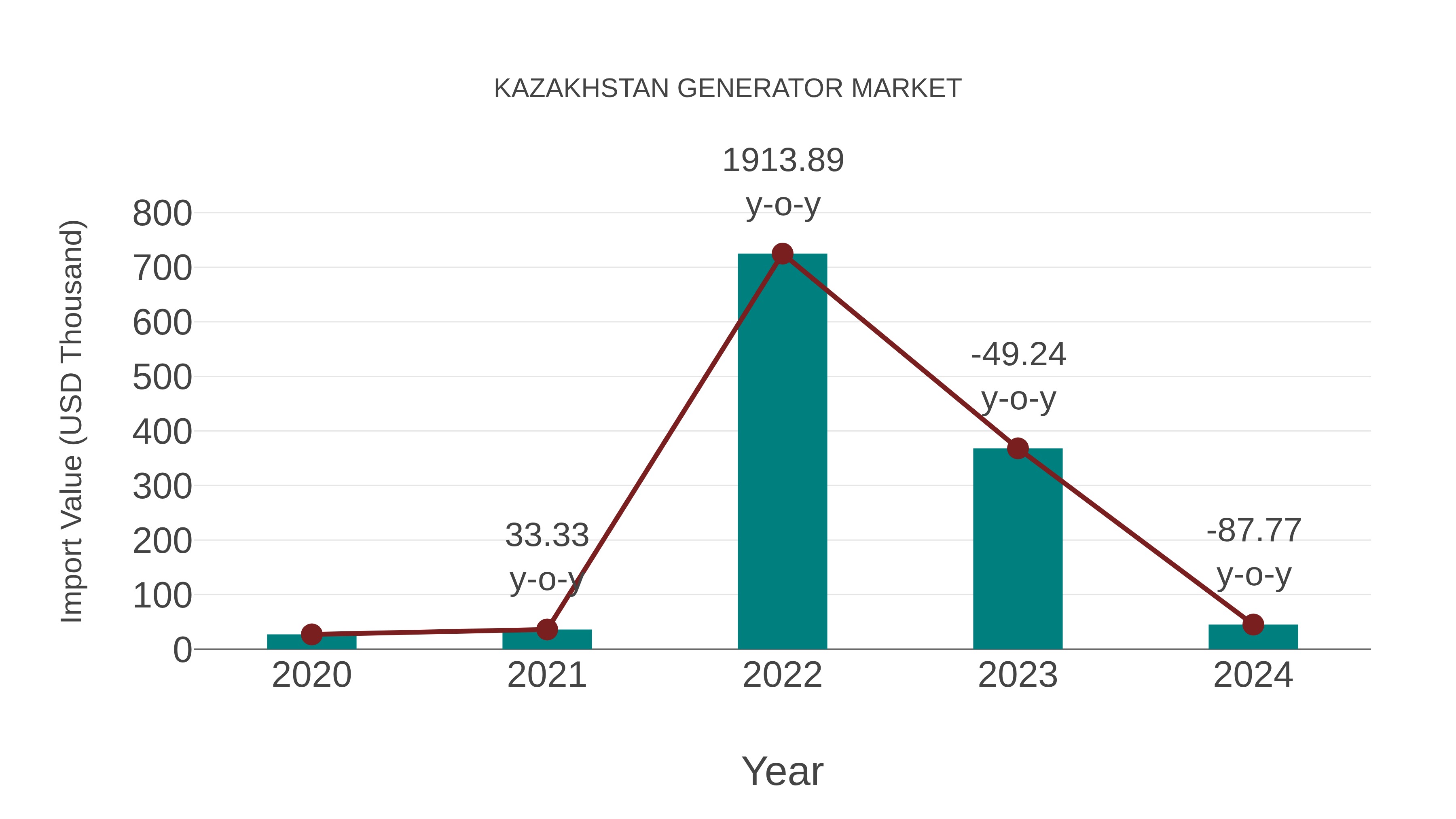
In the Kazakhstan generator market, the import trend experienced a significant decline from 2023 to 2024, with a growth rate of -87.77%. However, the market showed a Compound Annual Growth Rate (CAGR) of 13.62% from 2020 to 2024. This sharp decline in imports can be attributed to a possible shift in demand dynamics or changes in trade policies impacting market stability.
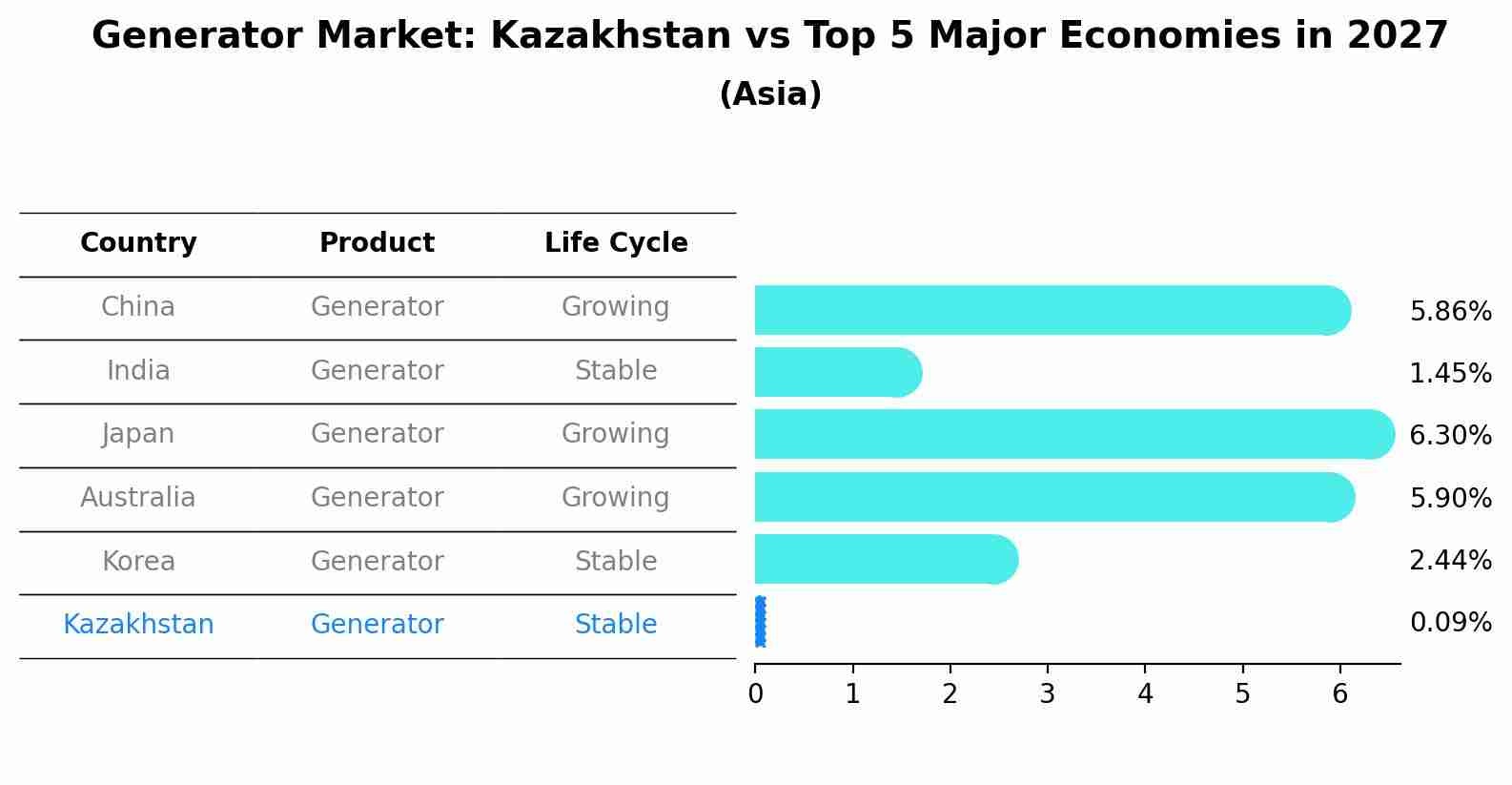
Generator Market: Kazakhstan vs Top 5 Major Economies in 2027 (Asia)
By 2027, Kazakhstan's Generator market is forecasted to achieve a stable growth rate of 0.09%, with China leading the Asia region, followed by India, Japan, Australia and South Korea.
Kazakhstan Generator Market Synopsis
The Kazakhstan generator market is experiencing steady growth driven by factors such as increasing demand for reliable power supply in various industries, rapid urbanization, and government initiatives to improve infrastructure. Diesel generators are the most commonly used type due to their reliability and ability to operate in remote areas with limited access to the main power grid. The market is also witnessing a shift towards cleaner and more sustainable energy sources, leading to a growing interest in natural gas and solar-powered generators. Key players in the Kazakhstan generator market include Caterpillar Inc., Cummins Inc., and Generac Power Systems, among others, who are focusing on product innovation and expansion of their distribution network to capitalize on the increasing demand for generators in the country.
Kazakhstan Generator Market Trends
The Kazakhstan Generator Market is experiencing growth driven by various factors such as increasing demand for reliable power supply in industries, commercial establishments, and residential sectors. There is a rising focus on backup power solutions due to frequent power outages in certain regions, leading to a higher adoption of generators. Additionally, the ongoing industrial development and infrastructure projects in Kazakhstan are driving the demand for generators for powering construction sites and other applications. There is also a growing interest in eco-friendly and energy-efficient generator technologies to align with sustainability goals. Overall, the market is witnessing a shift towards more advanced, reliable, and efficient generator solutions to meet the evolving power needs in Kazakhstan.
Kazakhstan Generator Market Challenges
In the Kazakhstan generator market, several challenges are faced, including competition from established global brands, fluctuating fuel prices impacting operational costs, and the need for continuous technological advancements to meet evolving customer demands. Additionally, limited access to financing options for customers looking to invest in generators, as well as regulatory uncertainties and compliance requirements, pose obstacles for market growth. The market also faces challenges related to infrastructural limitations and distribution network constraints, particularly in remote or rural areas. Overall, overcoming these challenges will require market players to focus on innovation, strategic partnerships, and tailored marketing strategies to effectively penetrate the market and gain a competitive edge.
Kazakhstan Generator Market Investment Opportunities
The Kazakhstan Generator Market presents various investment opportunities due to the country`s growing demand for reliable power supply across industries such as oil and gas, mining, construction, and telecommunications. With a focus on modernizing its infrastructure and increasing electricity generation capacity, there is a need for high-quality generators that can provide backup power during outages or serve as primary power sources in remote areas. Investors can explore opportunities in supplying diesel generators, gas generators, renewable energy-based generators, and hybrid solutions tailored to Kazakhstan`s specific requirements. Additionally, investing in distribution networks, maintenance services, and rental solutions for generators can also be lucrative in this market. Overall, the Kazakhstan Generator Market offers potential for long-term growth and profitability for investors looking to capitalize on the country`s energy sector development.
Jordan Agar Market Government Policies
Government policies related to the Kazakhstan Generator Market include the promotion of renewable energy sources to reduce reliance on traditional fossil fuels, as well as incentives for investing in clean energy technologies such as wind and solar power. The government has implemented regulations to ensure the quality and safety of generators imported and used in the country, including certification requirements and standards compliance. Additionally, there are initiatives to encourage local manufacturing of generators to boost the domestic industry and create job opportunities. Overall, the government is focused on achieving energy security, reducing environmental impact, and fostering economic growth in the generator market through a combination of regulatory measures and support for sustainable energy solutions.
Kazakhstan Generator Market Future Outlook
The Kazakhstan generator market is expected to witness steady growth in the coming years due to increasing industrialization, infrastructure development, and a growing need for reliable power supply across various sectors such as manufacturing, mining, and construction. The government`s focus on diversifying the economy and enhancing energy security is also likely to drive demand for generators in the country. Additionally, the increasing adoption of renewable energy sources and the need for backup power solutions in remote regions are expected to further boost the generator market in Kazakhstan. Factors such as technological advancements, rising investments in the power sector, and the government`s initiatives to modernize the energy infrastructure will play a crucial role in shaping the future outlook of the Kazakhstan generator market.
Key Highlights of the Report:
- Kazakhstan Generator Market Outlook
- Market Size of Kazakhstan Generator Market, 2021
- Forecast of Kazakhstan Generator Market, 2031
- Historical Data and Forecast of Kazakhstan Generator Revenues & Volume for the Period 2018 - 2031
- Kazakhstan Generator Market Trend Evolution
- Kazakhstan Generator Market Drivers and Challenges
- Kazakhstan Generator Price Trends
- Kazakhstan Generator Porter's Five Forces
- Kazakhstan Generator Industry Life Cycle
- Historical Data and Forecast of Kazakhstan Generator Market Revenues & Volume By Application for the Period 2018 - 2031
- Historical Data and Forecast of Kazakhstan Generator Market Revenues & Volume By Stationary Generators for the Period 2018 - 2031
- Historical Data and Forecast of Kazakhstan Generator Market Revenues & Volume By Portable Generators for the Period 2018 - 2031
- Historical Data and Forecast of Kazakhstan Generator Market Revenues & Volume By Fuel for the Period 2018 - 2031
- Historical Data and Forecast of Kazakhstan Generator Market Revenues & Volume By Diesel Generators for the Period 2018 - 2031
- Historical Data and Forecast of Kazakhstan Generator Market Revenues & Volume By Gas Generators for the Period 2018 - 2031
- Historical Data and Forecast of Kazakhstan Generator Market Revenues & Volume By End Use for the Period 2018 - 2031
- Historical Data and Forecast of Kazakhstan Generator Market Revenues & Volume By Residential Generators for the Period 2018 - 2031
- Historical Data and Forecast of Kazakhstan Generator Market Revenues & Volume By Commercial Generators for the Period 2018 - 2031
- Historical Data and Forecast of Kazakhstan Generator Market Revenues & Volume By Industrial Generators for the Period 2018 - 2031
- Historical Data and Forecast of Kazakhstan Generator Market Revenues & Volume By Others for the Period 2018 - 2031
- Historical Data and Forecast of Kazakhstan Generator Market Revenues & Volume By Capacity for the Period 2018 - 2031
- Historical Data and Forecast of Kazakhstan Generator Market Revenues & Volume By 0-100 kVA for the Period 2018 - 2031
- Historical Data and Forecast of Kazakhstan Generator Market Revenues & Volume By 100-350 kVA for the Period 2018 - 2031
- Historical Data and Forecast of Kazakhstan Generator Market Revenues & Volume By 350-1000kVA for the Period 2018 - 2031
- Historical Data and Forecast of Kazakhstan Generator Market Revenues & Volume By Above 1000kVA for the Period 2018 - 2031
- Kazakhstan Generator Import Export Trade Statistics
- Market Opportunity Assessment By Application
- Market Opportunity Assessment By Fuel
- Market Opportunity Assessment By End Use
- Market Opportunity Assessment By Capacity
- Kazakhstan Generator Top Companies Market Share
- Kazakhstan Generator Competitive Benchmarking By Technical and Operational Parameters
- Kazakhstan Generator Company Profiles
- Kazakhstan Generator Key Strategic Recommendations






































