Kazakhstan Human Hair Extension Market: Import Trend Analysis
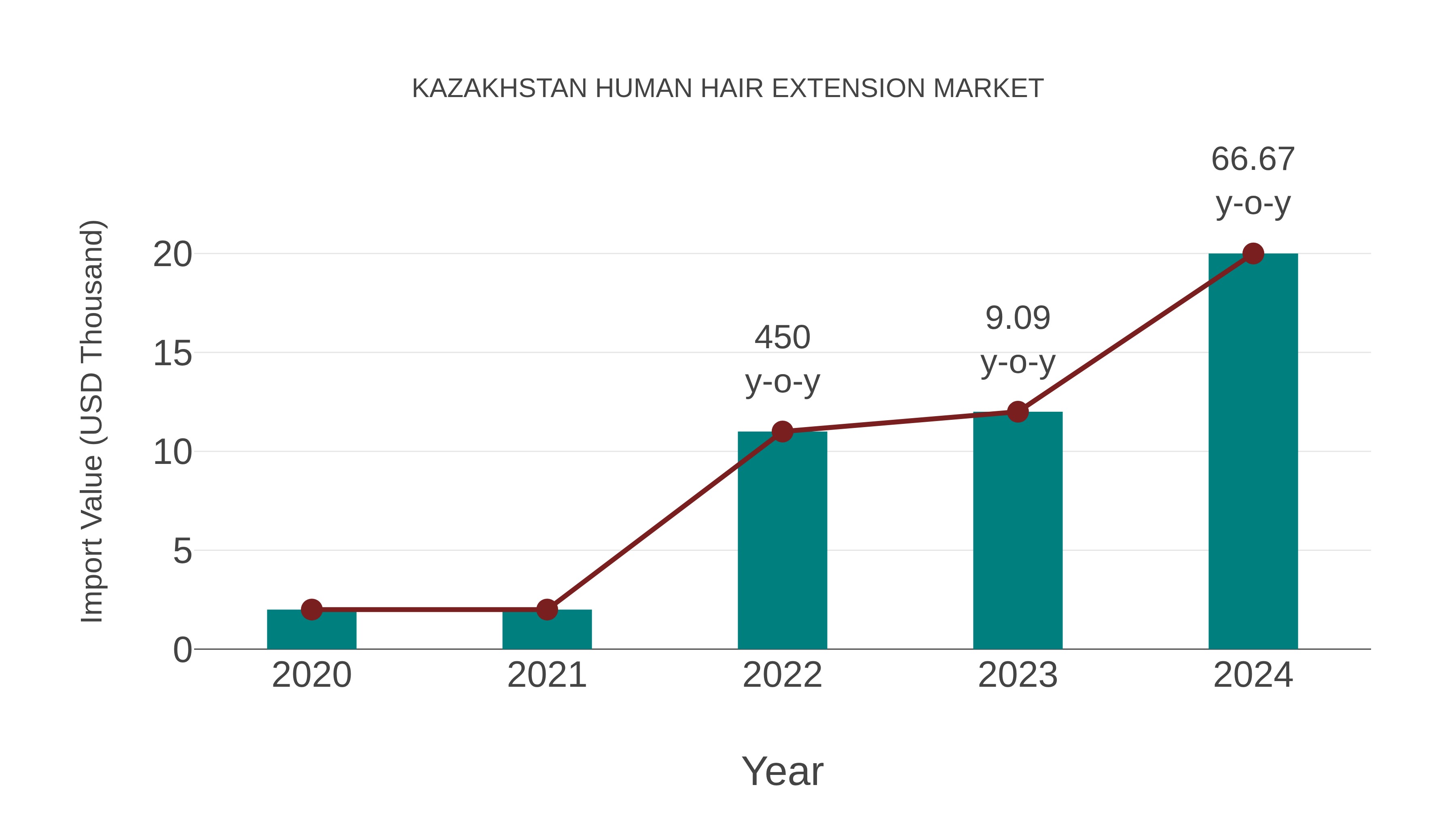
In the Kazakhstan human hair extension market, the import trend showed significant growth from 2023 to 2024, with a notable increase of 66.67%. The compound annual growth rate (CAGR) for the period 2020-2024 was recorded at 77.83%. This surge in imports can be attributed to a shifting demand for high-quality hair products and a favorable trade environment that encouraged market stability during this period.
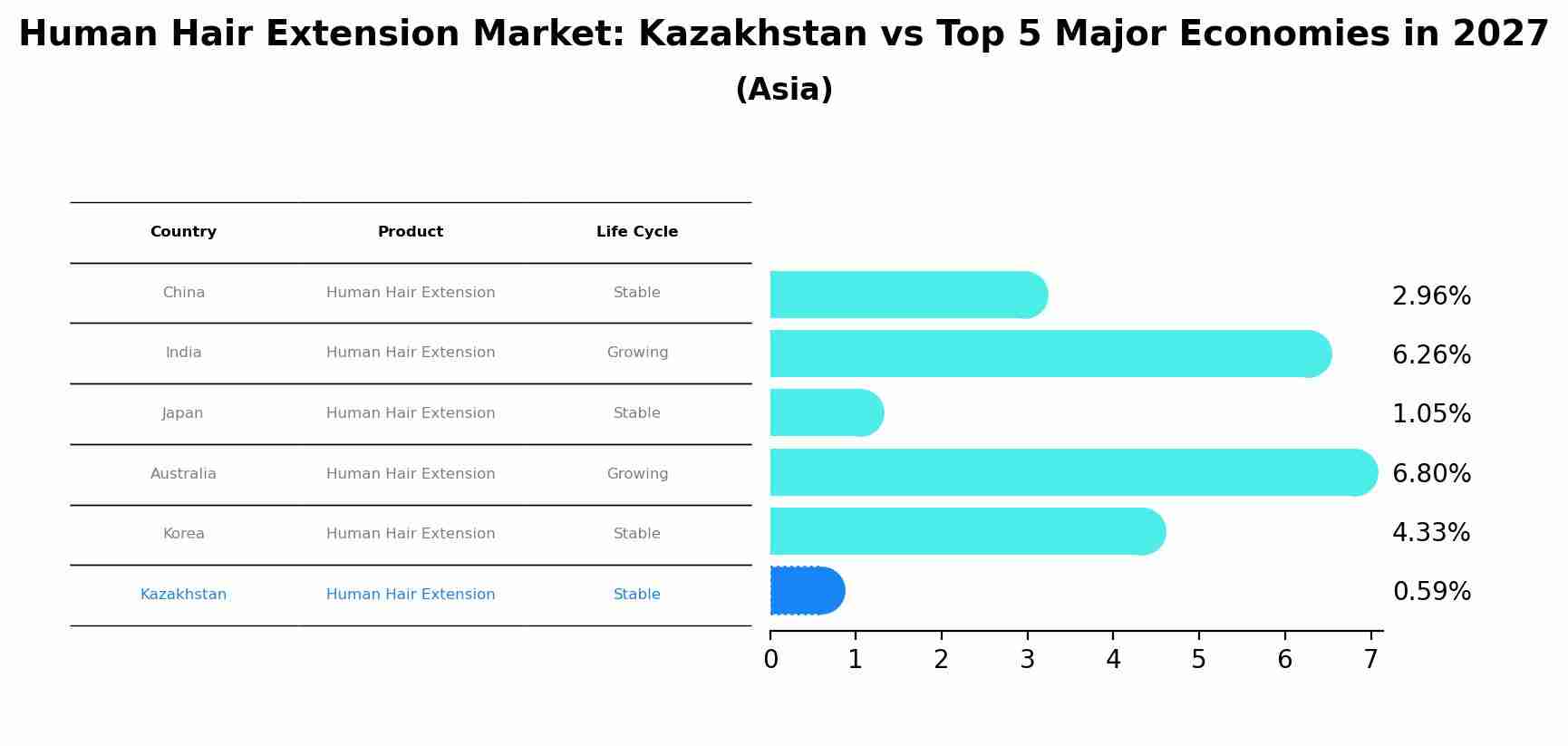
Human Hair Extension Market: Kazakhstan vs Top 5 Major Economies in 2027 (Asia)
By 2027, Kazakhstan's Human Hair Extension market is forecasted to achieve a stable growth rate of 0.59%, with China leading the Asia region, followed by India, Japan, Australia and South Korea.
Kazakhstan Human Hair Extension Market Synopsis
The Kazakhstan human hair extension market is experiencing steady growth driven by increasing beauty consciousness among consumers, rising disposable incomes, and a growing desire for aesthetic enhancements. The market is characterized by a wide range of products including clip-in extensions, tape-in extensions, and fusion extensions, catering to diverse customer preferences. Key players in the market offer high-quality human hair extensions sourced from various regions globally, with a focus on durability and natural appearance. The market also benefits from the influence of social media platforms and beauty influencers, which drive awareness and demand for hair extensions. With a growing number of salons and beauty retailers offering these products, the Kazakhstan human hair extension market is expected to continue its growth trajectory in the foreseeable future.
Kazakhstan Human Hair Extension Market Trends
The Kazakhstan Human Hair Extension Market is experiencing a growing demand for high-quality, ethically sourced hair extensions. Consumers are increasingly seeking natural-looking extensions that blend seamlessly with their own hair, leading to a rise in popularity of premium virgin hair extensions. Sustainability and eco-friendliness are becoming important factors for consumers, driving the demand for extensions made from ethically sourced and environmentally friendly materials. Additionally, there is a growing trend towards customization and personalization, with consumers looking for unique extension options that cater to their individual style preferences. As the market continues to evolve, companies are focusing on innovation and product development to meet the changing needs and preferences of consumers in Kazakhstan.
Kazakhstan Human Hair Extension Market Challenges
In the Kazakhstan human hair extension market, some key challenges include the presence of counterfeit products, which can undermine consumer trust and impact the reputation of authentic brands. Another challenge is the fluctuating demand for high-quality human hair extensions, as consumer preferences and trends evolve rapidly. Additionally, competition from international brands and online retailers can pose a threat to local suppliers. Ensuring the authenticity and quality of the products, staying abreast of fashion trends, and effectively competing with both local and global players are crucial challenges faced by businesses operating in the Kazakhstan human hair extension market. Developing effective marketing strategies, maintaining product quality, and building strong relationships with customers can help companies navigate these challenges and succeed in this competitive market.
Kazakhstan Human Hair Extension Market Investment Opportunities
The Kazakhstan Human Hair Extension Market presents promising investment opportunities due to the increasing demand for high-quality hair extensions driven by the growing beauty and fashion industry in the country. Investors can capitalize on this trend by establishing or partnering with hair extension manufacturers or distributors to cater to the local market. Additionally, there is potential for exporting Kazakh human hair extensions to international markets, leveraging the country`s reputation for producing natural and durable hair. Investing in marketing strategies, product development, and establishing strong distribution channels can help investors tap into this lucrative market segment and benefit from the rising consumer interest in hair extensions in Kazakhstan and beyond.
Kazakhstan Human Hair Extension Market Future Outlook
The Kazakhstan human hair extension market is poised for steady growth in the coming years, driven by increasing disposable incomes, changing fashion trends, and rising awareness about personal grooming. As the beauty industry continues to flourish in Kazakhstan, the demand for high-quality human hair extensions is expected to rise, especially among the younger population and urban consumers. The market is likely to witness a shift towards more sustainable and ethically sourced products, with a growing preference for natural-looking extensions. Additionally, the rise of social media influencers and celebrities endorsing hair extensions is anticipated to further fuel market growth. However, increasing competition from both domestic and international brands may present challenges, thereby necessitating innovative marketing strategies and product differentiation to capture a larger market share.
Key Highlights of the Report:
- Kazakhstan Human Hair Extension Market Outlook
- Market Size of Kazakhstan Human Hair Extension Market, 2025
- Forecast of Kazakhstan Human Hair Extension Market, 2032
- Historical Data and Forecast of Kazakhstan Human Hair Extension Revenues & Volume for the Period 2022 - 2032F
- Kazakhstan Human Hair Extension Market Trend Evolution
- Kazakhstan Human Hair Extension Market Drivers and Challenges
- Kazakhstan Human Hair Extension Price Trends
- Kazakhstan Human Hair Extension Porter's Five Forces
- Kazakhstan Human Hair Extension Industry Life Cycle
- Historical Data and Forecast of Kazakhstan Human Hair Extension Market Revenues & Volume By Hair Type for the Period 2022 - 2032F
- Historical Data and Forecast of Kazakhstan Human Hair Extension Market Revenues & Volume By Human Hair for the Period 2022 - 2032F
- Historical Data and Forecast of Kazakhstan Human Hair Extension Market Revenues & Volume By Animal Hair for the Period 2022 - 2032F
- Historical Data and Forecast of Kazakhstan Human Hair Extension Market Revenues & Volume By Synthetic Hair for the Period 2022 - 2032F
- Historical Data and Forecast of Kazakhstan Human Hair Extension Market Revenues & Volume By Application for the Period 2022 - 2032F
- Historical Data and Forecast of Kazakhstan Human Hair Extension Market Revenues & Volume By Fusion & Pre-bonded for the Period 2022 - 2032F
- Historical Data and Forecast of Kazakhstan Human Hair Extension Market Revenues & Volume By Tap-in for the Period 2022 - 2032F
- Historical Data and Forecast of Kazakhstan Human Hair Extension Market Revenues & Volume By Clip-in for the Period 2022 - 2032F
- Historical Data and Forecast of Kazakhstan Human Hair Extension Market Revenues & Volume By Distribution Channel for the Period 2022 - 2032F
- Historical Data and Forecast of Kazakhstan Human Hair Extension Market Revenues & Volume By Non-Store Based for the Period 2022 - 2032F
- Historical Data and Forecast of Kazakhstan Human Hair Extension Market Revenues & Volume By Store Based for the Period 2022 - 2032F
- Kazakhstan Human Hair Extension Import Export Trade Statistics
- Market Opportunity Assessment By Hair Type
- Market Opportunity Assessment By Application
- Market Opportunity Assessment By Distribution Channel
- Kazakhstan Human Hair Extension Top Companies Market Share
- Kazakhstan Human Hair Extension Competitive Benchmarking By Technical and Operational Parameters
- Kazakhstan Human Hair Extension Company Profiles
- Kazakhstan Human Hair Extension Key Strategic Recommendations






































