Kazakhstan Industrial Flooring Market Size, Share & Growth Rate
The Kazakhstan Industrial Flooring Market was estimated at USD 122 Million in 2025 and is projected to reach USD 132 Million by 2032, growing at a CAGR of 1.1% from 2026 to 2032. This gradual growth trajectory is primarily driven by the country's rapid industrialization and urbanization, which are prompting industries to invest in high-performance flooring solutions. As businesses focus on enhancing workplace safety and meeting regulatory requirements, the demand for innovative flooring materials with superior durability and chemical resistance continues to rise.
Kazakhstan Industrial Flooring Market Year-wise Growth Rate and Key Drivers
This graph highlights how the Kazakhstan Industrial Flooring Market has steadily grown over the years, supported by major growth factors.
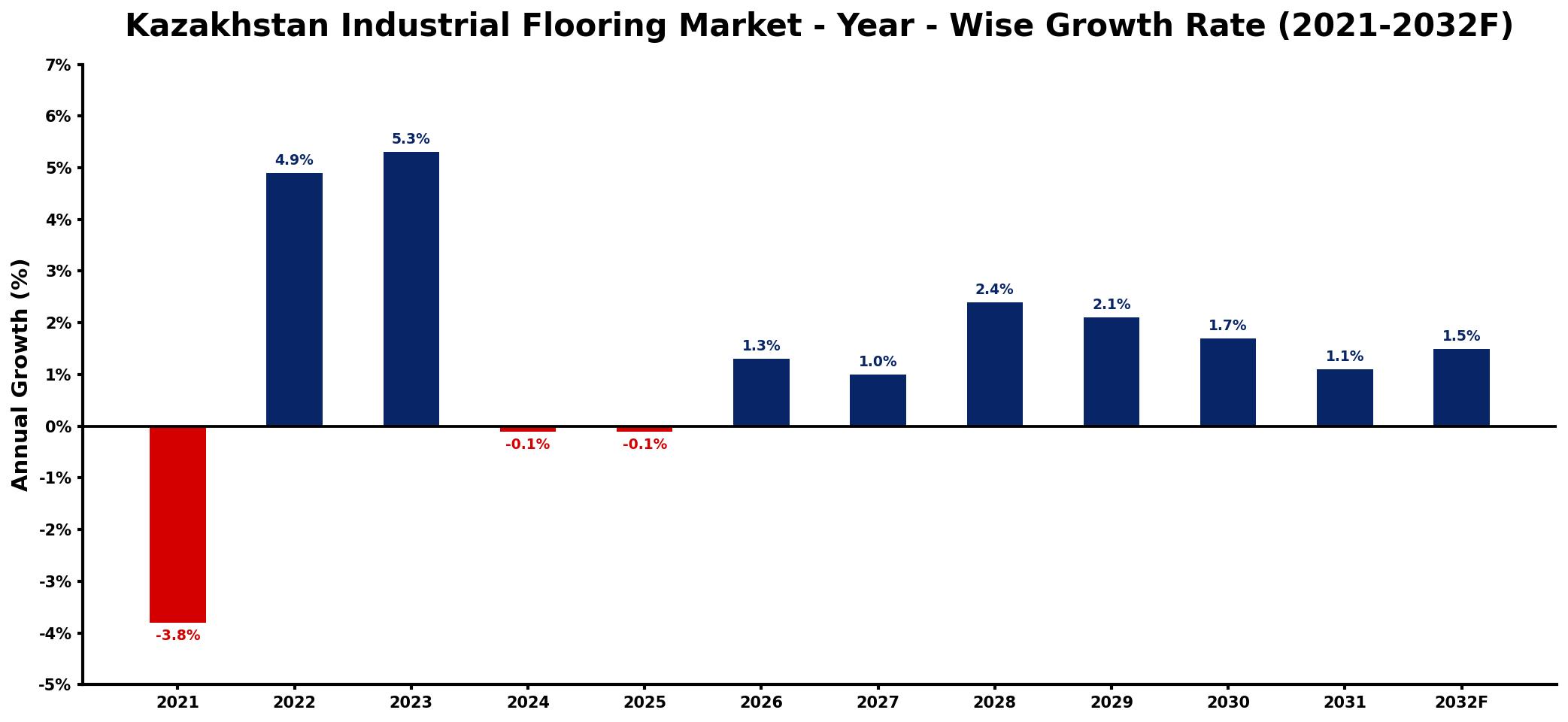
The table below presents the year‑wise growth rates along with the key drivers influencing the market
| Year | Growth Rate | Major Drivers |
| 2021 | -3.8% | decreased investments in infrastructure projects |
| 2022 | 4.9% | increased demand from construction sector |
| 2023 | 5.3% | growing manufacturing sector activities |
| 2024 | -0.1% | reduced construction project approvals |
| 2025 | -0.1% | lower investments in real estate |
| 2026 | 1.3% | expansion of logistics facilities investments |
| 2027 | 1.0% | rise in manufacturing capacity utilization |
| 2028 | 2.4% | increased focus on sustainability initiatives |
| 2029 | 2.1% | growing demand from retail sector |
| 2030 | 1.7% | improved raw material availability |
| 2031 | 1.1% | rising demand from healthcare facilities |
| 2032 | 1.5% | growing emerging market penetration |
Note: Market size estimations and growth projections presented in this report are based on 6Wresearch's proprietary forecasting methodology, utilizing the latest available industry data, government publications, and primary research inputs.
Kazakhstan Industrial Flooring Market Synopsis
The Kazakhstan Industrial Flooring Market has recently experienced a notable momentum, spurred by increased investments across various industrial sectors. However, the market is set to evolve as it aligns more closely with modern safety and environmental standards, reflecting a shift towards sustainable practices.
Looking ahead, the focus will likely pivot toward enhanced product features such as anti-slip properties and ease of maintenance, ensuring that the flooring solutions not only meet functional demands but also contribute to a safer workplace environment. This balancing act of performance, safety, and aesthetic appeal is expected to shape the market's future.
Kazakhstan Industrial Flooring Market Key Takeaways
- The market is characterized by a strong demand for chemical-resistant and durable flooring solutions.
- Government policies are increasingly promoting eco-friendly and sustainable flooring materials.
- Rapid urbanization and industrial growth are pivotal in driving market expansion.
- Challenges include meeting stringent safety regulations and environmental compliance.
- Continued innovation in flooring technology is essential for future market competitiveness.
Evaluation of Restraints in Kazakhstan Industrial Flooring Market
The Kazakhstan Industrial Flooring Market faces several real constraints that could limit growth. One primary concern is the need for flooring solutions that not only provide durability but also exhibit superior chemical resistance to withstand the rigors of industrial activities. Additionally, manufacturers must navigate the complexities of compliance with regulatory standards, which can impose additional burdens in product development. The challenge of sourcing sustainable materials while keeping costs manageable also poses a significant hurdle for market players looking to innovate without sacrificing affordability.
Kazakhstan Industrial Flooring Market Trends
Several current and emerging trends are reshaping the Kazakhstan Industrial Flooring Market. There's a noticeable shift towards the incorporation of technology into flooring solutions, such as advanced anti-slip finishes and self-leveling compounds that enhance both safety and efficiency. Furthermore, a growing preference for environmentally friendly materials signifies a broader trend toward sustainability, compelling manufacturers to rethink their product offerings.
Kazakhstan Industrial Flooring Market Opportunities
Opportunities for growth within the Kazakhstan Industrial Flooring Market abound as industries seek to upgrade their facilities. The rising emphasis on operational efficiency and worker safety creates an avenue for innovative flooring solutions that meet specific industry needs. Moreover, the governments push for sustainable practices presents lucrative prospects for manufacturers willing to invest in eco-friendly materials and technologies that comply with evolving regulatory demands.
Government Initiatives in the Kazakhstan Industrial Flooring Market
Government initiatives are playing a pivotal role in shaping the Kazakhstan Industrial Flooring Market by promoting policies that favor the adoption of durable and safe flooring solutions. Financial incentives for companies that utilize sustainable materials and regulatory frameworks aimed at enhancing safety standards are central to these efforts. As the government continues to prioritize eco-friendly initiatives, manufacturers are encouraged to align their product offerings accordingly.
Future Insights of the Kazakhstan Industrial Flooring Market
From 2026 to 2032, the Kazakhstan Industrial Flooring Market is expected to undergo significant transformation as innovations in materials and design reshape industry standards. As regulatory pressures intensify and consumer preferences evolve, companies that invest in advanced, high-performance flooring solutions will likely thrive. The integration of technology into manufacturing processes will further enhance product capabilities, ensuring that the market remains dynamic and responsive to industrial needs.
Kazakhstan Industrial Flooring Market Latest Developments (2025 - 2026)
In the past year, the Kazakhstan Industrial Flooring Market has seen several pivotal developments that signal a shift in industry direction. Many manufacturers are actively exploring innovative materials that offer enhanced durability and chemical resistance, in line with increasing demand from industrial sectors. Additionally, there is a noticeable uptick in collaboration between businesses and research institutions aimed at advancing flooring technology and sustainability practices.
Kazakhstan Industrial Flooring Market - Key Attractiveness of the Report
- 10 Years of Market Numbers
- Historical Data Starting from 2022 to 2025
- Base Year: 2025
- Forecast Data until 2032
- Key Performance Indicators Impacting the Market
- Major Upcoming Developments and Projects
Key Highlights of the Report:
- Kazakhstan Industrial Flooring Market Outlook
- Market Size of Kazakhstan Industrial Flooring Market, 2025
- Forecast of Kazakhstan Industrial Flooring Market, 2032
- Historical Data and Forecast of Kazakhstan Industrial Flooring Revenues & Volume for the Period 2022-2032F
- Kazakhstan Industrial Flooring Market Trend Evolution
- Kazakhstan Industrial Flooring Market Drivers and Challenges
- Kazakhstan Industrial Flooring Price Trends
- Kazakhstan Industrial Flooring Porter's Five Forces
- Kazakhstan Industrial Flooring Industry Life Cycle
- Historical Data and Forecast of Kazakhstan Industrial Flooring Market Revenues & Volume By End User Industry for the Period 2022-2032F
- Historical Data and Forecast of Kazakhstan Industrial Flooring Market Revenues & Volume By Chemical for the Period 2022-2032F
- Historical Data and Forecast of Kazakhstan Industrial Flooring Market Revenues & Volume By Food and Beverages for the Period 2022-2032F
- Historical Data and Forecast of Kazakhstan Industrial Flooring Market Revenues & Volume By Healthcare for the Period 2022-2032F
- Historical Data and Forecast of Kazakhstan Industrial Flooring Market Revenues & Volume By Transportation and Aviation for the Period 2022-2032F
- Historical Data and Forecast of Kazakhstan Industrial Flooring Market Revenues & Volume By Others for the Period 2022-2032F
- Historical Data and Forecast of Kazakhstan Industrial Flooring Market Revenues & Volume By Thickness for the Period 2022-2032F
- Historical Data and Forecast of Kazakhstan Industrial Flooring Market Revenues & Volume By Light duty for the Period 2022-2032F
- Historical Data and Forecast of Kazakhstan Industrial Flooring Market Revenues & Volume By Medium Duty for the Period 2022-2032F
- Historical Data and Forecast of Kazakhstan Industrial Flooring Market Revenues & Volume By Heavy Duty for the Period 2022-2032F
- Historical Data and Forecast of Kazakhstan Industrial Flooring Market Revenues & Volume By Material Type for the Period 2022-2032F
- Historical Data and Forecast of Kazakhstan Industrial Flooring Market Revenues & Volume By Epoxy for the Period 2022-2032F
- Historical Data and Forecast of Kazakhstan Industrial Flooring Market Revenues & Volume By Polyaspartic for the Period 2022-2032F
- Historical Data and Forecast of Kazakhstan Industrial Flooring Market Revenues & Volume By Polyurethane for the Period 2022-2032F
- Historical Data and Forecast of Kazakhstan Industrial Flooring Market Revenues & Volume By Anhydrite for the Period 2022-2032F
- Historical Data and Forecast of Kazakhstan Industrial Flooring Market Revenues & Volume By Others for the Period 2022-2032F
- Kazakhstan Industrial Flooring Import Export Trade Statistics
- Market Opportunity Assessment By End User Industry
- Market Opportunity Assessment By Thickness
- Market Opportunity Assessment By Material Type
- Kazakhstan Industrial Flooring Top Companies Market Share
- Kazakhstan Industrial Flooring Competitive Benchmarking By Technical and Operational Parameters
- Kazakhstan Industrial Flooring Company Profiles
- Kazakhstan Industrial Flooring Key Strategic Recommendations






































