Kazakhstan Kosher Food Market Size, Share & Growth Rate
The Kazakhstan Kosher Food Market was estimated at USD 460 Million in 2025 and is projected to reach USD 651 Million by 2032, growing at a CAGR of 5.1% from 2026 to 2032. This growth trajectory is primarily fueled by an increasing awareness and demand for kosher-certified products among diverse consumer segments, including health-conscious individuals and those seeking ethically produced foods. Furthermore, the expanding Jewish community within Kazakhstan plays a significant role in bolstering this market, resulting in enhanced product offerings and distribution strategies from key suppliers.
Kazakhstan Kosher Food Market Year-wise Growth Rate and Key Drivers
This graph highlights how the Kazakhstan Kosher Food Market has steadily grown over the years, supported by major growth factors.
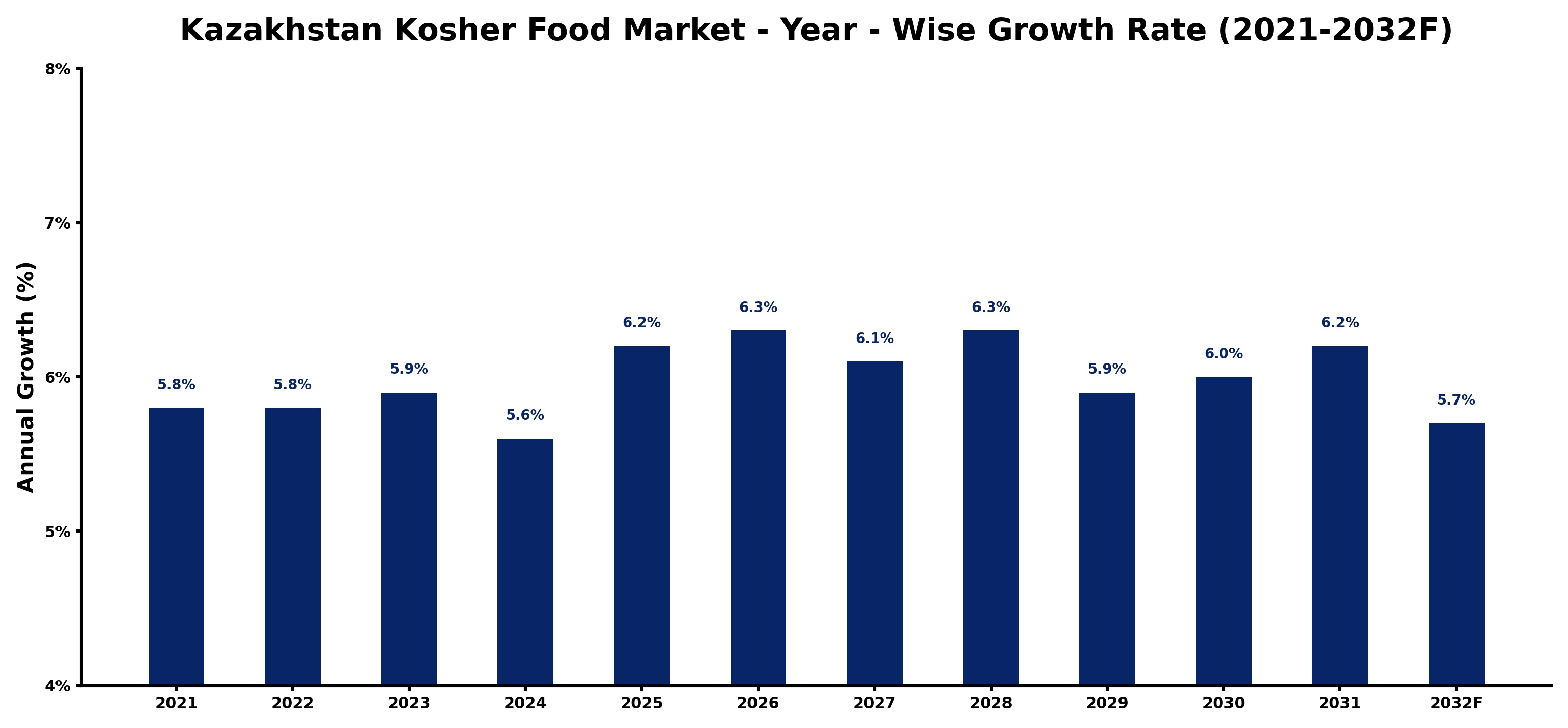
The table below presents the year‑wise growth rates along with the key drivers influencing the market
| Year | Growth Rate | Major Drivers |
| 2021 | 5.8% | Export driven demand for certified kosher products boosts local processing capacity |
| 2022 | 5.8% | Export driven technology upgrades enhance Kazakhstan's kosher food processing efficiency |
| 2023 | 5.9% | Improved halal certification processes boost local kosher food production |
| 2024 | 5.6% | Export driven demand for certified kosher products boosts production efficiency |
| 2025 | 6.2% | Retail partnerships expanded distribution channels for kosher food products |
| 2026 | 6.3% | Manufacturing investments in local facilities enhance kosher food production capacity |
| 2027 | 6.1% | Local manufacturers optimize processing lines for higher kosher food outputs |
| 2028 | 6.3% | Kosher certification enhancements boost local food production capacities |
| 2029 | 5.9% | Increased investment in kosher processing facilities boosted local production capacity |
| 2030 | 6.0% | Kosher certification processes improved food safety compliance across suppliers |
| 2031 | 6.2% | Technology integration streamlined kosher food production and logistics processes |
| 2032 | 5.7% | Local processing facilities expanded to meet rising kosher food demand |
Note - Market size estimations and growth projections presented in this report are based on 6Wresearch's advanced forecasting approach, validated with industry datasets as of June 2026.
Kazakhstan Kosher Food Market Synopsis
Kazakhstan's kosher food sector is characterized by its commitment to meeting rigorous dietary laws that ensure cleanliness and purity, attracting a consumer base that prioritizes food safety. As health awareness rises, non-Jewish consumers are increasingly gravitating towards kosher products, viewing them as high-quality and ethically sourced options.
The country's unique position at the crossroads of Europe and Asia facilitates a rich cultural blend, impacting dietary preferences and driving demand for kosher foods. Additionally, the integration of modern retail channels is enhancing accessibility for kosher-certified products, making them more prominent in mainstream markets.
Kazakhstan Kosher Food Market Key Takeaways
- The market is supported by an expanding Jewish population and a growing segment of health-conscious consumers.
- Increased awareness about food safety and ethical production is driving preferences for kosher-certified products.
- Logistical challenges related to kosher certification processes may limit some producers' capabilities.
- Government policies are evolving to embrace cultural diversity and support the kosher food sector.
- Innovations in food technology are contributing to the expansion of product varieties in the kosher food market.
Evaluation of Restraints in Kazakhstan Kosher Food Market
Despite its promising growth, the Kazakhstan kosher food market faces certain restraints that could hinder its expansion. One significant factor is the relatively small Jewish population in the country, which may limit the overall demand for kosher-certified products. Furthermore, producers must navigate the complexities associated with compliance to strict kosher dietary laws, which often presents logistical and operational challenges. These factors can impact the supply chain and increase costs, potentially deterring new entrants into the market.
Kazakhstan Kosher Food Market Trends
Current trends in the Kazakhstan kosher food market indicate a shift toward more innovative and health-focused product offerings. Consumers are increasingly seeking organic and natural ingredients within kosher certifications, reflecting broader dietary trends. Moreover, technology-driven solutions such as online shopping platforms and mobile apps are enhancing consumer engagement and convenience, further driving market growth.
Kazakhstan Kosher Food Market Opportunities
The Kazakhstan kosher food market presents significant growth opportunities, especially for businesses willing to adapt to evolving consumer preferences. The increasing integration of kosher products in mainstream retail is a vital avenue for expansion. Additionally, as global interest in health and wellness continues to rise, companies can capitalize on the demand for premium kosher offerings that align with these trends, such as gluten-free and plant-based alternatives.
Government Initiatives in the Kazakhstan Kosher Food Market
Government policies in Kazakhstan are becoming increasingly supportive of cultural diversity and religious freedoms, which positively impacts the kosher food market. Regulatory frameworks are being put in place to ensure food safety standards and proper certification processes for kosher products. Furthermore, initiatives aimed at promoting interfaith dialogue and cooperation within the food sector enhance the environment for kosher producers and consumers alike.
Future Insights of the Kazakhstan Kosher Food Market
Looking ahead to 2026-2032, the Kazakhstan kosher food market is poised for substantial development. As consumer preferences continue to shift toward ethical and health-conscious food choices, the demand for kosher-certified products will likely escalate. Enhanced marketing strategies and distribution networks will be essential for businesses to capture the growing interest from both Jewish and non-Jewish populations. With an increasing focus on quality and safety, the kosher segment is expected to become a significant player in the overall food industry landscape in Kazakhstan.
Kazakhstan Kosher Food Market Latest Developments (May 2025 - June 2026)
In recent months, there have been notable shifts within the Kazakhstan kosher food market that reflect broader industry trends. Innovations in product offerings have emerged, with a focus on healthier alternatives that cater to a diverse audience. Additionally, the integration of e-commerce platforms has made kosher products more accessible, allowing for greater consumer engagement. Regulatory developments are also supporting enhanced food safety measures, ensuring that kosher certifications remain robust and trustworthy.
Kazakhstan Kosher Food Market - Key Attractiveness of the Report
- 10 Years of Market Numbers
- Historical Data Starting from 2022 to 2025
- Base Year: 2025
- Forecast Data until 2032
- Key Performance Indicators Impacting the Market
- Major Upcoming Developments and Projects
Key Highlights of the Report:
- Kazakhstan Kosher Food Market Outlook
- Market Size of Kazakhstan Kosher Food Market, 2025
- Forecast of Kazakhstan Kosher Food Market, 2032
- Historical Data and Forecast of Kazakhstan Kosher Food Revenues & Volume for the Period 2022-2032F
- Kazakhstan Kosher Food Market Trend Evolution
- Kazakhstan Kosher Food Market Drivers and Challenges
- Kazakhstan Kosher Food Price Trends
- Kazakhstan Kosher Food Porter's Five Forces
- Kazakhstan Kosher Food Industry Life Cycle
- Historical Data and Forecast of Kazakhstan Kosher Food Market Revenues & Volume By Type for the Period 2022-2032F
- Historical Data and Forecast of Kazakhstan Kosher Food Market Revenues & Volume By Meat for the Period 2022-2032F
- Historical Data and Forecast of Kazakhstan Kosher Food Market Revenues & Volume By Dairy for the Period 2022-2032F
- Historical Data and Forecast of Kazakhstan Kosher Food Market Revenues & Volume By Pareve for the Period 2022-2032F
- Historical Data and Forecast of Kazakhstan Kosher Food Market Revenues & Volume By Application for the Period 2022-2032F
- Historical Data and Forecast of Kazakhstan Kosher Food Market Revenues & Volume By Seafood for the Period 2022-2032F
- Historical Data and Forecast of Kazakhstan Kosher Food Market Revenues & Volume By Processed Meat and Poultry for the Period 2022-2032F
- Historical Data and Forecast of Kazakhstan Kosher Food Market Revenues & Volume By Beverages for the Period 2022-2032F
- Historical Data and Forecast of Kazakhstan Kosher Food Market Revenues & Volume By Staples for the Period 2022-2032F
- Historical Data and Forecast of Kazakhstan Kosher Food Market Revenues & Volume By Snacks & Savoury for the Period 2022-2032F
- Historical Data and Forecast of Kazakhstan Kosher Food Market Revenues & Volume By Bakery and Confectionery for the Period 2022-2032F
- Historical Data and Forecast of Kazakhstan Kosher Food Market Revenues & Volume By Others for the Period 2022-2032F
- Historical Data and Forecast of Kazakhstan Kosher Food Market Revenues & Volume By Distribution Channel for the Period 2022-2032F
- Historical Data and Forecast of Kazakhstan Kosher Food Market Revenues & Volume By Supermarkets and Hypermarkets for the Period 2022-2032F
- Historical Data and Forecast of Kazakhstan Kosher Food Market Revenues & Volume By Grocery Stores for the Period 2022-2032F
- Historical Data and Forecast of Kazakhstan Kosher Food Market Revenues & Volume By Online Stores for the Period 2022-2032F
- Kazakhstan Kosher Food Import Export Trade Statistics
- Market Opportunity Assessment By Type
- Market Opportunity Assessment By Application
- Market Opportunity Assessment By Distribution Channel
- Kazakhstan Kosher Food Top Companies Market Share
- Kazakhstan Kosher Food Competitive Benchmarking By Technical and Operational Parameters
- Kazakhstan Kosher Food Company Profiles
- Kazakhstan Kosher Food Key Strategic Recommendations






































