Kazakhstan Leather Market Summary
The kazakhstan leather market was estimated at USD 338 Million in 2025 and is projected to reach USD 474 Million by 2032, growing at a CAGR of 5.5% from 2026 to 2032.
Kazakhstan Leather Market Year-wise Growth Rate and Key Drivers
This graph highlights how the Kazakhstan Leather Market has steadily grown over the past five years, supported by major growth factors.
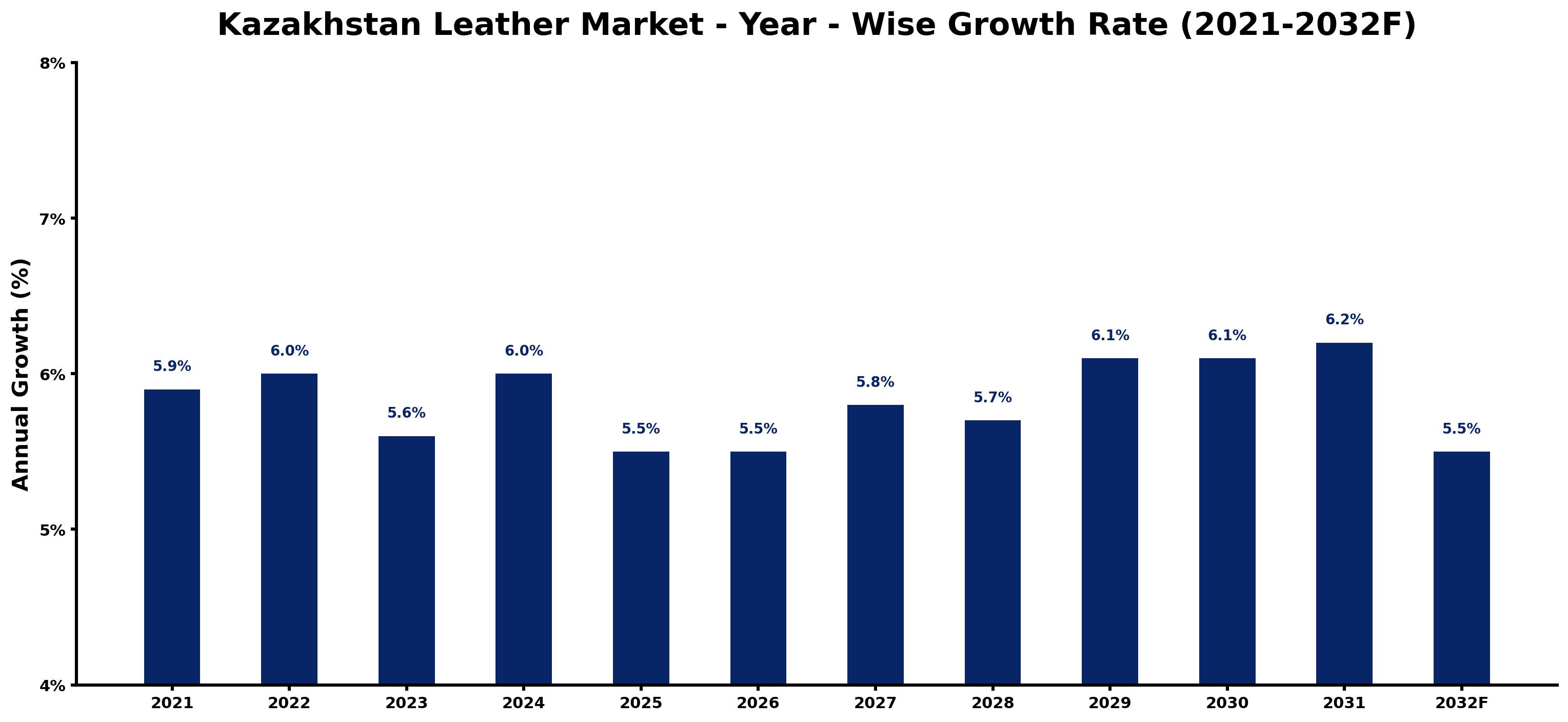
The table below presents the year wise growth rates along with the key drivers influencing the market
| Year | Growth Rate | Major Drivers |
| 2021 | 5.9% | Post-lockdown retail projects stimulated consumer interest in local leather products. |
| 2022 | 6.0% | Emerging e-commerce platforms enhanced accessibility for Kazakh leather brands nationwide. |
| 2023 | 5.6% | Traditional craftsmanship blended with modern design attracted younger demographics to leather goods. |
| 2024 | 6.0% | Increased disposable income led to heightened consumer spending on luxury fashion items. |
| 2025 | 5.5% | Local craftsmanship initiatives emphasized sustainability, appealing to environmentally conscious buyers. |
| 2026 | 5.5% | Collaboration between artisans and fashion designers created unique product offerings in leather. |
| 2027 | 5.8% | Enhanced quality standards positioned Kazakh leather competitively against international markets. |
| 2028 | 5.7% | Cultural festivals showcasing local artisans boosted national pride and leather brand visibility. |
| 2029 | 6.1% | Investment in logistics infrastructure improved supply chain efficiency for leather manufacturers. |
| 2030 | 6.1% | Growing interest in bespoke leather products fostered a niche market for personalization. |
| 2031 | 6.2% | Cross-border trade agreements opened new avenues for Kazakh leather exports to Asia. |
| 2032 | 5.5% | Integration of technology in production processes streamlined operations and reduced costs. |
Note - Market size estimations and growth projections presented in this report are based on 6Wresearch's advanced forecasting approach, validated with industry datasets as of June 2026.
Kazakhstan Leather Market Synopsis
The Kazakhstan Leather Market is projected to reach 5.5% and witness significant growth during the forecast period (2026-2032). This expansion is underpinned by a combination of factors, including the resurgence of domestic craftsmanship, rising consumer awareness regarding quality and sustainability, and enhanced government initiatives aimed at boosting local production. The country's extensive livestock resources and its strategic geographical position are vital factors ensuring the sustained demand for leather products across various sectors such as fashion, automotive, and furniture.
Kazakhstan Leather Market Growth Drivers
Several key drivers are propelling the growth of the Kazakhstan Leather Market. Firstly, the increasing disposable income of the population is facilitating a shift in consumer preferences towards premium leather goods. Secondly, the country's historical expertise in leather craftsmanship allows for a unique blend of traditional techniques and modern designs, appealing to both local and international markets. Additionally, the global trend towards sustainable products is encouraging manufacturers to adopt eco-friendly practices, which aligns with the evolving expectations of consumers.
- The burgeoning middle class in Kazakhstan is driving demand for quality leather products.
- Investment in advanced manufacturing technologies is enhancing production efficiency and product quality.
- Collaborations between local artisans and international designers are fostering innovation in product offerings.
- Growing export opportunities are enabling local producers to tap into larger markets beyond Kazakhstan.
- The rise of e-commerce platforms is facilitating easier access for consumers to premium leather products.
Kazakhstan Leather Market Trends and Opportunities
The Kazakhstan Leather Market is currently witnessing a shift towards more sustainable and ethically sourced materials. Companies are increasingly implementing eco-friendly practices in their production processes, driven by heightened consumer demand for environmentally responsible products. There is also a marked interest in innovative technologies such as digital printing and 3D modeling, enabling firms to create unique leather products that cater to diverse consumer preferences.
- Sustainable sourcing is becoming a key differentiator in the competitive landscape of the leather market.
- Research and development investments are leading to innovative product designs and applications.
- Brand collaborations are expanding, allowing for the introduction of novel designs to the marketplace.
- The demand for leather in the automotive sector is creating opportunities for specialized product development.
- Government initiatives aimed at enhancing export capabilities are opening new markets for local manufacturers.
Kazakhstan Leather Market Challenges and Restraints
Despite the positive outlook, the Kazakhstan Leather Market faces several challenges. The inconsistent quality of raw materials presents significant hurdles for manufacturers striving to meet international standards. Additionally, limited access to modern technology and machinery restricts production capabilities and innovation. The fluctuating global demand for leather products further complicates the market dynamics, compounded by intense competition from international players.
- The scarcity of skilled labor in the leather processing sector is a critical barrier to growth.
- Subpar infrastructure hampers the logistics and supply chain efficiency for local producers.
- Inadequate government support can hinder innovation and market penetration efforts.
- Intense competition from established global brands challenges the pricing strategies of local manufacturers.
- The lack of specialized training programs could impede workforce development in the sector.
Kazakhstan Leather Market Investment Opportunities
The Kazakhstan leather market offers rich investment opportunities, particularly for ventures focused on the production of high-quality leather goods. Investors can explore setting up tanneries and leather processing facilities to meet the growing domestic and international demand for leather products. Collaborations with local suppliers and designers to combine traditional craftsmanship with modern market trends present pathways for significant value creation.
- Investments in tanneries can leverage Kazakhstan's abundant livestock resources.
- Establishing manufacturing units for leather goods can cater to both local and export markets.
- Opportunities for partnerships with local designers can create unique product offerings.
- Investing in technological advancements will enhance product quality and production efficiency.
- The strategic geographic position of Kazakhstan offers access to neighboring markets, amplifying export potential.
Kazakhstan Leather Market Government Investment and Initiatives
Government policies significantly influence the direction of the Kazakhstan Leather Market. Initiatives focused on promoting domestic production, improving quality standards, and enhancing export opportunities are critical to the industry's growth. The government is actively providing financial incentives to support local leather producers, while also investing in infrastructure enhancements that facilitate production and distribution.
- Financial support mechanisms for local producers are designed to bolster competitiveness in the global market.
- Regulations ensuring compliance with international quality standards are being enforced to improve industry credibility.
- Investment in infrastructure aimed at improving logistics and distribution channels is a government priority.
- Participation in international trade fairs showcases local products and enhances market visibility.
- Collaboration with educational institutions is promoting skills development tailored to the leather industry.
Kazakhstan Leather Market Latest Developments (May 2025 - June 2026)
Recent developments in the Kazakhstan leather market reflect a transition towards more sustainable and innovative practices. Various manufacturers have begun adopting eco-friendly materials and processes, aligning their product lines with global sustainability trends. The introduction of advanced technologies in production has also gained traction, with industry leaders investing in digitization and automation to enhance efficiency and product quality.
- There is a noticeable increase in collaborations aimed at merging traditional techniques with modern fashion demands.
- The rise in local fashion brands is contributing to a greater appreciation for domestically produced leather goods.
- Government support for exports has led to broader market access for local manufacturers.
- Consumer awareness campaigns focused on sustainability have amplified interest in eco-friendly leather products.
- Market analysis indicates a steady growth trajectory, supported by favorable economic conditions and rising consumer spending.
Kazakhstan Leather Market - Key Attractiveness of the Report
- 10 Years of Market Numbers
- Historical Data Starting from 2022 to 2025
- Base Year: 2025
- Forecast Data until 2032
- Key Performance Indicators Impacting the Market
- Major Upcoming Developments and Projects
Key Highlights of the Report:
- Kazakhstan Leather Market Outlook
- Market Size of Kazakhstan Leather Market, 2025
- Forecast of Kazakhstan Leather Market, 2032F
- Historical Data and Forecast of Kazakhstan Leather Revenues & Volume for the Period 2022-2032F
- Kazakhstan Leather Market Trend Evolution
- Kazakhstan Leather Market Drivers and Challenges
- Kazakhstan Leather Price Trends
- Kazakhstan Leather Porter's Five Forces
- Kazakhstan Leather Industry Life Cycle
- Historical Data and Forecast of Kazakhstan Leather Market Revenues & Volume By Type for the Period 2022-2032F
- Historical Data and Forecast of Kazakhstan Leather Market Revenues & Volume By Luggage for the Period 2022-2032F
- Historical Data and Forecast of Kazakhstan Leather Market Revenues & Volume By Footwear for the Period 2022-2032F
- Historical Data and Forecast of Kazakhstan Leather Market Revenues & Volume By Accessories for the Period 2022-2032F
- Historical Data and Forecast of Kazakhstan Leather Market Revenues & Volume By Distribution Channel for the Period 2022-2032F
- Historical Data and Forecast of Kazakhstan Leather Market Revenues & Volume By Online for the Period 2022-2032F
- Historical Data and Forecast of Kazakhstan Leather Market Revenues & Volume By Offline for the Period 2022-2032F
- Kazakhstan Leather Import Export Trade Statistics
- Market Opportunity Assessment By Type
- Market Opportunity Assessment By Distribution Channel
- Kazakhstan Leather Top Companies Market Share
- Kazakhstan Leather Competitive Benchmarking By Technical and Operational Parameters
- Kazakhstan Leather Company Profiles
- Kazakhstan Leather Key Strategic Recommendations






































