Kazakhstan Lithium Hydroxide Market: Import Trend Analysis
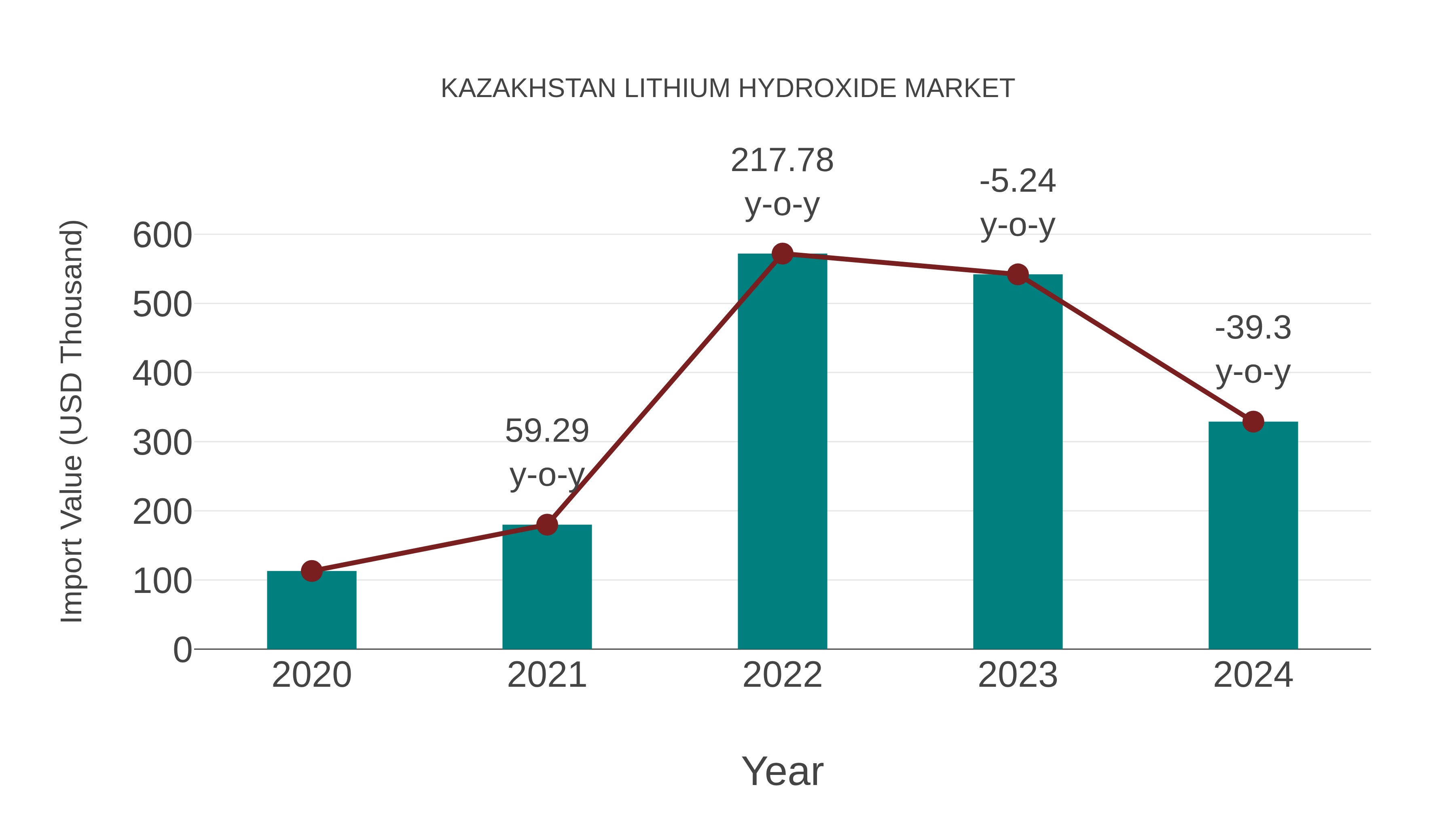
In the Kazakhstan lithium hydroxide market, the import trend experienced a significant decline from 2023 to 2024, with a growth rate of -39.3%. However, the compound annual growth rate (CAGR) for the period of 2020-2024 stood at a notable 30.63%. This decline in import momentum could be attributed to shifts in demand dynamics or changes in trade policies impacting the market stability during that period.
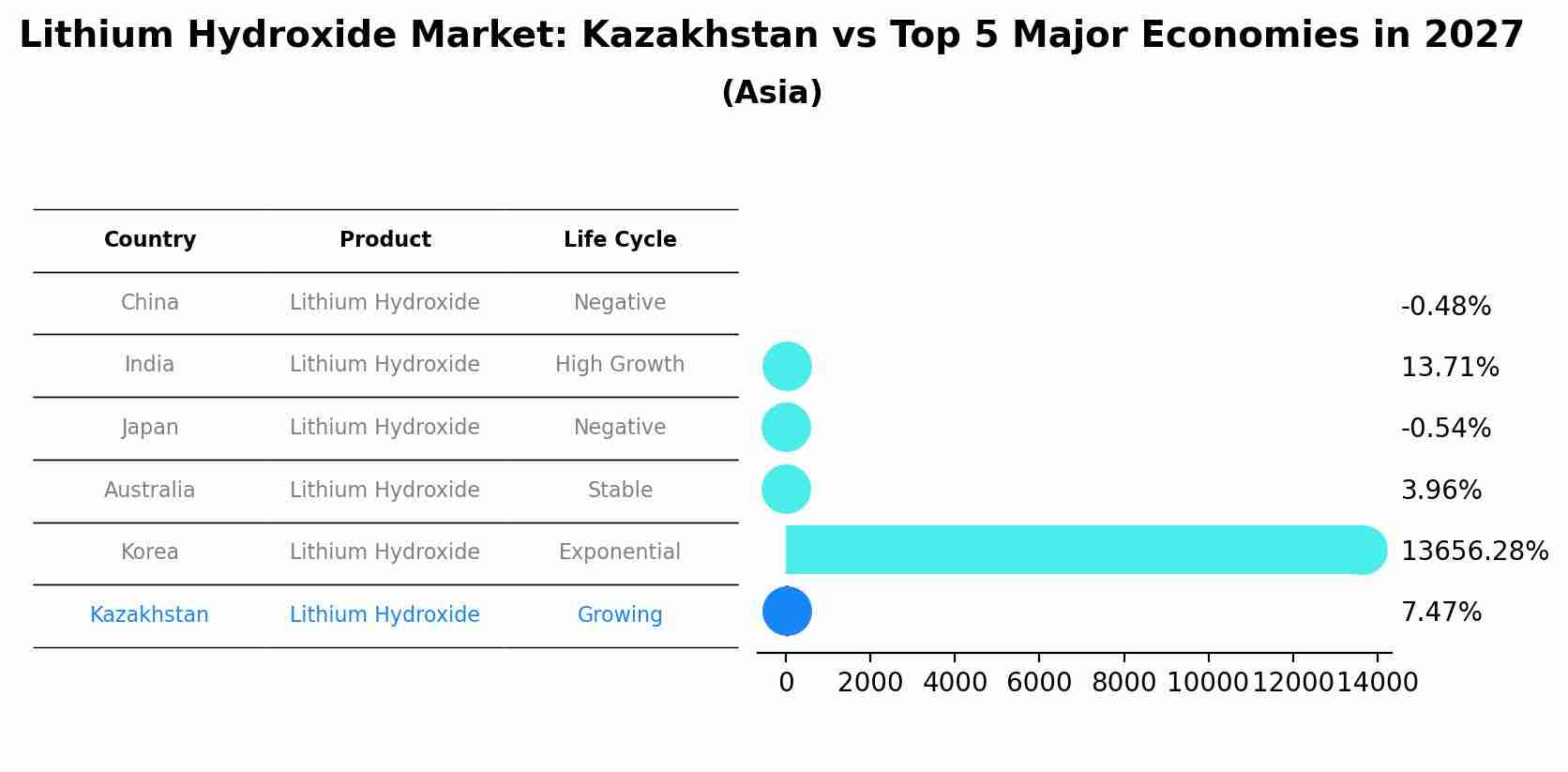
Lithium Hydroxide Market: Kazakhstan vs Top 5 Major Economies in 2027 (Asia)
By 2027, the Lithium Hydroxide market in Kazakhstan is anticipated to reach a growth rate of 7.47%, as part of an increasingly competitive Asia region, where China remains at the forefront, supported by India, Japan, Australia and South Korea, driving innovations and market adoption across sectors.
Kazakhstan Lithium Hydroxide Market Overview
Lithium hydroxide is gaining prominence in Kazakhstan lithium industry, particularly as a key material for high-performance lithium-ion batteries. With increasing investments in battery manufacturing and electric vehicle production, the demand for lithium hydroxide is expected to surge in the coming years.
Drivers of the market
The lithium hydroxide market in Kazakhstan is driven by its use in the production of lithium-ion batteries, which are essential for electric vehicles and portable electronics. The push for sustainable energy solutions and the growing automotive sector`s focus on electrification are key drivers of market growth.
Challenges of the market
One challenge in the lithium hydroxide market is the competition from alternative battery technologies and the need to continuously innovate and improve lithium-ion battery performance. Investing in research and development for next-generation battery technologies and optimizing production processes can help maintain market competitiveness.
Government Policy of the market
Similar to other lithium compounds, the government regulates the lithium hydroxide market to support its sustainable production and use in battery manufacturing, pharmaceuticals, and other industries. This may involve environmental impact assessments and compliance with safety standards.
Key Highlights of the Report:
- Kazakhstan Lithium Hydroxide Market Outlook
- Market Size of Kazakhstan Lithium Hydroxide Market, 2025
- Forecast of Kazakhstan Lithium Hydroxide Market, 2032
- Historical Data and Forecast of Kazakhstan Lithium Hydroxide Revenues & Volume for the Period 2022-2032F
- Kazakhstan Lithium Hydroxide Market Trend Evolution
- Kazakhstan Lithium Hydroxide Market Drivers and Challenges
- Kazakhstan Lithium Hydroxide Price Trends
- Kazakhstan Lithium Hydroxide Porter's Five Forces
- Kazakhstan Lithium Hydroxide Industry Life Cycle
- Historical Data and Forecast of Kazakhstan Lithium Hydroxide Market Revenues & Volume By Application for the Period 2022-2032F
- Historical Data and Forecast of Kazakhstan Lithium Hydroxide Market Revenues & Volume By Batteries for the Period 2022-2032F
- Historical Data and Forecast of Kazakhstan Lithium Hydroxide Market Revenues & Volume By Lubricating Greases for the Period 2022-2032F
- Historical Data and Forecast of Kazakhstan Lithium Hydroxide Market Revenues & Volume By Purification for the Period 2022-2032F
- Historical Data and Forecast of Kazakhstan Lithium Hydroxide Market Revenues & Volume By Others for the Period 2022-2032F
- Kazakhstan Lithium Hydroxide Import Export Trade Statistics
- Market Opportunity Assessment By Application
- Kazakhstan Lithium Hydroxide Top Companies Market Share
- Kazakhstan Lithium Hydroxide Competitive Benchmarking By Technical and Operational Parameters
- Kazakhstan Lithium Hydroxide Company Profiles
- Kazakhstan Lithium Hydroxide Key Strategic Recommendations






































