Kazakhstan Mobile Application Security Market Size & Growth Rate (2026-2032)
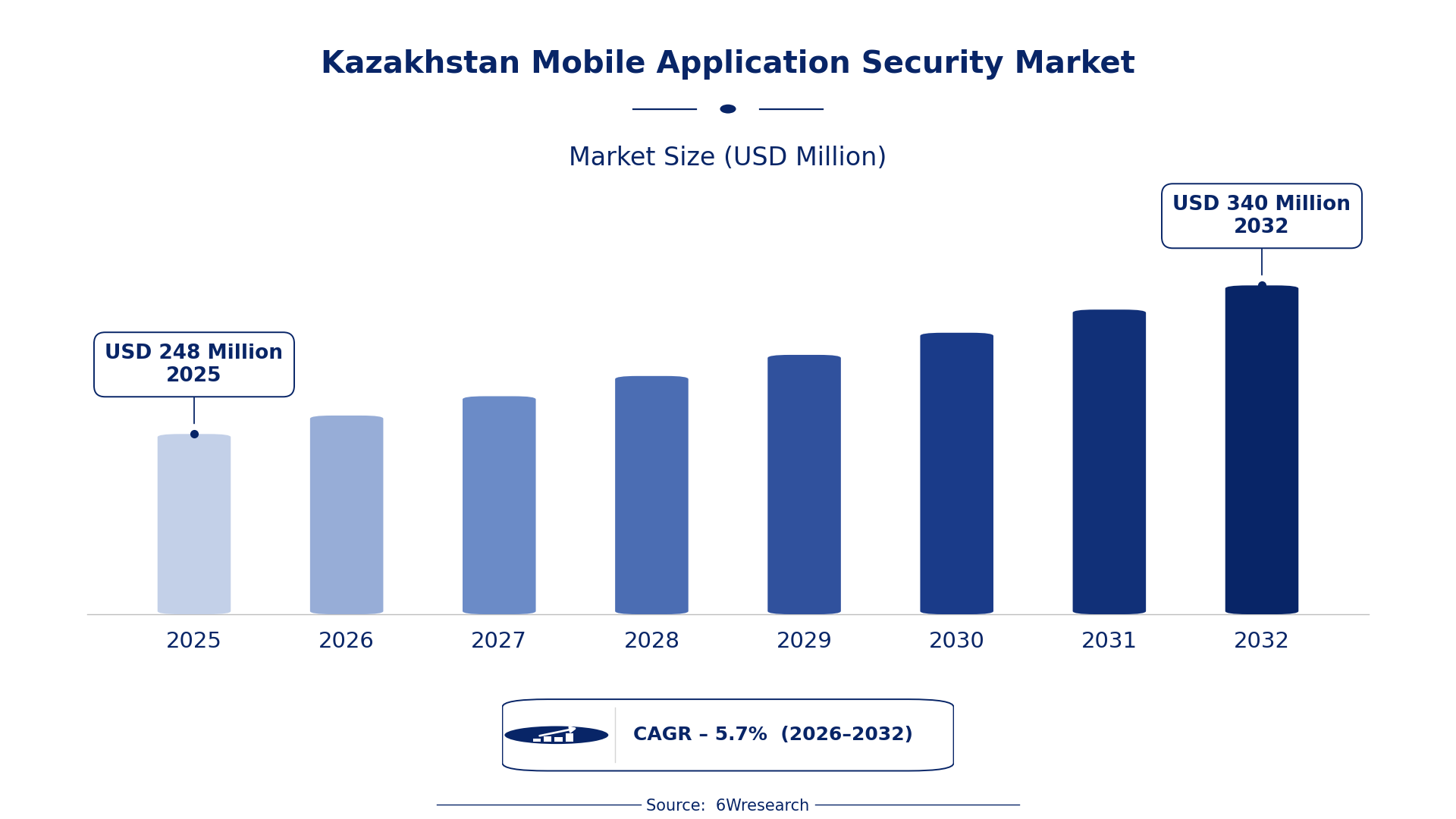
The Kazakhstan Mobile Application Security Market was estimated at USD 248 Million in 2025 and is projected to reach USD 340 Million by 2032, growing at a CAGR of 5.7% from 2026 to 2032.
Kazakhstan Mobile Application Security Market Synopsis
The most compelling force shaping the Kazakhstan Mobile Application Security Market today is the increasing concern surrounding data privacy and the prevalence of cyber threats. As both consumers and enterprises lean heavily on mobile applications, the imperative for comprehensive security measures has never been clearer.
Data breaches and vulnerabilities have turned mobile apps into attractive targets for cybercriminals. The market is responding to this heightened risk by advancing security solutions designed to protect sensitive user data. This focus on robust security frameworks is critical for fostering consumer trust and compliance with local regulations.
Kazakhstan Mobile Application Security Market Year-wise Growth Rate and Key Drivers
This graph illustrates the annual growth rates of the Kazakhstan Mobile Application Security Market from 2021 to 2032, highlighting a steady upward trajectory and projected expansion over the forecast period.
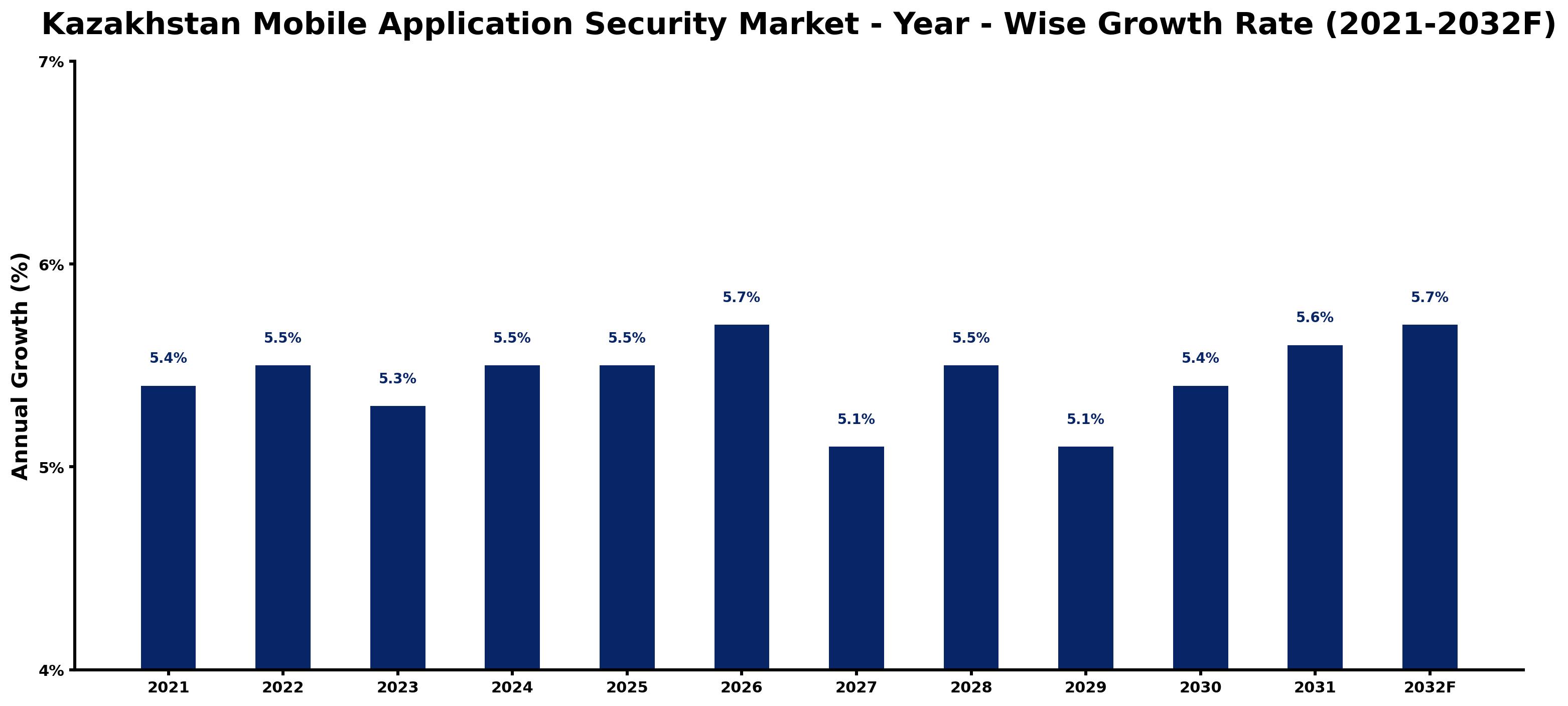
The table below presents the year‑wise growth rates along with the key drivers influencing the market
| Year | Growth Rate | Major Drivers |
| 2021 | 5.4% | Growing mobile payments drive need for security measures. |
| 2022 | 5.5% | Increased smartphone penetration heightens application security concerns. |
| 2023 | 5.3% | Cybersecurity regulations from the Ministry of Digital Development. |
| 2024 | 5.5% | Government backing boosts local cybersecurity innovation initiatives. |
| 2025 | 5.5% | Rising data privacy awareness spurs mobile security investments. |
| 2026 | 5.7% | Tech-savvy youth drive demand for secure mobile apps. |
| 2027 | 5.1% | Local businesses adopting mobile solutions boost security focus. |
| 2028 | 5.5% | Regulatory compliance efforts necessitate enhanced app protection. |
| 2029 | 5.1% | Emergence of mobile gaming heightens security considerations. |
| 2030 | 5.4% | Increased internet accessibility amplifies mobile security needs. |
| 2031 | 5.6% | Integration of AI technologies demands robust application security. |
| 2032 | 5.7% | Partnerships between banks and tech firms enhance security frameworks. |
Note: Market size estimations and growth projections presented in this report are based on 6Wresearch's proprietary forecasting methodology, utilizing the latest available industry data, government publications, and primary research inputs.
Kazakhstan Mobile Application Security Market Key Takeaways
Below are some of the specific key takeaways from the market, including:
- The market is driven by a surge in mobile app usage across various sectors, demanding enhanced security protocols.
- Continuous updates to security measures are critical due to the rapidly evolving nature of cyber threats.
- A lack of awareness among SMEs regarding mobile application security can hinder overall market growth.
- Government regulations are shaping the market, making compliance mandatory for mobile app developers.
- Investment in security solutions is becoming increasingly essential to protect sensitive user data from unauthorized access.
Evaluation of Restraints in Kazakhstan Mobile Application Security Market
The Kazakhstan Mobile Application Security Market faces several restraints that impede its growth. One primary challenge is the sophistication of cyber threats, which constantly evolves, necessitating equally agile security solutions. Businesses often grapple with the technical difficulty of integrating strong security measures without detracting from user experience. on top of that, budget constraints among small and medium-sized enterprises (SMEs) limit their ability to invest in advanced security technologies. Lastly, there exists a pervasive lack of awareness regarding the importance of mobile security, which further stalls market growth.
Kazakhstan Mobile Application Security Market Trends
As businesses and consumers grapple with an ever-increasing reliance on mobile applications, several trends are shaping the demand for mobile application security. One notable trend is the growing inclination towards adopting artificial intelligence (AI) and machine learning (ML) to identify and combat security threats proactively. Additionally, there’s a marked shift towards privacy-first policies, where applications are designed from the ground up to safeguard user data. The focus on regulatory compliance is also intensifying, as firms seek to avoid penalties related to data breaches.
Kazakhstan Mobile Application Security Market Opportunities
Emerging opportunities within the Kazakhstan Mobile Application Security Market are vast. There's significant growth potential in the development of tailored security solutions specifically designed for the unique needs of local businesses and industries. Partnerships with tech firms specializing in AI-driven security tools can create an innovative edge. on top of that, as awareness about data privacy grows, there's an opportunity to offer educational programs and resources aimed at enhancing understanding of mobile security among end-users and businesses.
Government Initiatives in the Kazakhstan Mobile Application Security Market
Government initiatives play a crucial role in strengthening the Kazakhstan Mobile Application Security Market. The regulatory framework is increasingly prioritizing data protection and privacy, reflecting a growing recognition of the importance of cybersecurity in the digital economy. Such policies are designed to bolster compliance among app developers and protect user information. This regulatory shift is vital for fostering a secure environment for both consumers and businesses.
- A regulatory framework introduced in 2025 mandates stringent data protection measures for all mobile applications.
- Currently underway is a national awareness campaign focused on educating SMEs about mobile security risks and best practices.
- A planned public-private partnership aims to develop a centralized monitoring system to track cybersecurity threats in real-time by 2028.
- A recently launched initiative has begun implementing industry standards for mobile application security to enhance consumer trust.
- The government is working on a comprehensive cybersecurity strategy expected to roll out in late 2026, emphasizing collaboration with tech experts.
Future Insights of the Kazakhstan Mobile Application Security Market
Looking forward to 2026-2032, the Kazakhstan Mobile Application Security Market is on track for substantial growth. As the landscape becomes increasingly complex with more apps and data traffic, the demand for advanced security solutions will skyrocket. Companies that innovate by integrating AI and machine learning will stand out, offering predictive capabilities that can thwart potential threats before they materialize. As more regulations are introduced, compliance will become an essential focus, driving further investment in security measures.
Kazakhstan Mobile Application Security Market Latest Developments
In the last year, the Kazakhstan Mobile Application Security Market has seen a surge in activity, reflecting the increasing prioritization of cybersecurity. Companies are rapidly adopting new technologies to meet evolving security standards and consumer expectations. These movements highlight a concerted effort to bolster defenses against cyber threats and enhance mobile application security protocols.
- A leading regional operator recently launched a new mobile application security suite in Q1 2025, featuring advanced encryption and user authentication options.
- Currently ongoing is a partnership between software developers and security firms to create next-generation security solutions, expected to conclude by late 2025.
- An initiative aimed at integrating biometric security features into mobile applications is planned to begin in early 2026.
- A recent upgrade of a popular mobile app included enhanced security features, completed by mid-2025, demonstrating a proactive approach to user data protection.
- A significant workshop series on mobile security practices was held in late 2025, engaging both industry professionals and government representatives.
Kazakhstan Mobile Application Security Market - Key Attractiveness of the Report
- 10 Years of Market Numbers
- Historical Data Starting from 2022 to 2025
- Base Year: 2025
- Forecast Data until 2032
- Key Performance Indicators Impacting the Market
- Major Upcoming Developments and Projects
Key Highlights of the Report:
- Kazakhstan Mobile Application Security Market Outlook
- Market Size of Kazakhstan Mobile Application Security Market, 2025
- Forecast of Kazakhstan Mobile Application Security Market, 2032
- Historical Data and Forecast of Kazakhstan Mobile Application Security Revenues & Volume for the Period 2022-2032F
- Kazakhstan Mobile Application Security Market Trend Evolution
- Kazakhstan Mobile Application Security Market Drivers and Challenges
- Kazakhstan Mobile Application Security Price Trends
- Kazakhstan Mobile Application Security Porter's Five Forces
- Kazakhstan Mobile Application Security Industry Life Cycle
- Historical Data and Forecast of Kazakhstan Mobile Application Security Market Revenues & Volume By Solution for the Period 2022-2032F
- Historical Data and Forecast of Kazakhstan Mobile Application Security Market Revenues & Volume By Antivirus & Antitheft for the Period 2022-2032F
- Historical Data and Forecast of Kazakhstan Mobile Application Security Market Revenues & Volume By Data Recovery for the Period 2022-2032F
- Historical Data and Forecast of Kazakhstan Mobile Application Security Market Revenues & Volume By Others for the Period 2022-2032F
- Historical Data and Forecast of Kazakhstan Mobile Application Security Market Revenues & Volume By Deployment Type for the Period 2022-2032F
- Historical Data and Forecast of Kazakhstan Mobile Application Security Market Revenues & Volume By Cloud for the Period 2022-2032F
- Historical Data and Forecast of Kazakhstan Mobile Application Security Market Revenues & Volume By On Premise for the Period 2022-2032F
- Historical Data and Forecast of Kazakhstan Mobile Application Security Market Revenues & Volume By Industry Vertical for the Period 2022-2032F
- Historical Data and Forecast of Kazakhstan Mobile Application Security Market Revenues & Volume By BFSI for the Period 2022-2032F
- Historical Data and Forecast of Kazakhstan Mobile Application Security Market Revenues & Volume By Healthcare for the Period 2022-2032F
- Historical Data and Forecast of Kazakhstan Mobile Application Security Market Revenues & Volume By IT & Telecom for the Period 2022-2032F
- Historical Data and Forecast of Kazakhstan Mobile Application Security Market Revenues & Volume By Manufacturing for the Period 2022-2032F
- Historical Data and Forecast of Kazakhstan Mobile Application Security Market Revenues & Volume By Government and Public Sector for the Period 2022-2032F
- Historical Data and Forecast of Kazakhstan Mobile Application Security Market Revenues & Volume By Retail & E-commerce for the Period 2022-2032F
- Historical Data and Forecast of Kazakhstan Mobile Application Security Market Revenues & Volume By Others for the Period 2022-2032F
- Kazakhstan Mobile Application Security Import Export Trade Statistics
- Market Opportunity Assessment By Solution
- Market Opportunity Assessment By Deployment Type
- Market Opportunity Assessment By Industry Vertical
- Kazakhstan Mobile Application Security Top Companies Market Share
- Kazakhstan Mobile Application Security Competitive Benchmarking By Technical and Operational Parameters
- Kazakhstan Mobile Application Security Company Profiles
- Kazakhstan Mobile Application Security Key Strategic Recommendations






































