Kazakhstan Multifunctional Composite Materials Market Summary
The kazakhstan multifunctional composite materials market was estimated at USD 673 Million in 2025 and is projected to reach USD 968 Million by 2032, growing at a CAGR of 6.2% from 2026 to 2032.
Kazakhstan Multifunctional Composite Materials Market Year-wise Growth Rate and Key Drivers
This graph highlights how the Kazakhstan Multifunctional Composite Materials Market has steadily grown over the past five years, supported by major growth factors.
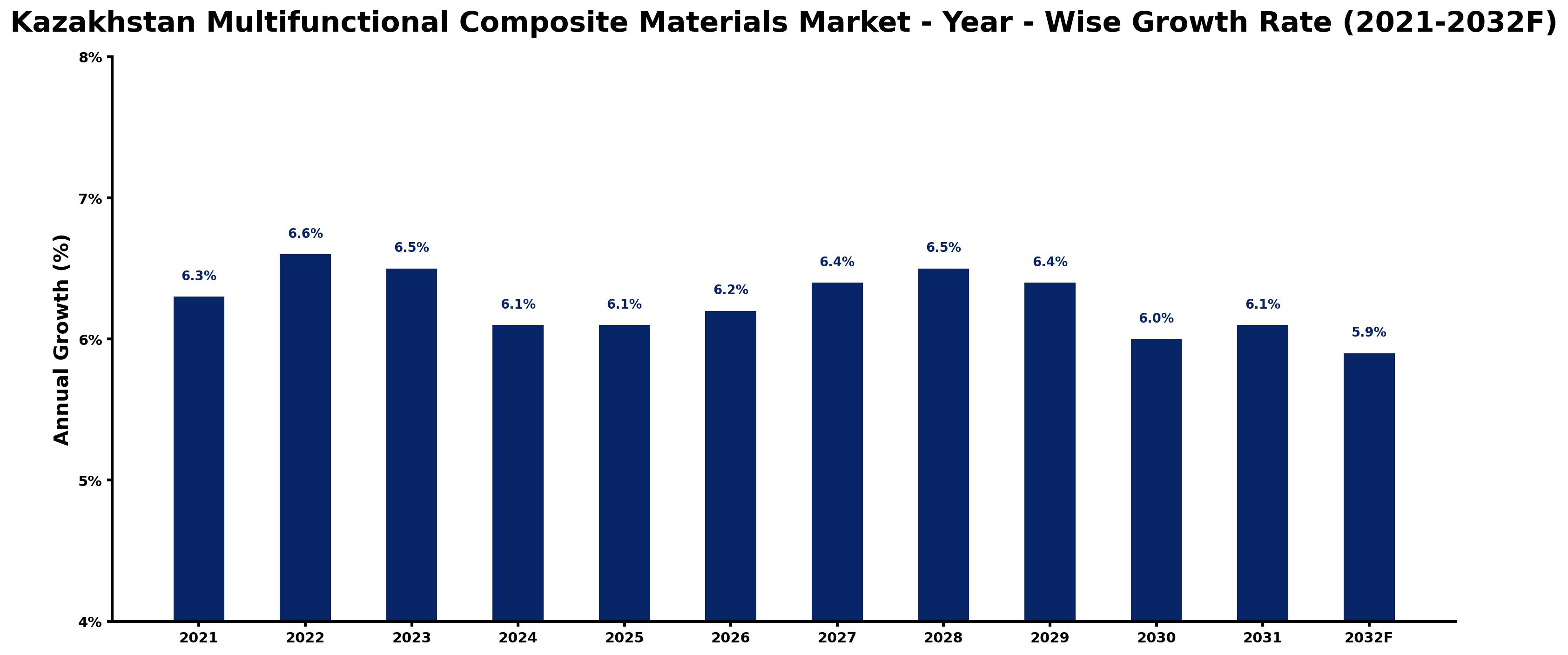
The table below presents the year wise growth rates along with the key drivers influencing the market
| Year | Growth Rate | Major Drivers |
| 2021 | 6.3% | Post-pandemic recovery sparked interest in advanced construction materials across sectors. |
| 2022 | 6.6% | Local manufacturers began investing in R&D for composite materials tailored for regional climates. |
| 2023 | 6.5% | Increased infrastructure projects stimulated demand for lightweight and durable material solutions. |
| 2024 | 6.1% | Energy sector's transition to renewables emphasized the need for innovative composite applications. |
| 2025 | 6.1% | Collaborations between academia and industry fostered breakthroughs in multifunctional material technologies. |
| 2026 | 6.2% | Regional trade agreements expanded market access, boosting composite materials' competitive positioning. |
| 2027 | 6.4% | Emerging construction trends highlighted benefits of composite materials in energy efficiency and sustainability. |
| 2028 | 6.5% | Shifts towards urbanization led to heightened requirements for durable, multifunctional building materials. |
| 2029 | 6.4% | Rising investment in local manufacturing capabilities aimed to reduce dependence on imports. |
| 2030 | 6.0% | Increased environmental awareness created opportunities for eco-friendly composite materials innovation. |
| 2031 | 6.1% | Growing automotive industry demands composites for lightweighting, enhancing fuel efficiency and performance. |
| 2032 | 5.9% | Integration of smart technologies in materials opened avenues for multifunctionality in various applications. |
Note - Market size estimations and growth projections presented in this report are based on 6Wresearch's advanced forecasting approach, validated with industry datasets as of June 2026.
Kazakhstan Multifunctional Composite Materials Market Synopsis
The Kazakhstan Multifunctional Composite Materials Market is projected to reach 6.2% and witness significant growth during the forecast period (2026-2032). As various industries increasingly turn towards advanced materials, this market presents considerable opportunities driven by technological advancements and demand from key sectors such as aerospace, automotive, and construction.
Kazakhstan Multifunctional Composite Materials Market Growth Drivers
The growth of the Kazakhstan Multifunctional Composite Materials Market is primarily influenced by several key drivers:
- The aerospace sector in Kazakhstan is witnessing rapid advancements, with multifunctional composites being integral to aircraft manufacturing due to their lightweight and high-strength properties.
- In the automotive industry, the push for fuel efficiency and sustainability is leading manufacturers to adopt lightweight materials, significantly increasing the demand for composite solutions.
- Infrastructure development in Kazakhstan is on the rise, driven by the government's emphasis on modernizing construction practices, whereby multifunctional composite materials provide enhanced durability and corrosion resistance.
- Technological innovations in material science are enabling the creation of advanced composite materials, bolstering their adoption across various sectors.
- Increasing awareness of environmental sustainability is pushing industries towards composite materials that contribute to energy-efficient practices, thereby supporting market growth.
Kazakhstan Multifunctional Composite Materials Market Challenges and Restraints
Despite the promising outlook, the Kazakhstan Multifunctional Composite Materials Market faces several challenges:
- The high cost of raw materials and production processes for composite materials poses a significant barrier for local manufacturers, limiting competitiveness against international players.
- There exists a notable gap in local expertise and technological capabilities, which hampers the development of advanced composites tailored to specific industry needs.
- Competition from established global suppliers who offer a broad range of composite solutions poses a threat to emerging domestic manufacturers.
- Lack of substantial investment in research and development stifles innovation and the improvement of product offerings, which is vital for market growth.
- Regulatory compliance with international quality and safety standards can be challenging for local firms, affecting their ability to penetrate global markets.
Kazakhstan Multifunctional Composite Materials Market Government Investment and Initiatives
The government of Kazakhstan plays a crucial role in the development of the multifunctional composite materials market through various initiatives and policies. Public funding is directed towards research and innovation in materials science, fostering collaborations between academia and industry to enhance local capabilities. Initiatives include:
- Investment in technology transfer programs aimed at equipping local companies with the necessary skills and knowledge to produce advanced composite materials.
- Establishment of public-private partnerships to encourage investment in composite technologies, enhancing competitiveness and reducing reliance on imports.
- Regulatory frameworks that address quality standards, ensuring that products meet international safety and performance benchmarks.
- Financial incentives and subsidies for companies that invest in sustainable practices and integrate composite materials into their operations.
- Support for educational programs focused on composite material sciences to build a skilled workforce capable of advancing the industry.
Kazakhstan Multifunctional Composite Materials Market Latest Developments (May 2025 - June 2026)
During the period from May 2025 to June 2026, the Kazakhstan Multifunctional Composite Materials Market has seen a series of strategic initiatives aimed at bolstering growth and innovation. Notable trends include:
- Increased partnerships between local universities and industries to foster research in composite materials, aimed at developing locally-sourced raw materials and innovative applications.
- Enhanced focus on sustainability, prompting industries to invest in eco-friendly composites that reduce environmental impact while maintaining performance standards.
- Government-led initiatives have emphasized the need for adopting advanced manufacturing technologies, contributing to reduced production costs and improved quality of composite products.
- Growing interest in the aerospace sector has led to the establishment of specialized manufacturing facilities dedicated to composite materials, further diversifying local capabilities.
- Implementation of quality assurance measures to improve compliance with international standards, facilitating better market access for domestic products.
Kazakhstan Multifunctional Composite Materials Market - Key Attractiveness of the Report
- 10 Years of Market Numbers
- Historical Data Starting from 2022 to 2025
- Base Year: 2025
- Forecast Data until 2032
- Key Performance Indicators Impacting the Market
- Major Upcoming Developments and Projects
Key Highlights of the Report:
- Kazakhstan Multifunctional Composite Materials Market Outlook
- Market Size of Kazakhstan Multifunctional Composite Materials Market, 2025
- Forecast of Kazakhstan Multifunctional Composite Materials Market, 2032
- Historical Data and Forecast of Kazakhstan Multifunctional Composite Materials Revenues & Volume for the Period 2022-2032F
- Kazakhstan Multifunctional Composite Materials Market Trend Evolution
- Kazakhstan Multifunctional Composite Materials Market Drivers and Challenges
- Kazakhstan Multifunctional Composite Materials Price Trends
- Kazakhstan Multifunctional Composite Materials Porter's Five Forces
- Kazakhstan Multifunctional Composite Materials Industry Life Cycle
- Historical Data and Forecast of Kazakhstan Multifunctional Composite Materials Market Revenues & Volume By Product Type for the Period 2022-2032F
- Historical Data and Forecast of Kazakhstan Multifunctional Composite Materials Market Revenues & Volume By Carbon Fiber for the Period 2022-2032F
- Historical Data and Forecast of Kazakhstan Multifunctional Composite Materials Market Revenues & Volume By Fabrics/Reinforcements for the Period 2022-2032F
- Historical Data and Forecast of Kazakhstan Multifunctional Composite Materials Market Revenues & Volume By Prepregs/Resins for the Period 2022-2032F
- Historical Data and Forecast of Kazakhstan Multifunctional Composite Materials Market Revenues & Volume By Adhesives for the Period 2022-2032F
- Historical Data and Forecast of Kazakhstan Multifunctional Composite Materials Market Revenues & Volume By Honeycomb for the Period 2022-2032F
- Historical Data and Forecast of Kazakhstan Multifunctional Composite Materials Market Revenues & Volume By Other for the Period 2022-2032F
- Historical Data and Forecast of Kazakhstan Multifunctional Composite Materials Market Revenues & Volume By Applications for the Period 2022-2032F
- Historical Data and Forecast of Kazakhstan Multifunctional Composite Materials Market Revenues & Volume By Aerospace Industry for the Period 2022-2032F
- Historical Data and Forecast of Kazakhstan Multifunctional Composite Materials Market Revenues & Volume By Medical Industry for the Period 2022-2032F
- Historical Data and Forecast of Kazakhstan Multifunctional Composite Materials Market Revenues & Volume By Machinery Industry for the Period 2022-2032F
- Historical Data and Forecast of Kazakhstan Multifunctional Composite Materials Market Revenues & Volume By Achitechture Industry for the Period 2022-2032F
- Historical Data and Forecast of Kazakhstan Multifunctional Composite Materials Market Revenues & Volume By Other for the Period 2022-2032F
- Kazakhstan Multifunctional Composite Materials Import Export Trade Statistics
- Market Opportunity Assessment By Product Type
- Market Opportunity Assessment By Applications
- Kazakhstan Multifunctional Composite Materials Top Companies Market Share
- Kazakhstan Multifunctional Composite Materials Competitive Benchmarking By Technical and Operational Parameters
- Kazakhstan Multifunctional Composite Materials Company Profiles
- Kazakhstan Multifunctional Composite Materials Key Strategic Recommendations






































