Kazakhstan Network as a Service Market Size & Growth Rate (2026-2032)
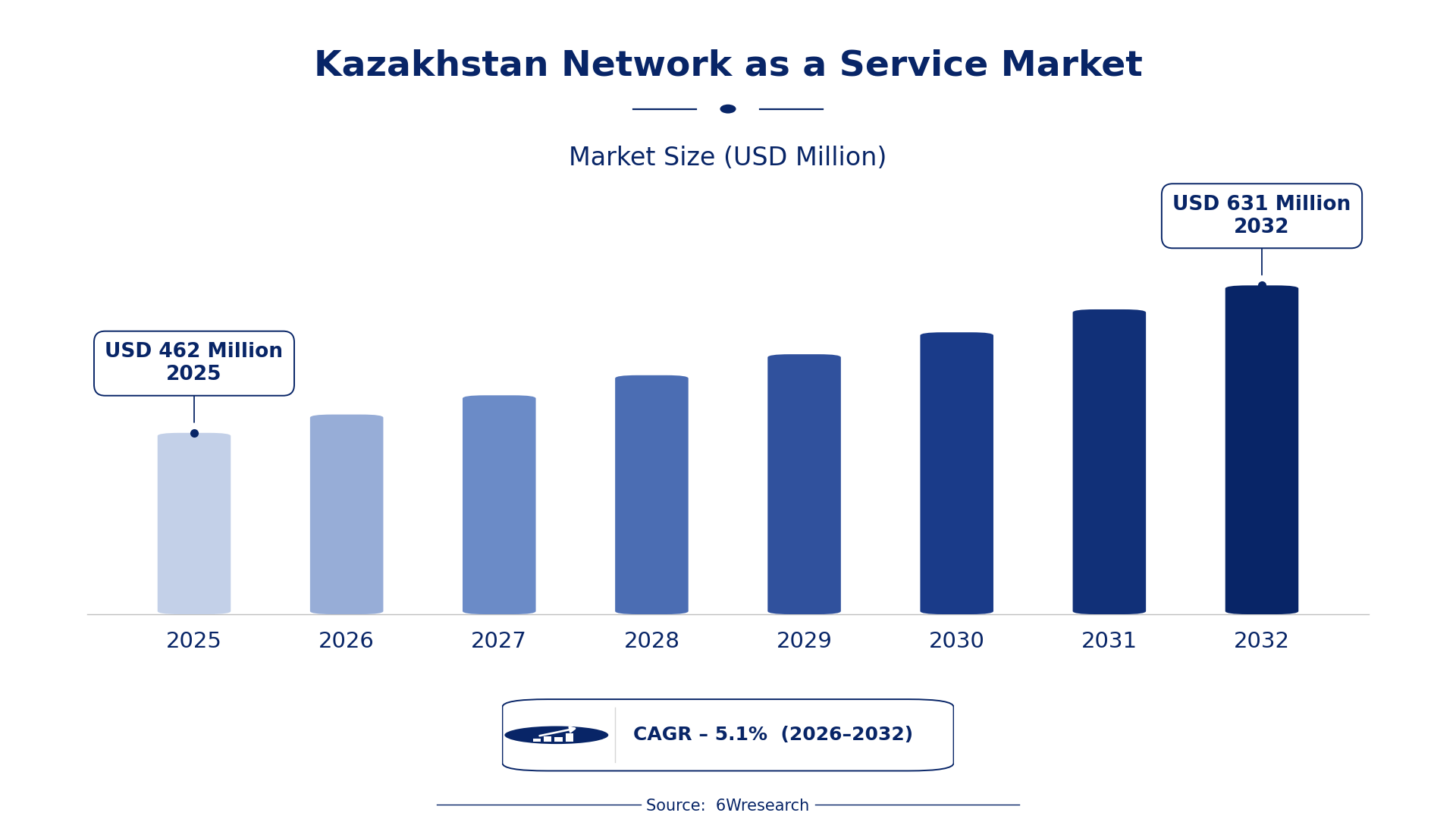
The Kazakhstan Network as a Service Market was estimated at USD 462 Million in 2025 and is projected to reach USD 631 Million by 2032, growing at a CAGR of 5.1% from 2026 to 2032.
Kazakhstan Network as a Service Market Synopsis
The Kazakhstan Network as a Service Market is witnessing an upward trend, primarily fueled by the country’s accelerated push towards digitalization and cloud-based networking solutions. As organizations increasingly shift from traditional infrastructure to flexible and scalable networking options, the demand for NaaS offerings is set to rise significantly.
However, the path ahead is not without its challenges. Infrastructure limitations and connectivity issues, particularly in remote areas, pose substantial barriers. Despite these obstacles, the growth trajectory remains positive as businesses and government initiatives work to enhance network capabilities across the nation.
Kazakhstan Network as a Service Market Year-wise Growth Rate and Key Drivers
This graph illustrates the annual growth rates of the Kazakhstan Network as a Service Market from 2021 to 2032, highlighting a steady upward trajectory and projected expansion over the forecast period.
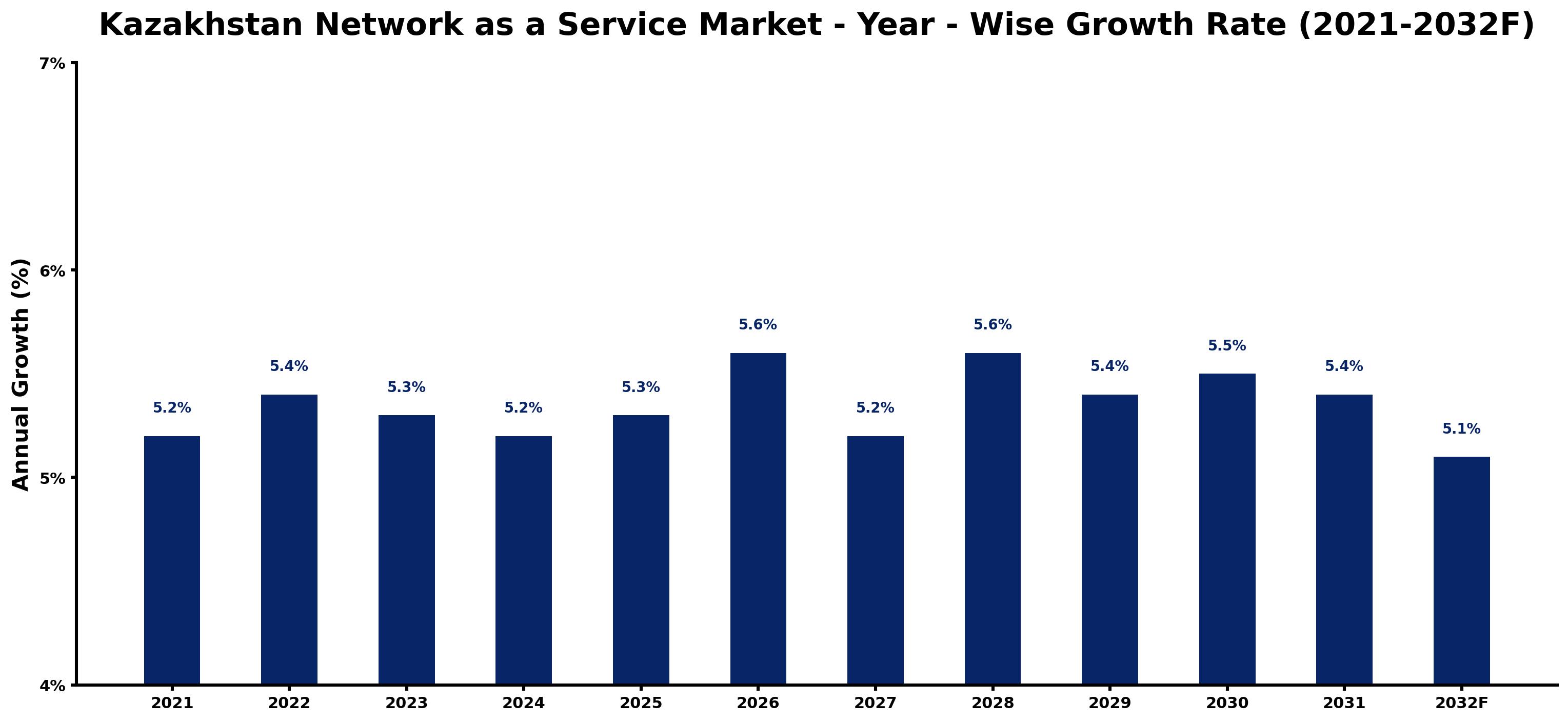
The table below presents the year‑wise growth rates along with the key drivers influencing the market
| Year | Growth Rate | Major Drivers |
| 2021 | 5.2% | Growth in regional data center investments and infrastructure. |
| 2022 | 5.4% | Government's Digital Kazakhstan initiative enhances connectivity services. |
| 2023 | 5.3% | Increased demand for cloud solutions among local enterprises. |
| 2024 | 5.2% | Rising adoption of IoT technologies in various sectors. |
| 2025 | 5.3% | Expanding user base for digital services in rural areas. |
| 2026 | 5.6% | Collaboration with international firms boosts technology access. |
| 2027 | 5.2% | Development of 5G networks facilitates better service offerings. |
| 2028 | 5.6% | Increased focus on cybersecurity regulations drives service need. |
| 2029 | 5.4% | Local fintech startups demand enhanced network solutions. |
| 2030 | 5.5% | Government incentives promote telecommunication technology enhancements. |
| 2031 | 5.4% | Higher digital literacy rates drive network service demand. |
| 2032 | 5.1% | Emergence of smart agriculture solutions requiring network support. |
Note: Market size estimations and growth projections presented in this report are based on 6Wresearch's proprietary forecasting methodology, utilizing the latest available industry data, government publications, and primary research inputs.
Kazakhstan Network as a Service Market Key Takeaways
Below are some of the specific key takeaways from the market, including:
- The market is shifting towards cloud-based networking solutions, driven by the demand for flexibility and cost-efficiency.
- Kazakhstan's growing SME sector is a primary driver for NaaS adoption as businesses seek scalable solutions.
- Government initiatives are focused on promoting the NaaS model, aiming to enhance digital infrastructure.
- Challenges related to infrastructure and connectivity remain significant hurdles for market expansion.
- The market is projected to grow at a CAGR of 5.3%, reflecting increasing demand for network services.
Evaluation of Restraints in Kazakhstan Network as a Service Market
A number of real limitations are holding back the Kazakhstan Network as a Service Market. Chief among these are infrastructure inadequacies that particularly impact rural and underserved areas, resulting in unreliable and slow connectivity. The absence of high-speed networks in these regions hampers the performance and availability of NaaS offerings, making it difficult for businesses to fully realize the benefits of cloud-based solutions. Additionally, regulatory barriers and bureaucratic delays can slow down the adoption of new technologies, further complicating the market's growth potential.
Kazakhstan Network as a Service Market Trends
Recent trends indicate a strong pivot towards hybrid networking models, which blend traditional infrastructure with cloud-based services. This approach allows businesses to optimize their networking resources while maintaining control over critical functions. on top of that, the increasing emphasis on cybersecurity is shaping demand as organizations seek NaaS solutions that offer robust security features.
The focus on digital transformation is also driving investment in advanced networking technologies, such as Software-Defined Networking (SDN) and Network Functions Virtualization (NFV). These technologies are crucial for enhancing network flexibility and reducing operational costs, making them attractive options for companies in Kazakhstan.
Kazakhstan Network as a Service Market Opportunities
Opportunities abound in the Kazakhstan Network as a Service Market, particularly for companies that can offer tailored solutions to SMEs. With the government pushing for enhanced digital infrastructure, businesses can capitalize on public-private partnerships aimed at upgrading network services. Additionally, the ongoing digitalization efforts across various sectors create a fertile ground for innovative NaaS solutions that address specific industry needs.
Government Initiatives in the Kazakhstan Network as a Service Market
The government of Kazakhstan recognizes the importance of cloud-based networking solutions in driving economic growth. Public policy is increasingly oriented towards creating a favorable environment for the Network as a Service model, ensuring that businesses have access to the resources they need for digital transformation. This includes initiatives aimed at improving overall network infrastructure and supporting technological advancement in the public sector.
- A national digital infrastructure upgrade programme recently launched to enhance connectivity across urban and rural areas.
- An ongoing initiative focused on providing technical assistance to SMEs adopting NaaS solutions, aimed at facilitating smoother transitions to cloud-based services.
- A regulatory framework introduced in 2025 to streamline the approval processes for NaaS providers, encouraging market entry.
- Planned public-private collaborations expected to increase the availability of high-speed internet services by 2028.
Future Insights of the Kazakhstan Network as a Service Market
Looking ahead to 2026-2032, the Kazakhstan Network as a Service Market is set for substantial growth. The anticipated improvements in network infrastructure, spurred by government initiatives, will facilitate broader adoption of NaaS solutions. As more organizations recognize the cost benefits and operational flexibility that come with cloud-based networking, the demand will only intensify. Expect a surge in investment aimed at enhancing cybersecurity measures and supporting advanced technologies such as AI-driven networking solutions.
Kazakhstan Network as a Service Market Latest Developments
In the past year, the Kazakhstan Network as a Service Market has experienced several notable developments. The government has intensified efforts to improve digital infrastructure, while private sector players are increasingly investing in innovative solutions to meet rising demand.
- A major technology vendor announced the rollout of a new NaaS platform in Q2 2025, aimed at enhancing service delivery for local enterprises.
- An initiative that began in early 2025 and remains underway is focused on expanding broadband access in rural regions, which is critical for NaaS adoption.
- A leading regional operator launched a pilot project in late 2025 to test a hybrid networking model combining on-premises and cloud resources.
- Upcoming collaborations between government agencies and private firms are expected to kick off in mid-2026, aimed at improving cybersecurity standards for NaaS solutions.
Kazakhstan Network as a Service Market - Key Attractiveness of the Report
- 10 Years of Market Numbers
- Historical Data Starting from 2022 to 2025
- Base Year: 2025
- Forecast Data until 2032
- Key Performance Indicators Impacting the Market
- Major Upcoming Developments and Projects
Key Highlights of the Report:
- Kazakhstan Network as a Service Market Outlook
- Market Size of Kazakhstan Network as a Service Market, 2025
- Forecast of Kazakhstan Network as a Service Market, 2032
- Historical Data and Forecast of Kazakhstan Network as a Service Revenues & Volume for the Period 2022-2032F
- Kazakhstan Network as a Service Market Trend Evolution
- Kazakhstan Network as a Service Market Drivers and Challenges
- Kazakhstan Network as a Service Price Trends
- Kazakhstan Network as a Service Porter's Five Forces
- Kazakhstan Network as a Service Industry Life Cycle
- Historical Data and Forecast of Kazakhstan Network as a Service Market Revenues & Volume By Type for the Period 2022-2032F
- Historical Data and Forecast of Kazakhstan Network as a Service Market Revenues & Volume By Local Area Network and Wireless Local Area Network for the Period 2022-2032F
- Historical Data and Forecast of Kazakhstan Network as a Service Market Revenues & Volume By Wire Area Network for the Period 2022-2032F
- Historical Data and Forecast of Kazakhstan Network as a Service Market Revenues & Volume By Communication and Collaboration for the Period 2022-2032F
- Historical Data and Forecast of Kazakhstan Network as a Service Market Revenues & Volume By Network Security for the Period 2022-2032F
- Historical Data and Forecast of Kazakhstan Network as a Service Market Revenues & Volume By End User for the Period 2022-2032F
- Historical Data and Forecast of Kazakhstan Network as a Service Market Revenues & Volume By Banking, Financial, Services, and Insurance for the Period 2022-2032F
- Historical Data and Forecast of Kazakhstan Network as a Service Market Revenues & Volume By Manufacturing for the Period 2022-2032F
- Historical Data and Forecast of Kazakhstan Network as a Service Market Revenues & Volume By Retail and eCommerce for the Period 2022-2032F
- Historical Data and Forecast of Kazakhstan Network as a Service Market Revenues & Volume By Software and Technology for the Period 2022-2032F
- Historical Data and Forecast of Kazakhstan Network as a Service Market Revenues & Volume By Media and Entertainment for the Period 2022-2032F
- Historical Data and Forecast of Kazakhstan Network as a Service Market Revenues & Volume By Healthcare for the Period 2022-2032F
- Historical Data and Forecast of Kazakhstan Network as a Service Market Revenues & Volume By Education for the Period 2022-2032F
- Historical Data and Forecast of Kazakhstan Network as a Service Market Revenues & Volume By Government for the Period 2022-2032F
- Historical Data and Forecast of Kazakhstan Network as a Service Market Revenues & Volume By Organization Size for the Period 2022-2032F
- Historical Data and Forecast of Kazakhstan Network as a Service Market Revenues & Volume By Large Enterprises for the Period 2022-2032F
- Historical Data and Forecast of Kazakhstan Network as a Service Market Revenues & Volume By SMEs for the Period 2022-2032F
- Historical Data and Forecast of Kazakhstan Network as a Service Market Revenues & Volume By Application for the Period 2022-2032F
- Historical Data and Forecast of Kazakhstan Network as a Service Market Revenues & Volume By UCaaS/Video Conferencing for the Period 2022-2032F
- Historical Data and Forecast of Kazakhstan Network as a Service Market Revenues & Volume By Virtual Private Network for the Period 2022-2032F
- Historical Data and Forecast of Kazakhstan Network as a Service Market Revenues & Volume By Cloud and SaaS Connectivity for the Period 2022-2032F
- Historical Data and Forecast of Kazakhstan Network as a Service Market Revenues & Volume By Bandwidth on Demand for the Period 2022-2032F
- Historical Data and Forecast of Kazakhstan Network as a Service Market Revenues & Volume By Multi-Branch Connectivity for the Period 2022-2032F
- Historical Data and Forecast of Kazakhstan Network as a Service Market Revenues & Volume By WAN Optimization for the Period 2022-2032F
- Historical Data and Forecast of Kazakhstan Network as a Service Market Revenues & Volume By Secure Web Gateway for the Period 2022-2032F
- Kazakhstan Network as a Service Import Export Trade Statistics
- Market Opportunity Assessment By Type
- Market Opportunity Assessment By End User
- Market Opportunity Assessment By Organization Size
- Market Opportunity Assessment By Application
- Kazakhstan Network as a Service Top Companies Market Share
- Kazakhstan Network as a Service Competitive Benchmarking By Technical and Operational Parameters
- Kazakhstan Network as a Service Company Profiles
- Kazakhstan Network as a Service Key Strategic Recommendations






































