Kazakhstan Organic Cotton Market Size, Share & Growth Rate
The Kazakhstan Organic Cotton Market was estimated at USD 401 Million in 2025 and is projected to reach USD 536 Million by 2032, growing at a CAGR of 4.2% from 2026 to 2032. This growth is fueled by a burgeoning global demand for sustainable textiles and heightened consumer awareness surrounding eco-friendly products. Coupled with the favorable climatic conditions for cotton cultivation in Kazakhstan, these factors position the nation as an emerging hub for organic cotton production.
Kazakhstan Organic Cotton Market Year-wise Growth Rate and Key Drivers
This graph highlights how the Kazakhstan Organic Cotton Market has steadily grown over the years, supported by major growth factors.
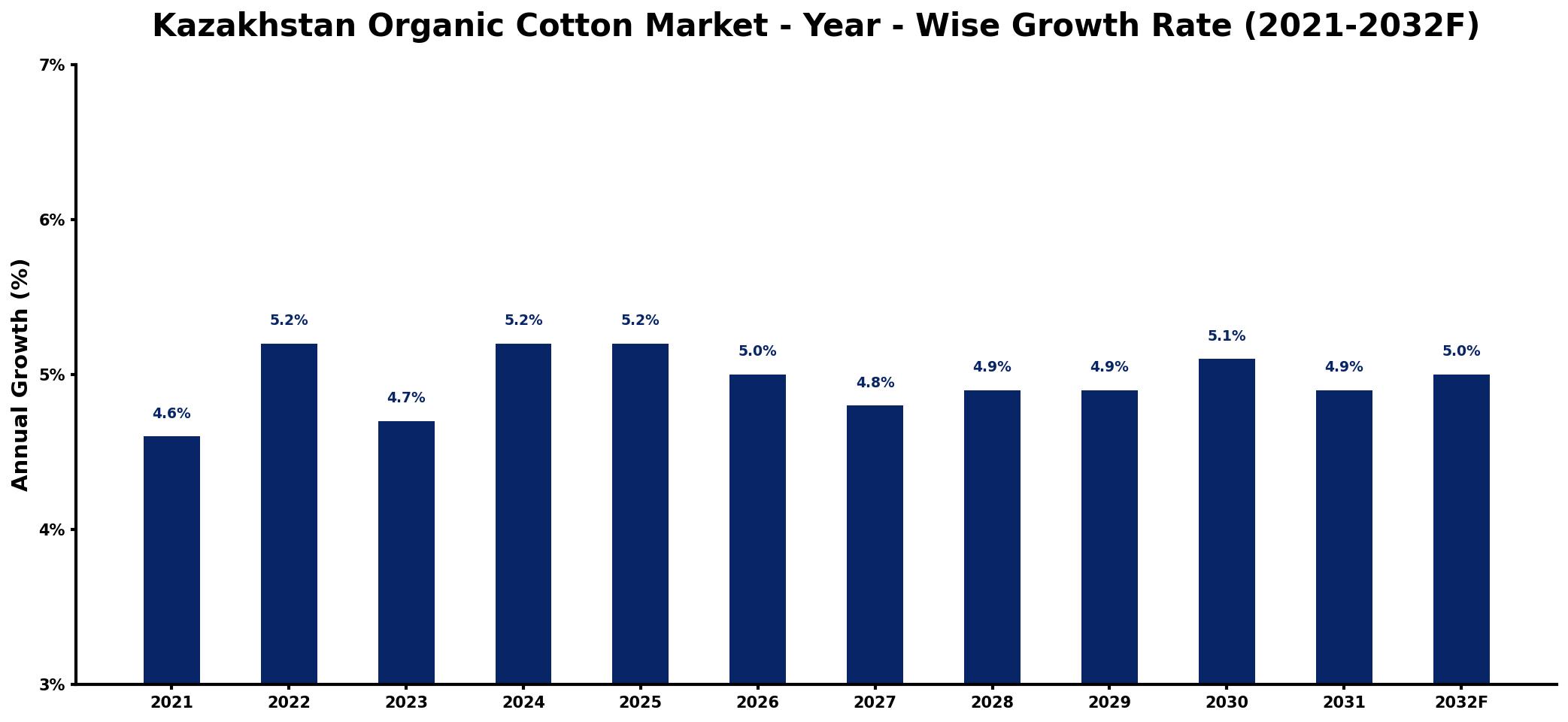
The table below presents the year‑wise growth rates along with the key drivers influencing the market
| Year | Growth Rate | Major Drivers |
| 2021 | 4.6% | Rising consumer sustainability awareness |
| 2022 | 5.2% | Increased investment in agriculture technology |
| 2023 | 4.7% | Growing demand for eco-friendly textiles |
| 2024 | 5.2% | Expansion of sustainable farming practices |
| 2025 | 5.2% | Emergence of new market players |
| 2026 | 5.0% | Strengthening of export opportunities |
| 2027 | 4.8% | Development of local supply chains |
| 2028 | 4.9% | Increased collaboration among stakeholders |
| 2029 | 4.9% | Expansion into new international markets |
| 2030 | 5.1% | Enhanced government support initiatives |
| 2031 | 4.9% | Growth of ethical fashion brands |
| 2032 | 5.0% | increased capital investment inflows |
Note: Market size estimations and growth projections presented in this report are based on 6Wresearch's proprietary forecasting methodology, utilizing the latest available industry data, government publications, and primary research inputs.
Kazakhstan Organic Cotton Market Synopsis
In recent years, the Kazakhstan organic cotton market has gained momentum, propelled by increasing awareness of sustainable practices among consumers. However, as the demand for organic products escalates, the market is on the cusp of significant expansion, leveraging its unique agricultural strengths and government backing.
The future trajectory of the market appears bright, with the organic cotton sector increasingly aligning itself with global trends toward ethical fashion. As more farmers adopt organic practices and the regulatory landscape strengthens, Kazakhstan is poised to solidify its position in the global organic cotton supply chain.
Kazakhstan Organic Cotton Market Key Takeaways
- The market is growing at a steady rate, driven by global shifts towards sustainable and ethical fashion.
- Government incentives and support for organic farming practices are crucial to the industry's expansion.
- Increased consumer awareness is leading to higher demand for organic cotton products.
- Challenges remain, including competition from conventional cotton producers and high production costs.
- Investment opportunities exist for stakeholders keen on tapping into the growing organic textile market.
Evaluation of Restraints in Kazakhstan Organic Cotton Market
Despite its potential, the Kazakhstan organic cotton market faces several constraints. The initial investment required for organic farming practices can be significant, often deterring farmers from transitioning from conventional methods. Moreover, consumer awareness of the benefits of organic cotton is still developing, which limits market penetration. Additionally, competition from conventional cotton farmers, who can offer lower prices due to higher yields, poses a consistent challenge. Addressing these barriers will require strategic collaborations and robust marketing efforts to educate consumers about the advantages of organic cotton.
Kazakhstan Organic Cotton Market Trends
One of the prevailing trends in the Kazakhstan organic cotton market is the increasing adoption of organic farming methods by local farmers. As consumer consciousness around sustainability grows, more stakeholders are actively promoting transparency in sourcing and production processes. Furthermore, there is a noticeable shift towards developing supply chains that prioritize eco-friendly practices, positioning organic cotton as a viable alternative to conventional textiles.
Kazakhstan Organic Cotton Market Opportunities
Investment opportunities within the Kazakhstan organic cotton market are promising, particularly in production and processing. As global demand for organic textiles rises, there is potential for establishing processing facilities that can meet international standards. Collaborating with local farmers to facilitate the transition to organic practices could also yield significant returns. Export opportunities are ripe as international markets seek authentic organic cotton products, further opening avenues for growth.
Government Initiatives in the Kazakhstan Organic Cotton Market
The government of Kazakhstan has demonstrated a commitment to fostering the organic cotton market through various supportive policies. These initiatives include financial incentives for farmers transitioning to organic production and the establishment of certification programs that ensure compliance with international organic standards. Such measures aim not only to enhance the competitiveness of Kazakhstans cotton industry but also to promote environmentally sustainable practices that benefit both the economy and the ecosystem.
Future Insights of the Kazakhstan Organic Cotton Market
Looking ahead to 2026-2032, the Kazakhstan organic cotton market is expected to continue its upward trajectory. The alignment of consumer preferences towards ethical and eco-friendly products signifies a strong market potential. Ongoing government support and the anticipated growth of the sustainable fashion movement will further solidify Kazakhstan's role in the global organic cotton supply chain. As stakeholders collaborate to innovate and educate consumers, the sector is poised for substantial growth.
Kazakhstan Organic Cotton Market Latest Developments (2025 - 2026)
Recent developments in the Kazakhstan organic cotton market indicate a growing emphasis on sustainability and transparency within the supply chain. Increased cooperation between farmers and textile manufacturers has been noted, with initiatives aimed at improving the efficiency of organic cotton production. Additionally, various local organizations are stepping up efforts to promote organic cotton awareness, aligning closely with global trends toward sustainable fashion.
Kazakhstan Organic Cotton Market - Key Attractiveness of the Report
- 10 Years of Market Numbers
- Historical Data Starting from 2022 to 2025
- Base Year: 2025
- Forecast Data until 2032
- Key Performance Indicators Impacting the Market
- Major Upcoming Developments and Projects
Key Highlights of the Report:
- Kazakhstan Organic Cotton Market Outlook
- Market Size of Kazakhstan Organic Cotton Market, 2025
- Forecast of Kazakhstan Organic Cotton Market, 2032
- Historical Data and Forecast of Kazakhstan Organic Cotton Revenues & Volume for the Period 2022-2032F
- Kazakhstan Organic Cotton Market Trend Evolution
- Kazakhstan Organic Cotton Market Drivers and Challenges
- Kazakhstan Organic Cotton Price Trends
- Kazakhstan Organic Cotton Porter's Five Forces
- Kazakhstan Organic Cotton Industry Life Cycle
- Historical Data and Forecast of Kazakhstan Organic Cotton Market Revenues & Volume By Type for the Period 2022-2032F
- Historical Data and Forecast of Kazakhstan Organic Cotton Market Revenues & Volume By Long-Staple Cotton for the Period 2022-2032F
- Historical Data and Forecast of Kazakhstan Organic Cotton Market Revenues & Volume By Short-Staple Cotton for the Period 2022-2032F
- Historical Data and Forecast of Kazakhstan Organic Cotton Market Revenues & Volume By Middle Staple Cotton for the Period 2022-2032F
- Historical Data and Forecast of Kazakhstan Organic Cotton Market Revenues & Volume By Extra-long Staple Cotton for the Period 2022-2032F
- Historical Data and Forecast of Kazakhstan Organic Cotton Market Revenues & Volume By Others for the Period 2022-2032F
- Historical Data and Forecast of Kazakhstan Organic Cotton Market Revenues & Volume By Quality Type for the Period 2022-2032F
- Historical Data and Forecast of Kazakhstan Organic Cotton Market Revenues & Volume By Supima/Pima for the Period 2022-2032F
- Historical Data and Forecast of Kazakhstan Organic Cotton Market Revenues & Volume By Upland for the Period 2022-2032F
- Historical Data and Forecast of Kazakhstan Organic Cotton Market Revenues & Volume By Giza for the Period 2022-2032F
- Historical Data and Forecast of Kazakhstan Organic Cotton Market Revenues & Volume By Others for the Period 2022-2032F
- Historical Data and Forecast of Kazakhstan Organic Cotton Market Revenues & Volume By Application for the Period 2022-2032F
- Historical Data and Forecast of Kazakhstan Organic Cotton Market Revenues & Volume By Apparel for the Period 2022-2032F
- Historical Data and Forecast of Kazakhstan Organic Cotton Market Revenues & Volume By Packaging for the Period 2022-2032F
- Historical Data and Forecast of Kazakhstan Organic Cotton Market Revenues & Volume By Others for the Period 2022-2032F
- Kazakhstan Organic Cotton Import Export Trade Statistics
- Market Opportunity Assessment By Type
- Market Opportunity Assessment By Quality Type
- Market Opportunity Assessment By Application
- Kazakhstan Organic Cotton Top Companies Market Share
- Kazakhstan Organic Cotton Competitive Benchmarking By Technical and Operational Parameters
- Kazakhstan Organic Cotton Company Profiles
- Kazakhstan Organic Cotton Key Strategic Recommendations






































