Kazakhstan Personal Computers Market: Import Trend Analysis
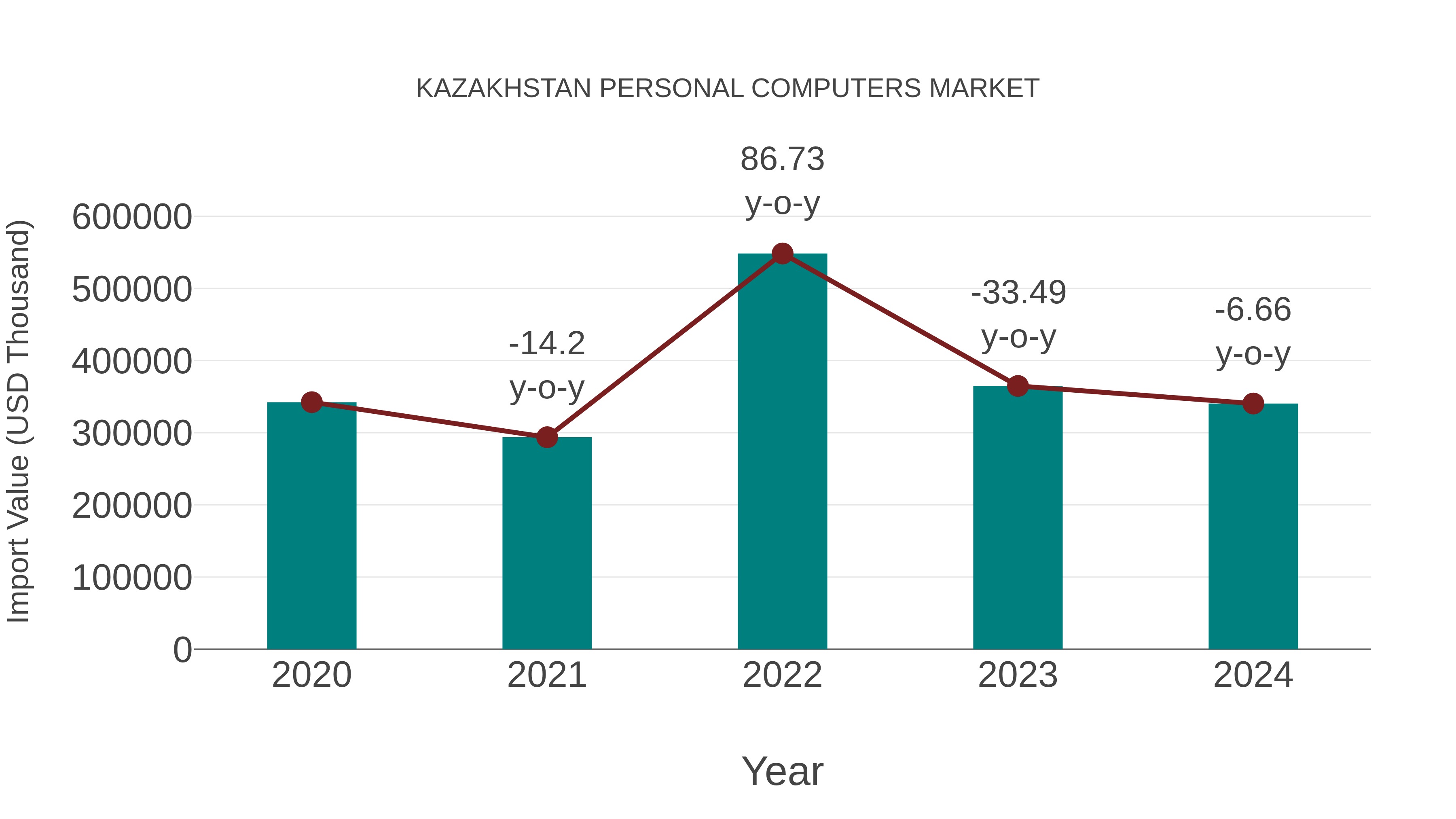
In the Kazakhstan personal computers market, the import trend experienced a decline with a growth rate of -6.66% from 2023 to 2024, resulting in a compound annual growth rate (CAGR) of -0.14% for the period 2020-2024. This negative momentum could be attributed to shifts in consumer preferences, changes in trade policies, or market saturation impacting import dynamics.
Kazakhstan Personal Computers Market Synopsis
The Kazakhstan Personal Computers Market is experiencing steady growth driven by increasing demand for laptops, desktops, and tablets across various industries and among individual consumers. The market is characterized by a growing preference for portable devices, especially laptops, due to their convenience and mobility. Key players in the market include international brands such as HP, Dell, and Lenovo, as well as local manufacturers catering to specific consumer needs. The market is also witnessing a shift towards higher performance computing devices as users require more advanced features for work, education, and entertainment purposes. Government initiatives to promote digital literacy and technology adoption are further fueling market growth, making Kazakhstan an attractive market for personal computer manufacturers and retailers.
Kazakhstan Personal Computers Market Trends
The Personal Computers (PC) market in Kazakhstan is currently experiencing a shift towards more portable and powerful devices, with a growing demand for laptops and ultrabooks. The increasing popularity of remote work and online learning has fueled this trend, as consumers seek devices that offer mobility and performance. Additionally, there is a rising interest in gaming PCs among the younger demographic, driving sales of high-end gaming laptops and desktops. The market is also witnessing a surge in demand for all-in-one PCs, as they offer space-saving solutions for home and office use. Overall, the Kazakhstan PC market is evolving to meet the changing needs of consumers, with a focus on versatility, performance, and convenience.
Kazakhstan Personal Computers Market Challenges
The Kazakhstan Personal Computers Market faces several challenges including a relatively low level of consumer awareness and adoption of new technologies, limited purchasing power of the population due to economic factors, and the dominance of international brands over local manufacturers. Additionally, the market is impacted by fluctuations in currency exchange rates and import tariffs, which can affect pricing and availability of products. Furthermore, the lack of a robust distribution network in certain regions of Kazakhstan poses a challenge in reaching potential customers effectively. Overall, addressing these challenges will require strategic marketing efforts, competitive pricing strategies, and partnerships with local retailers to expand market reach and increase market share in the Kazakhstan Personal Computers Market.
Kazakhstan Personal Computers Market Investment Opportunities
The Kazakhstan Personal Computers Market presents various investment opportunities, with growth driven by factors such as increasing digitalization, rising disposable incomes, and a growing demand for technology products. Opportunities exist for investments in both hardware and software segments, including the manufacturing and distribution of personal computers, peripherals, and accessories. Additionally, there is potential for growth in the market for computer software and services, such as cybersecurity solutions, cloud computing services, and software development. Investors may also consider opportunities in retail and e-commerce channels to reach the expanding consumer base. Overall, the Kazakhstan Personal Computers Market offers a favorable environment for investors looking to capitalize on the country`s technological advancement and increasing adoption of digital technologies.
Jordan Agar Market Government Policies
The Kazakhstan government has implemented various policies to support the Personal Computers Market in the country. These include initiatives to promote digital literacy and access to technology, such as the Digital Kazakhstan program, which aims to increase internet connectivity and digital skills among the population. Additionally, the government has introduced tax incentives and subsidies for local PC manufacturers to stimulate domestic production and reduce dependence on imports. Furthermore, regulations on data protection and cybersecurity have been enforced to ensure consumer trust and security in the use of personal computers. Overall, these policies are designed to foster growth and innovation in the Kazakhstan Personal Computers Market while safeguarding the interests of consumers and promoting economic development in the digital sector.
Kazakhstan Personal Computers Market Future Outlook
The future outlook for the Kazakhstan Personal Computers Market appears promising, driven by factors such as the increasing digitization trends in businesses, educational institutions, and households. The market is expected to witness steady growth with the rising demand for PCs due to remote working and learning arrangements, as well as the growing popularity of gaming and entertainment activities. Additionally, the government`s initiatives to promote digital literacy and technology adoption among the population are likely to further fuel the market growth. Advancements in technology, such as the introduction of more powerful and energy-efficient PCs, are anticipated to attract consumers looking for enhanced performance. Overall, the Kazakhstan Personal Computers Market is projected to expand in the coming years, presenting opportunities for industry players to innovate and cater to evolving consumer needs.
Key Highlights of the Report:
- Kazakhstan Personal Computers Market Outlook
- Market Size of Kazakhstan Personal Computers Market, 2025
- Forecast of Kazakhstan Personal Computers Market, 2032
- Historical Data and Forecast of Kazakhstan Personal Computers Revenues & Volume for the Period 2022 - 2032F
- Kazakhstan Personal Computers Market Trend Evolution
- Kazakhstan Personal Computers Market Drivers and Challenges
- Kazakhstan Personal Computers Price Trends
- Kazakhstan Personal Computers Porter's Five Forces
- Kazakhstan Personal Computers Industry Life Cycle
- Historical Data and Forecast of Kazakhstan Personal Computers Market Revenues & Volume By Product Type for the Period 2022 - 2032F
- Historical Data and Forecast of Kazakhstan Personal Computers Market Revenues & Volume By Desktop for the Period 2022 - 2032F
- Historical Data and Forecast of Kazakhstan Personal Computers Market Revenues & Volume By Notebook for the Period 2022 - 2032F
- Historical Data and Forecast of Kazakhstan Personal Computers Market Revenues & Volume By Workstation for the Period 2022 - 2032F
- Historical Data and Forecast of Kazakhstan Personal Computers Market Revenues & Volume By Others for the Period 2022 - 2032F
- Historical Data and Forecast of Kazakhstan Personal Computers Market Revenues & Volume By Distribution Channel for the Period 2022 - 2032F
- Historical Data and Forecast of Kazakhstan Personal Computers Market Revenues & Volume By Business-To-Business (B2B) for the Period 2022 - 2032F
- Historical Data and Forecast of Kazakhstan Personal Computers Market Revenues & Volume By Business-To-Consumer (B2C) for the Period 2022 - 2032F
- Historical Data and Forecast of Kazakhstan Personal Computers Market Revenues & Volume By Application for the Period 2022 - 2032F
- Historical Data and Forecast of Kazakhstan Personal Computers Market Revenues & Volume By Consumer for the Period 2022 - 2032F
- Historical Data and Forecast of Kazakhstan Personal Computers Market Revenues & Volume By Commercial for the Period 2022 - 2032F
- Historical Data and Forecast of Kazakhstan Personal Computers Market Revenues & Volume By Industrial for the Period 2022 - 2032F
- Kazakhstan Personal Computers Import Export Trade Statistics
- Market Opportunity Assessment By Product Type
- Market Opportunity Assessment By Distribution Channel
- Market Opportunity Assessment By Application
- Kazakhstan Personal Computers Top Companies Market Share
- Kazakhstan Personal Computers Competitive Benchmarking By Technical and Operational Parameters
- Kazakhstan Personal Computers Company Profiles
- Kazakhstan Personal Computers Key Strategic Recommendations






































