Kazakhstan Physical Security Market Size & Growth Rate (2026-2032)
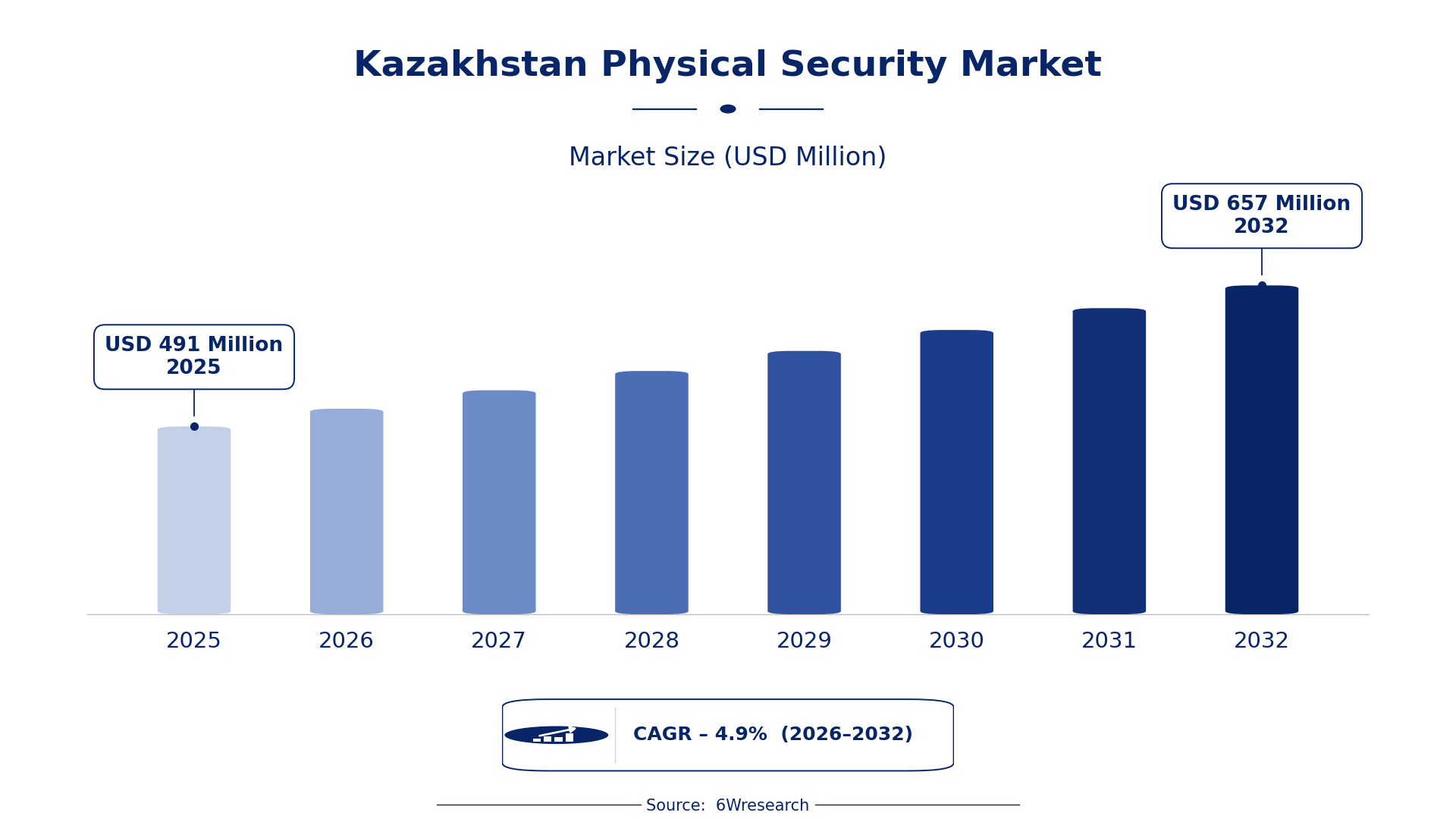
The Kazakhstan Physical Security Market was estimated at USD 491 Million in 2025 and is projected to reach USD 657 Million by 2032, growing at a CAGR of 4.9% from 2026 to 2032.
Kazakhstan Physical Security Market Synopsis
The increasing demand for advanced security solutions is shaping the Kazakhstan Physical Security Market, particularly as sectors like government and finance seek robust measures to counter rising threats. The government’s commitment to enhancing public safety through infrastructure development further drives this demand.
Technological innovations, particularly in video surveillance and biometric security, are not only creating new opportunities but are also addressing evolving security challenges. As awareness of security risks grows among businesses and residents, the market is set to expand rapidly.
Kazakhstan Physical Security Market Year-wise Growth Rate and Key Drivers
This graph illustrates the annual growth rates of the Kazakhstan Physical Security Market from 2021 to 2032, highlighting a steady upward trajectory and projected expansion over the forecast period.
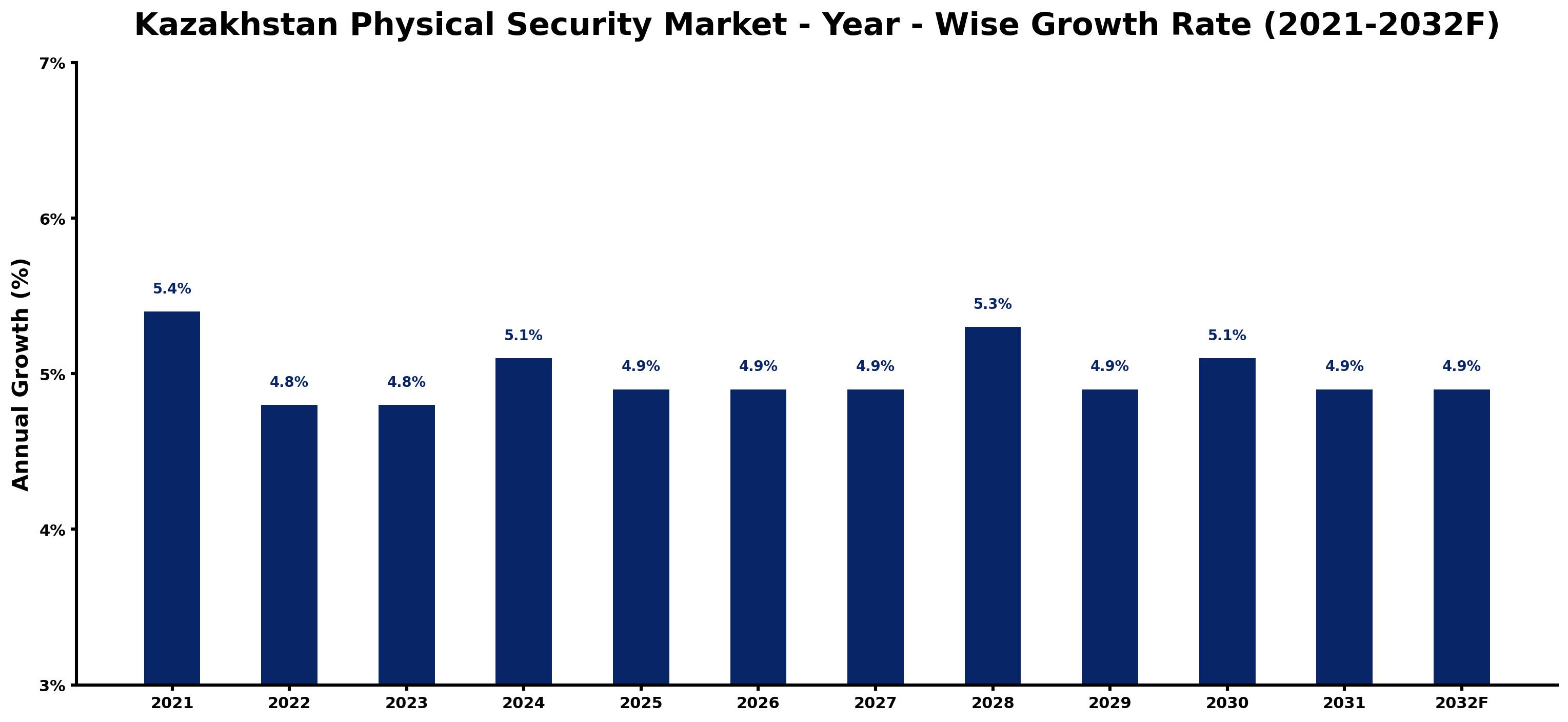
The table below presents the year‑wise growth rates along with the key drivers influencing the market
| Year | Growth Rate | Major Drivers |
| 2021 | 5.4% | Kazakh government funding for urban surveillance projects. |
| 2022 | 4.8% | Increased border security measures post-COVID-19 pandemic. |
| 2023 | 4.8% | Growth in demand for biometric access control systems. |
| 2024 | 5.1% | Implementation of new safety regulations by Ministry of Internal Affairs. |
| 2025 | 4.9% | Rising crime rates spurring demand for private security services. |
| 2026 | 4.9% | Adoption of advanced CCTV technologies in urban areas. |
| 2027 | 4.9% | Support from local businesses for enhanced physical security. |
| 2028 | 5.3% | Government incentives for installation of smart security systems. |
| 2029 | 4.9% | Collaboration with international security firms expanding market offerings. |
| 2030 | 5.1% | Focus on safeguarding energy infrastructure against threats. |
| 2031 | 4.9% | Urbanization leading to increased demand for monitoring services. |
| 2032 | 4.9% | Emphasis on public safety initiatives in major cities. |
Note: Market size estimations and growth projections presented in this report are based on 6Wresearch's proprietary forecasting methodology, utilizing the latest available industry data, government publications, and primary research inputs.
Kazakhstan Physical Security Market Key Takeaways
Below are some of the specific key takeaways from the market, including:
- The Kazakhstan Physical Security Market is experiencing robust growth driven by increased demand for security technologies.
- Advancements in video surveillance and access control systems are key drivers of this market evolution.
- Government initiatives focused on public safety are enhancing the security infrastructure.
- Integration of artificial intelligence in security solutions is transforming operational efficiency.
- Investment opportunities are expanding, particularly in technology partnerships and infrastructure projects.
Evaluation of Restraints in Kazakhstan Physical Security Market
While the Kazakhstan Physical Security Market shows promising growth potential, it is hindered by several critical constraints. A lack of awareness about the importance of physical security measures among businesses leads to underinvestment in necessary solutions. Additionally, there is a notable shortage of skilled professionals capable of implementing complex security systems, which stifles innovation and effectiveness in service delivery.
Regulatory challenges also complicate market dynamics, with fluctuating policies affecting company operations and market entry. The evolving threat landscape necessitates that security providers continuously adapt, which requires substantial investment in technology and training. Addressing these issues is crucial for unlocking the market's full potential.
Kazakhstan Physical Security Market Trends
A noticeable trend in the Kazakhstan Physical Security Market is the shift towards integrated and intelligent security systems that offer real-time monitoring and analytics. Biometric solutions and cloud-based systems are gaining traction, reflecting a growing preference for scalable and flexible security solutions.
on top of that, as the awareness of security threats escalates, the demand for sophisticated monitoring systems is expected to increase. Companies are focusing on enhancing their capabilities through the incorporation of artificial intelligence and machine learning to improve threat detection and response times.
Kazakhstan Physical Security Market Opportunities
Investment opportunities are abundant in the Kazakhstan Physical Security Market, particularly within the government, finance, and energy sectors. With the heightened threat of terrorism and cybercrime, there is an urgent need for advanced security technologies. Collaborations with local firms for customized solutions can also present lucrative avenues for investors.
The government's focus on smart city initiatives provides further impetus for the growth of physical security solutions, as urban areas become increasingly dependent on technology for safety and efficiency. Thus, tapping into these sectors offers strategic benefits to investors looking to establish a foothold in the market.
Government Initiatives in the Kazakhstan Physical Security Market
Government policies are crucial in shaping the Kazakhstan Physical Security Market, focusing on enhancing safety measures across public and private sectors. Regulatory frameworks aim to streamline operations of security firms and encourage technology adoption. Recent initiatives show a commitment to building a secure environment for citizens and businesses alike.
- A licensing framework for security companies was established in 2025 to ensure compliance with industry standards.
- Currently underway is a public-private partnership to upgrade security infrastructure across major cities.
- In early 2025, a comprehensive review of security regulations was initiated to address evolving market needs.
- A planned project to incorporate AI-based surveillance systems in public spaces is expected to commence in 2026.
- The government has launched a campaign to educate businesses on the importance of physical security measures, aiming for completion by mid-2026.
Future Insights of the Kazakhstan Physical Security Market
Looking ahead, the Kazakhstan Physical Security Market is set for continuous expansion through 2032. The interplay between technological advancements and rising security concerns will define the market's trajectory. As investment in infrastructure develops, including smart city projects, there will be a growing emphasis on integrated solutions that enhance efficiency and responsiveness.
on top of that, increasing collaboration between the public and private sectors is anticipated to further stimulate innovation and service quality. Companies that stay ahead of technological trends and regulatory changes will likely find the most success in this evolving environment.
Kazakhstan Physical Security Market Latest Developments
In the past year, the Kazakhstan Physical Security Market has witnessed notable activity, showcasing a commitment to modernizing security practices. Firms are actively engaging in technology upgrades and forming strategic alliances to enhance service offerings. The emphasis on improving public safety remains a driving force.
- A major technology vendor rolled out a next-generation video surveillance solution in early 2025, gaining significant market traction.
- An initiative focused on installing biometric access control systems in government buildings is currently underway, expected to enhance security protocols.
- By mid-2026, a local firm plans to launch a cloud-based security management platform to streamline operations for businesses.
- A recent collaboration between private firms and government agencies has begun to address infrastructure vulnerabilities through enhanced surveillance measures.
- In late 2025, a regional operator announced plans to expand its service offerings to include AI-driven analytics for security monitoring, currently in the testing phase.
Kazakhstan Physical Security Market - Key Attractiveness of the Report
- 10 Years of Market Numbers
- Historical Data Starting from 2022 to 2025
- Base Year: 2025
- Forecast Data until 2032
- Key Performance Indicators Impacting the Market
- Major Upcoming Developments and Projects
Key Highlights of the Report:
- Kazakhstan Physical Security Market Outlook
- Market Size of Kazakhstan Physical Security Market, 2025
- Forecast of Kazakhstan Physical Security Market, 2032
- Historical Data and Forecast of Kazakhstan Physical Security Revenues & Volume for the Period 2022-2032F
- Kazakhstan Physical Security Market Trend Evolution
- Kazakhstan Physical Security Market Drivers and Challenges
- Kazakhstan Physical Security Price Trends
- Kazakhstan Physical Security Porter's Five Forces
- Kazakhstan Physical Security Industry Life Cycle
- Historical Data and Forecast of Kazakhstan Physical Security Market Revenues & Volume By Component for the Period 2022-2032F
- Historical Data and Forecast of Kazakhstan Physical Security Market Revenues & Volume By Systems (PACS, PSIM, PIAM, Video Surveillance, Fire and Life Safety) for the Period 2022-2032F
- Historical Data and Forecast of Kazakhstan Physical Security Market Revenues & Volume By Services for the Period 2022-2032F
- Historical Data and Forecast of Kazakhstan Physical Security Market Revenues & Volume By Vertical for the Period 2022-2032F
- Historical Data and Forecast of Kazakhstan Physical Security Market Revenues & Volume By BFSI for the Period 2022-2032F
- Historical Data and Forecast of Kazakhstan Physical Security Market Revenues & Volume By Government for the Period 2022-2032F
- Historical Data and Forecast of Kazakhstan Physical Security Market Revenues & Volume By Retail for the Period 2022-2032F
- Historical Data and Forecast of Kazakhstan Physical Security Market Revenues & Volume By Transportation for the Period 2022-2032F
- Historical Data and Forecast of Kazakhstan Physical Security Market Revenues & Volume By Residential for the Period 2022-2032F
- Historical Data and Forecast of Kazakhstan Physical Security Market Revenues & Volume By Telecom and IT for the Period 2022-2032F
- Historical Data and Forecast of Kazakhstan Physical Security Market Revenues & Volume By Other Verticals (Healthcare, Manufacturing, Energy and Utilities, and Education). for the Period 2022-2032F
- Historical Data and Forecast of Kazakhstan Physical Security Market Revenues & Volume By Organization Size for the Period 2022-2032F
- Historical Data and Forecast of Kazakhstan Physical Security Market Revenues & Volume By SMEs for the Period 2022-2032F
- Historical Data and Forecast of Kazakhstan Physical Security Market Revenues & Volume By Large Enterprises for the Period 2022-2032F
- Kazakhstan Physical Security Import Export Trade Statistics
- Market Opportunity Assessment By Component
- Market Opportunity Assessment By Vertical
- Market Opportunity Assessment By Organization Size
- Kazakhstan Physical Security Top Companies Market Share
- Kazakhstan Physical Security Competitive Benchmarking By Technical and Operational Parameters
- Kazakhstan Physical Security Company Profiles
- Kazakhstan Physical Security Key Strategic Recommendations






































