Kazakhstan Policy Management in Telecom Market Size & Growth Rate (2026-2032)
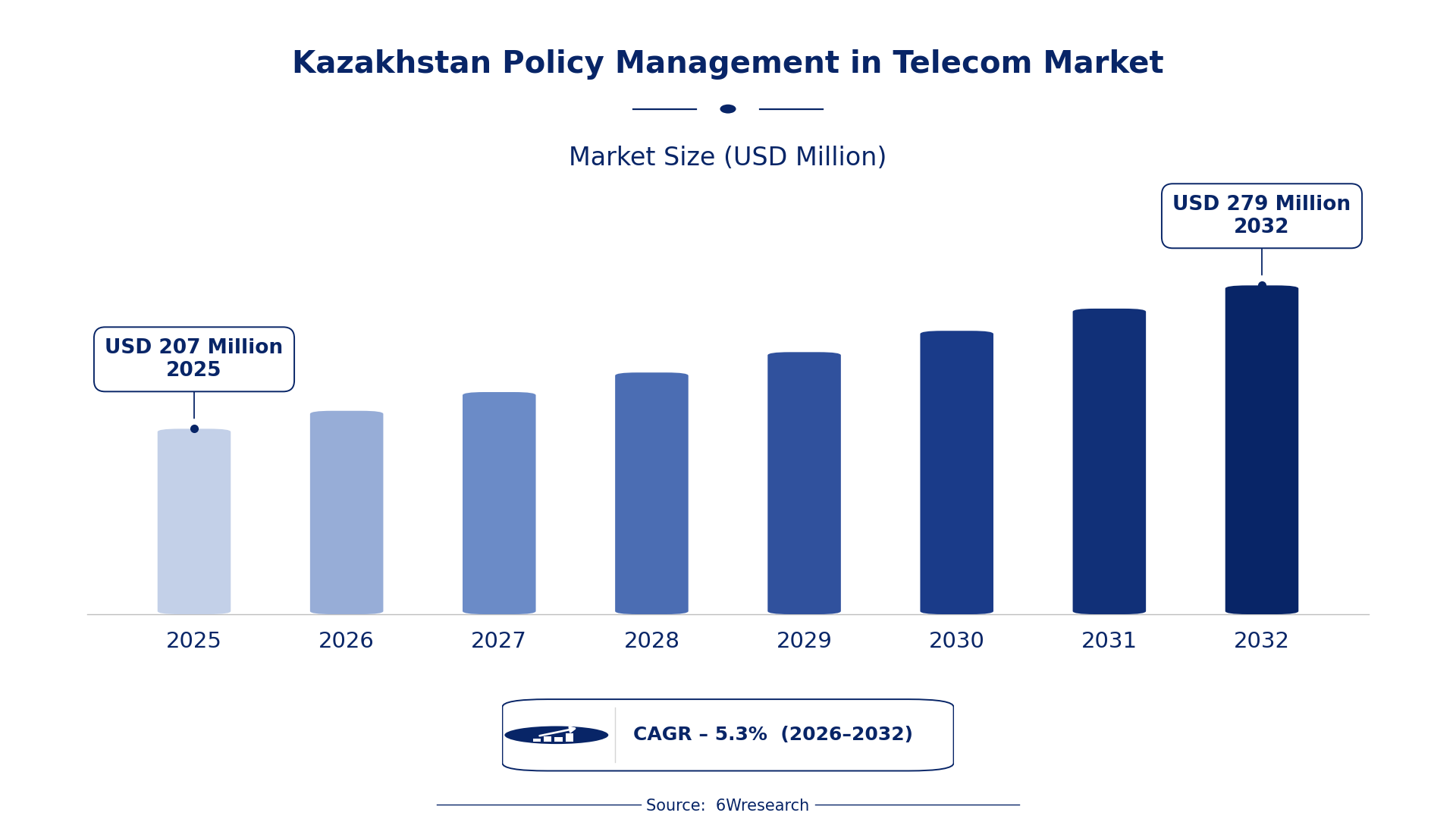
The Kazakhstan Policy Management in Telecom Market was estimated at USD 207 Million in 2025 and is projected to reach USD 279 Million by 2032, growing at a CAGR of 5.3% from 2026 to 2032.
Kazakhstan Policy Management in Telecom Market Synopsis
The market for policy management in telecom within Kazakhstan is currently experiencing a transitional phase as operators work towards streamlining their operations and enhancing customer experience. While recent strides have been made in adopting advanced technologies, the path forward requires addressing systemic challenges to fully realize the potential benefits.
Looking ahead, the demand for sophisticated policy management solutions will intensify as network complexities grow. Regulatory changes will continue to shape operational frameworks, emphasizing the need for telecom operators to adapt quickly to remain competitive and compliant.
Kazakhstan Policy Management in Telecom Market Year-wise Growth Rate and Key Drivers
This graph illustrates the annual growth rates of the Kazakhstan Policy Management in Telecom Market from 2021 to 2032, highlighting a steady upward trajectory and projected expansion over the forecast period.
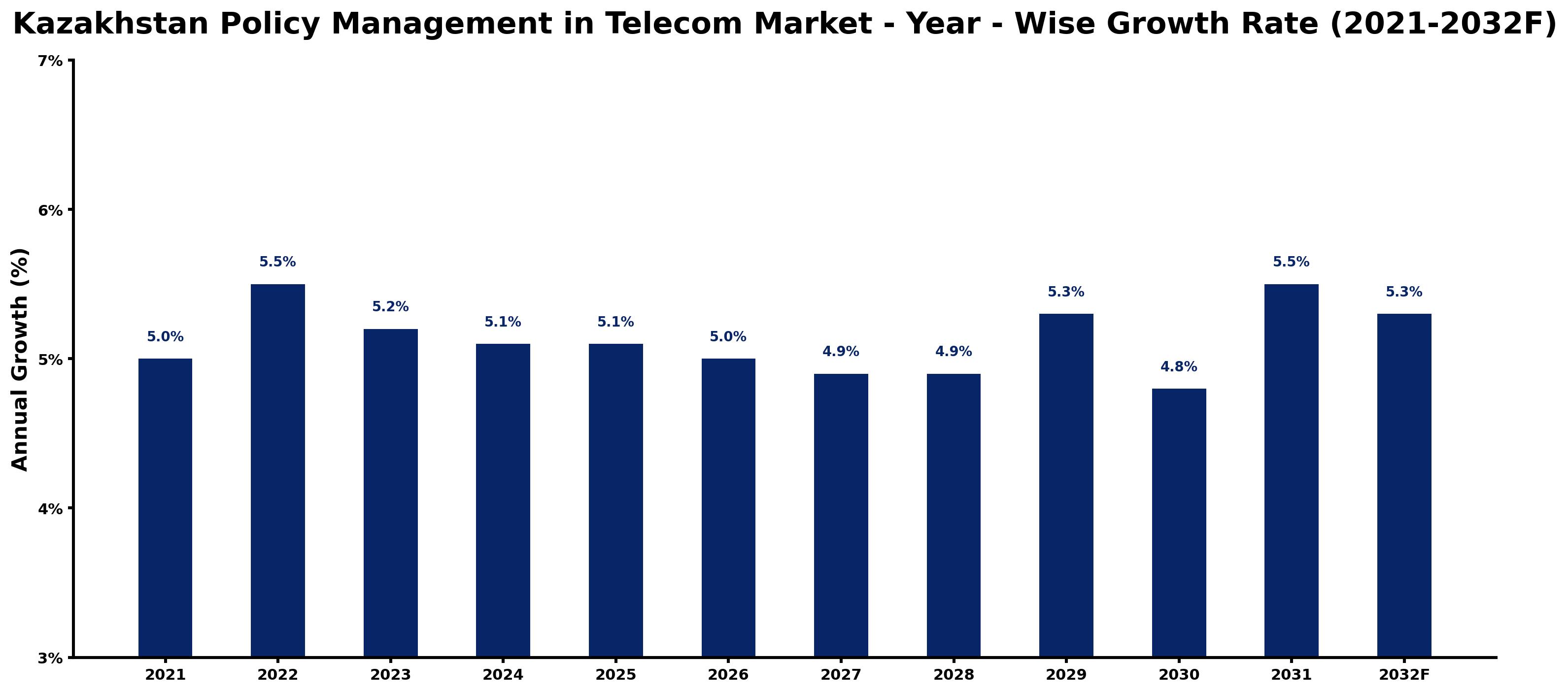
The table below presents the year‑wise growth rates along with the key drivers influencing the market
| Year | Growth Rate | Major Drivers |
| 2021 | 5.0% | Launch of Astana Digital Smart City initiative boosts telecom policies. |
| 2022 | 5.5% | Government offers incentives for telecom infrastructure modernization. |
| 2023 | 5.2% | Increased investment in 5G technology by local providers. |
| 2024 | 5.1% | Regulatory support for spectrum allocation enhances service delivery. |
| 2025 | 5.1% | Growing digital literacy initiatives expand consumer telecom access. |
| 2026 | 5.0% | Partnerships between telecom firms and tech startups proliferate. |
| 2027 | 4.9% | State subsidies promote rural broadband connectivity advancements. |
| 2028 | 4.9% | Investment in cybersecurity guidelines strengthens telecom market stability. |
| 2029 | 5.3% | Public demand for improved telecom services drives policy reforms. |
| 2030 | 4.8% | E-commerce growth necessitates better telecom regulatory frameworks. |
| 2031 | 5.5% | International partnerships improve telecom standards and compliance. |
| 2032 | 5.3% | Enhanced privacy regulations boost trust in telecom services. |
Note: Market size estimations and growth projections presented in this report are based on 6Wresearch's proprietary forecasting methodology, utilizing the latest available industry data, government publications, and primary research inputs.
Kazakhstan Policy Management in Telecom Market Key Takeaways
Below are some of the specific key takeaways from the market, including:
- The market is on track for steady growth driven by increasing regulatory compliance needs.
- Integration of AI and machine learning technologies is transforming policy management efficiency.
- Telecom operators face significant infrastructure challenges that hinder market progress.
- Government initiatives are crucial in fostering a competitive and fair telecom environment.
- Opportunities for investment are emerging as the regulatory framework evolves.
Evaluation of Restraints in Kazakhstan Policy Management in Telecom Market
Despite positive momentum, several constraints are stifling the market. Regulatory uncertainties pose significant challenges, with frequent shifts in policy impacting investment decisions. The telecom infrastructure, which requires considerable upgrades, remains a critical bottleneck for the effective implementation of advanced policy management solutions. Operators are often deterred by the high costs associated with these necessary upgrades, which slows the overall adoption of technology designed to optimize service delivery.
Kazakhstan Policy Management in Telecom Market Trends
A notable trend in the Kazakhstan telecom sector is the increasing reliance on data analytics to enhance service efficiency and customer satisfaction. As competition heats up, operators are deploying predictive analytics to anticipate customer needs and streamline their service offerings. Moreover, there's a marked shift toward cloud-based policy management systems, enabling greater flexibility and scalability in operations. This migration is vital for telecom firms looking to remain agile in a fast-paced regulatory environment.
Kazakhstan Policy Management in Telecom Market Opportunities
Investment opportunities abound, particularly in upgrading infrastructure to support advanced policy management technologies. As the demand for better customer experiences grows, telecom operators that invest in these upgrades stand to gain a competitive edge. Additionally, leveraging AI in policy management opens avenues for enhanced operational efficiency. There's also potential for collaborative public-private partnerships aimed at expanding broadband access, especially in underserved regions.
Government Initiatives in the Kazakhstan Policy Management in Telecom Market
Government policies are fundamental in shaping the telecom sector in Kazakhstan. Prioritizing market competition, the regulatory framework has focused on infrastructure development and consumer rights protection. These policies are designed to facilitate a stable environment for operators and ensure equitable access to telecom services for all citizens.
- A regulatory framework introduced in 2025 mandating billing transparency and consumer data protection.
- A national digital infrastructure upgrade programme now in its rollout phase to enhance network capabilities.
- Current efforts to streamline spectrum allocation processes to reduce bureaucratic delays in new service deployments.
- A planned public-private initiative expected to expand telecom infrastructure access by 2028.
- Measures aimed at fostering competition among telecom operators to ensure fair pricing and service quality.
Future Insights of the Kazakhstan Policy Management in Telecom Market
As we move towards 2032, the Kazakhstan Policy Management in Telecom Market is expected to evolve significantly. Emphasis on regulatory compliance will lead to the widespread adoption of advanced policy management solutions. Additionally, as telecom networks grow more intricate, the interplay between regulatory frameworks and technological innovations will create both challenges and opportunities. Success will hinge on operators' ability to adapt quickly and strategically to ongoing changes in policy and market dynamics.
Kazakhstan Policy Management in Telecom Market Latest Developments
In the past year, significant developments have occurred in the Kazakhstan Policy Management in Telecom Market. Operators are increasingly focusing on enhancing their policy management capabilities to comply with the evolving regulatory environment. Initiatives aimed at upgrading infrastructure and integrating advanced technologies are taking center stage, indicating a proactive approach to tackling existing challenges.
- A leading regional operator launched an AI-driven policy management system in early 2025, aimed at optimizing customer interactions.
- An initiative that began in mid-2025 to update telecom regulations is currently underway, focused on improving service delivery standards.
- A major technology vendor is expected to roll out a cloud-based policy management solution by late 2026 to streamline operations for telecom providers.
- A collaborative project initiated in early 2025 aims to enhance broadband coverage in rural areas, improving access to digital services.
- Research and development efforts launched by government entities in late 2025 will support local startups in developing telecom solutions.
Kazakhstan Policy Management in Telecom Market - Key Attractiveness of the Report
- 10 Years of Market Numbers
- Historical Data Starting from 2022 to 2025
- Base Year: 2025
- Forecast Data until 2032
- Key Performance Indicators Impacting the Market
- Major Upcoming Developments and Projects
Key Highlights of the Report:
- Kazakhstan Policy Management in Telecom Market Outlook
- Market Size of Kazakhstan Policy Management in Telecom Market, 2025
- Forecast of Kazakhstan Policy Management in Telecom Market, 2032
- Historical Data and Forecast of Kazakhstan Policy Management in Telecom Revenues & Volume for the Period 2022-2032F
- Kazakhstan Policy Management in Telecom Market Trend Evolution
- Kazakhstan Policy Management in Telecom Market Drivers and Challenges
- Kazakhstan Policy Management in Telecom Price Trends
- Kazakhstan Policy Management in Telecom Porter's Five Forces
- Kazakhstan Policy Management in Telecom Industry Life Cycle
- Historical Data and Forecast of Kazakhstan Policy Management in Telecom Market Revenues & Volume By Network for the Period 2022-2032F
- Historical Data and Forecast of Kazakhstan Policy Management in Telecom Market Revenues & Volume By Fixed for the Period 2022-2032F
- Historical Data and Forecast of Kazakhstan Policy Management in Telecom Market Revenues & Volume By Wireless for the Period 2022-2032F
- Historical Data and Forecast of Kazakhstan Policy Management in Telecom Market Revenues & Volume By Component for the Period 2022-2032F
- Historical Data and Forecast of Kazakhstan Policy Management in Telecom Market Revenues & Volume By Solutions for the Period 2022-2032F
- Historical Data and Forecast of Kazakhstan Policy Management in Telecom Market Revenues & Volume By Services for the Period 2022-2032F
- Historical Data and Forecast of Kazakhstan Policy Management in Telecom Market Revenues & Volume By Deployment for the Period 2022-2032F
- Historical Data and Forecast of Kazakhstan Policy Management in Telecom Market Revenues & Volume By Cloud for the Period 2022-2032F
- Historical Data and Forecast of Kazakhstan Policy Management in Telecom Market Revenues & Volume By On-Premises for the Period 2022-2032F
- Kazakhstan Policy Management in Telecom Import Export Trade Statistics
- Market Opportunity Assessment By Network
- Market Opportunity Assessment By Component
- Market Opportunity Assessment By Deployment
- Kazakhstan Policy Management in Telecom Top Companies Market Share
- Kazakhstan Policy Management in Telecom Competitive Benchmarking By Technical and Operational Parameters
- Kazakhstan Policy Management in Telecom Company Profiles
- Kazakhstan Policy Management in Telecom Key Strategic Recommendations






































