Kazakhstan Procurement Analytics Market Size & Growth Rate (2026-2032)
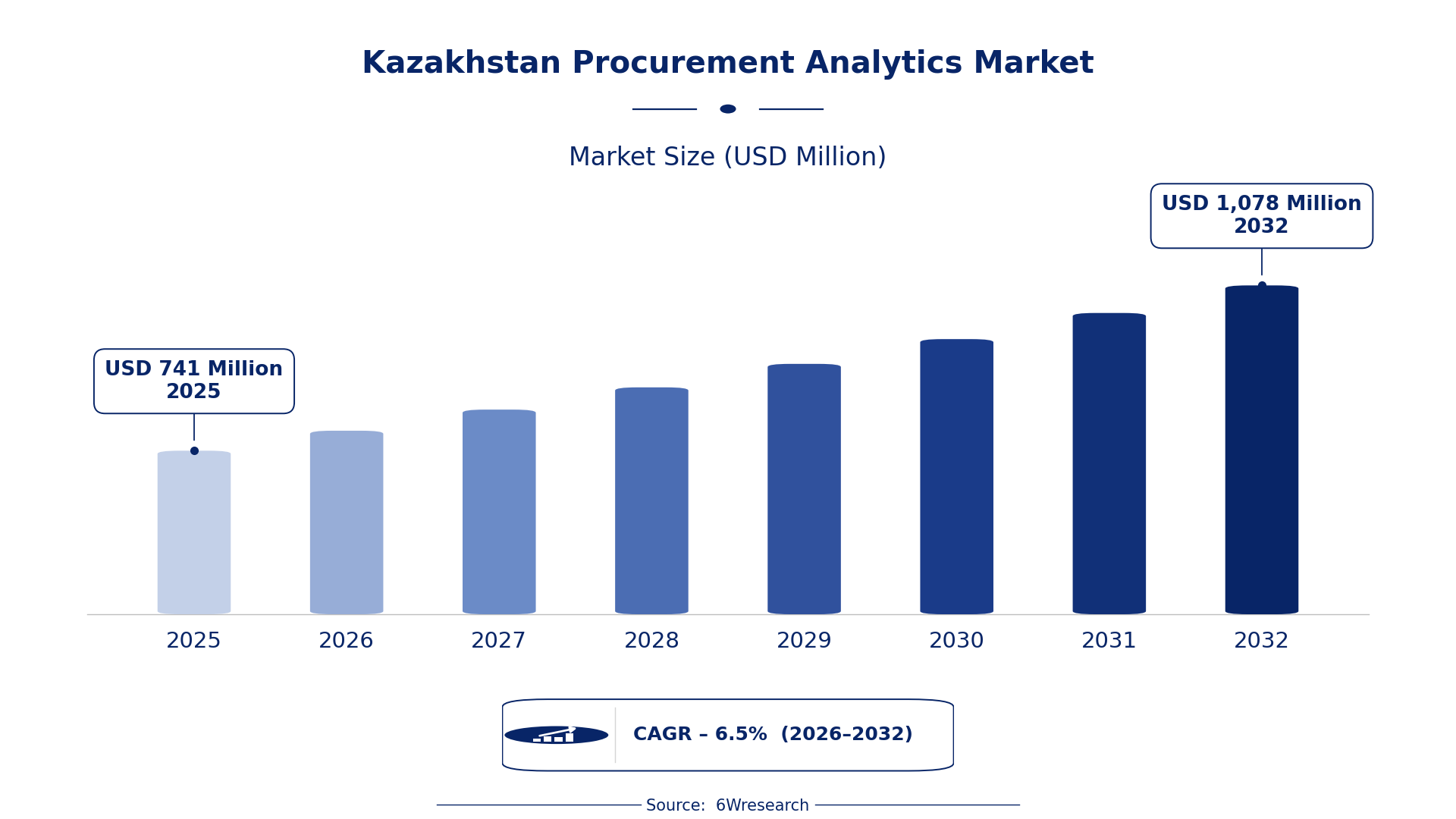
The Kazakhstan Procurement Analytics Market was estimated at USD 741 Million in 2025 and is projected to reach USD 1078 Million by 2032, growing at a CAGR of 6.5% from 2026 to 2032.
Kazakhstan Procurement Analytics Market Synopsis
The procurement analytics market in Kazakhstan is rapidly evolving, reflecting a growing recognition of the value that data-driven insights can bring to procurement processes. Businesses are increasingly turning to advanced analytics tools to enhance supplier performance, optimize costs, and manage risks effectively.
This shift is further encouraged by the government's initiatives aimed at increasing transparency and efficiency in public procurement. As organizations realize the potential of analytics, the demand for tailored solutions that can meet specific procurement needs is expected to rise.
Kazakhstan Procurement Analytics Market Year-wise Growth Rate and Key Drivers
This graph illustrates the annual growth rates of the Kazakhstan Procurement Analytics Market from 2021 to 2032, highlighting a steady upward trajectory and projected expansion over the forecast period.
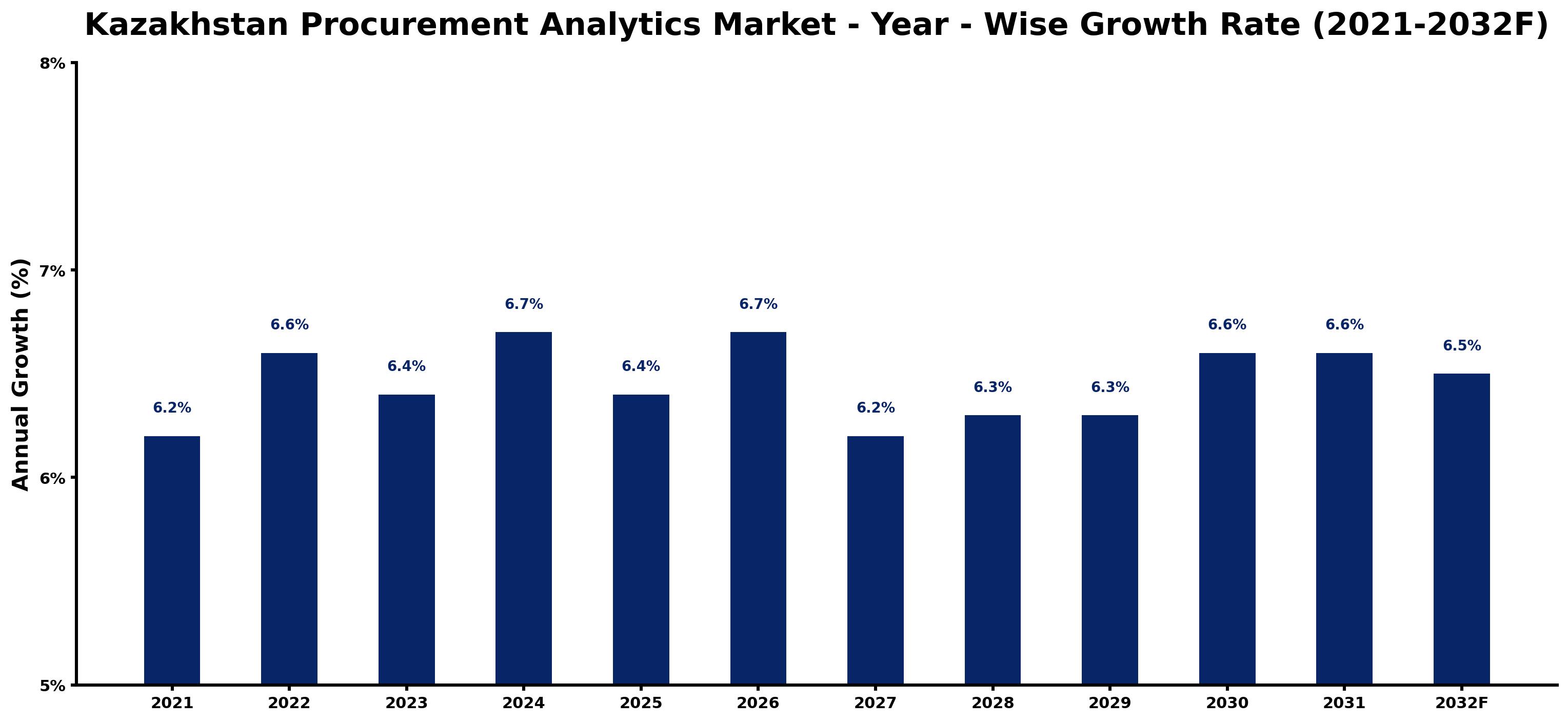
The table below presents the year‑wise growth rates along with the key drivers influencing the market
| Year | Growth Rate | Major Drivers |
| 2021 | 6.2% | Kazakhstan's digitalization strategy boosts procurement efficiencies. |
| 2022 | 6.6% | Increased government transparency enhances supplier competition. |
| 2023 | 6.4% | Adoption of e-procurement platforms by state-owned enterprises. |
| 2024 | 6.7% | Investment in local start-ups focused on procurement solutions. |
| 2025 | 6.4% | Growing public sector demand for data-driven decision-making. |
| 2026 | 6.7% | Implementation of new e-Government regulations for procurement. |
| 2027 | 6.2% | Rise in online supplier registration boosting market access. |
| 2028 | 6.3% | Enhanced supply chain resilience initiatives amid global disruptions. |
| 2029 | 6.3% | Focus on sustainable procurement practices by government agencies. |
| 2030 | 6.6% | Boost in international partnerships for procurement technology. |
| 2031 | 6.6% | Local adoption of AI analytics in procurement processes. |
| 2032 | 6.5% | Increased funding for digital transformation within public sectors. |
Note: Market size estimations and growth projections presented in this report are based on 6Wresearch's proprietary forecasting methodology, utilizing the latest available industry data, government publications, and primary research inputs.
Kazakhstan Procurement Analytics Market Key Takeaways
Below are some of the specific key takeaways from the market, including:
- Data-driven decision-making is becoming essential in procurement strategies.
- The government supports initiatives to enhance transparency and efficiency in procurement.
- There is a growing interest in solutions that integrate supplier performance metrics.
- Challenges such as cost and complexity of implementation are hindering market growth.
- A lack of skilled professionals is a critical barrier for adoption of advanced analytics tools.
Evaluation of Restraints in Kazakhstan Procurement Analytics Market
Despite the positive outlook, several factors are restraining the growth of the Kazakhstan Procurement Analytics Market. The high costs associated with implementing advanced analytics solutions remain a significant hurdle for many companies. on top of that, a lack of understanding about the benefits that procurement analytics can offer limits adoption rates across various sectors.
Additionally, the market is struggling with a shortage of skilled professionals who can effectively use analytics tools to optimize procurement efficiencies. Data quality and integration issues further complicate the landscape, making it challenging for organizations to fully leverage analytics in their procurement strategies.
Kazakhstan Procurement Analytics Market Trends
Several trends are shaping the Kazakhstan Procurement Analytics Market. The increasing focus on digital transformation across industries has led organizations to adopt more sophisticated analytics tools. Companies are keen on using predictive analytics to forecast supplier performance and optimize their procurement strategies accordingly.
Additionally, there is a notable trend toward integrating procurement analytics with other business intelligence systems. This integration allows for more comprehensive insights, enabling firms to make more informed procurement decisions based on real-time data.
Kazakhstan Procurement Analytics Market Opportunities
The potential for growth in the Kazakhstan Procurement Analytics Market is considerable. As businesses increasingly recognize the need for data-driven insights, opportunities for service providers and software developers are expanding. Companies that can offer tailored solutions addressing the specific needs of various sectors will find ample opportunities.
on top of that, as the government continues to emphasize transparency and efficiency, partnerships with public entities can provide additional growth avenues. Investments in training and development to enhance the skills of procurement professionals will also create a more favorable environment for analytics adoption.
Government Initiatives in the Kazakhstan Procurement Analytics Market
Government policy is playing a crucial role in shaping the Kazakhstan Procurement Analytics Market. The focus on transparency and efficiency in public procurement is driving the adoption of data analytics solutions. Through various initiatives, the government aims to promote the use of analytics in procurement processes, ensuring that public sector activities are both effective and accountable.
- A recently completed initiative focused on enhancing transparency in public procurement through the introduction of an online analytics platform.
- Currently ongoing is a program aimed at training procurement professionals in data analytics and procurement best practices.
- A planned initiative expected to launch in 2026 will provide funding for the development of advanced procurement analytics solutions across various sectors.
- Regulatory frameworks introduced recently mandate the integration of data analytics in public procurement processes.
- A public-private partnership initiative is in the works to foster innovation in procurement analytics technologies.
Future Insights of the Kazakhstan Procurement Analytics Market
Looking ahead to 2026-2032, the Kazakhstan Procurement Analytics Market is set to expand significantly. As organizations continue to embrace digital transformation, the demand for data-driven insights will only grow. Companies that invest in advanced analytics solutions will likely gain a competitive edge by optimizing their procurement processes and enhancing supplier relationships.
The government's ongoing support for transparency and efficiency initiatives will further bolster the market's growth. Expect to see a surge in innovative solutions that integrate analytics with procurement strategies, leading to more informed decision-making and improved outcomes for businesses.
Kazakhstan Procurement Analytics Market Latest Developments
In the past year, the Kazakhstan Procurement Analytics Market has witnessed a flurry of activity as companies and the government ramp up efforts to enhance procurement processes. The focus has shifted toward adopting more advanced analytics tools and frameworks, which has spurred a wave of innovation across the sector.
- A major technology vendor launched a new analytics platform aimed at improving supplier performance tracking in Q2 2025.
- An initiative began in early 2025 to integrate procurement analytics with existing business intelligence systems, enhancing data visibility for organizations.
- Currently underway is a government-funded training program for procurement professionals focusing on data analytics skills, expected to conclude in late 2025.
- A rollout of a new public procurement monitoring system is planned for mid-2026, which will leverage advanced analytics for enhanced oversight.
- A leading regional operator announced a partnership in early 2025 to develop tailored analytics solutions for the public sector, enhancing procurement efficiencies.
Kazakhstan Procurement Analytics Market - Key Attractiveness of the Report
- 10 Years of Market Numbers
- Historical Data Starting from 2022 to 2025
- Base Year: 2025
- Forecast Data until 2032
- Key Performance Indicators Impacting the Market
- Major Upcoming Developments and Projects
Key Highlights of the Report:
- Kazakhstan Procurement Analytics Market Outlook
- Market Size of Kazakhstan Procurement Analytics Market, 2025
- Forecast of Kazakhstan Procurement Analytics Market, 2032
- Historical Data and Forecast of Kazakhstan Procurement Analytics Revenues & Volume for the Period 2022-2032F
- Kazakhstan Procurement Analytics Market Trend Evolution
- Kazakhstan Procurement Analytics Market Drivers and Challenges
- Kazakhstan Procurement Analytics Price Trends
- Kazakhstan Procurement Analytics Porter's Five Forces
- Kazakhstan Procurement Analytics Industry Life Cycle
- Historical Data and Forecast of Kazakhstan Procurement Analytics Market Revenues & Volume By Component for the Period 2022-2032F
- Historical Data and Forecast of Kazakhstan Procurement Analytics Market Revenues & Volume By Solutions for the Period 2022-2032F
- Historical Data and Forecast of Kazakhstan Procurement Analytics Market Revenues & Volume By Services for the Period 2022-2032F
- Historical Data and Forecast of Kazakhstan Procurement Analytics Market Revenues & Volume By Organization Size for the Period 2022-2032F
- Historical Data and Forecast of Kazakhstan Procurement Analytics Market Revenues & Volume By Large Enterprises for the Period 2022-2032F
- Historical Data and Forecast of Kazakhstan Procurement Analytics Market Revenues & Volume By SMEs for the Period 2022-2032F
- Historical Data and Forecast of Kazakhstan Procurement Analytics Market Revenues & Volume By Deployment Mode for the Period 2022-2032F
- Historical Data and Forecast of Kazakhstan Procurement Analytics Market Revenues & Volume By Cloud for the Period 2022-2032F
- Historical Data and Forecast of Kazakhstan Procurement Analytics Market Revenues & Volume By On-premises for the Period 2022-2032F
- Historical Data and Forecast of Kazakhstan Procurement Analytics Market Revenues & Volume By Application for the Period 2022-2032F
- Historical Data and Forecast of Kazakhstan Procurement Analytics Market Revenues & Volume By Supply Chain Analytics for the Period 2022-2032F
- Historical Data and Forecast of Kazakhstan Procurement Analytics Market Revenues & Volume By Risk Analytics for the Period 2022-2032F
- Historical Data and Forecast of Kazakhstan Procurement Analytics Market Revenues & Volume By Spend Analytics for the Period 2022-2032F
- Historical Data and Forecast of Kazakhstan Procurement Analytics Market Revenues & Volume By Demand Forecasting for the Period 2022-2032F
- Historical Data and Forecast of Kazakhstan Procurement Analytics Market Revenues & Volume By Contract Management for the Period 2022-2032F
- Historical Data and Forecast of Kazakhstan Procurement Analytics Market Revenues & Volume By Vendor Management for the Period 2022-2032F
- Historical Data and Forecast of Kazakhstan Procurement Analytics Market Revenues & Volume By Category Management for the Period 2022-2032F
- Historical Data and Forecast of Kazakhstan Procurement Analytics Market Revenues & Volume By Industry Vertical for the Period 2022-2032F
- Historical Data and Forecast of Kazakhstan Procurement Analytics Market Revenues & Volume By BFSI for the Period 2022-2032F
- Historical Data and Forecast of Kazakhstan Procurement Analytics Market Revenues & Volume By Retail and eCommerce for the Period 2022-2032F
- Historical Data and Forecast of Kazakhstan Procurement Analytics Market Revenues & Volume By Telecom and IT for the Period 2022-2032F
- Historical Data and Forecast of Kazakhstan Procurement Analytics Market Revenues & Volume By Manufacturing for the Period 2022-2032F
- Historical Data and Forecast of Kazakhstan Procurement Analytics Market Revenues & Volume By Healthcare and Life Sciences for the Period 2022-2032F
- Historical Data and Forecast of Kazakhstan Procurement Analytics Market Revenues & Volume By Energy and Utilities for the Period 2022-2032F
- Historical Data and Forecast of Kazakhstan Procurement Analytics Market Revenues & Volume By Government and Defense for the Period 2022-2032F
- Kazakhstan Procurement Analytics Import Export Trade Statistics
- Market Opportunity Assessment By Component
- Market Opportunity Assessment By Organization Size
- Market Opportunity Assessment By Deployment Mode
- Market Opportunity Assessment By Application
- Market Opportunity Assessment By Industry Vertical
- Kazakhstan Procurement Analytics Top Companies Market Share
- Kazakhstan Procurement Analytics Competitive Benchmarking By Technical and Operational Parameters
- Kazakhstan Procurement Analytics Company Profiles
- Kazakhstan Procurement Analytics Key Strategic Recommendations






































