Kazakhstan Retail And Wholesale Market Size, Share & Growth Rate
The Kazakhstan Retail And Wholesale Market was estimated at USD 689 Million in 2025 and is projected to reach USD 1136 Million by 2032, growing at a CAGR of 7.4% from 2026 to 2032. This trajectory is fueled by rising urbanization, as more consumers migrate to cities and seek modern retail experiences. The burgeoning middle class is enhancing disposable income levels, further propelling demand for a diverse range of products and services.
Kazakhstan Retail And Wholesale Market Year-wise Growth Rate and Key Drivers
This graph highlights how the Kazakhstan Retail And Wholesale Market has steadily grown over the years, supported by major growth factors.
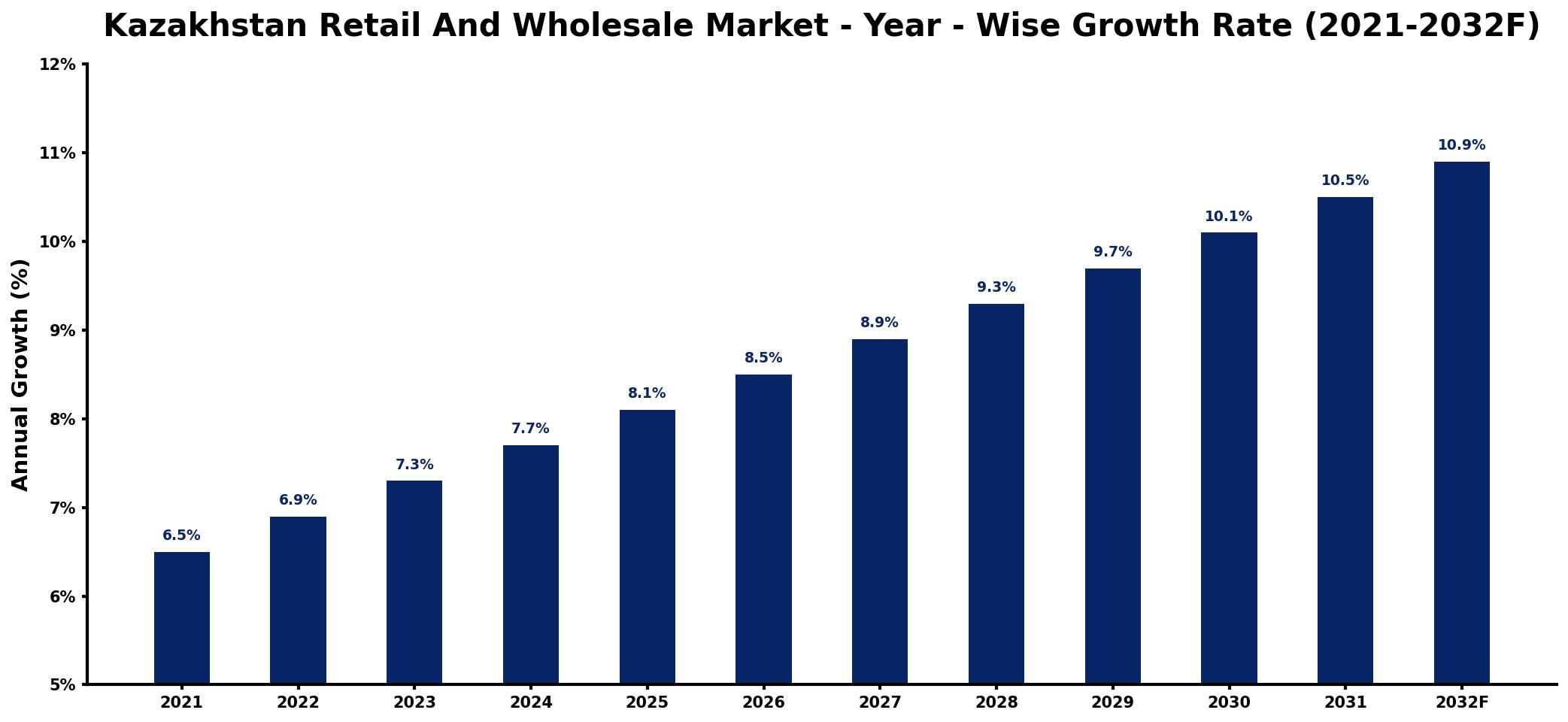
The table below presents the year‑wise growth rates along with the key drivers influencing the market
| Year | Growth Rate | Major Drivers |
| 2021 | 6.5% | E-commerce adoption accelerates rapidly |
| 2022 | 6.9% | Consumer spending increases significantly |
| 2023 | 7.3% | Investment in logistics infrastructure rises |
| 2024 | 7.7% | Urbanization trends drive purchasing habits |
| 2025 | 8.1% | Technological advancements enhance experiences |
| 2026 | 8.5% | Diverse product offerings attract consumers |
| 2027 | 8.9% | Sustainable practices gain consumer interest |
| 2028 | 9.3% | Rising disposable incomes boost sales |
| 2029 | 9.7% | Digital marketing strategies evolve effectively |
| 2030 | 10.1% | Supply chain efficiencies optimize costs |
| 2031 | 10.5% | Brand loyalty programs enhance retention |
| 2032 | 10.9% | Global partnerships expand market reach |
Note: Market size estimations and growth projections presented in this report are based on 6Wresearch's proprietary forecasting methodology, utilizing the latest available industry data, government publications, and primary research inputs.
Kazakhstan Retail And Wholesale Market Synopsis
In Kazakhstan, a significant demand for FMCG products is evident, reflecting a shift in consumer preferences towards quality and variety. The retail landscape features a hybrid model that integrates contemporary shopping venues like hypermarkets with traditional bazaars, catering to diverse shopper demographics.
International brands are increasingly penetrating the market, enhancing the product variety available to consumers. E-commerce is rapidly evolving as an essential channel, especially in urban areas, driven by the convenience it offers and a surge in online shopping habits among tech-savvy consumers.
Kazakhstan Retail And Wholesale Market Key Takeaways
- The market is characterized by a blend of modern retail formats and traditional shopping options.
- Digitalization is reshaping consumer shopping behaviors, with e-commerce witnessing significant growth.
- Challenges exist due to infrastructure limitations and regulatory complexities impacting market entry.
- Government policies are designed to encourage foreign investment and support local businesses.
- Opportunities abound in the FMCG sector, particularly in food, beverages, and household goods.
Evaluation of Restraints in Kazakhstan Retail And Wholesale Market
Despite its potential, the Kazakhstan retail and wholesale market faces several notable constraints. Regulatory hurdles often complicate the entry process for new businesses, with licensing and compliance demands being particularly time-consuming and costly. Furthermore, logistical issues, especially in remote areas, can disrupt distribution channels and inflate operational expenses. Competition from both local and international players intensifies, leading to price wars that can erode profit margins. Additionally, fluctuations in the national economy and currency rates can adversely influence consumer purchasing behaviors, further complicating the market landscape.
Kazakhstan Retail And Wholesale Market Trends
Key trends are emerging within the Kazakhstan retail and wholesale market. There is a pronounced shift towards digitalization, with consumers increasingly favoring online shopping platforms as internet and smartphone usage rises. Concurrently, sustainable and eco-friendly products are gaining traction, supported by growing consumer awareness and government backing. The influx of international brands into the market is also noteworthy, broadening the choices available to consumers and altering local retail dynamics.
Kazakhstan Retail And Wholesale Market Opportunities
The retail and wholesale landscape in Kazakhstan is ripe with investment opportunities, particularly in the fast-moving consumer goods (FMCG) sector. Segments such as food and beverage, personal care, and household products are poised for growth. The e-commerce segment offers lucrative potential, as online retail is on an upward trajectory. Furthermore, developing modern shopping malls and retail outlets is essential to meet the needs of an expanding middle class. Investing in logistics and distribution networks is also a viable strategy to enhance market penetration and operational efficiency.
Government Initiatives in the Kazakhstan Retail And Wholesale Market
The Kazakhstan government is actively implementing policies designed to foster growth within the retail and wholesale sectors. These include foreign investment regulations that facilitate market entry for international businesses, alongside consumer protection laws and competition regulations to ensure fair practices. Additionally, the government has made efforts to promote domestic products and support local enterprises through various initiatives. Regular reviews of tax policies and import/export regulations aim to create a business-friendly environment conducive to market development.
Future Insights of the Kazakhstan Retail And Wholesale Market
Looking ahead to 2026-2032, the Kazakhstan retail and wholesale market is expected to experience consistent growth. Factors such as increasing urbanization and rising disposable incomes will continue to drive demand. The shift towards online shopping and digital platforms is anticipated to reshape the market landscape significantly. Government initiatives aimed at infrastructure improvements and investment facilitation are likely to further attract international players, reinforcing Kazakhstan's position as a burgeoning consumer market.
Kazakhstan Retail And Wholesale Market Latest Developments (2025 - 2026)
Recent developments within the Kazakhstan retail and wholesale market indicate a trend towards greater digital engagement among consumers, with several online platforms launching enhanced services to cater to increasing demand. Initiatives promoting eco-friendly products are also gaining momentum, aligning with global sustainability trends. Furthermore, the competitive landscape is evolving, with both local and international retailers adjusting strategies to capture market share in response to changing consumer preferences.
Kazakhstan Retail And Wholesale Market - Key Attractiveness of the Report
- 10 Years of Market Numbers
- Historical Data Starting from 2022 to 2025
- Base Year: 2025
- Forecast Data until 2032
- Key Performance Indicators Impacting the Market
- Major Upcoming Developments and Projects
Key Highlights of the Report:
- Kazakhstan Retail And Wholesale Market Outlook
- Market Size of Kazakhstan Retail And Wholesale Market, 2025
- Forecast of Kazakhstan Retail And Wholesale Market, 2032
- Historical Data and Forecast of Kazakhstan Retail And Wholesale Revenues & Volume for the Period 2022-2032F
- Kazakhstan Retail And Wholesale Market Trend Evolution
- Kazakhstan Retail And Wholesale Market Drivers and Challenges
- Kazakhstan Retail And Wholesale Price Trends
- Kazakhstan Retail And Wholesale Porter's Five Forces
- Kazakhstan Retail And Wholesale Industry Life Cycle
- Historical Data and Forecast of Kazakhstan Retail And Wholesale Market Revenues & Volume By Type for the Period 2022-2032F
- Historical Data and Forecast of Kazakhstan Retail And Wholesale Market Revenues & Volume By Retail for the Period 2022-2032F
- Historical Data and Forecast of Kazakhstan Retail And Wholesale Market Revenues & Volume By Wholesale for the Period 2022-2032F
- Historical Data and Forecast of Kazakhstan Retail And Wholesale Market Revenues & Volume By Ownership for the Period 2022-2032F
- Historical Data and Forecast of Kazakhstan Retail And Wholesale Market Revenues & Volume By Retail Chain/Wholesale Chain for the Period 2022-2032F
- Historical Data and Forecast of Kazakhstan Retail And Wholesale Market Revenues & Volume By Independent Retailer/Independent Wholesalers for the Period 2022-2032F
- Historical Data and Forecast of Kazakhstan Retail And Wholesale Market Revenues & Volume By Price Range for the Period 2022-2032F
- Historical Data and Forecast of Kazakhstan Retail And Wholesale Market Revenues & Volume By Premium for the Period 2022-2032F
- Historical Data and Forecast of Kazakhstan Retail And Wholesale Market Revenues & Volume By Mid-Range for the Period 2022-2032F
- Historical Data and Forecast of Kazakhstan Retail And Wholesale Market Revenues & Volume By Economy for the Period 2022-2032F
- Historical Data and Forecast of Kazakhstan Retail And Wholesale Market Revenues & Volume By Distribution Channel for the Period 2022-2032F
- Historical Data and Forecast of Kazakhstan Retail And Wholesale Market Revenues & Volume By Supermarkets/Hypermarkets for the Period 2022-2032F
- Historical Data and Forecast of Kazakhstan Retail And Wholesale Market Revenues & Volume By Convenience Stores for the Period 2022-2032F
- Historical Data and Forecast of Kazakhstan Retail And Wholesale Market Revenues & Volume By Department Stores for the Period 2022-2032F
- Historical Data and Forecast of Kazakhstan Retail And Wholesale Market Revenues & Volume By Specialty Stores for the Period 2022-2032F
- Kazakhstan Retail And Wholesale Import Export Trade Statistics
- Market Opportunity Assessment By Type
- Market Opportunity Assessment By Ownership
- Market Opportunity Assessment By Price Range
- Market Opportunity Assessment By Distribution Channel
- Kazakhstan Retail And Wholesale Top Companies Market Share
- Kazakhstan Retail And Wholesale Competitive Benchmarking By Technical and Operational Parameters
- Kazakhstan Retail And Wholesale Company Profiles
- Kazakhstan Retail And Wholesale Key Strategic Recommendations






































