Kazakhstan Retail Industry Market Size, Share & Growth Rate
The Kazakhstan Retail Industry Market was estimated at USD 336 Million in 2025 and is projected to reach USD 428 Million by 2032, growing at a CAGR of 3.5% from 2026 to 2032. This growth trajectory is underpinned by a robust economic landscape, increasing urbanization, and a marked shift in consumer preferences towards more modern and convenient shopping experiences. The retail sector is responding with enhanced omnichannel strategies, integrating traditional and digital platforms to meet evolving demands.
Kazakhstan Retail Industry Market Year-wise Growth Rate and Key Drivers
This graph highlights how the Kazakhstan Retail Industry Market has steadily grown over the years, supported by major growth factors.
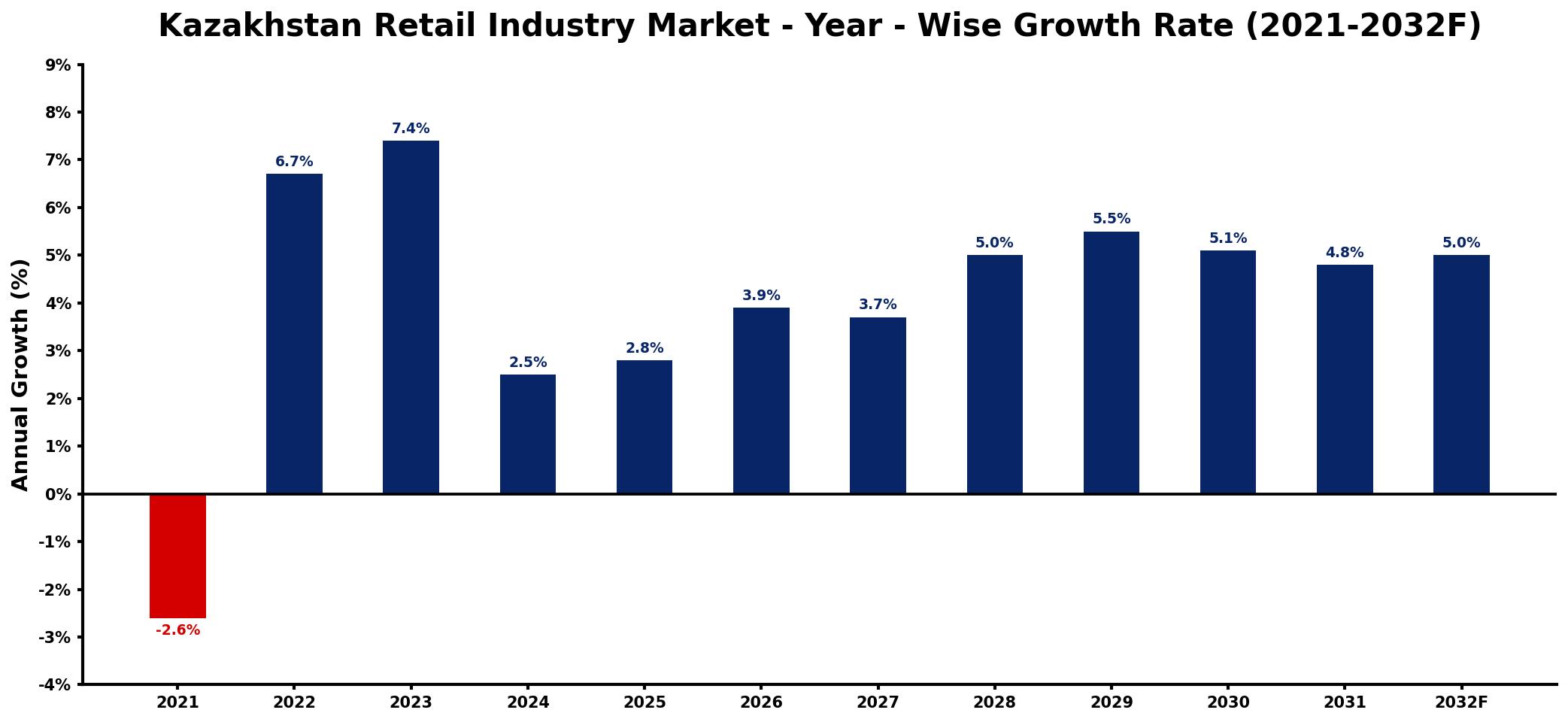
The table below presents the year‑wise growth rates along with the key drivers influencing the market
| Year | Growth Rate | Major Drivers |
| 2021 | -2.6% | decreased consumer spending patterns |
| 2022 | 6.7% | rising disposable income levels |
| 2023 | 7.4% | expansion of e-commerce platforms |
| 2024 | 2.5% | increased foreign investment flow |
| 2025 | 2.8% | growth in urban population density |
| 2026 | 3.9% | enhanced logistics and distribution |
| 2027 | 3.7% | development of modern shopping centers |
| 2028 | 5.0% | growing demand for online services |
| 2029 | 5.5% | emergence of local brands popularity |
| 2030 | 5.1% | strengthening of digital payment systems |
| 2031 | 4.8% | rising end-use demand growth |
| 2032 | 5.0% | increased focus on sustainability practices |
Note: Market size estimations and growth projections presented in this report are based on 6Wresearch's proprietary forecasting methodology, utilizing the latest available industry data, government publications, and primary research inputs.
Kazakhstan Retail Industry Market Synopsis
Recent momentum in the Kazakhstan Retail Industry has been characterized by significant technological adoption and changing consumer behavior. With traditional retailers increasingly competing with online platforms, the landscape is shifting, necessitating innovations in service delivery and customer engagement.
Looking ahead, the market is set to navigate economic fluctuations and a competitive environment. Retailers must adapt to the complexities of supply chain management and regulatory frameworks while continuing to enhance the shopping experience through digital advancements.
Kazakhstan Retail Industry Market Key Takeaways
- The retail market is poised for steady growth with a projected increase to USD 428 Million by 2032.
- Consumer preferences are shifting towards e-commerce, necessitating a blend of physical and digital shopping experiences.
- Adoption of advanced POS systems is critical for operational efficiency and improved customer service.
- Competition drives innovation, making continuous adaptation vital for retailers.
- Government initiatives are fostering a conducive environment for retail expansion, promoting both local and international investments.
Evaluation of Restraints in Kazakhstan Retail Industry Market
Despite the positive outlook, several factors restrain the Kazakhstan Retail Industry's growth. Economic fluctuations can significantly influence consumer spending patterns, causing uncertainty among retailers. The intensity of competition within the market requires businesses to be innovative continuously, which can strain resources. Additionally, regulatory complexities and supply chain management challenges complicate operations, requiring strategic navigation to maintain profitability and relevance.
Kazakhstan Retail Industry Market Trends
The current landscape is shaped by emerging trends that are redefining retail. The shift towards digital payment solutions is accelerating, driven by consumer demand for convenience and speed. Retailers are also leveraging big data to create personalized shopping experiences, enhancing customer satisfaction. Sustainability is becoming increasingly important, with consumers favoring brands that demonstrate social responsibility and eco-friendly practices.
Kazakhstan Retail Industry Market Opportunities
The Kazakhstan Retail Industry offers substantial growth and investment opportunities, particularly in the e-commerce sector. As consumers increasingly embrace online shopping, retailers can capitalize on this trend by enhancing their digital platforms and logistics. Furthermore, the governments supportive policies create an inviting landscape for foreign investments, especially in underserved regions where retail infrastructure can be developed. The integration of technology in retail operations also presents pathways to improved efficiency and customer engagement.
Government Initiatives in the Kazakhstan Retail Industry Market
Government policies in Kazakhstan are aimed at fostering a vibrant retail environment. By offering incentives for both domestic and international retailers, the government seeks to stimulate economic growth and bolster consumer spending. Initiatives to improve retail infrastructure and streamline regulatory processes further enhance the market's attractiveness, encouraging investment and expansion.
Future Insights of the Kazakhstan Retail Industry Market
Looking towards the period of 2026-2032, the Kazakhstan Retail Industry is expected to witness transformative changes driven by technological advancements and shifting consumer expectations. The focus on omnichannel strategies will intensify, allowing retailers to offer seamless integration across platforms. Additionally, as the market continues to mature, the emphasis on customer-centric services and innovative retail formats will be crucial in capturing and retaining consumer loyalty.
Kazakhstan Retail Industry Market Latest Developments (2025 - 2026)
Recent developments within the Kazakhstan Retail Industry highlight a significant shift towards enhanced digital capabilities. Many retailers are investing in advanced analytics to better understand consumer preferences, optimizing their inventory management and marketing strategies. Theres also a notable increase in partnerships between retailers and fintech companies to develop integrated payment solutions that cater to the growing demand for cashless transactions.
Kazakhstan Retail Industry Market - Key Attractiveness of the Report
- 10 Years of Market Numbers
- Historical Data Starting from 2022 to 2025
- Base Year: 2025
- Forecast Data until 2032
- Key Performance Indicators Impacting the Market
- Major Upcoming Developments and Projects
Key Highlights of the Report:
- Kazakhstan Retail Industry Market Outlook
- Market Size of Kazakhstan Retail Industry Market, 2025
- Forecast of Kazakhstan Retail Industry Market, 2032
- Historical Data and Forecast of Kazakhstan Retail Industry Revenues & Volume for the Period 2022-2032F
- Kazakhstan Retail Industry Market Trend Evolution
- Kazakhstan Retail Industry Market Drivers and Challenges
- Kazakhstan Retail Industry Price Trends
- Kazakhstan Retail Industry Porter's Five Forces
- Kazakhstan Retail Industry Industry Life Cycle
- Historical Data and Forecast of Kazakhstan Retail Industry Market Revenues & Volume By Product for the Period 2022-2032F
- Historical Data and Forecast of Kazakhstan Retail Industry Market Revenues & Volume By Food and Beverages for the Period 2022-2032F
- Historical Data and Forecast of Kazakhstan Retail Industry Market Revenues & Volume By Personal and Household Care for the Period 2022-2032F
- Historical Data and Forecast of Kazakhstan Retail Industry Market Revenues & Volume By Apparel, Footwear, and Accessories for the Period 2022-2032F
- Historical Data and Forecast of Kazakhstan Retail Industry Market Revenues & Volume By Furniture, Toys, and Hobby for the Period 2022-2032F
- Historical Data and Forecast of Kazakhstan Retail Industry Market Revenues & Volume By Electronic and Household Appliances for the Period 2022-2032F
- Historical Data and Forecast of Kazakhstan Retail Industry Market Revenues & Volume By Other Products for the Period 2022-2032F
- Historical Data and Forecast of Kazakhstan Retail Industry Market Revenues & Volume By Distribution Channel for the Period 2022-2032F
- Historical Data and Forecast of Kazakhstan Retail Industry Market Revenues & Volume By Supermarkets/Hypermarkets for the Period 2022-2032F
- Historical Data and Forecast of Kazakhstan Retail Industry Market Revenues & Volume By Convenience Stores for the Period 2022-2032F
- Historical Data and Forecast of Kazakhstan Retail Industry Market Revenues & Volume By Department Stores for the Period 2022-2032F
- Historical Data and Forecast of Kazakhstan Retail Industry Market Revenues & Volume By Specialty Stores for the Period 2022-2032F
- Historical Data and Forecast of Kazakhstan Retail Industry Market Revenues & Volume By Online for the Period 2022-2032F
- Historical Data and Forecast of Kazakhstan Retail Industry Market Revenues & Volume By Other Distribution Channels for the Period 2022-2032F
- Kazakhstan Retail Industry Import Export Trade Statistics
- Market Opportunity Assessment By Product
- Market Opportunity Assessment By Distribution Channel
- Kazakhstan Retail Industry Top Companies Market Share
- Kazakhstan Retail Industry Competitive Benchmarking By Technical and Operational Parameters
- Kazakhstan Retail Industry Company Profiles
- Kazakhstan Retail Industry Key Strategic Recommendations






































